A collection of out-of-copyright and rare books from the Cambridge University Library and other world-class institutions that have been digitally scanned, made available online, and reprinted in paperback.
To save content items to your account,
please confirm that you agree to abide by our usage policies.
If this is the first time you use this feature, you will be asked to authorise Cambridge Core to connect with your account.
Find out more about saving content to .
To save content items to your Kindle, first ensure no-reply@cambridge.org
is added to your Approved Personal Document E-mail List under your Personal Document Settings
on the Manage Your Content and Devices page of your Amazon account. Then enter the ‘name’ part
of your Kindle email address below.
Find out more about saving to your Kindle.
Note you can select to save to either the @free.kindle.com or @kindle.com variations.
‘@free.kindle.com’ emails are free but can only be saved to your device when it is connected to wi-fi.
‘@kindle.com’ emails can be delivered even when you are not connected to wi-fi, but note that service fees apply.
This four-volume edition of the Arabic text of the Journey of the Moroccan traveller Ibn Battuta (1304–68/9), with a French translation, was published in 1853–8 as part of the 'Collection d'ouvrages orientaux' of the French Société Asiatique. In 1325, Ibn Battuta, who came from a family of Islamic jurists in Tangier, set out to make the pilgrimage to Mecca - the beginning of a journey that would last for twenty-four years and take him as far as China. In Volume 1, he describes his departure from Tangier, and his journey via Tunis to Egypt, where he travelled to Cairo, planning to reach a Red Sea port and sail to Arabia. The route was closed, so he returned to Cairo and travelled from there to Damascus, taking in the holy places of Palestine en route. Having finally reached Medina and Mecca, he decided to travel on, to Najaf (in present-day Iraq).
This four-volume edition of the Arabic text of the Journey of the Moroccan traveller Ibn Battuta (1304–68/9), with a French translation, was published in 1853–8. In 1325, Ibn Battuta, who came from a family of Islamic jurists in Tangier, set out to make the pilgrimage to Mecca - the beginning of a journey that would last for twenty-four years and take him as far as China. In Volume 2, he leaves Najaf and heads for Persia, exploring Isfahan and Shiraz before returning to Baghdad. Next he goes north, as far as modern Turkey, before performing a second pilgrimage to Mecca. From Jeddah, he sails to Yemen and down the coast of Africa as far as modern-day Tanzania. After a third visit to Mecca he heads north as far as the Crimea and Astrakhan, whence he travels to Constantinople in the retinue of a Byzantine princess, before heading east again.
M. R. James (1862–1936) is probably best remembered as a writer of chilling ghost stories, but he was an outstanding scholar of medieval literature and palaeography, who served both as Provost of King's College, Cambridge, and as Director of the Fitzwilliam Museum. His short book from 1901 on the texts inscribed in the famous stained-glass windows of Canterbury Cathedral is paired here with an anonymous guide to the windows published in 1897. Its author is believed to have been Emily Williams, whose aim was 'to give some account of the changes which have taken place in the arrangement of the old painted glass' during the major restoration which was taking place throughout the nineteenth century. The preface is by Dean Farrar, the author of the popular morality tale for children, Eric, or Little by Little, and all proceeds were to go to the Cathedral Restoration Fund.
Mariana Starke (c.1762–1838) published this work in 1802, launching her career as a travel writer. Volume 2 contains nine beautifully written letters which evaluate the cultural attractions of the cities of Rome, Naples, Pompeii, Florence, Bologna, and Venice and the cities' surrounding countryside. The guide gives detailed information on the climate, dialects, population, geography and medical facilities of each city. A supplement offers advice on visiting the major cities of France and using the main transport links between them. The work quickly became popular as it took into account the increasing trend for less affluent families to travel abroad. Starke offers a wealth of advice on affordable food, accommodation, transport and entertainment; her famous rating system, employing exclamation marks to signify the quality of a cultural site, was the precursor of the modern-day system of star-rating. It is a classic of nineteenth-century travel writing.
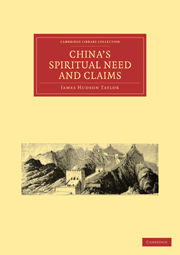
James Hudson Taylor (1832–1905), the founder of the large and respected China Inland Mission, wrote the pamphlet China's Spiritual Need and Claims in 1865. It was subsequently published as a book and reprinted in numerous editions. This volume contains the seventh edition, first published in 1887. The work is both a survey of Protestant missionary activity in China since the treaty of Tientsin in 1858 and a recruitment pamphlet that inspired many English men and women to travel to China as missionaries. It provides a wealth of demographic and cultural information about nineteenth-century China and about the western missionaries stationed there. As one of the most popular works on Protestant missions during the nineteenth century, it is an essential source for understanding the motivations of Victorian missionaries in general as well as Taylor's own beliefs. It is an indispensable source for researchers in mission history.
Or, New Zealand and its Inhabitants, Illustrating the Origin, Manners, Customs, Mythology, Religion, Rites, Songs, Proverbs, Fables, and Language of the Natives
Reverend Richard Taylor (1805–1873) was an English missionary, who wrote extensively on Maori culture and the plant and animal life of New Zealand. Taylor graduated from Queens' College, Cambridge in 1828 and was ordained as an Anglican priest the same year. After serving as a curate in the Isle of Ely, Taylor was appointed as a missionary to New Zealand for the Church Missionary Society. He arrived in Australia in 1836 and landed in New Zealand in 1839. Taylor quickly became a peacekeeper between the different Maori tribes in his district. This volume, first published in 1855, provides a detailed account of Maori mythology and culture with a description of the plant life, animal life and geology of the North Island. Taylor strongly condemns contemporary (nineteenth-century) attitudes to Maori culture and demonstrates the complexity of their society in this sympathetic book.
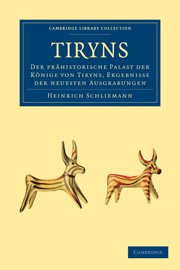
Heinrich Schliemann (1822–1890) was a businessman and self-taught archaeologist who is best known for discovering the legendary city of Troy. Inspired by his belief in the veracity of the Homeric poems, Schliemann turned his attention to uncovering other cities mentioned in the Iliad. This volume provides an account in German of his excavations in 1884–1885 at Tiryns, a major Bronze Age city and centre of Mycenaean civilisation. These revealed a palace complex at the site, which was the most complete example of its kind until Evans' excavation of Knossos: examples of Minoan art found at Tiryns were the first demonstration of Mycenaean contact with the Minoan culture of Crete. The topography and history of the site and its artefacts are described, together with detailed discussion of the palace, and a description of Schliemann's controversial excavation methods. This volume remains an important source for the historiography of archaeology.
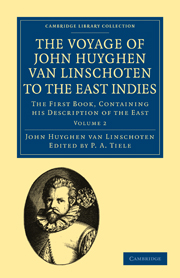
The publications of the Hakluyt Society (founded in 1846) made available edited (and sometimes translated) early accounts of exploration. The first series, which ran from 1847 to 1899, consists of 100 books containing published or previously unpublished works by authors from Christopher Columbus to Sir Francis Drake, and covering voyages to the New World, to China and Japan, to Russia and to Africa and India. This account of the East Indian travels of John Huyghen van Linschoten, originally published in the Netherlands in 1596 and translated into English in 1598, was published by the society in 1885 using an edited version of the early translation, supplemented with explanatory notes. It provides a rich source of information about Portuguese trade with the East Indies, as well as descriptions of the fauna, flora and indigenous peoples of the regions he visited, from the Azores and St Helena to Java and Sumatra.
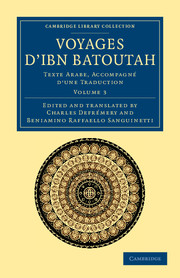
This four-volume edition of the Arabic text of the Journey of the Moroccan traveller Ibn Battuta (1304–68/9), with a French translation, was published in 1853–8. In 1325, Ibn Battuta, who came from a family of Islamic jurists in Tangier, set out to make the pilgrimage to Mecca - the beginning of a journey that would last for twenty-four years and take him as far as China. In Volume 3, having decided to visit the court of the Turkic sultan Muhammad bin Tughluq at Delhi, he travels via Bukhara and Samarkand to Afghanistan and then across the Hindu Kush into India. At Delhi, he was given the post of Judge by the sultan, and he stayed at the court for six years. He provides a history of the kingdom of Delhi and an account of Tughluq's reign, describing both his wisdom and generosity and his 'acts of violence and criminal deeds'.
In this 1835 work, Sarah Porter, née Ricardo (1790–1862) shows her enthusiasm for arithmetic, and her concern for teaching it in a way that will develop the pupil's mind: 'There is no branch of early education so admirably adapted to call forth and strengthen the reasoning powers.' She uses the device of a conversation between pupil and teacher, popularised by Jane Marcet (several of whose works are reissued in the Cambridge Library Collection), to guide young Edmund from the written symbols for numbers through addition, subtraction, multiplication and division, fractions and decimals, proportion, and square and cube roots. Answers to the questions are provided at the end of the book. A member of the Central Society of Education, which promoted imaginative theories of education instead of rote learning, Mrs Porter reworked her book in 1852 as Rational Arithmetic, a more conventional and less entertaining textbook for use in schools.
The Italian adventurer Giovanni Belzoni (1778–1823) is one of the most colourful and notorious figures in Egyptology. After the Napoleonic invasion of Egypt, European interest in the country, and especially in its antiquities, led to a demand for artifacts, the larger the better. Belzoni happened to be pursuing his two careers, as circus strong-man and hydraulic engineer, in Egypt in 1815, when he was asked to organise the transport of a 7-ton statue of Ramesses II from Thebes to the British Museum. After the success of this enterprise, he turned his attention to the discovery of other antiquities, though using destructive techniques which were deplored by serious contemporary scholars. His narrative of his adventures was enormously popular at the time, and remains readable and entertaining today. This reissue omits the plates from the original edition, which are too large to be reproduced satisfactorily in this format.
Bernal Díaz del Castillo (1492–1584) was a foot soldier in the army of Mexico's conqueror Hernán Cortés. The first edition of his True History of the Conquest of New Spain (as it was entitled in a later English translation) was published in Madrid in 1632 from a manuscript copy sent to Spain shortly after the author's death. Written in a highly accessible style, and describing the experiences of the troops themselves, the work became even more successful than the official accounts and went through many editions and translations. The two-volume edition reissued here was first published in 1904 and is considered a more reliable text, as it was based on the original manuscript preserved in Guatemala City. Volume 1 contains an introduction by the editor, the influential Mexican historian and book-collector Genaro García (1867–1920), a table of variant readings, and chapters 1–139 of the text.
Sir John Malcolm (1769–1833) was a soldier and diplomat in British India and Persia. He returned to India on the eve of the British conquest of Malwa, a region of central India previously little known to Europeans, in 1818. Malcolm studied the region's geology, its agriculture and the history of its ruling families in the eighteenth and nineteenth centuries. His reports were first published in Calcutta in 1821, and were revised and expanded for publication in two volumes in London in 1823. Based on interviews with native inhabitants and oral testimonies, Malcolm's work was the leading authority on Malwa until the 1930s, and remains valuable for its first-hand account of nineteenth-century Malwa's politics, culture and society. The most important chapter of Volume 2 contains Malcolm's recommendations for the future of British rule in Malwa. The volume also has an extensive appendix of over 200 pages of primary texts.
The growth of an 'imperial' outlook in colonial policy at the end of the nineteenth century led to calls for greater imperial integration, which prompted studies and scholarly works on the economic relations between Britain and its imperial possessions. This volume, first published in 1903 and written by the economist John William Root, explores both the internal and external trade relations in the British Empire and its constituent colonies. Focusing on the practical aspects of international trade, Root discusses the customs policies and tariffs, main imports and exports and external influences on trade of the United Kingdom, New Zealand, Australia, the West Indies and Canada. Organised by geographical region, the book also discusses fiscal warfare and the effect of preferential trade tariffs, using Canada as an example. This volume provides a detailed analysis of the system of trade regulations and their impact on imperial trade in the early twentieth century.
Aeschylus' Tragedies are here presented in the original Greek, with Latin translations, notes, scholia, and readings assembled by one of the eminent classical scholars of the nineteenth century, Samuel Butler (1774–1839). Based upon the monumental seventeenth-century commentary edition by Thomas Stanley, and drawing upon scholarship published in the intervening century, Butler's four volumes of the complete plays represent an important synthesis of early critical responses to Aeschylus. The history of Greek scholarship in England – from the labours of one its first and most influential interpreters, Stanley, to the efforts of one of its most respected teachers, Butler – is amply demonstrated in this set of works. The second volume (1811) contains Seven Against Thebes and Agamemnon in Greek, with Stanley's Latin translation and notes. Headmaster of Shrewsbury School and later bishop of Lichfield, Butler is central to histories of classical scholarship and education in England.
First published in 1924, this volume contains the Donnellan lectures given by Francis Crawford Burkitt (1864–1935) at Trinity College Dublin in June 1923. Their subject is Manichaeism, a dualistic form of Christianity that thrived during the fourth and fifth centuries in Central Asia. Burkitt focuses especially on the discovery of fragments of Manichaean literary texts in Chinese Turkestan, near the Siberian border, early in the twentieth century. The first lecture introduces the history of the Manichees and reviews the sources of information available about them. The second discusses the Manichaean view of Jesus, Manichaean church organisation and Manichaean eschatology. The third analyses the influences behind Manichaean thought and teaching, including the important influences of Marcion and Saint Augustine. Burkitt's lectures were influential in publicising the new finds of Manichaean manuscript fragments, and remain an important resource for those studying heterodox movements in early Christianity.
Sir Joseph Dalton Hooker (1817–1911), botanist, explorer, and director of the Royal Botanical Gardens at Kew, is chiefly remembered as a close friend and colleague of Darwin, his publications on geographical distribution of plants supporting Darwin's theory of evolution by natural selection. In 1839 Hooker became an assistant surgeon on HMS Erebus during Ross' Antarctic expedition. The boat wintered along the New Zealand coast, Tasmania and the Falkland Islands, enabling Hooker to collect over 700 plant species. Drawing heavily on Hooker's illustrated Flora Novae Zelandiae (1854–1855), this two-volume work (1864–1867) contains a comprehensive list of New Zealand plant species as well as those of the Chatham, Kermadec, Auckland, Campbell and Macquarrie Islands. As the first major study of New Zealand flora, Hooker's handbook remained the authority on the subject for half a century. Volume 2 continues Hooker's meticulous description and categorization of New Zealand flora.