To save content items to your account,
please confirm that you agree to abide by our usage policies.
If this is the first time you use this feature, you will be asked to authorise Cambridge Core to connect with your account.
Find out more about saving content to .
To save content items to your Kindle, first ensure no-reply@cambridge.org
is added to your Approved Personal Document E-mail List under your Personal Document Settings
on the Manage Your Content and Devices page of your Amazon account. Then enter the ‘name’ part
of your Kindle email address below.
Find out more about saving to your Kindle.
Note you can select to save to either the @free.kindle.com or @kindle.com variations.
‘@free.kindle.com’ emails are free but can only be saved to your device when it is connected to wi-fi.
‘@kindle.com’ emails can be delivered even when you are not connected to wi-fi, but note that service fees apply.
Lucy Terry (c. 1730–1821) has long been credited – not without good reason – as the first known African-American author, and her one surviving work, the poem “Bars Fight” (c. 1746), is widely anthologized as the earliest surviving poem by an American slave. The story of the poem's survival – composed by Terry shortly after an Indian raid on Deerfield, Massachusetts, in 1746, and preserved and transmitted through memorization and recitation until its first known publication in 1855, over thirty years after her death – is a highly plausible, but by no means indisputable, combination of legend and painstaking scholarship. The relation of the 1855 text to the original composition and its subsequent iterations is not definitively known. Readers of “Bars Fight” have continued to pursue the poem back to its likely but obscure origins in the versifying practice of a teenaged slave who had been kidnapped from Africa to New England as a young child and who was remembered and praised down the generations as a witty storyteller and skilled poet. It is the poem's pursuit of Terry that interests me here.
In the opening paragraph of his essay “The Transcendentalist,” first delivered as a lecture on December 23, 1841, as part of a series on “The Times,” Ralph Waldo Emerson offers this helpful formulation: “What is popularly called Transcendentalism among us, is Idealism; Idealism as it appears in 1842.” But what is idealism? Unsystematic in his use of the term, which titles the sixth section of his Nature (1836) and which he associated at various moments in various moods with, among others, Plato, Plotinus, George Berkeley, Emanuel Swedenborg, Immanuel Kant (whose 1781 Critique of Pure Reason uses the term “transcendental” to describe knowledge that transcends what he called Understanding [Verstand], or knowledge provided by sense experience), Johann Gottlieb Fichte, Friedrich von Schelling, Samuel Taylor Coleridge, Thomas Carlyle, Hinduism, Buddhism, and Sufism, Emerson continues in the next sentence of “The Transcendentalist” with a straightforward distinction:
As thinkers, mankind have ever divided into two sects, Materialists and Idealists; the first class founding on experience, the second on consciousness; the first class beginning to think from the data of the senses, the second class perceive that the senses are not final, and say, The senses give us representations of things, but what are the things themselves, they cannot tell. The materialist insists on facts, on history, on the force of circumstances and the animal wants of man; the idealist on the power of Thought and of Will, on inspiration, on miracle, on individual culture. These two modes of thinking are both natural, but the idealist contends that his way of thinking is in higher nature.
The outpouring of poetry in newspapers and magazines, North and South, during the Civil War period, served the wartime work of calling men to arms, offering solace for those who lost loved ones in battle, and justifying blood sacrifice in the name of patriotism. Precisely when the constitution of nations was at stake, writers and readers believed that poetry's communicative powers could both express and shape national beliefs and sentiments. Poetry's communicative powers depended not just on its internal formal and rhetorical properties, but also on the vast informational network that served the conflict and helped determine its outcomes; especially in the North, telegraph, railroad, newspapers, and magazines consolidated into a mass media system that drew its energy from the war. The hunger for information fueled a new profession: the eyewitness reporter sent in sketches or stories composed at the site of events unfolding. Railroad and telegraph transmission enabled people far away from the action to receive reports with an astonishing rapidity that caused a newly intense addiction to the news; people needed only “bread and newspaper,” according to Oliver Wendell Holmes, Sr. Newspapers like Harper's Illustrated Weekly, Frank Leslie's Illustrated Weekly, and Southern Illustrated Weekly fed that addiction, carrying poetry alongside journalistic reportage and illustrations. These communicative modes or genres were by no means separate; each informed the other.
Let no man who loves the Negro race then decry poetry, for it is by this and other proofs of genius that our race will be enabled to take its place among the nations of the earth.
Katherine Tillman
In her 1897 review of “Afro-American Poets and Their Verse,” Katherine Tillman, writing for the African Methodist Episcopal Church Review, notes that Albery Allson Whitman was one of a growing number of writers whose increasing presence in the arts marked the increasing progress of the race. Whitman's “The Freedman's Triumphant Song,” Tillman commented, abounded in “graceful metaphors” and contained “an easy flow of words.” Tillman's praise for Whitman was as much about his particular versification as it was with his having delivered the poem at the 1893 World's Fair that many African Americans saw as the approach of a new dawn with the fin de siècle. Indeed, linking Whitman with the revered Frances Ellen Watkins Harper and a host of younger writers, Tillman viewed poetry as an index to the race.
Joining other prominent African Americans in Chicago, Whitman read “The Freedman's Triumphant Song” at the “Colored American Day” of the World's Columbian Exposition. “The Freedman's Triumphant Song” chronicles the perseverance and loyalty of African Americans to the nation. Like William Cooper Nell's Colored Patriots of the American Revolution (1855) and William Wells Brown's Negro in the American Rebellion: His Heroism and His Fidelity (1867), Whitman references Bunker Hill and Valley Forge to accentuate the bond of African Americans to the country by underlining their military service.
The Poetess is one of those nineteenth-century social facts that make twentieth- and twenty-first-century literary historians uncomfortable. Like the horsehair sofa, the Poetess seems to us now a somewhat embarrassing commonplace of nineteenth-century culture we do well to live without. Eve Sedgwick's observation on the fortunes of “sentimentality” goes double for the Poetess:
The strange career of “sentimentality,” from the later eighteenth century when it was a term of high ethical and aesthetic praise, to the twentieth when it can be used to connote, beyond pathetic weakness, an actual principle of evil … is a career that displays few easily articulable consistencies, and those are not … consistencies of subject matter. Rather, they seem to inhere in the nature of the investment of a viewer in a subject matter
Like “sentimentality,” the Poetess is difficult to define except as an occasion for shifting historical definitions of women and of poetry. Yet notions of the nineteenth-century Poetess have not only depended on changing understandings of gender or verse or poetics (histories to which we will return), but have consistently converged on a hermeneutics of suspicion. Is the Poetess just a fancy name for the woman poet? If so, then why not “drop the feminine termination,” as the poet Elizabeth Oakes Smith suggested in the mid nineteenth century? Perhaps it has proven difficult to follow Oakes Smith's sensible suggestion because what is at stake in the idea of the Poetess is overdetermined, in excess of subject or subject matter. The Poetess neither is nor was simply a poet. What you think a Poetess is may depend entirely on your investment in the idea – and certainly depended on very different nineteenth-century investments in the idea. Such a relativist definition of the Poetess as a hologram of readerly desire may fit twenty-first-century postmodern or poststructuralist tastes better than did the lace-collared portrait of the woman poet over the horsehair sofa, but the most interesting thing about the strange career of the Poetess since the eighteenth century is that the figure seems to have had this apparently modern indexical function all along.
Their respective ties to the Southern United States alone might lead us to assign Edgar Allan Poe, Henry Timrod, and Sidney Lanier to a single Southern tradition. As we shall see, however, these writers were connected by a deeper tie that is evident in their engagement with each other's work on the topic of poetics. The mutual engagement among these authors yields a conceptual tradition, but one in which, as we shall see, different emphases arise: Poe reveals a transcendental concern with romantic aesthetics, Timrod reveals a nationalist concern with Southern Confederate autonomy, and Lanier reveals a racial concern with Anglo-Saxon ethnic difference. In what follows I will treat each of these writers in turn, moving chronologically through Poe and Timrod to Lanier in order to sketch the differing views that emerge from these authors' engagement with each other.
Edgar Allan Poe was born in 1809 in Boston and was educated at the University of Virginia and West Point. His education was primarily in ancient and modern languages, which gave him access to poetic works indirectly, but he did not make the study of poetry itself a central academic pursuit. Instead, his poetic collections appeared in a manner that was ancillary to his academic work. These collections included a first in 1827, a second in 1829, a third in 1831, and a fourth in 1845, with several uncollected poems rounding out his total output. Poe's poetic writings form just a fraction of his total written work, much of which consists of prose short stories.
It cannot be said of nineteenth-century American poetry that it needs no introduction. Shifting interests and new paradigms have substantially altered the ways in which we view and value a field that for some time has indeed seemed less like a field of study in its own right than the collected works of two writers of genius surrounded by a host of lesser lights. With many of the standards and methodological assumptions associated with a modernist aesthetic now called into question, older continuities have been challenged while new ones have emerged. In short, over the past two decades a growing body of scholarship has been engaged in reconceptualizing and reevaluating a largely neglected area of study in US literary history. Each of the essays commissioned for this collection reflects and helps advance this spirit of new directions and revisionism.
Of course, the recent surge of interest in verse written in the United States during the nineteenth century has not developed in isolation from trends that have marked literary criticism elsewhere. Among these, three seem worth singling out in particular: the waning importance assigned to distinctions between high or elite culture and popular or mass entertainment; the increased appreciation for women's contribution to poetry and the various traditions from which it proceeds; and the rewriting of literary history in ways that travel outside or beyond national demarcations. When applied to nineteenth-century verse written in the United States, each of these rubrics overlaps to a considerable extent, but not so much so that, for the purposes of this overview, they cannot be considered consecutively.
If the pursuit of what an author “really” intended to convey in the words of a particular poem is a fascinating though frustrating task, the pursuit of what was understood by readers from some past moment and time – such as nineteenth-century America – is even more intriguing. Recently, scholars have turned to the question of how nineteenth-century Americans responded to the genre of poetry in order to resolve what, in conventional accounts, has seemed like a paradox: nineteenth-century Americans wrote and read poetry extensively and valued it highly but most of the poetry they wrote was judged by the twentieth-century to be inconsequential at best and ugly at worst. The rise of modernist aesthetics in the early twentieth century had so totally displaced what had come before that by mid-century even the names of many formerly important poets of the nineteenth century – especially the names of women poets – were forgotten. Even more forgotten was a sense of what readers had appreciated in the work of once famous poets such as Henry Wadsworth Longfellow or Lydia Sigourney. The New Criticism of the early part of the century and then the poststructuralist criticism of the last part of the century contributed to this, as they asked questions that nineteenth-century American poetry didn't seem to answer. But as scholars in the emerging fields of critical race studies and feminist studies started to search for, as Alice Walker puts it, “our mothers' gardens,” they inaugurated a broad-reaching reevaluation of nineteenth-century literary history.
This Companion is the first critical collection of its kind devoted solely to American poetry of the nineteenth century. It covers a wide variety of authors, many of whom are currently being rediscovered. A number of anthologies in the recent past have been devoted to the verse of groups such as Native Americans, African-Americans and women. This volume offers essays covering these groups as well as more familiar figures such as Dickinson, Whitman, Longfellow and Melville. The contents are divided between broad topics of concern such as the poetry of the Civil War or the development of the 'poetess' role and articles featuring specific authors such as Edgar Allan Poe or Sarah Piatt. In the past two decades a growing body of scholarship has been engaged in reconceptualizing and re-evaluating this largely neglected area of study in US literary history - this Companion reflects and advances this spirit of revisionism.
The drama of the English Middle Ages is perennially popular with students and theatre audiences alike, and this is an updated edition of a book which has established itself as a standard guide to the field. The Cambridge Companion to Medieval English Theatre, second edition continues to provide an authoritative introduction and an up-to-date, illustrated guide to the mystery cycles, morality drama and saints' plays which flourished from the late fourteenth to the mid-sixteenth centuries. The book emphasises regional diversity in the period and engages with the literary and particularly the theatrical values of the plays. Existing chapters have been revised and updated where necessary, and there are three entirely new chapters, including one on the cultural significance of early drama. A thoroughly revised reference section includes a guide to scholarship and criticism, an enlarged classified bibliography and a chronological table.
This 2003 Companion is a fascinating and accessible exploration of the world of grand opera. Through this volume a team of scholars and writers on opera examine those important Romantic operas which embraced the Shakespearean sweep of tragedy, history, love in time of conflict, and the struggle for national self-determination. Rival nations, rival religions and violent resolutions are common elements, with various social or political groups represented in the form of operatic choruses. The book traces the origins and development of a style created during an increasingly technical age, which exploited the world-renowned skills of Parisian stage-designers, artists, and dancers as well as singers. It analyses in detail the grand operas by Rossini, Auber, Meyerbeer and Halévy, discusses grand opera in Russia and Germany, and also in the Czech lands, Italy, Britain and the Americas. The volume also includes an essay by the renowned opera director David Pountney.
Francis of Assisi (1181/82–1226) was one of the most vibrant and colourful personalities in the Middle Ages. The life of this remarkable reformer of the medieval Church was celebrated in art, drama, poetry, music, the new vernacular literature and architecture. His ideal was to enter into a restorative and enriching relationship with Jesus Christ, whom he wished to imitate in the most perfect manner, a direct and immediate goal which captured the contemporary imagination. This Companion explores the life of Francis of Assisi and his enduring legacy throughout the centuries. The first part concentrates on his life and works whilst the second explores the way in which his heritage influenced the apostolic activities of his followers in the century following his death. This book is a must-read for students and scholars of Church history, as well as medieval social and intellectual history.
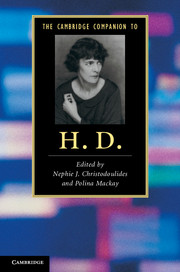
H. D. (Hilda Doolittle) was one of the central figures in literary modernism in the 1910s. She collaborated with Ezra Pound and others and played an important role in the early development of modernist poetry. This Cambridge Companion is a critical introduction to H. D. containing essays on all her major works. The first part explores the author's initial exclusion from the canon and her subsequent reinstatement; her tendency to merge fact with fiction in her autobiographical texts; her contribution to the little magazines; her relation to modernism; her representation of gender; and her influence on later generations of writers. The second part offers close and accessible critical analyses of H. D.'s style, her poems Hymen and Trilogy, her novels HERmione and Majic Ring, her understanding of translation as literary practice and of her notion of history in Tribute to Freud and The Gift.
Family changes engulfing advanced western societies over the last four decades – divorce, out-of-wedlock births, father absence, etc. – were first interpreted by social scientists as benign. The sociologist Talcott Parsons said in the 1950s that families were changing but still fulfilling their functions. The feminist sociologist Jessie Bernard said in her influential The Future of Marriage (1972) that these changes were not dangerous; that they were not harming children; that marriage was not particularly good for women anyway; and that divorce, cohabitation and non-marital births would contribute to the increased freedom of women. Some social scientists held that family changes were harmful only when they ended in poverty. A wider welfare net and a healthy economy, they argued, could prevent these negative consequences.
Since the late 1980s, there has been a worldwide change in the attitudes within the social sciences toward these family changes. Sociologists, psychologists and economists today are much more willing to acknowledge that they have been damaging to large numbers of people. The family changes have contributed to the declining well-being of children, the ‘feminisation of poverty’ (the shift of poverty from the elderly to single mothers and their children) and the ‘feminisation of kinship’ (the trend toward women alone sustaining families without the help of fathers and husbands). Although most social scientists now concur that these changes have been costly to individuals and society, they disagree over whether they can be reversed or must simply be accepted with the hope of mitigating their negative consequences.