To save content items to your account,
please confirm that you agree to abide by our usage policies.
If this is the first time you use this feature, you will be asked to authorise Cambridge Core to connect with your account.
Find out more about saving content to .
To save content items to your Kindle, first ensure no-reply@cambridge.org
is added to your Approved Personal Document E-mail List under your Personal Document Settings
on the Manage Your Content and Devices page of your Amazon account. Then enter the ‘name’ part
of your Kindle email address below.
Find out more about saving to your Kindle.
Note you can select to save to either the @free.kindle.com or @kindle.com variations.
‘@free.kindle.com’ emails are free but can only be saved to your device when it is connected to wi-fi.
‘@kindle.com’ emails can be delivered even when you are not connected to wi-fi, but note that service fees apply.
Drawing on the burgeoning scholarship on the Global 1960s, this chapter argues that the Vietnam War was a key historic event that internationalized radical social movements. The war did so in three main ways. First, through the conflict, activists in different parts of the world formed a global public sphere. Opposition to the war helped to transcend Cold War and colonial divisions, but the political movements that emerged resonated differently through various parts of the First, Second, and Third Worlds. Second, resistance against the Vietnam War fostered internationalism by foregrounding the agency of the marginalized. The war featured a David versus Goliath competition between a presumably backward, peasant society against the mightiest military in the world. Third, the wars in Southeast Asia helped to internationalize antiwar resistance by illuminating the interconnectedness of various systems of inequality. Imperialism and colonization became part of the activist lexicon, utilized to interpret cultural, racial, class, gender, and other forms of exploitation. The chapter concludes by reflecting on the agency of the Democratic Republic of Vietnam and the National Liberation Front in consciously cultivating these antiwar internationalist affiliates.
The fighting stopped in 1975 with Hanois victory. But the battle for the hearts and minds of the American people continued and was propelled by politicians manipulating the mythical cause of POWs/MIAs. Postwar movies filled out the scenario of a war lost because of poor leadership in Washington combined with the baleful influence of the anti-war movement. Presidents wrestled with the legacy of Vietnam, including the controversy over the national Vietnam Memorial. Gerald Ford and Jimmy Carter both attempted to move the nation beyond the grasp of the Vietnam Specter. Both failed. Ronald Reagan used it to help him win the presidency in 1980, after the debacle that followed the occupation of the American Embassy in Tehran, which only seemed to emphasize the nations lost claims to world leadership after Vietnam. George H. W. Bush claimed that it had been buried in the sands of Iraq after the rapid victory in Gulf War I. Bill Clinton succeeded in establishing diplomatic and economic relations with Vietnam. But it re-emerged with renewed force during the Second Gulf War and the never-ending war in Afghanistan. Even today it shapes much thinking about military interventionism.
Nineteen sixty-eight was an exceptional year in which people across the world mobilized in protest against imperialism, authoritarianism, and Cold War hegemony. The “Global 1968” has come to represent an era of social and political transformation, and its meaning has been debated into the twenty-first century. This chapter provides an overview of two major events that challenged the bipolar world order in 1968 – the Tet Offensive and the Prague Spring – and explores how the Vietnam War and Vietnamese people influenced protest movements around the world in this historic year. The Vietnamese communist revolution became a global symbol of anti-imperialism and Third World self determination, while South Vietnamese dissidents carried out protests for freedom and democracy that mirrored uprisings in other parts of the world.
This chapter offers an overview of developments in postwar Vietnam until the 2010s. After the war, the communist government sought to impose a socialist system in the South in the same way they had done in the North since 1954. This utopian march to socialism was draconian and produced an economic collapse and a looming famine in the mid 1980s. With leadership change and support from Soviet leader Mikhail Gorbachev, Vietnamese leaders embarked on market reform but refused political reform. For more than three decades, the communist party has overseen rapid economic growth that lifted millions out of poverty and raised national income many times. Despite impressive economic achievements, Vietnam’s political system is undergoing severe decay, with an aging leadership still pledging loyalty to communism while party and state bureaucracies are thoroughly penetrated by corrupt patronage networks that peddle offices and influences to serve officials and their cronies. The perverse outcome of a communist revolution that produced an oppressive and corrupt regime in Vietnam today has lately brought about the moment of reckoning for many Vietnamese about the true meaning of the Vietnam War.
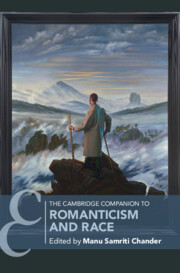
Amidst the popularization of race science and rapid colonial expansion that characterized the Romantic era, newly urgent discussions about the morality and legality of slavery emerged that would pave the way for formal abolition. The thirteen essays collected here make clear that these developments thoroughly informed Romantic-era literature: the very terms that have long defined Romanticism – revolution and radicalism, poetry and “powerful feeling,” the solitary self and the social world – were shaped by a changing global order in which race figured centrally. Combining academic rigor with accessibility, this diverse group of scholars presents specialists and non-specialists alike with a rich picture of this key moment in the literary and cultural history of race. Engaging with the distinctly Romantic meanings of race, chapters invite readers to consider how eighteenth- and nineteenth-century ideas about difference continue to shape the modern world.
This chapter introduces social scientific perspectives and methods applicable to observing the relationship between artificial intelligence (AI) and religion. It discusses the contributions that anthropological and sociological approaches can make to this entanglement of two modern social phenomena while also drawing attention to the inherent biases and perspectives that both fields bring with them due to their histories. Examples of research on religion and AI are highlighted, especially when they demonstrate agile and new methodologies for engaging with AI in its many applications; including but not limited to online worlds, multimedia formats, games, social media and the new spaces made by technological innovation such as the innovations such as the platforms underpinning the gig economy. All these AI-enabled spaces can be entangled with religious and spiritual conceptions of the world. This chapter also aims to expand upon the relationship between AI and religion as it is perceived as a general concept or object within human society and civilisation. It explains how both anthropology and sociology can provide frameworks for conceptualising that relationship and give us ways to account for our narratives of secularisation – informed by AI development – that see religion as a remnant of a prior, less rational stage of human civilisation.
Edited by
Randall Lesaffer, KU Leuven & Tilburg University,Anne Peters, Max Planck Institute for Comparative Public Law and International Law, Heidelberg
As every reader of Lucian knows, he always belongs to something without belonging to it wholly. His relationship to his own Greek identity is undoubtedly the most symbolic instance: although wholly mastering the Greek language, he emphasises his being a barbarian. Lucian’s foreignness is a typical mark of his protean authorial persona throughout his œuvre, producing a constant tension between an inside and an outside as Lucian emphasises his own paradoxical liminality. This chapter discusses six of his texts (True Histories, Scythian, The Hall, On Salaried Posts, Symposium, and Lexiphanes), suggesting that a movement towards the inside and then the outside marks Lucian’s textuality in disparate ways. Depending on the specific narrative context, this movement assumes different meanings (autobiographical, metaphorical, metapoetical, rhetorical) that are often combined with each other, but most importantly produces a fundamental tension between meaning itself and the absence of significance.
This chapter explores the intersection of Hindu philosophy and practice with the development of artificial intelligence (AI). The chapter first introduces aspects of technological growth in Hindu contexts, including the reception of ‘Western’ ideas about AI in Hindu communities before describing key elements of the Hindu traditions. It then shows how AI technologies can be conceived of from a Hindu perspective and moves from there to the philosophical contributions Hinduism offers for global reflection on AI. Specifically, the chapter describes openings and contentions for AI in Hindu rituals. The focus is the use of robotics and/or AI in Hindu pūjā (worship of gods) and the key practice of darśan (mutual seeing) with the divine. Subsequently, the chapter investigates how Hindu philosophers have engaged the distinctive qualities of human beings and their investigation into body, minds and consciousness/awareness. The chapter concludes by raising questions for future research.
Lucian’s position as a commentator on religion has been debated intensely since late antiquity: for most of the last two millennia, it has been the main focus for commentators. This is primarily due to Lucian teasing Christians in a couple of places (although in fact they get off relatively lightly); but he is also, and indeed much more insistently, scathing about aspects of Greco-Roman ‘paganism’. This chapter begin by unpicking some of this reception history, and showing how modern scholarly perspectives remain locked into nineteenth-century cultural-historical narratives (which were designed to play ‘Hellenism’ off against ‘Christianity’, in various forms). It then argues that we should set aside the construct of Lucian’s status as a religious ‘outsider’— a legacy of nineteenth-century thinking — and consider Lucian instead as an agent operating within the field of Greek religion, and contributing richly (albeit satirically) to ongoing, vital questions over humans’ relationship with the divine. He should be ranged, that is to say, alongside figures like Aristides, Pausanias, and Apuleius as keen observers of the religious culture of the time.
Artificial intelligence (AI) is presented as a portal to more liberative realities, but its broad implications for society and certain groups in particular require more critical examination. This chapter takes a specifically Black theological perspective to consider the scepticism within Black communities around narrow applications of AI as well as the more speculative ideas about these technologies, for example general AI. Black theology’s perpetual push towards Black liberation, combined with womanism’s invitation to participate in processes that reconstitute Black quality of life, have perfectly situated Black theological thought for discourse around artificial intelligence. Moreover, there are four particular categories where Black theologians and religious scholars have already broken ground and might be helpful to religious discourse concerning Blackness and AI. Those areas are: white supremacy, surveillance and policing, consciousness and God. This chapter encounters several scholars and perspectives within the field of Black theology and points to potential avenues for future theological areas of concern and exploration.
Focusing on Menippus’ description of his celestial journey and the great cosmic distances he has travelled, I argue that Icaromenippus is a playful point of reception for mathematical astronomy. Through his acerbic satire, Lucian intervenes in the traditions of cosmology and astronomy to expose how the authority of the most technical of scientific hypotheses can be every bit as precarious as the assertions of philosophy, historiography, or even fiction itself. Provocatively, he draws mathematical astronomy – the work of practitioners such as Archimedes and Aristarchus – into the realm of discourse analysis and pits the authority of science against myth. Icaromenippus therefore warrants a place alongside Plutarch’s On the Face of the Moon and the Aetna poem, other works of the imperial era that explore scientific and mythical explanations in differing ways, and Apuleius’ Apology, which examines the relationship between science and magic. More particularly, Icaromenippus reveals how astronomy could ignite the literary imagination, and how literary works can, in turn, enrich our understanding of scientific thought, inviting us to think about scientific method and communication, the scientific viewpoint, and the role of the body in the domain of perhaps the most incorporeal of the natural sciences, astronomy itself.
Defending the indefensible and praising the unpraiseworthy were staples of Greek declamation in the Roman imperial period. Lucian’s Phalaris I and II have generally been considered as undemanding rhetorical exercises, inverting the standard tropes of anti-tyrant invective to produce a paradoxical encomium of the proverbially wicked tyrant Phalaris of Akragas. This paper argues that Phalaris I and II are in fact considerably more sophisticated and caustic texts then they appear at first sight. Phalaris’ letter to the Delphians in Phalaris I is carefully crafted to show that Phalaris is indeed, despite his protestations, a self-deluding psychopath; he now wishes to dedicate his notorious bronze bull to the Delphic Apollo in order to whitewash his terrible reputation. The speech of the anonymous Delphian in Phalaris II makes a radically cynical case for welcoming the gift of the bull with no questions asked, in full knowledge that Phalaris may be just as wicked as he is reputed to be. The texts are an ironic commentary on the murky ethics of Delphic patronage in the second century CE, and the venality of oracular shrines more generally; Lucian may specifically have in mind the lavish Delphic patronage of the Roman emperor Domitian.
This chapter traces the publication history and animating ideas of Luciani Opuscula, a set of translations of Lucian begun as a collaboration between Thomas More and Desiderius Erasmus. I examine the volume’s contents, which grew over time as Erasmus kept adding to them, and the letters with which both translators prefaced their own selections, explaining to fellow humanists how the works are to be read. These interpretive letters tell us much about how the two great northern humanists understood Lucian and what role he played in their own evolution as the foremost ‘Lucianists’ of their age.