To save content items to your account,
please confirm that you agree to abide by our usage policies.
If this is the first time you use this feature, you will be asked to authorise Cambridge Core to connect with your account.
Find out more about saving content to .
To save content items to your Kindle, first ensure no-reply@cambridge.org
is added to your Approved Personal Document E-mail List under your Personal Document Settings
on the Manage Your Content and Devices page of your Amazon account. Then enter the ‘name’ part
of your Kindle email address below.
Find out more about saving to your Kindle.
Note you can select to save to either the @free.kindle.com or @kindle.com variations.
‘@free.kindle.com’ emails are free but can only be saved to your device when it is connected to wi-fi.
‘@kindle.com’ emails can be delivered even when you are not connected to wi-fi, but note that service fees apply.
This chapter challenges the Gandhian narrative that Hinduism preaches peace. It argues that Hinduism is composed of many strands of thought that include both nonviolent traditions and martial violence.
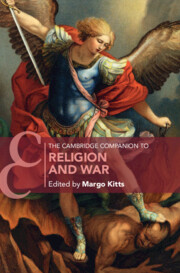
This Companion offers a global, comparative history of the interplay between religion and war from ancient times to the present. Moving beyond sensationalist theories that seek to explain why 'religion causes war,' the volume takes a thoughtful look at the connection between religion and war through a variety of lenses - historical, literary, and sociological-as well as the particular features of religious war. The twenty-three carefully nuanced and historically grounded chapters comprehensively examine the religious foundations for war, classical just war doctrines, sociological accounts of religious nationalism, and featured conflicts that illustrate interdisciplinary expressions of the intertwining of religion and war. Written by a distinguished, international team of scholars, whose essays were specially commissioned for this volume, The Cambridge Companion to Religion and War will be an indispensable resource for students and scholars of the history and sociology of religion and war, as well as other disciplines.
Edited by
Ben Kiernan, Yale University, Connecticut,T. M. Lemos, Huron University College, University of Western Ontario,Tristan S. Taylor, University of New England, Australia
General editor
Ben Kiernan, Yale University, Connecticut
This chapter looks at specific evidence of political violence and massacres during the medieval Delhi Sultanate (1206-1526), for most of which period roughly the whole of the Indian Subcontinent was ruled from Delhi by powerful Sultans with Turkish antecedents and exposure to Persianate political culture of Central Asia and Iran. In view of the abundant material in contemporary sources, the focus is on genocidal massacres under three most despotic rulers who brooked no criticism, resistance or protest against their rule, which tended to be arbitrary and in complete disregard of existing conventions of politics and governance. They were Sultan Ghiyas-ud-Din Balban (ruled 1266-86), Sultan Ala-ud-Din Khalji (ruled 1296-1316), and Sultan Muhammad bin Tughluq (ruled 1325-51). Historian Ziya-ud-Din Barani’s mid-14th century discussion of their reigns show not only that opponents resisting their conquests or regimes were brutally killed in large numbers during armed combat, but also that many of those captured alive were later massacred in cold blood. The women and children of soldiers from the other camp were not only imprisoned and enslaved, but also bodily harmed, often killed; women were also raped as punishment for alleged crimes of their male relatives.
Between 1904 and 1908 an estimated 80% of the Herero and half of the Nama population, in total some 75,000 men, women and children, lost their lives in German South-West Africa, present-day Namibia. They were killed by German soldiers, died in concentration camps, or perished in the desert after being chased away from their homelands. The genocides were a culmination of years of ruthless and forceful German dispossession of Herero and Nama land and property. This chapter focuses on the racial prejudice and fear of the Other at the root of the Herero and Nama genocides. Since the founding of the protectorate in 1884, Germans aimed to brutally subjugate the Herero and Nama peoples. Notions of racial superiority that attempted to justify taking Indigenous land and acts of violence against the colonized had always been balanced by a fear of anticolonial violence. Even prior to the genocide, this led to ever-greater atrocities, including the genocidal Hoornkrans Massacre (1893) and the incarceration of the Khauas-Khoi in concentration camps (1896). The chapter argues that racism and dehumanization shaped the events taking place before, during and directly after the genocide, which was long forgotten as a mere ‘colonial war’.
Edited by
Ben Kiernan, Yale University, Connecticut,T. M. Lemos, Huron University College, University of Western Ontario,Tristan S. Taylor, University of New England, Australia
General editor
Ben Kiernan, Yale University, Connecticut
The Novgorod genocidal massacre of 1570 is one of the major events of the reign of Ivan the Terrible (1533-1584). It shows the tyranny of the tsar in terms of the 16th century and has been used in the historiography for 200 years to show how a tsar who had reigned for 20 years as a reformer could change and commit the most horrible crimes against his own people before turning back to his normal reign again. Supposing the Novgorodians were planning treason, the tsar and his army went secretly to Novgorod, shamed the Archbishop and began a massacre among the population as well as forcibly looted the town and its environments. The sources all tell the same story, as if they were from the same eyewitness. Also, contemporary sources appeared only in Western Europe from 1570 on, 17th ct. Russian sources betray a textual relationship to the Western sources so that the conclusion is that the Russian history of the Novgorod genocidal massacre derives rather from the Western than from native eyewitnesses’ descriptions.
The Spice Islands or the Moluccas in Indonesia are home to an abundance of cloves, nutmeg and mace. The region was historically highly coveted by various foreign merchants Asian and European alike. When the Dutch joined the search for possession of the spices in the region their eye fell on the Banda Archipelago where nutmeg and mace had formed the cornerstone of the Banda civilization of free traders consisting of 15,000 people. The Dutch set out to capture the spices and succeeded in making small encroachments on several of the small islands of the Banda Archipelago in the first decades of the 17th century. In 1621 Jan Pieterszoon Coen the Dutch Governor-General of the Dutch East India Company gave the order to capture the whole of the Banda Archipelago and caused a genocide that destroyed the Bandanese Civilization in the archipelago. In that year many Bandanese elites were killed or enslaved and the Banda population decimated or made to flee into the hills or in the sea where many passed away. Their lands were occupied by the Dutch East India Company who from then on had a monopoly of the nutmeg and mace production in the world.
The literature on Australia’s Stolen Generations and genocide has focused on the twentieth century but forcible child removal was integral to colonization from its beginning in in 1788. This historical analysis chronicles the abuse and deaths of stolen children at colonists’ hands during the nineteenth century through the rubric of the United Nations Convention on Genocide in 1948. This is a history of private kidnapping along spreading frontiers, sanctioned by colonial authorities, and government projects for “Christianizing and civilizing” the children in isolated missions. Both reasons for removing children provided labor for colonists and cleared Aboriginal families from their lands. Despite critics in Britain and the colonies and opposition from Aboriginal families these practices continued into the twentieth century and contributed to the foundations of the modern “Stolen Generations”. The Australian Federal Constitution (1901) left Aboriginal people under the control of state governments. New laws extinguishing citizenship and economic independence increased family poverty and vulnerability of all Aboriginal people, including those of ‘mixed’ descent. Forcible removals to draconian institutions and menial labor for life became normalized for many children until the mid-twentieth century. The enormity of these crimes committed against Aboriginal children and their kin prompts the question, what restorative effects the Genocide Convention might offer their descendants? This chapter traces this history, focusing on the colonies of New South Wales, Van Diemen's Land (Tasmania), Queensland, Victoria and Western Australia.
Edited by
Ben Kiernan, Yale University, Connecticut,T. M. Lemos, Huron University College, University of Western Ontario,Tristan S. Taylor, University of New England, Australia
General editor
Ben Kiernan, Yale University, Connecticut
This chapter focuses on the series of conflicts between the Roman government and the Jewish population of the Roman empire during the first and second centuries CE. Modern theories on this relationship are as elaborate and convoluted as the corpus of primary sources available for it. Both will be analyzed here through the scope of genocide, in an attempt to determine whether there ever existed a Roman intent to destroy the Jewish group or parts of it, and the extent to which actual destruction ultimately occurred.
In 2015, the Truth and Reconciliation Commission of Canada (TRC) concluded that Canada had committed “cultural genocide” in government-supported residential schools that aimed to forcibly assimilate First Nations peoples since the nineteenth century. The TRC’s finding of cultural genocide in Canada can inform our understanding of American Indian boarding schools in the U.S. given the similarities and connections between the two systems. Both countries founded their schools with the aim of achieving total assimilation, or cultural genocide. Both, however, did much more than forcibly assimilate Indigenous youth. At the root of U.S. and Canadian Indigenous education project rests a genocidal truth: they may have committed all of the genocidal crimes enumerated in the UNGC. School administrators held people year after year with full knowledge of how lethal the schools were and an explicit plan to commit cultural genocide. This chapter demonstrates how scholars of the American Indian boarding schools can learn from the TRC, consider how we may evaluate the schools under the UNGC, and ultimately conduct additional data-gathering in order to reach a better understanding of what happened in these institutions.
Edited by
Ben Kiernan, Yale University, Connecticut,T. M. Lemos, Huron University College, University of Western Ontario,Tristan S. Taylor, University of New England, Australia
General editor
Ben Kiernan, Yale University, Connecticut
Beginning in 302 CE, the four emperors of the Roman tetrarchy collectively issued a series of edicts that decreed severe penalties against the Empire’s Manichaean and Christian subjects. These decrees constituted the most widespread and systematic religious persecutions in imperial history. In this chapter, I explore these edicts and their consequences in the context of a global history of genocide. I argue that, while these persecutions may not satisfy modern juristic definitions of genocide, which tend to emphasize physical violence, they nonetheless suggest that the emperors aimed to eliminate alternative systems of knowledge, to remove particular religio-cultural populations from the civic collective, and to prevent these groups’ social reproduction. I suggest the tetrarchy’s edicts comprise something akin to a “cultural genocide” by the Roman government. I conclude with some brief reflections on the use of cultural genocide as an interpretive tool for understanding ancient acts of community violence.
The date 24 April 1915 is generally seen as the symbolic beginning of the Armenian genocide, as it marks the date on which some 200 Armenian political, religious and intellectual leaders in Istanbul were arrested. In fact, massacres of Armenians had already begun in the southeastern and eastern provinces of Anatolia and the Caucasus as early as August–September 1914, months before the Ottoman entry into World War One.
The British colonisation of Van Diemen’s Land (later Tasmania) began in 1803. There was an estimated 6,000 Aborigines (Palawa) living on the island with a history dating back over 40,000 years. By 1835, there were just over 100 Palawa living in forced exile on one of Tasmania’s smaller offshore islands. Only two residents remained when the government closed the Aboriginal Settlement in 1871. This chapter traces the history of Tasmania’s colonisation from 1803 to 1871 and finds that the British committed acts against the Palawa that meet the 1948 UN Convention on the Prevention and Punishment of the Crime of Genocide: killings, child removals, and creating conditions unconducive to sustaining life. Tasmania has been cited as one the ‘classical’ cases of genocide, but the finding has also stirred debate. This chapter surveys the historiography of Tasmanian genocide including Raphael Lemkin’s 1940s finding of a clear case of genocide; Henry Reynolds’ 2001 counter evidence of gubernatorial humanitarianism; and the subsequent histories that recognise genocide within the structure of settler colonialism. This chapter concludes that the British committed genocide in Tasmania with intent, but reported and framed that crime within the rhetoric, and even the guidelines, of contemporaneous humanitarian policies.
Sudan was the largest country in Africa until 2011, when its South gained independence. (See Map 28.1.) In the twentieth and early twenty-first centuries, multiple conflicts became sites of mass violence. The second civil war between the government of Sudan and the southern rebels lasted twenty-two years from 1983 to 2005, with large repercussions for civilians in both the south (future South Sudan) and the Nuba Mountains. Then, during the negotiations between the southern rebels of the Sudan People’s Liberation Army (SPLA) and Khartoum, a new conflict erupted in Darfur in 2003. It garnered international attention, and the US government labelled the war in Darfur a ‘genocide’. The International Criminal Court (ICC) issued six arrest warrants, including against then sitting president of Sudan, Omar El-Beshir, for alleged crimes of genocide, war crimes and crimes against humanity. This was a marked escalation in the history of international reactions to mass violence in the Sudan since the 1980s. In 2013, a new war erupted in independent South Sudan. The international community did not escalate its rhetoric to label that mass violence as genocidal, preferring to use the term ‘ethnic cleansing’, while warning that it could become a genocide.
The history of genocide prevention across the long twentieth century is a history of failure. Only very rarely have international actors acted collectively to halt or mitigate a genocide underway or one in the making. That said, across the arc of the twentieth century, there have been important developments and milestones in norms, law and policy as they pertain to prevention. These changes amount to incremental, if episodic, progress. They do not, however, amount either to a consistent, effective multilateral policy or to consistent, effective foreign policies of particular states. But if we measure the global norms, legal instruments, institutions, and policy tools available at the start of the twentieth century compared to those at the start of the twenty-first century, there are significant differences to observe. This chapter summarises those changes and charts them across key cases. It concludes with a discussion of future challenges and opportunities for genocide prevention.1
Edited by
Ben Kiernan, Yale University, Connecticut,T. M. Lemos, Huron University College, University of Western Ontario,Tristan S. Taylor, University of New England, Australia
General editor
Ben Kiernan, Yale University, Connecticut
The chapter explores the workings of gender in genocidal processes. It frames the subject inclusively, to address women and men; masculinities and femininities; the specific vulnerabilities of LGBT people; survivor, victim and perpetrator experiences; and structural and institutional forms of sexualized violence alongside event-specific ones. The chapter encourages readers to rethink major categories of analysis and themes in genocide studies as gendered phenomena.
Although pervasive, gender is often overlooked for its role in how genocide is conceived, performed, and experienced. The chapter traces its influence in connection to other explanatory narratives and theories such as the roles of the state, militarism, war, imperialism, racism, and sexism. Was gender one of many facets or a primary force in escalating or de-escalating the violence over time and space? Variables of race and ethnicity, themselves typically intersecting with social class, crucially shape how gender identities are imposed, interpreted, and experienced. The interaction of gender with an age variable is also noted. The coverage spans case studies of genocide in Europe, Asia, the Americas and Africa in order to illuminate the universal and particular. The authors also present on the role of courts in prosecuting mass rape and sexual violence as acts of genocide. The conclusion points out key intellectual, ethical and policy challenges ahead.