To save content items to your account,
please confirm that you agree to abide by our usage policies.
If this is the first time you use this feature, you will be asked to authorise Cambridge Core to connect with your account.
Find out more about saving content to .
To save content items to your Kindle, first ensure no-reply@cambridge.org
is added to your Approved Personal Document E-mail List under your Personal Document Settings
on the Manage Your Content and Devices page of your Amazon account. Then enter the ‘name’ part
of your Kindle email address below.
Find out more about saving to your Kindle.
Note you can select to save to either the @free.kindle.com or @kindle.com variations.
‘@free.kindle.com’ emails are free but can only be saved to your device when it is connected to wi-fi.
‘@kindle.com’ emails can be delivered even when you are not connected to wi-fi, but note that service fees apply.
This Element examines clientelism and its impact on democratic institutions and markets, emphasizing that, alongside electoral competition, politics hosts two additional arenas: one where political actors seek campaign resources and active supporters, and another where socioeconomic actors pursue access to state-distributed resources. Clientelism emerges from reciprocal exchanges between these actors. Political parties use clientelism to incentivize collective action and organize campaigns. Playing this 'clientelist game', no party can reduce clientelistic practices without risking electoral defeat or internal fragmentation. Clientelism weakens the provision of public goods and skews policymaking to benefit clients over general welfare. Eventually, it generates an economic 'tragedy of the commons', as state resources are overexploited and the economy suffers, while formal institutions often fail to constrain it. Even in advanced democracies like the United States, political competition is not only electoral, targeting voters, but structurally clientelist. This title is also available as Open Access on Cambridge Core.
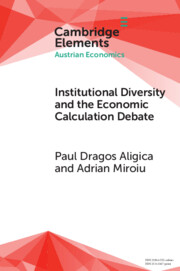
This Element brings together the problems of economic calculation, institutional diversity, and institutional feasibility, arguing that these themes are deeply interconnected and mutually reinforcing. Building on recent developments in institutional theory, political economy, social philosophy, and logical analysis, the Element revisits the classic debates surrounding alternative economic and governance systems. The discussion is organized around three core elements: (1) an overview of recent developments in institutional theory and social philosophy, that driven by technological advances have revitalized debates on alternative economic and governance systems; (2) a reexamination of the economic calculation debate, tracing its evolution from Austrian economics to a broader theoretical synthesis incorporating institutional political economy and conflict theory; and (3) a discussion of the formal, logical, and philosophical foundations for thinking about feasibility and realizability, offering analytical tools for evaluating the plausibility of institutional alternatives within specific historical and social contexts.
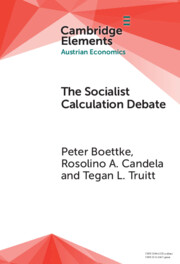
For over a generation, the collapse of communism in the Soviet Union and Eastern and Central Europe delegitimized the abolition of private property in the means of production and the practice of central planning as an effective way to achieve the ends of socialism. However, the aspiration of achieving the ends of socialism remains to this day. This Element provides a narrative of a century-long debate that was initiated by Ludwig von Mises in 1920. In so doing, it tells the history of the problem of economic calculation in the socialist commonwealth and its continuing relevance for developments in economics, political economy, and social philosophy.
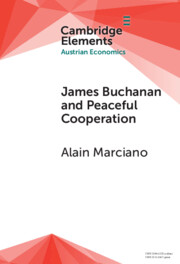
Buchanan believed that individuals are fundamentally willing to cooperate with others. It was at the center of his works in public finance in the late 1940s and early 1950s, and also crucial to his work in public choice in the 1960s. The purpose of this book is to show which forms this belief took over these two decades or so, and to explain the continuity between these forms. We adopt a historical approach that allows us to recount the story of how Buchanan came to develop a theory of collective action, including his conception of cooperation in small groups, to implement a technical condition about the pricing of public goods he defended early in his career. We describe the different steps Buchanan took, the encounters that influenced him, and the events and challenges that led him to revise his views to make room for this fundamental philosophical conviction.
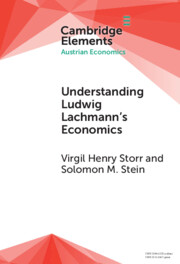
Ludwig Lachmann is a central but underappreciated figure within the Austrian school of economics. Although his understanding of institutions, his appreciation of the heterogeneity of capital, his emphasis on subjectivity, and his focus on the dynamism and uncertainty of the real world have become dominant positions amongst Austrian economists, he is still viewed as something of an outsider. As such, the contributions of Lachmann's economics are arguably misunderstood. This Element attempts to tease out and discuss the critical contributions of Lachmann's economics. Arguably, one way in which to understand Lachmann's economics is by seeing it as unified in considering, in various ways, a single conceptual 'problem' – the apparent tension between the dynamic nature of social reality and the intelligible nature of the social world. Approaching Lachmann with this theme in mind allows us to put things together more coherently than other exegetical strategies.
This Element explores the topics of terrorism, counterterrorism, and the US government's war on terror following the September 11, 2001 terror attacks. It draw on insights from Austrian and public choice economics. First, the foundations of the economics of terrorism are discussed emphasizing that the behaviors of terrorists and counter-terrorists are purposeful and goal-oriented. Then, the economics of counterterrorism policies and the importance of institutional change is considered. Next, the three dilemmas facing liberal societies as it relates to counterterrorism efforts is focused on. The Element then provides an assessment of the US government's war on terror. It discusses the origins of the war, discuss whether it can be judged a success or failure, and consider some of the main effects both abroad and within the United States. The final chapter concludes with a discussion of several areas for future research.
Public pensions in the United States face an impending funding crisis in the wake of the financial crisis and the COVID-19 recession. Many cities and states will struggle to meet these growing obligations without major cuts in government services, reneging on pension promises, or raising taxes. This Element examines the development of the pension crisis through the lens of political economy. We analyze the knowledge and incentive problems inherent in the institutional structure, governance, and accounting of public pensions. We conclude by offering several institutional, governance, and reporting reforms to address the pension funding crisis.
Property rights are the rules governing ownership in society. This Element offers an analytical framework to understand the origins and consequences of property rights. It conceptualizes of the political economy of property rights as a concern with the follow questions: What explains the origins of economic and legal property rights? What are the consequences of different property rights institutions for wealth creation, conservation, and political order? Why do property institutions change? Why do legal reforms relating to property rights such as land redistribution and legal titling improve livelihoods in some contexts but not others? In analyzing property rights, the authors emphasize the complementarity of insights from a diversity of disciplinary perspectives, including Austrian economics, public choice, and institutional economics, including the Bloomington School of institutional analysis and political economy.
Increasingly, economists realize that a deeper understanding of culture can improve their insights into the most important questions in economics. The Austrian school of political economy, which has always taken economics to be a science of meaning, and therefore, a science of culture, offers a unique approach to the study of culture in economic life. We consider three important differences between these Austrian and non-Austrian approaches: the Austrian focus on culture as meaning rather than culture as norms, beliefs, or attitudes; the Austrian emphasis on culture as an interpretative lens rather than as a tool or form of capital; and the Austrian insistence that cultural analysis be a qualitative exercise rather than a quantitative one. We also examine Geertz's description of culture, Gadamer's approach to hermeneutics, and Weber's interpretative sociology, demonstrating their connections to the Austrian approach and offering examples of what Austrian cultural economics can look like.
This Element surveys the field of defense, peace, and war economics with particular emphasis on the contributions made by Austrian economists. I first review treatments of defense, peace, and war by the classical economists. I then discuss the rise of a distinct and systematic defense, peace, and war economics field of study starting in the 1960s. Next, I consider the contributions by Austrian economists to the field. This includes the economic analysis of the nature of the war economy, problems with the public good justification for the state-provision of defense, the seen and unseen costs of war, the idea of the liberal peace, and the realities and limitations of foreign intervention. I conclude with a discussion of some open areas for future research.
Economists commit a category mistake when they treat democratic governments as indebted. Monarchs can be indebted, as can individuals. In contrast, democracies can't truly be indebted. They are financial intermediaries that form a bridge between what are often willing borrowers and forced lenders. The language of public debt is an ideological language that promotes politically expressed desires and is not a scientific language that clarifies the practice of public finance. Economists have gone astray by assuming that a government is just another person whose impulses toward prudent action will restrict recourse to public debt and induce rational political action.
This Element presents a new framework for Austrian capital theory, starting from the notion that capital is value. Capital is the value attributed by the valuer at any moment in time to the combination of production-goods and labor available for production. Capital is the result obtained by calculating the current value of a business-unit or business-project that employs resources over time. It is the result of a (subjective) entrepreneurial calculation process that relates the flow of consumptions goods to the value of the productive resources that will produce those consumptions goods. The entrepreneur is a ubiquitous calculating presence. In a review of the development of Austrian capital theory, by Carl Menger, Eugen von Böhm-Bawerk, Ludwig von Mises, Friedrich Hayek, Ludwig Lachmann as well as recent contributions, the Element incorporates the seminal contributions into the new framework in order to provide a more accessible perspective on Austrian capital theory.
Institutions are the formal or informal 'rules of the game' that facilitate economic, social, and political interactions. These include such things as legal rules, property rights, constitutions, political structures, and norms and customs. The main theoretical insights from Austrian economics regarding private property rights and prices, entrepreneurship, and spontaneous order mechanisms play a key role in advancing institutional economics. The Austrian economics framework provides an understanding for which institutions matter for growth, how they matter, and how they emerge and can change over time. Specifically, Austrians have contributed significantly to the areas of institutional stickiness and informal institutions, self-governance and self-enforcing contracts, institutional entrepreneurship, and the political infrastructure for development.
Recommend this
Email your librarian or administrator to recommend adding this to your organisation's collection.