To save content items to your account,
please confirm that you agree to abide by our usage policies.
If this is the first time you use this feature, you will be asked to authorise Cambridge Core to connect with your account.
Find out more about saving content to .
To save content items to your Kindle, first ensure no-reply@cambridge.org
is added to your Approved Personal Document E-mail List under your Personal Document Settings
on the Manage Your Content and Devices page of your Amazon account. Then enter the ‘name’ part
of your Kindle email address below.
Find out more about saving to your Kindle.
Note you can select to save to either the @free.kindle.com or @kindle.com variations.
‘@free.kindle.com’ emails are free but can only be saved to your device when it is connected to wi-fi.
‘@kindle.com’ emails can be delivered even when you are not connected to wi-fi, but note that service fees apply.
This Element considers the relationship between the traditional view of God as all-powerful, all-knowing and wholly good on the one hand, and the idea of human free will on the other. It focuses on the potential threats to human free will arising from two divine attributes: God's exhaustive foreknowledge and God's providential control of creation.
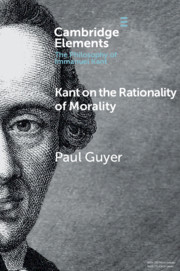
Kant claims that the fundamental principle of morality is given by pure reason itself. Many have interpreted Kant to derive this principle from a conception of pure practical reason (as opposed to merely prudential reasoning about the most effective means to empirically given ends). But Kant maintained that there is only one faculty of reason, although with both theoretical and practical applications. This Element shows how Kant attempted to derive the fundamental principle and goal of morality from the general principles of reason as such, defined by the principles of non-contradiction and sufficient reason and the ideal of systematicity.
The 'ethical commonwealth', the central social element in Kant's account of religion, provides the church, as 'the moral people of God', with a role in establishing a cosmopolitan order of peace. This role functions within an interpretive realignment of Kant's critical project that articulates its central concern as anthropological: critically disciplined reason enables humanity to enact peacemaking as its moral vocation in history. Within this context, politics and religion are not peripheral elements in the critical project. They are, instead, complementary social modalities in which humanity enacts its moral vocation to bring lasting peace among all peoples.
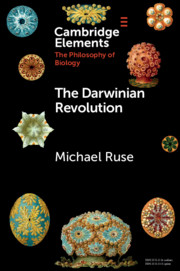
What is the Darwinian revolution and why is it important for philosophers? These are the questions tackled in this Element. In four sections, the topics covered are the story of the revolution, the question of whether it really was a revolution, the nature of the revolution, and the implications for philosophy, both epistemology and ethics.
Harry Potter fans contribute their immaterial and affective labor in multiple arenas: as peer-to-peer marketers via fan sites and social media; as participants in amateur fan festivals; or as activists for social change. Fans' participation in the Harry Potter universe has contributed to its success. This Element examines how fans' labor might continue to support the franchise for future readers. Starting with the context and theoretical frameworks that support a multidimensional analysis of the Harry Potter fan experience, this Element examines tensions between fans and Warner Bros., as fan participation tests the limits of corporate control.
Touch screen panels (TSPs) have become an integral part of modern-day lifestyle. To enhance user experience, attributes such as form-factor flexibility, multi-dimensional sensing, low power consumption and low cost have become highly desirable. This Element addresses the design of multi-functional TSPs with integrated concurrent capture of ubiquitous capacitive touch signals and force information. It compares and contrasts interactive technologies and presents design considerations for multi-dimensional touch screens with high detection sensitivity, accuracy and resolution.
Biological accounts of art typically start with evolutionary, psychological or neurobiological theories. These approaches might be able to explain many of the similarities we see in art behaviors within and across human populations, but they don't obviously explain the differences we also see. Nor do they give us guidance on how we should engage with art, or the conceptual basis for art. A more comprehensive framework, based also on the ecology of art and how art behaviors get expressed in engineered niches, can help us better understand the full range of art behaviors, their normativity and conceptual basis.
This Element aims to present an outline of mathematics and its history, with particular emphasis on events that shook up its philosophy. It ranges from the discovery of irrational numbers in ancient Greece to the nineteenth- and twentieth-century discoveries on the nature of infinity and proof. Recurring themes are intuition and logic, meaning and existence, and the discrete and the continuous. These themes have evolved under the influence of new mathematical discoveries and the story of their evolution is, to a large extent, the story of philosophy of mathematics.
This Element is a contribution to the ongoing debate on what it meant to publish a book in manuscript. It offers case-studies of three twelfth-century Anglo-Norman historians: William of Malmesbury, Henry of Huntingdon, and Geoffrey of Monmouth. It argues that the contemporary success and rapid attainment of canonical authority for their histories was in significant measure the result of successfully conducted publishing activities. These activities are analysed using the concept of a 'publishing circle'. This concept, it is suggested, may have wider utility in the study of authorial publishing in a manuscript culture. This Element is also available as Open Access.
What motivates public employees to work hard? This Element systematically reviews answers from public administration research. The authors locate this research in a novel two-dimensional typology, which shows that public employees can be motivated for other- and self-interested reasons and extrinsic (motivated by outcomes) and intrinsic (motivated by work itself) reasons. Public administration research sheds significant light on extrinsic motivators: working hard to help society (public service motivation), one's organization (organizational commitment) and oneself (financial incentives). Future research should focus on hitherto understudied motivators: symbolic rewards and intrinsic motivators, such as enjoyable work tasks, warm glow, and relatedness with colleagues. Supplementary material for this Element is available online.
Exploring efforts to integrate women into combat forces in the military, we investigate how resistance to equity becomes entrenched, ultimately excluding women from being full participants in the workplace. Based on focus groups and surveys with members of Special Operations, we found most of the resistance is rooted in traditional gender stereotypes that are often bolstered through organizational policies and practices. The subtlety of these practices often renders them invisible. We refer to this invisibility as organizational obliviousness. Obliviousness exists at the individual level, it becomes reinforced at the cultural level, and, in turn, cultural practices are entrenched institutionally by policies. Organizational obliviousness may not be malicious or done to actively exclude or harm, but the end result is that it does both. Throughout this Element we trace the ways that organizational obliviousness shapes individuals, culture, and institutional practices throughout the organization.
Academic bookselling inhabits a landscape fundamentally impacted by legislative and political pressure, colonised by new textual forms and new publishing ventures, experiencing constant change. Capital Letters defines the academic bookshop, text, and market, examining change drivers in the UK, the USA and Asia. Drawing on current research, inclusive of commercial publishers and publishing interest groups, Capital Letters also includes quantitative and qualitative research data from academic booksellers. In evaluating the response of academic bookshops to the changing landscape, Capital Letters argues that academic booksellers can understand, shape, and lead a sustainable and equitable future for academic text within the marketplace.
In popular culture and scholarship, a consistent trope about Mormonism is that it features a propensity for violence, born of the religion's theocratic impulses and the antinomian tendencies of special revelation. Mormonism and Violence critically assesses the relationship of Mormonism and violence through a close examination of Mormon history and scripture, focusing on the Church of Jesus Christ of Latter-day Saints. The Element pays special attention to violence in the Book of Mormon and the history of the movement, from the 1830s to the present.
Hypothesis testing is a common statistical analysis for empirical data generated by studies of perception, but its properties and limitations are widely misunderstood. This Element describes several properties of hypothesis testing, with special emphasis on analyses common to studies of perception. The author also describes the challenges and difficulties with using hypothesis testing to interpret empirical data. Many common applications of hypothesis testing inflate the intended Type I error rate. Other aspects of hypothesis tests have important implications for experimental design. Solutions are available for some of these difficulties, but many issues are difficult to deal with.
This Element provides a critical review of existing literature on the role of ideas and institutions in the politics of public policy with the aim of contributing to the study of the politics of public policy. Because most policy scholars deal with the role of ideas or institutions in their research, such a critical review should help them improve their knowledge of crucial analytical issues in policy and political analysis. The following discussion brings together insights from both the policy studies literature and new institutionalism in sociology and political science, and stresses the explanatory role of ideas and institutions.
Across the humanities, a set of interrelated concepts - excess, becoming, the event - have gained purchase as analytical tools for thinking about power. Some versions of affect theory rely on Gilles Deleuze's concept of 'becoming', proposing that affect is best understood as a field of dynamic novelty. Reconsidering affect theory's relationship with life sciences, Schaefer argues that this procedure fails as a register of the analytics of power. By way of a case study, this work concludes with a return to the work of Saba Mahmood, in particular her 2005 study of the women's mosque movement in Cairo, Politics of Piety.
Penguin Classics have built their reputation as one of the largest and most successful modern imprints for 'classic' texts on the notion of 'the general reader'. Following an interrogation of this idea, Leah Tether investigates the publication of medieval French literature on this list and shines a light on the drivers, motivations, negotiations and decision-making processes behind it. Focusing on the medieval French texts published between c.1956 and 2000, Tether demonstrates that, rather than Penguin's frequently cited 'general reader', a more academic market may have contributed to ensuring the success of these titles.
The basis of Chinese religious culture, and with that many aspects of daily life, was the threat and fear of demonic attacks. These were inherently violent and could only be counteracted by violence as well - even if this reactive violence was masked by euphemisms such as execution, expulsion, exorcisms and so on. At the same time, violence was a crucial dimension of the maintenance of norms and values, for instance in sworn agreements or in beliefs about underworld punishment. Violence was also an essential aspect of expressing respect through sacrificial gifts of meat (and in an earlier stage of Chinese culture also human flesh) and through a culture of auto-mutilation and ritual suicide. At the same time, conventional indigenous terms for violence such as bao 暴 were not used for most of these practices since they were not experienced as such, but rather justified as positive uses of physical force.
With the victory of Donald Trump in the 2016 United States presidential election, populists have come to power in the US for the first time in many years. However, US political scientists have been flat-footed in their response, failing to anticipate or measure populism's impact on the campaign or to offer useful policy responses. In contrast, populism has long been an important topic of study for political scientists studying other regions, especially Latin America and Europe. The conceptual and theoretical insights of comparativist scholars can benefit Americanists, and applying their techniques can help US scholars and policymakers place events in perspective.
Why do some people adapt to the risks of climate change, while others do not? This Element provides an in-depth overview of the psychology of climate change adaptation. It begins with an overview of adaptation behaviour and highlights the importance of successful adaptation by individuals and households. Key psychological theories are introduced that can explain adaptation behaviour and the role of a wide variety of motivational variables in adaptation behaviour is discussed, such as risk perception, experiences with climate-related hazards, and perceived responsibility. Next, the authors examine three examples of how this psychological knowledge has been used to develop and test interventions to promote adaptation behaviour in real-world settings. After which, the relationship between climate adaptation behaviour and climate mitigation behaviour are considered and the potential for integrating these bodies of literature is put forward. It concludes with an agenda for future psychological research on climate change adaptation behaviour.