To save content items to your account,
please confirm that you agree to abide by our usage policies.
If this is the first time you use this feature, you will be asked to authorise Cambridge Core to connect with your account.
Find out more about saving content to .
To save content items to your Kindle, first ensure no-reply@cambridge.org
is added to your Approved Personal Document E-mail List under your Personal Document Settings
on the Manage Your Content and Devices page of your Amazon account. Then enter the ‘name’ part
of your Kindle email address below.
Find out more about saving to your Kindle.
Note you can select to save to either the @free.kindle.com or @kindle.com variations.
‘@free.kindle.com’ emails are free but can only be saved to your device when it is connected to wi-fi.
‘@kindle.com’ emails can be delivered even when you are not connected to wi-fi, but note that service fees apply.
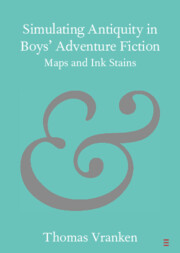
A genre that glorifies brutish masculinity and late Victorian imperialism, boys' 'lost world' adventure fiction has traditionally been studied for its politically problematic content. While attuned to these concerns, this Element approaches the genre from a different angle, viewing adventure fiction as not just a catalogue of texts but a corpus of books. Examining early editions of Treasure Island, King Solomon's Mines, and The Lost World, the Element argues that fin-de-siècle adventure fiction sought to resist the nineteenth-century industrialisation of book production from within. As the Element points out, the genre is filled with nostalgic simulations of material anachronisms – 'facsimiles' of fictional pre-modern paper, printing, and handwriting that re-humanise the otherwise alienating landscape of the modern book and modern literary production. The Element ends by exploring a subversive revival of lost world adventure fiction that emerged in response to ebooks at the beginning of the twenty-first century.
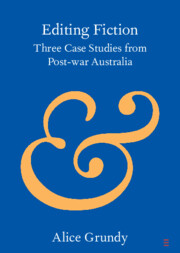
Editing Fiction considers the collaborative efforts of literary production as well as editorial practice in its own right, using case studies by Australian novelists Jessica Anderson, Thea Astley and Ruth Park. An emphasis on collaboration is necessary because literary criticism often takes books as finite, discrete works rather than the result of multiple contributors, engaged to differing degrees. The editorial process always involves a negotiation over edits for the sake of the work, taking its potential reception or projected sales into account. Through examination of the archives, this Element shows that editing can be formative, limiting, commercially directed, a literary collaboration – or a mix of all these interventions. For editors and scholars alike, the Element examines practices of the recent past, seeking to determine the responsibilities of editors and publishers to authors, the text itself and to society; and the interrelation of editorial work, social conditions and market forces.
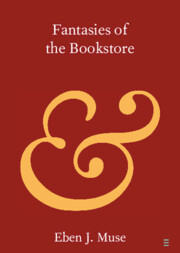
This Element surveys the place of the bookstore in the creative imagination (the fantasies of the bookstore) through a study of novels in which bookstores play a prominent role in the setting or plot. Nearly 500 'bookstore novels' published since the first in 1917 have been identified. The study borrows the concept of 'meaningful locations' from the field of human geography to assess fictional bookstores as narrative events rather than static backgrounds. As a meaningful location, the bookstore creates the potential for events that can occur both within the place of the store and in the wider space within which it functions. Elements of the narrative space include its spatio-temporal location, its locale or composition, and the events which these elements generate to define the bookstore's sense of place.
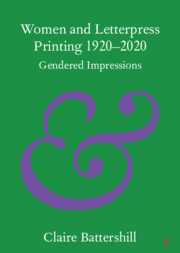
This Element analyses the relationship between gender and literary letterpress printing from the early 20th century to the beginning of the 21st. Drawing on examples from modernist writer/printers of the 1920s to literary book artists of the early 21st, it offers a way of thinking about the feminist historiography of printing as we confront the presence and particular character of letterpress in a digital age. This Element is divided into four sections: the first, 'Historicizing' traces the critical histories of women and print through to the twentieth and twenty-first centuries. The second section, 'Learning,' offers an analysis of some of the modes of discourse and training through which women and gender minorities have learned the craft of printing. The third section, 'Individualizing' offers brief biographical vignettes. The fourth section, 'Writing,' focuses on printers' own written reflections about letterpress. This title is also available as Open Access on Cambridge Core.
This Element explores the politics of literary translation via case studies from the Heinemann African Writers Series and the work of twenty-first-century literary translators in Cameroon. It intervenes in debates concerning multilingualism, race and decolonization, as well as methodological discussion in African literary studies, world literature, comparative literature and translation studies. The task of translating African literary texts has developed according to political and socio-economic contexts. It has contributed to the consecration of a canon of African classics and fuelled polemics around African languages. Yet retranslation remains rare and early translations are frequently criticised. This Element's primary focus on the labour rather than craft or art of translation emphasises the material basis that underpins who gets to translate and how that embodied labour occurs within the process of book production and reception. The arguments draw on close readings, fresh archival material, interviews, and co-production and observation of literary translation workshops.
This is a book about the book. Is this a book? is a question of wide appeal and interest. With the arrival of ebooks, digital narratives and audiobooks, the time is right for a fresh discussion of what is a book. Older definitions that rely solely on print no longer work, and as the boundaries of the book have been broken down, this volume offers a fresh and lively discussion of the form and purpose of the book. How does the audiobook fit into the book family? How is the role of reading changing in the light of digital developments? Does the book still deserve a privileged place in society? The authors present a dynamic model of the book and how it lives on in today's competitive media environment.
The creation of texts preserves culture, literature, myth, and society, and provides invaluable insights into history. Yet we still have much to learn about the history of how those texts were produced and how the production of texts has influenced modern societies, particularly in smaller nations like Wales. The story of publishing in Wales is closely connected to the story of Wales itself. Wales, the Welsh people, and the Welsh language have survived invasion, migration, oppression, revolt, resistance, religious and social upheaval, and economic depression. The books of Wales chronicle this story and the Welsh people's endurance over centuries of challenges. Ancient law-books, medieval manuscripts, legends and myths, secretly printed religious works, poetry, song, social commentary, and modern novels tell a story of a tiny nation, its hardy people, and an enduring literary legacy that has an outsized influence on culture and literature far beyond the Welsh borders.
This Element examines a watershed moment in the recent history of digital publishing through a case study of the pre-web, serious hypertext periodical, the Eastgate Quarterly Review of Hypertext (1994-1995). Early hypertext writing relied on standalone, mainframe computers and specialized authoring software. With the Web launching as a mass distribution platform, EQRH faced a fast-evolving technological landscape, paired with an emergent gift and open access economy. Its non-linear writing experiments afford key insights into historical, medium-specific authoring practices. Access constraints have left EQRH under-researched and threatened by obsolescence. To address this challenge, this study offers platform-specific analyses of all the EQRH's cross-media materials, including works that have hitherto escaped scholarly attention. It deploys a form of conceptually oral ethno-historiography: the lore of electronic literature. The Element deepens our understanding of the North American publishing industry's history and contributes to the overdue preservation of early digital writing.
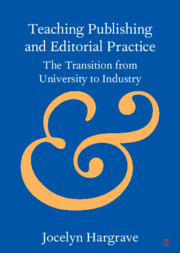
A key challenge facing all educators working in practice-based subjects is the need to negotiate tensions between past and present and provide a training that prepares students for fast-changing conditions, while also conveying long-standing principles. This Element therefore investigates how effectively editing and publishing programmes prepare graduates for industry and how well these graduates translate this instruction to the workplace. Taking a global perspective to gauge the state of the discipline, the mixed-methods approach used for this Element comprised two online surveys for educators and graduates, three semi-structured interviews with industry practitioners (scholarly, education and trade) and ethnographic practice (author as educator and practitioner). Three key concepts also framed this Element's enquiry: being, learning and doing. The Element demonstrates how these transitioning but interdependent concepts have the potential to form a holistic practice-led pedagogy for students of editing and publishing programmes.
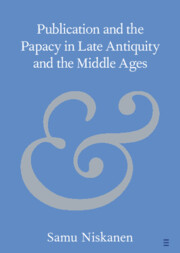
This Element explores the papacy's engagement in authorial publishing in late antiquity and the Middle Ages. The opening discussion demonstrates that throughout the medieval period, papal involvement in the publication of new works was a phenomenon, which surged in the eleventh century. The efforts by four authors to use their papal connexions in the interests of publicity are examined as case studies. The first two are St Jerome and Arator, late antique writers who became highly influential partly due to their declaration that their literary projects enjoyed papal sanction. Appreciation of their publication strategies sets the scene for a comparison with two eleventh-century authors, Fulcoius of Beauvais and St Anselm. This Element argues that papal involvement in publication constituted a powerful promotional technique. It is a hermeneutic that brings insights into both the aspirations and concerns of medieval authors. This title is also available as Open Access on Cambridge Core.
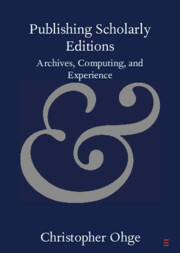
Publishing Scholarly Editions offers new intellectual tools for publishing digital editions that bring readers closer to the experimental practices of literature, editing, and reading. After the Introduction (Section 1), Sections 2 and 3 frame intentionality and data analysis as intersubjective, interrelated, and illustrative of experience-as-experimentation. These ideas are demonstrated in two editorial exhibitions of nineteenth-century works: Herman Melville's Billy Budd, Sailor, and the anti-slavery anthology The Bow in the Cloud, edited by Mary Anne Rawson. Section 4 uses pragmatism to rethink editorial principles and data modelling, arguing for a broader conception of the edition rooted in data collections and multimedia experience. The Conclusion (Section 5) draws attention to the challenges of publishing digital editions, and why digital editions have failed to be supported by the publishing industry. If publications are conceived as pragmatic inventions based on reliable, open-access data collections, then editing can embrace the critical, aesthetic, and experimental affordances of editions of experience.
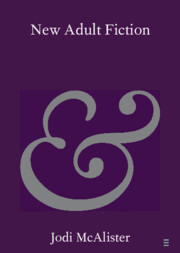
The term 'new adult' was coined in 2009 by St Martin's Press, when they sought submissions for a contest for 'fiction similar to YA that can be published and marketed as adult – a sort of 'older YA' or 'new adult'.' However, the literary category that later emerged bore less resemblance to young adult fiction and instead became a sub-genre of another major popular genre: romance. This Element uses new adult fiction as a case study to explore how genres develop in the twenty-first-century literary marketplace. It traces new adult's evolution through three key stages in order to demonstrate the fluidity that characterises contemporary genres. It argues for greater consideration of paratextual factors in studies of genre. Using a genre worlds approach, it contends that in order to productively examine genre, we must consider industrial and social factors as well as texts.
This study focuses on the spread of print in colonial India towards the middle and end of the nineteenth century. Till the first half of the century, much of the print production in the subcontinent emanated from presidency cities such as Calcutta, Bombay and Madras, along with centres of missionary production such as Serampore. But with the growing socialization of print and the entry of local entrepreneurs into the field, print began to spread from the metropole to the provinces, from large cities to mofussil towns. This Element will look at this phenomenon in eastern India, and survey how printing spread from Calcutta to centres such as Hooghly-Chinsurah, Murshidabad, Burdwan, Rangpur etc. The study will particularly consider the rise of periodicals and newspapers in the mofussil, and asses their contribution to a nascent public sphere.
While the term 'bestseller' explicitly relates books to sales, commercially successful books are also products of individual creative work. This Element presents a new perspective on the relationship between art and the market, with particular reference to bestselling writers and books. We examine some existing perspectives on art's relationship to the marketplace to trouble persistent binaries that see the two in opposition; we break down the monolith of the marketplace by thinking of it as made up of a range of invested, non-hostile participants such as publishing personnel and readers; we articulate the material dimensions of creative writing in the industry through the words of bestselling writers themselves; and we examine how the existence of bestselling books and writers in the world of letters bears enormous influence on the industry, and on the practice of other writers.
Entrepreneurship underpins many roles within the publishing industry, from freelancing to bookselling. Entrepreneurs are shaped by the contexts in which their entrepreneurship is situated (social, political, economic, and national). Additionally, entrepreneurship is integral to occupational identity for book publishing entrepreneurs. This Element examines entrepreneurship through the lens of identity and narrative based on interview data with book publishing entrepreneurs in the US Book publishing entrepreneurship narratives of independence, culture over commerce, accidental profession, place, risk, (in)stability, busyness, and freedom are examined in this Element.
This Element looks at the publishing history of the genre, girls' literature, in the United States spanning 1850–1940. The genre is set in context, beginning with an examination of the early American women's literature that preceded girls' literature. Then the Element explores several sub-genres of girls' literature, the family story, orphan story, school story, as well as African American girls' literature. Underpinning each of these stories is the bildungsroman, which overwhelmingly ends with girls 'growing down' to marry and raise children, following the ideals outlined in the cult of domesticity.
Reprinting, republishing and re-covering old books in new clothes is an established publishing practice. How are books that have fallen out of taste and favour resituated by publishers, and recognised by readers, as relevant and timely? This Element outlines three historical textures within British culture of the late 1970s and early 1980s – History, Remembrance and Heritage – that enabled Virago's reprint publishing to become a commercial and cultural success. With detailed archival case studies of the Virago Reprint Library, Testament of Youth and the Virago Modern Classics, it elaborates how reprints were profitable for the publisher and moved Virago's books - and the Virago brand name - from the periphery of culture to the centre. Throughout Virago's reprint publishing - and especially with the Modern Classics - the epistemic revelation that women writers were forgotten and could, therefore, be rediscovered, was repeated, again and again, and made culturally productive through the marketplace.
This Element proposes to relate the eighteenth-century world of travel and travel writing with the bluestocking salon. It locates eminent British travellers and explorers in the female-presided intellectual space and examines their multifaceted interaction with the bluestockings between 1760 and 1799. The study shows how the bluestockings acquired knowledge of the world through reading, discussing, writing and collecting travel accounts. It explores the 'social life' of manuscript and printed travel texts in the circle, their popularity and impact on the bluestockings. This Element builds upon the body of evidence provided by their published and unpublished diaries, correspondence and private library catalogues.
Natural language generation (NLG) is the process wherein computers produce output in readable human languages. Such output takes many forms, including news articles, sports reports, prose fiction, and poetry. These computer-generated texts are often indistinguishable from human-written texts, and they are increasingly prevalent. NLG is here, and it is everywhere. However, readers are often unaware that what they are reading has been computer-generated. This Element considers how NLG conforms to and confronts traditional understandings of authorship and what it means to be a reader. It argues that conventional conceptions of authorship, as well as of reader responsibility, change in instances of NLG. What is the social value of a computer-generated text? What does NLG mean for modern writing, publishing, and reading practices? Can an NLG system be considered an author? This Element explores such question, while presenting a theoretical basis for future studies.
Wiradjuri woman, Anita Heiss, is arguably one of the first Aboriginal Australian authors of popular fiction. A focus on the political characterises her chick lit; and her identity as an author is both supplemented and complemented by her roles as an academic, activist and public intellectual. Heiss has discussed genre as a means of targeting audiences that may be less engaged with Indigenous affairs, and positions her novels as educative but not didactic. Her readership is constituted by committed readers of romance and chick lit as well as politically engaged readers that are attracted to Heiss' dual authorial persona; and, both groups bring radically distinct expectations to bear on these texts. Through analysis of online reviews and surveys conducted with users of the book reviewing website Goodreads, I complicate the understanding of genre as a cogent interpretative frame, and deploy this discussion to explore the social significance of Heiss' literature.