To save content items to your account,
please confirm that you agree to abide by our usage policies.
If this is the first time you use this feature, you will be asked to authorise Cambridge Core to connect with your account.
Find out more about saving content to .
To save content items to your Kindle, first ensure no-reply@cambridge.org
is added to your Approved Personal Document E-mail List under your Personal Document Settings
on the Manage Your Content and Devices page of your Amazon account. Then enter the ‘name’ part
of your Kindle email address below.
Find out more about saving to your Kindle.
Note you can select to save to either the @free.kindle.com or @kindle.com variations.
‘@free.kindle.com’ emails are free but can only be saved to your device when it is connected to wi-fi.
‘@kindle.com’ emails can be delivered even when you are not connected to wi-fi, but note that service fees apply.
This Element discusses the idea of creation ex nihilo as an expression of monotheistic belief mainly with reference to Jewish and Christian traditions. It outlines the philosophical and theological discussion about monotheism and creation, considering key historical figures such as Philo, Irenaeus, Augustine, and Aquinas as well as contemporary thinkers. It reviews key topics such as divine sovereignty, the goodness of creation, pantheism, process, and feminist thinking on creation. It argues for creation ex nihilo over other models. In particular, it examines the notion of 'creaturehood' as an overlooked and under-developed dimension in contemporary debates about the relationship between created humanity and the one God. The doctrine of creation does not just address the question of origins, it also serves to affirm the finite or immanent aspects of life.
In the nineteenth and early twentieth centuries, numerous Western missionaries were involved in debating the existence of God in various religious texts and practices in ancient China. Drawing on both the rising philological scholarship in Europe and their own field experience in China, the Western missionaries examined the idea of God, the Thearch, and Heaven as the Supreme Being in the spiritual life and ritual activities of the Chinese people. From the Christian perspective, they attempted to identify the original belief in one God in ancient China in order to convert their Chinese audience. Furthermore, they addressed the issue of monotheism in the broader Asian context by suggesting the universal monotheistic degeneration from Persia to China across Asia continent.
Monotheism, belief in only one God, and wisdom, learning to cope by reason alone and teaching others to do so, faced resistance in the polytheistic world of ancient Egypt, Mesopotamia, and lesser states including Israel. Paradoxically, in early biblical wisdom (Proverbs, Job, and Ecclesiastes) the deity was thought to be both human-like, with disturbing attributes, and increasingly transcendent-silent, disembodied, and inactive. Like Egyptian Ma'at, God the creator established the universe by decree, a law rewarding goodness and punishing evil, the flaw in creation, never satisfactorily resolved. Satan, a semi-divine rival, bore responsibility for bad things, while Wisdom, a personified female, communicated God's will to the discerning. Combining biblical revelation and Hellenism, Sirach and Wisdom of Solomon chose piety over Job's realism and the vanity literature of Ecclesiastes. Over millennia, the concept of God evolved, continuing a process begun in Paleolithic times.
This Element explores the relationship between monotheism and relativism. Over the last two decades, emerging relativist theories have been extensively developed and debated within the fields of philosophy. How does monotheistic theology relate to relativism, especially to relativism about truth? Given that truth relativism contends that beliefs and propositions are invariably only relatively true, it appears to conflict with traditional monotheism, which asserts the absolute truth of God's existence. This book examines the compatibility of relativist positions with monotheism, emphasising the need to differentiate among the diverse forms, types, and domains of relativism. It presents a nuanced stance on the relationship between relativism and monotheism.
This Element addresses the opportunities and constraints operating on monotheistic peacebuilding, focusing on the three Abrahamic faiths, Christianity, Judaism, and Islam, which share a common origin. These opportunities and constraints are approached through what the volume calls 'the paradox of monotheism'. Monotheism is defined by belief in one omnipotent, benign, and loving God, but this God does not or cannot prevent violence, war, and conflict. Moreover, monotheism can actually promote conflict between the Abrahamic faiths, and with other world religions, giving us the puzzle of holy wars fought in God's name. The first section of the Element outlines the paradox of monotheism and its implications for monotheistic peacebuilding; the second section addresses the peacebuilding efforts of three Abrahamic monotheistic religions and the constraints that operate as a result of the paradox of monotheism. This paradox tends to limit monotheistic peacebuilding to inter-faith dialogue, which often does not go far enough.
Monotheism implies a God who is active in creation. An author writing a novel provides a better analogy for God's creative activity than an artificer constructing a mechanism. A miracle is then not an interruption of the ordinary course of nature so much as a divine decision to do something out of the ordinary, and miracle is primarily a narrative category. We perceive as miracles events that are extraordinary while also fitting our understanding of divine purpose. Many miracle accounts may remain problematic, however, since recognizing that a given story purports to narrate a miracle does not determine whether the miracle occurred. This Elementweighs competing narratives. In doing so the understanding of the normal workings of nature will carry considerable weight. Nevertheless, there can be instances where believers may, from their own faith perspective, be justified in concluding that a miracle has occurred.
This Element will provide an essential tracing of selected Greek views of the afterlife which engage in dynamic tension with the Christian understanding of Paradise as fulfilled in the Resurrected state. The main three sections in this Element are Ideas of the Afterlife in the Greek Tragedians; Plato: The Difficulty of Paradise; and Holiness and Violence: A Christian View of the Resurrected State. The imposition of justice and the expiation of guilt through suffering are necessary prerequisites to our approach to the relationship between Monotheism and Paradise. Additional discussions will focus on weak theology and of a God not transcendent enough to ensure the desire for Heaven. As such, the sections are organized to isolate and trace this thread.
While angels have played a decisive role in all the world's major religions and continue to loom large in the popular religious and creative imagination, modern theology has tended to ignore or trivialize them. The comparatively few scholarly works on angels over the last century have typically interpreted them as mere symbols and metaphors: they are said to offer glimpses not of the divine order, but of human desires, anxieties, and ideologies. Angelology has collapsed into anthropology. By contrast, this polemical book argues for the indispensable importance of studying angels as divinely created beings, for theology at large, and for understanding the defining doctrine of monotheistic religions in particular. Additionally, the book contends that the spirit of modern science did not originate with the so-called Scientific Revolution but was actually inspired centuries earlier by the angelological lucubrations of medieval scholastics.
Monotheism, the belief in the One True God, seems to have an ambiguous role in political life: On the one hand, monotheism may foster the inclusion of everybody, regardless of identity or background. On the other, monotheistic religions demand submission to a singular revealed truth, distinguish between faithful and the heretics, and thus seemingly promote an antagonistic and tribalistic politics. What, then, are the political implications of the monotheistic belief in absolute truth? This Element traces the Enlightenment origins of our contemporary debates about monotheism and argues that these debates reflect a deeper Western ambivalence towards religion. It does so while discussing both secular and Christian critics of the politics of monotheism. The Element contends that there is no singular politics of monotheism, and that we can only approach monotheism's political significance if we take seriously the various ways in which truth is represented in political life in monotheistic traditions.
This book offers a selective, typological overview of Jewish perspectives on the belief in God's oneness. To achieve this, the author divides the history of Judaism into four phases - biblical, rabbinic, medieval, and modern - and presents diverse models for understanding the reality of divine oneness within each phase. These models not only offers insight into different perspectives on the topic but also illuminate diverse layers of polemical discourse in the Jewish tradition, whether internal or in dialogue with other religions and worldviews. In addition, the author invites readers to consider how to think about the plurality of the perspectives at hand, and if and how such meta-reflection can enrich the lives of contemporary readers, Jewish and non-Jewish alike. No prior knowledge of Judaism is necessary.
What connects the phenomenon of music as an art with the belief in one indivisible God? What has music, a non-linguistic medium, to say about the personal, loving, communicative God of Scripture and the Prophets, or the omniscient, omnipotent, omnipresent, transcendent God of the Philosophers and can it bring these 'concepts of God' together? To answer these questions, this book takes divine Creation as its starting point, that the God of monotheism must be the Creator of all that is. It thus argues that anything which instantiates and facilitates communication within the created realm has been enabled to do so by a God who communicates with His Creation, and who wishes that His Creation be communicative. Indeed, it will argue that the communication allowed by music, and aesthetic experience in general, is the very raison d'être of Abrahamic monotheism and might thus allow an opportunity for dialogue between monotheistic faiths.
In the monotheistic traditions, there are people who report having special experiences that justify their monotheistic beliefs. They see, hear, or otherwise experience directly the one true God, ruler of the universe. In order to understand what is going on in these experiences and how we should respond to reports of these experiences, it is important to understand what religious experiences can and can't be, what the claim of monotheism entails, and therefore how what reports of such experiences mean, both for the experiencer and for the recipient of the report.
The emotional turn in scholarship has changed the way in which historians of religion think about monotheistic traditions. New histories of religion have adapted and incorporated the totalizing sensibilities of twentieth century annalistes, the granular view of social historians, groundbreaking philosophical investigations, and the spirit of interdisciplinary collaboration between historical analysis, anthropology, and psychology. Religion as a principal bearer of culture has shaped emotional life profoundly, just as human emotion has constituted religious life. Taking a qualified constructivist approach to emotion enables understanding of the dynamism, fluidity, and ambiguity in emotional experience, alongside continuities, and facilitates analysis of how that feeling has animated religious life in monotheistic traditions. It equally sharpens insight into how monotheistic religion itself has made emotion. Affect, emotion, and mixed emotions are three categories of feelings evidenced in monotheistic religions. Each is illustrated with respect to the similarities and differences among Judaism, Christianity, and Islam.
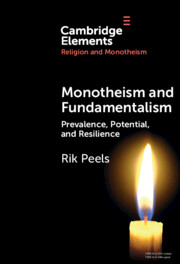
This Element explores the relation between monotheism and fundamentalism. It does so from both an empirical perspective and a more theoretical one that combines theological and philosophical insights. The empirical part addresses how as a matter of fact, particularly quantitively, monotheism and fundamentalism relate to one another. The more theoretical part studies the relation between the two by considering the doctrine of God and the issue of exclusion, theories of revelation, and ethics. Finally, the book considers whether monotheism has particular resources that can be employed in mitigating the consequences of or even altogether preventing fundamentalism. This title is also available as Open Access on Cambridge Core.
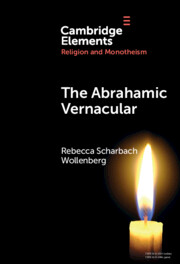
Contemporary thought typically places a strong emphasis on the exclusive and competitive nature of Abrahamic monotheisms. This instinct is certainly borne out by the histories of religious wars, theological polemic, and social exclusion involving Jews, Christians, and Muslims. But there is also another side to the Abrahamic coin. Even in the midst of communal rivalry, Jews, Christians, and Muslim practitioners have frequently turned to each other to think through religious concepts, elucidate sacred history, and enrich their ritual practices. Scholarship often describes these interactions between the Abrahamic monotheisms using metaphors of exchange between individuals-as if one tradition might borrow a theological idea from another in the same way that a neighbor might borrow a recipe. This Element proposes that there are deeper forms of entanglement at work in these historical moments.
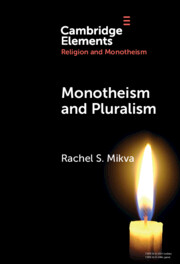
Can monotheistic traditions affirm the comparable value of diverse religions? Can they celebrate our world's multiple spiritual paths? This Element explores historical foundations and contemporary paradigms for pluralism in Judaism, Christianity, and Islam. Recognizing that there are other ways to interpret the traditions, it excavates the space for theological parity.
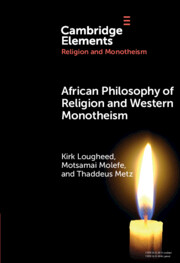
The Abrahamic faiths of Christianity, Judaism, and Islam are typically recognized as the world's major monotheistic religions. However, African Traditional Religion is, despite often including lesser spirits and gods, a monotheistic religion with numerous adherents in sub-Saharan Africa; it includes the idea of a single most powerful God responsible for the creation and sustenance of everything else. This Element focuses on drawing attention to this major world religion that has been much neglected by scholars around the globe, particularly those working in the West or Northern Hemisphere. It accomplishes this primarily by bringing it into conversation with topics in the Anglo-American philosophy of religion.
This Element shows Open theism as a monotheist model of God according to which the future is objectively open-ended, not just from the finite perspective of creation, but from God's perspective as well. This Element has three main sections. The first carefully defines open theism, distinguishes its major variants, compares it to other monotheistic models, and summarizes its history. The second develops biblical and philosophical arguments for open theism against its main rivals, emphasizing a novel philosophical argument that a causally open future must also be ontically, alethically, epistemically, and providentially open as well. The third responds to common objections against open theism related to perfect being theology, the ethics of risk-taking, biblical prophecy, and theological tradition.
Biblical monotheism imagines God as a slave master who owns and has total control over humans as his slaves, who are expected to show obedience to him. The theological use of slavery metaphors has a limited value, however, and is deeply problematic from the perspective of real-life slave practices. Ancient authors already supplemented the metaphor of God as a slave master with other images and emphasized God's difference from human slave owners. Ancient and modern experiences of and attitudes toward slavery determined the understanding and applicability of the slavery metaphors. This Element examines the use of slavery metaphors in ancient Judaism and Christianity in the context of the social reality of slavery, modern abolitionism, and historical-critical approaches to the ancient texts.
The aggression of the biblical God is notorious. The phrase 'Old Testament God' conjures up images of jealousy and wrath, smiting and judging. But is it only an accident that this god became capital-G God, the unique creator and sustainer of three world religions? Or is there a more substantive connection between monotheism and divine aggression? This Element proposes exactly this causal connection. In three case studies, it showcases ways that literarily treating one god alone as god amplifies divine destructiveness. This happens according to two dynamics: God absorbs the destructive power of other divine beings-and God monopolizes divinity such that other beings, even special ones like God's beloved king or the people of God, are rendered vulnerable to divine aggression. The Element also attends to the literary contexts and counterbalances within which the Hebrew Bible imagines divine aggression.