To save content items to your account,
please confirm that you agree to abide by our usage policies.
If this is the first time you use this feature, you will be asked to authorise Cambridge Core to connect with your account.
Find out more about saving content to .
To save content items to your Kindle, first ensure no-reply@cambridge.org
is added to your Approved Personal Document E-mail List under your Personal Document Settings
on the Manage Your Content and Devices page of your Amazon account. Then enter the ‘name’ part
of your Kindle email address below.
Find out more about saving to your Kindle.
Note you can select to save to either the @free.kindle.com or @kindle.com variations.
‘@free.kindle.com’ emails are free but can only be saved to your device when it is connected to wi-fi.
‘@kindle.com’ emails can be delivered even when you are not connected to wi-fi, but note that service fees apply.
Children with non-syndromic orofacial clefts are at higher risk for developmental difficulties. Speech and language as commonly affected developmental domains in these children.
Objectives
The aim of the current study was to explore the effects of early interventions for speech and language on later cognitive outcomes in this patient population.
Methods
A combined retrospective/prospective-comparative study was carried out at the Department of Pediatrics of the University of Pécs in Hungary. The participants were children between 6 and 16 years of age. The study consisted of a self-designed demographic questionnaire and an IQ test (WISC-IV).
Results
A total of 41 children with non-syndromic orofacial clefts and 44 age-matched controls participated in the study. Children of the cleft group were examined by pedagogical professional services and required special education plans significantly more often than controls (p<0.001 and p=0.02, respectively). Participants of the cleft group who received early speech and language therapy score higher on the Verbal Comprehension Index (p=.005). Full-Scale IQ score was also higher for cleft participants who received therapy, however not significant but borderline (p=0.08).
Conclusions
Early language and speech interventions for children with non-syndromic orofacial clefts may have a positive effect on verbal skills and overall cognitive development. Future longitudinal studies examining baseline cognitive functioning of infants are needed to provide more conclusive evidence on the effects of interventional programs on speech and language development in cleft patients.
Simulation-based training (Sim) is an established method of teaching in medical education and can help bridge the gap between medical theory and clinical practice. While sim is well-established in medical and surgical specialties, it is less well developed in psychiatry. Psychiatric emergencies often occur out of hours when there are fewer senior staff available on-site. Sim offers a safe setting for development of essential clinical skills with carefully delivered feedback.
Sim can be high-cost involving specialized simulation facilities, especially when utilising high-fidelity equipment. Even lower-fidelity techniques requiring standardized patients (SPs) require funding for actors and this can be a barrier to utilising Sim.
Objectives
We piloted a Sim course to NCHDs working in psychiatry in a tertiary university hospital with the aim of improving trainee skills and confidence in managing psychiatric emergencies on-call including risk assessment, involuntary admission and acute behavioural disturbance. A low-fidelity approach was taken with minimal use of SPs.
Methods
A sim handbook developed by Irish Centre for Applied Patient Safety and Simulation (ICAPSS) was used for reference in developing the simulation modules. Three modules were delivered in a structured manner over three hours; involuntary admission, risk assessment and management of acute behavioural disturbance. Each module involved the simulation exercise (20 minutes) followed by debrief (20 minutes). The facilitated debrief involved open discussion and prompted reflective learning. Anonymous, paper-based questionnaires were used to collect feedback on participants’ experience of the training.
Results
There were 12 attendees and ten participants completed the feedback. All participants (100%, n=10) agreed or strongly agreed that sim helped them to learn and all agreed that the topics covered were relevant to their clinical role. All participants (100%, n=10), indicated that they enjoyed the workshop. Eighty percent (n=8) agreed or strongly agreed that they would like to do more sim-based workshops. The supportive environment and debrief sessions were reported as the most enjoyable aspects of the workshop.
Conclusions
Participants unanimously agreed that the training was useful to them in their clinical roles and helped them to learn. Sim was effective in teaching high risk complex psychiatric cases to psychiatry NCHDs and consideration should be given to expand this teaching method within postgraduate psychiatry training in Ireland.
Depressive disorder is a common public health problem that significantly impairs quality of life and has a high risk of mortality and morbidity.
Objectives
The aim of this study was to investigate circadian rhythm differences, stressful life events and coping styles in patients with depression.
Methods
The study involved 100 participants, including 50 patients with depression and 50 healthy controls, recruited from the psychiatric clinic of one-university hospital. The participants completed a sociodemographic information form, Beck Depression Inventory (BDI), Life Events Checklist (LEC-5), Coping Inventory for Stressful Situations-Short Form (CISS-21) and Morningness-Eveningness Questionnaire (MEQ).
Results
The mean age of the patients with depression was 31.88±10.6 years, and the control group was 29.84±8.02 years. There were no significant relationships between the variables including gender and some other sociodemographic characteristics except education level. There were significant differences between the depression and control groups in terms of coping styles for stressful life events. Emotional coping was significantly higher in patients with depression compared to the control group, whereas task-oriented coping was significantly lower than the control group (p<0.05). The majority of both depression and the control group consisted of intermediate type. Natural disasters, severe suffering, and other stressful events or experiences were more frequent stressful life events in the depression group. Task-oriented coping scores and emotional coping scores showed significant discrimination with sensitivity and specificity values.
Conclusions
Recognizing stressful life events and the coping strategies used to deal with them is important for identifying future mental problems such as depression and developing treatment and follow-up plans. Longitudinal studies are needed to fully understand how the reporting of mature and dissociative coping methods interacts with depression in recovery from traumatic events.
War tends to produce fear. The devastating and traumatic occurrences of war can have both short- and long-term effects on the mental well-being of populations. Russia’s invasion of Ukraine indirectly affects all populations, especially individuals of Ukrainian descent.
Objectives
To assess the mental health impact of the Russian invasion of Ukraine on Canadian residents who subscribed to ‘Text4Hope Ukraine’ program and to ascertain if there are differences in mental health impacts between those with and without Ukrainian descent.
Methods
Canadians were invited to self-subscribe to the text messaging program. An online survey was used to collect sociodemographic, war-related, and clinical information; stress, resilience, likely anxiety disorder and likely depressive disorder from subscribers. Outcome measures included baseline scores using validated scales. Data were analyzed using SPSS Version 25. To examine the association of psychological problems with the sociodemographic and war-related factors, univariate analysis using the Chi-square/Fishers Exact test was performed with two-tailed significance (p ≤ .05). An independent sample t-test with two-tailed significance (p-value ≤ 0.05) was employed to assess the differences in the respective mean scores of the psychological problems across the two groups. The first group represents the participants who did not have citizenship or ancestors from Ukraine (NUk), while the second group represents the respondents are Ukrainian who either have previously held citizenship or have ancestors/family from Ukraine (Ukr). No imputation of missing data and reported data represents the complete responses
Results
Study findings reflected prevalence of low resilience (59.7%), moderate to high stress (87.5%), likely Generalized Anxiety Disorder (45.8%) and likely Major Depressive Disorder (38.9%). Respondents who identified as female had a higher likelihood of presenting with low resilience (χ2(1) = 5.68, p = .02) and likely Generalized Anxiety Disorder (χ2 (1) = 4.85, p = .03) compared to male respondents. There was no statistically significant difference in the mean scores of the four psychological problems based on any of the variables that suggest Ukrainian descent or not (p>.05).
Conclusions
War can have negative impacts on all populations irrespective of their location, or association of individuals with the impacted country. This study provides valuable insights into the mental health impact of the Russian invasion of Ukraine on a specific sample of Canadian residents who subscribed to the ‘Text4Hope Ukraine’ text messaging program. This information is relevant when planning mental health intervention for this population. Governments should target and provide adequate mental health and psychosocial support or interventions for global populations at risk during war.
Patients undergoing electroconvulsive treatment (ECT) may display an acute confusional state, often characterized by transient disorientation, inattention, memory and cognitive deficits.
Objectives
In this retrospective medical chart naturalistic study, we sought the determine whether white mater lesions and brain atrophy associate with the emergence of confusion during ECT treatment and preliminary results are presented herein
Methods
Medical charts of 24 consecutive inpatients with depression admitted to a psychogeriatric ward and subjected to bilateral frontotemporal ECT were examined retrospectively for patient and clinical characteristics. Mini-Mental State Examination (MMSE) and Geriatric Depression Scale (GDS) scores at admission and hospital discharge were retrospectively collected. Available brain Magnetic Resonance Imaging (MRI) scans were graded for lesions (white matter hyperintensities, WMH), parietal, temporal and global brain atrophy
Results
In this pilot study of mostly elderly patients, 50% displayed signs of confusion. All patients improved substantially, as indicated by MMSE and GDS scores, irrespectively of whether they experienced transient confusion during ECT. Preliminary results indicate that WMH are unrelated to the emergence of confusion. Instead, brain atrophy, and in particular temporal lobe and mostly frontal lobe atrophy associated with confusion
Conclusions
In our sample of elderly inpatients with depression subjected to bilateral ECT, preliminary results of this pilot study indicate that brain atrophy, as evidenced by MRI scans, appears as a predictor of post-ECT confusion. Moreover, the Pasquier scale, and specifically the scale sub-scores regarding brain atrophy in the frontal and temporal sulci, could prove useful in helping the clinician estimate the probability of ECT-related confusion during ECT treatment
The EDE-Q-7 Portuguese version presented good reliability and validity in Portuguese women fro the general population (Pereira et al. 2022).
Objectives
The aim of our study was to analyse the psychometric properties of the EDE-Q-7 in a sample of Portuguese women during the perinatal period.
Methods
Participants were 346 women with a mean age of 31.68 of years old (± 4.061; range: 18-42). 160 were pregnant (second or third trimester) and 186 were in the post-partum (mean baby´s age=4.37 months (± 2.87; range: 1-12). They answered an online survey including the Portuguese version of the EDE-Q-7 and of the Screen for Disordered Eating/SDE.
Results
Confirmatory factor analysis (CFA) presented adequate fit, in pregnancy (χ2/df=; RMSEA=, p<.001; CFI=; TLI=; GFI=), postpartum (χ2/df=; RMSEA=, p<.001; CFI=; TLI=; GFI=) and considering both – perinatal period (χ2/df=2.7998; RMSEA=.0722, p<.001; CFI=.9709; TLI=.9444; GFI=.9761). The Cronbach’s alpha coefficients were >0.90 for the total and approximately .70 for the three factors - Dietary restraint, Shape/weight overvaluation and Body dissatisfaction. All the items contributed to the internal consistency and presented high internal consistency. Pearson correlations between factors and total scores were significant, positive and high, as well as between the EDE-Q-7 measures and SDE (>.60 with the total; >.40 with the factors), in pregnancy, postpartum and considering both periods.
Conclusions
Presented sound psychometric properties across the perinatal period, the EDE-Q-7 and can be very useful to evaluate the presence and severity of eating disorders symptoms in women in pregnancy and post-partum.
Orthorexia is defined as a dependence on healthy food or an obsession to consume healthy food. One area deemed influential upon disordered eating and dietary intake is perfectionism.
Objectives
To investigate the relationship between orthorexia and perfectionism in medical students.
Methods
We conducted a cross-sectional, descriptive, and analytical study in the faculty of medicine of Sfax (Tunisia), between February and April 2023. A self-reported questionnaire was distributed to students via social media. We used ORTO-15 for the assessment of orthorexia, and the Big Three Perfectionism Scale (BTPS) to assess perfectionism.
Results
The research has enrolled 220 students. Their mean age was 21.40±1.68 years, with female predominance (70%). The ORTO-15 mean total score was 36.88±6.76. A total of 60% of participants had an orthorexic behavior. The BTPS mean total score was 45.52±12.45 with a mean score of 13.25±4.35 for rigid perfectionism, 18.31±6.37 for self-critical perfectionism, and 13.99±5.47 for narcissistic perfectionism.
Students with orthorexic behavior had significantly higher scores of perfectionism (p= 0.048).
Conclusions
Our study has drawn a significant association between orthorexia and perfectionism among medical students. This result suggests that students experiencing highly critical and judgemental beliefs associated with perfectionism are more susceptible to orthorexic eating behaviors.
In recent years, there has been an increase in interest and research into the link between alcohol use disorders (AUD) and dementia. Alcohol use disorders, which are characterised by excessive and problematic alcohol consumption, have been associated to a variety of detrimental health effects, including liver disease, cardiovascular difficulties, and cognitive impairments.
Objectives
To explore the link between alcohol use disorders and dementia onset and progression, explaining probable causes and emphasising preventive approaches.
Methods
The present study involved a thorough examination of relevant research papers, with a specific emphasis on longitudinal cohort studies, neuropathological observations, and biochemical interactions pertaining to the effects of alcohol on the brain. In addition to the aforementioned criteria, the review also took into account other complicating factors, including choices regarding lifestyle, genetic predisposition, and coexisting medical conditions.
Results
The results indicate a strong association between prolonged and excessive alcohol consumption and a heightened susceptibility to the early onset of dementia. The mechanisms underlying alcohol-related neurological damage encompass direct neurotoxic effects of alcohol, thiamine shortage, and alcohol-related cerebrovascular illness. Moreover, it is worth noting that alcohol use disorder (AUD) has the potential to worsen the advancement of neurodegenerative processes in individuals already diagnosed with dementia.
Conclusions
The association between AUD (Alcohol Use Disorder) and dementia is complex and involves multiple factors, presenting considerable difficulties in terms of clinical intervention and treatment. The use of early intervention strategies and public health initiatives focused on addressing alcohol use disorder (AUD) could have a significant impact on preventing or reducing the development of dementia.
In the workplace, a smoke-free environment is crucial to guaranteeing the health of workers and those around them. Understanding the relationship between smoking and work is a prerequisite for implementing effective tobacco control measures.
Objectives
To assess the prevalence of smoking in an electricity and gas company in Sfax and to determine the relationship between workers’ nicotine dependence and perceived workload.
Methods
We conducted a cross-sectional survey evaluating the smoking behavior of 100 employees of an electricity and gas company. The survey was carried out from July to December 2022 using a two-part questionnaire. The first part was completed by the participants, and the second was administered by the interviewer. Nicotine dependence was assessed using the Fagerström test, while perceived workload was evaluated using the raw NASA-TLX questionnaire.
Results
Our study population consisted of 82 male participants. Active smoking was reported by 45.1% of participants. Among smokers, 40.5% had moderate to high nicotine dependence as assessed by the Fagerström test. According to the raw NASA-TLX questionnaire, the mean scores for mental, physical, and temporal demands were 88.8±13.5, 63.6±24.7, and 59.1±28.4, respectively. The mean scores for effort, performance, and frustration were 83.8±14, 85.4±13.1, and 34.5±28.1, respectively. Bivariate analysis indicated an inverse correlation between nicotine dependence and physical demands at work. However, a significant positive correlation was found between nicotine dependence and frustration at work.
Conclusions
Smoking among electricity and gas company workers is a prevalent issue, highlighting the urgent need for smoking cessation interventions. The association of smoking with perceived workload underscores the importance of preventive measures to reduce work-related stress.
Adolescence is a period marked by highest vulnerability to the onset of depression, with profound implications for adult health. Neuroimaging studies have revealed considerable atrophy in brain structure in these patients with depression. Of particular importance are regions responsible for cognitive control, reward, and self-referential processing. However, the causal structural networks underpinning brain region atrophies in adolescents with depression remain unclear.
Objectives
This study aimed to investigate the temporal course and causal relationships of gray matter atrophy within the brains of adolescents with depression.
Methods
We analyzed T1-weighted structural images using voxel-based morphometry in first-episode adolescent patients with depression (n=80, 22 males; age = 15.57±1.78) and age, gender matched healthy controls (n=82, 25 males; age = 16.11±2.76) to identify the disease stage-specific gray matter abnormalities. Then, with granger causality analysis, we arranged the patients’ illness duration chronologically to construct the causal structural covariance networks that investigated the causal relationships of those atypical structures.
Results
Compared to controls, smaller volumes in ventral medial prefrontal cortex (vmPFC), dorsal anterior cingulate cortex (dACC), middle cingulate cortex (MCC) and insula areas were identified in patients with less than 1 year illness duration, and further progressed to the subgenual ACC, regions of default, frontoparietal networks in longer duration. Causal network results revealed that dACC, vmPFC, MCC and insula were prominent nodes projecting exerted positive causal effects to regions of the default mode and frontoparietal networks. The dACC, vmPFC and insula also had positive projections to the reward network, which included mainly the thalamus, caudate and putamen, while MCC also exerted a positive causal effect on the insula and thalamus.
Conclusions
These findings revealed the progression of structural atrophy in adolescent patients with depression and demonstrated the causal relationships between regions involving cognitive control, reward and self-referential processes.
High-fat diet (HFD) consumption during pregnancy can shape fetal brain development, increasing susceptibility to mental disorders. Nevertheless, the mechanisms underlying these negative outcomes remain unclear.
Objectives
We hypothesize that mHFD induces inflammation and oxidative stress (OS) in the fetal brain, disrupting excitatory/inhibitory (E/I) balance in the adult brain. This results in altered hypothalamic-pituitary-adrenal (HPA) axis reactivity, emotional regulation, and cognitive function. We tested the ability of N-acetyl-cysteine (NAC) - a powerful anti-oxidant and anti-inflammatory compound - to counteract mHFD effects.
Methods
Our mHFD model consists of female C57BL/6N mice fed either HFD (fat 58%, carbohydrate 25.5%, and protein 16.4%) or control diet (CD, fat 10.5%, carbohydrate 73.1% and protein 16.4%) before and during pregnancy (13 weeks). After 5 weeks on diets, half of them received NAC (1g/kg) for 8 weeks, until delivery.
Gene expression of Il-1b, Cd68, Tmem119, iNOS, and Arg1 was measured in fetal brains. Cognitive function and emotional phenotype were assessed in adult male and female offspring through the Morris Water Maze (MWM) and the Emergence test, respectively. HPA axis functionality was assessed by measuring plasma corticosterone levels by ELISA following acute stress. Gene expression of vesicular glutamate transporter 1 (Vglut1) and vesicular GABA transporter (Vgat) were assessed as markers of E/I balance.
Results
Exposure to mHFD induced inflammation and OS in the fetal brain of both sexes, by increasing Il-1b and iNOS/Arg1. Additionally, Cd68 and Tmem119 were specifically increased in females. In adulthood, mHFD reduced latency to emerge from the shelter in the Emergence test in both sexes. In females, mHFD impaired cognitive function, reducing time spent in the MWM target zone, and increased HPA reactivity in response to acute stress. Furthermore, mHFD decreased Vgat expression in both sexes, resulting in an imbalanced Vglut1/Vgat ratio towards excessive excitatory input. Maternal NAC supplementation rescued this imbalance.
Conclusions
Overall, these data show that mHFD increases inflammation and OS in fetal brains, with greater effects in female offspring, inducing alterations in the E/I neuronal balance with concomitant disruptions of the neuroendocrine system and the emotional and cognitive profiles during adulthood. The supplementation with NAC was effective in rescuing the E/I imbalance as well as the behavioral phenotype.
Men and women with psychosis have different courses and presentations of symptoms. Men with psychosis have an earlier onset of illness, more negative symptoms, and worse premorbid functioning. Women, on the other hand, have better social functioning and less substance abuse. Despite these evident differences, there are few studies that delve into these distinctions, especially from a subjective perspective.
Objectives
The aim of this study is to understand the differences in the perception of psychosis between men and women.
Methods
Five women and five men diagnosed with schizophrenia participated in the study. They were matched so that the age difference between them was no more than 5 years, with ages ranging from 40 to 56 years. Participants had not experienced acute decompensation of their underlying illness and had not required admission to an Acute Care Unit in the 6 months prior to inclusion in the study. Data collection was conducted through the Spanish translation of the Indiana Psychiatric Illness Interview, consisting of five parts: a narrative about their life, a narrative about the illness, questions related to how the illness has changed their life and what has not changed, the overall influence of the illness on their life, and lastly, expectations for the future.
Results
Men expressed more concerns about work (4 men versus 2 women), while women expressed more concerns about not having become mothers (3 out of 5 women, compared to one man). All participants shared experiences of isolation in intimate relationships, including romantic relationships. Regarding stigma, three women believed that people treated them like children and dismissed their opinions. However, two of them viewed this behavior from their loved ones positively. Two women discussed the impact that psychosis and medications had on their bodies and how others had reacted to these changes
Conclusions
The concerns and stigma associated with mental illness differ between genders. These differences should be taken into account when developing specific biopsychosocial treatment plans.
Many COVID-19 survivors who were attacked and suffered severe symptoms of the virus have suffered from post-traumatic stress disorder (PTSD) which persists for long periods. These people need treatment to alleviate the severity of these disorders. Metacognitive therapy (MCT) is one of the modern therapeutic trends in psychological counseling, which focuses on the nature of the thought rather than on identifying and changing the thought as in other cognitive therapies. It is also concerned with whether people possess an aspect of reflective awareness and aims for a broader understanding of the way the mind works. Working on the process of metacognition, that is, the individual’s thinking about what he knows, being aware of his thoughts, and constantly monitoring and organizing them, helps reduce anxiety disorders and mood swings, and this will reduce psychotic disorders.
Objectives
The current study aims to identify the effect of a virtual reality (VR) counseling program based on MCT in reducing the severity of PTSD among survivors of Covid-19. It also examines the continuity of the effectiveness of this program in reducing these disorders.
Methods
The quasi-experimental method (two group design) with experimental and control groups with a pre-posttest and a follow-up test was adopted. The sample for the current study consisted of 60 COVID-19 survivors suffering from PTSD. The PTSD scale was applied online to a group of people recovering from Covid-19 from the Arab Republic of Egypt. Then those who had high scores were selected, contacted and their consent was obtained to apply a virtual reality counseling program to them. The counseling program was implemented via virtual reality technology, and consisted of 20 counseling sessions, each session lasted between 60-90 minutes. The program continued for two months, with two sessions per week.
Results
The results of the current research revealed a significant improvement in the experimental group through a significant reduction in their post-traumatic stress disorders. The results also showed the effectiveness of the counseling program based on metacognitive therapy in reducing the manifestations of post-traumatic stress disorders in those recovering from Covid-19. The results confirmed the continuing effect of the program after the follow-up period.
Conclusions
Using metacognitive therapy has an effective effect in reducing post-traumatic stress disorder, and it can be used with many psychologically disturbed people.
In recent years, research has focused on the older adults with bipolar disorder (OABD), aged 50 years and over, a constantly growing population due to the increased of life expectancy. Actually, some authors suggest that these individuals constitute a distinct subtype with a specific and different needs such as seen in epidemiologic, clinical and cognitive features. Further research has revealed significant differences between females and males with BD in clinical and cognitive variables in middle-aged and young patients, but this topic among OABD population remains unclear.
Objectives
The aim of this study is to identify the distinctive profile in clinical, functional and neurocognitive variables between females and males in OABD.
Methods
A sample of OABD and Healthy Controls (HC) were included. Euthymic patients or in partial remission were included. Neurocognition was measured with a battery of tests that included premorbid intelligence quotient, working memory, verbal and visual memory, processing speed, language and executive functions. Independent t-test and Chi-squared test analysis were performed as appropriated.
Results
According to the analysis, statistically significant differences were seen between females and males. A more impaired cognitive profile is observed in women. They performed worse in the subscales of Arithmetic (F= 6.728, p = <0.001), forward digits (F= 0.936, p= 0.019) and Total Digits (F= 1.208, p= 0.019) of the WAIS-III, in the Stroop Color Word Test, color reading (F= 0.130, p= < 0.001), in the Continuous Performance Test, block change measure (F= 2.059, p= 0.037), in the Rey-Osterrieth Complex Figure-copy (F= 0.005, p= 0.029) and in the Boston Naming Test (F= 0.011, p= 0.024). Nor significant differences were found in clinical neither in psychosocial functioning variables.
Conclusions
In view of the following results, and since no differences were observed between women and men in terms of clinical and functional outcomes, it could be said that the differences observed in cognition cannot be explained by disease-related factors. Furthermore, these results highlight the need to develop a gender-specific cognitive interventions in OABD population. In this way, we could have an impact on the course of the illness to reach a better quality of life.
Disclosure of Interest
S. Martín-Parra: None Declared, C. Torrent Grant / Research support from: Spanish Ministry of Science and Innovation (PI20/00344) integrated into the Plan Nacional de I+D+I and co-financed by the ISCIIISubdireccion General de Evaluación and the Fondo Europeo de Desarrollo Regional (FEDER), A. Ruiz: None Declared, M. Bort: None Declared, G. Fico Grant / Research support from: Fellowship from “La Caixa” Foundation (ID 100010434 - fellowship code LCF/BQ/DR21/11880019), V. Oliva: None Declared, M. Prisco: None Declared, J. Sanchez-Moreno Grant / Research support from: Spanish Ministry of Science and Innovation (PI20/00060) integrated into the Plan Nacional de I+D+I and co-financed by the ISCIII-Subdireccion General de Evaluación and the Fondo Europeo de Desarrollo Regional (FEDER), E. Jimenez Grant / Research support from: Spanish Ministry of Science and Innovation (PI20/00060) integrated into the Plan Nacional de I+D+I and co-financed by the ISCIII-Subdireccion General de Evaluación and the Fondo Europeo de Desarrollo Regional (FEDER), A. Martinez-Aran: None Declared, E. Vieta Grant / Research support from: Spanish Ministry of Science and Innovation (PI18/ 00805, PI21/00787) integrated into the Plan Nacional de I+D+I and cofinanced by the ISCIII Subdirección General de Evaluación and the Fondo Europeo de Desarrollo Regional (FEDER); the Instituto de Salud Carlos III; the CIBER of Mental Health (CIBERSAM); the Secretaria d’Universitats i Recerca del Departament d’Economia i Coneixement (2017 SGR 1365), the CERCA Programme, and the Departament de Salut de la Generalitat de Catalunya for the PERIS grant SLT006/17/00357; the European Union Horizon 2020 research and innovation program (EU.3.1.1. Understanding health, wellbeing and disease: Grant No 754907 and EU.3.1.3. Treating and managing disease: Grant No 945151), B. Sole: None Declared, L. Montejo: None Declared
Agitation and aggression are a serious problem in clinical psychiatry, especially in multimorbid patients of advanced age, including those with dementia.
Objectives
We wanted to investigate to what extent clozapine could be an option in the treatment of selected refractory patients.
Methods
A retrospective study included patients with a diagnosis of dementia who were treated with clozapine in a specialist geriatric psychiatry unit between August 2018 and February 2022, and medical records were systematically reviewed. The Clinical Global Impressions Scale was used for the assessment of improvement and the Pittsburgh Agitation Scale for the assessment of symptom reduction. In addition, there was detailed documentation of side effects and clinical features.
Results
A total of 31 patients with a median age of 82 years were identified.
Conclusions
In conclusion, clozapine was effective and well tolerated in 23 patients. This suggests that low-dose clozapine may help alleviate the suffering of difficult-to-treat multimorbid patients with advanced dementia and their carers. However, adverse effects, particularly in patients with cardiovascular and pulmonary impairment, should be carefully monitored.
Burnout was reclassified in 2019 as an occupational phenomenon in ICD-11. The new condition includes the classic tridimensional definition with symptoms in areas of fatigue/energy depletion, mental distance/cinism and sense of ineffectiveness/lack of accomplishment.
Objectives
To evaluate the knowledge and perceptions of psychiatrists regarding new ICD-11 burnout definition.
To analyse the frequency of burnout symptoms in the psychiatric consultations and among the psychiatrists as healthcare professionals.
Methods
An online survey (designed with Microsoft® Forms) was sent in June 2023 to psychiatrists from three regions of Spain, contacted form local scientific societies. Psychiatrists, currently working, had to consent and answer a brief survey (average time: 2 min 32 sec) of 9 questions regarding the definition of burnout, their experience in clinical practice, their own symptoms and symptoms observed in colleagues.
Results
164 psychiatrists answered, 114 females (69.5%), mean age: 43.61 ± 11.28 years. 48.2% assured they had never used the term Burnout or the ICD codes Z73.0/QD85, whereas a 9.1% used them frequently in clinical practice. 58.5% considered burnout just a condition related to work and a 38.4% either a syndrome or a disorder.
Most psychiatrists referred that their patients exhibited symptoms of the three dimensions. Fatigue was the most common, attended frequently by 79.5% of the surveyed, followed by ineffectiveness (73.1%) and cinism (65.3%).
When reporting their own symptoms, only 16.5% psychiatrists referred not suffering any symptom. The most frequently involved was fatigue (66.5%), then ineffectiveness (56.1%) and cinism (41.5%). 28,7% reported concomitant symptoms of the three dimensions.
70.7% recognized fatigue symptoms in their colleagues, 61% ineffectiveness, 72.6% cinism and 45,5% recognized symptoms from the three dimensions. Only a 7.3% did not identify any of them.
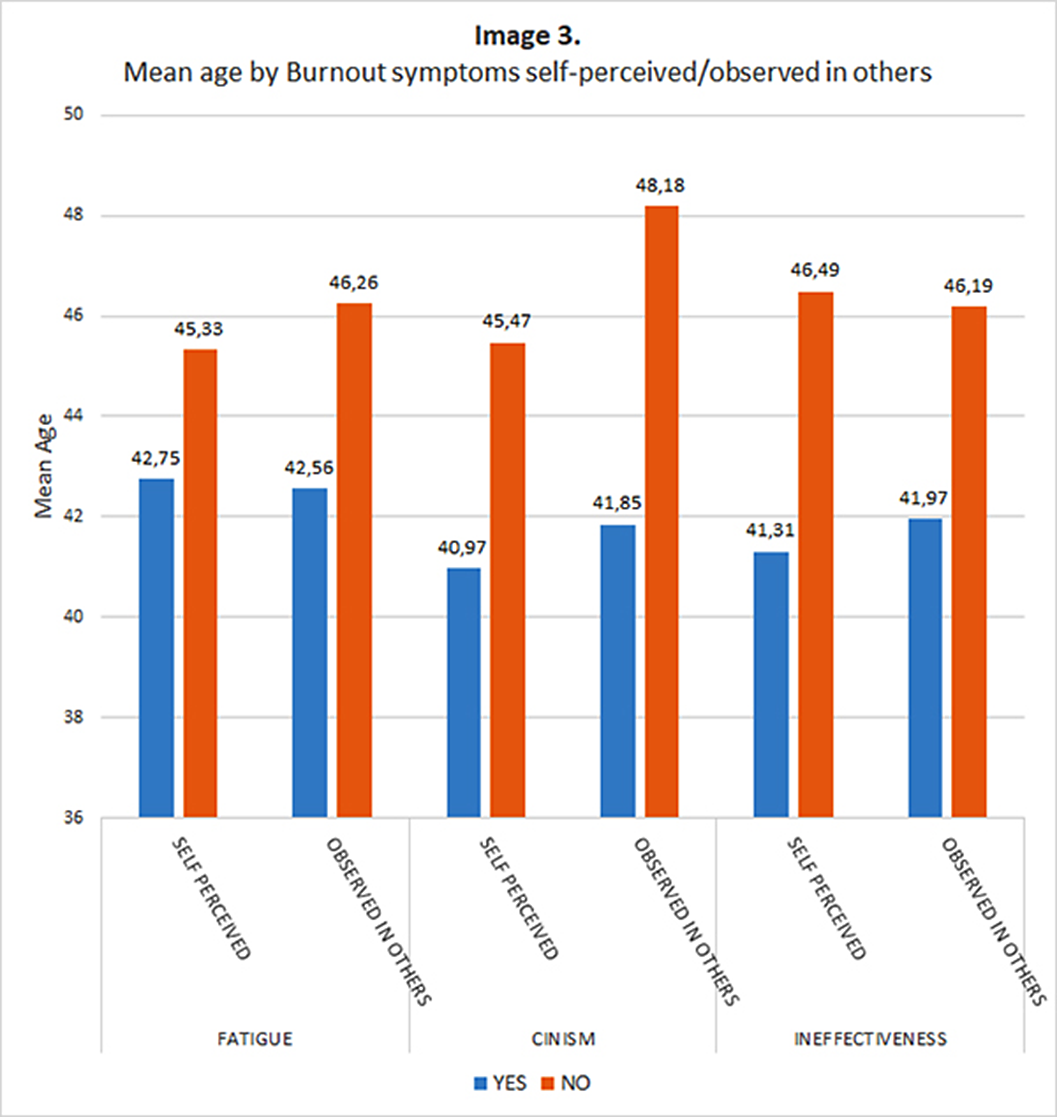
A younger age was related to higher probability of suffering cinism (T:2.546; p=0.012) and ineffectiveness (T:2.900; p=0.004) and to a higher probability of recognizing cinism (T=3,293; p=0,001) an ineffectiveness in others (T=2.355; p=0.020)
Females showed a higher frequency of ineffectiveness symptoms (61.4% vs 44%; χ2:4.274; p=0,029).
Image:
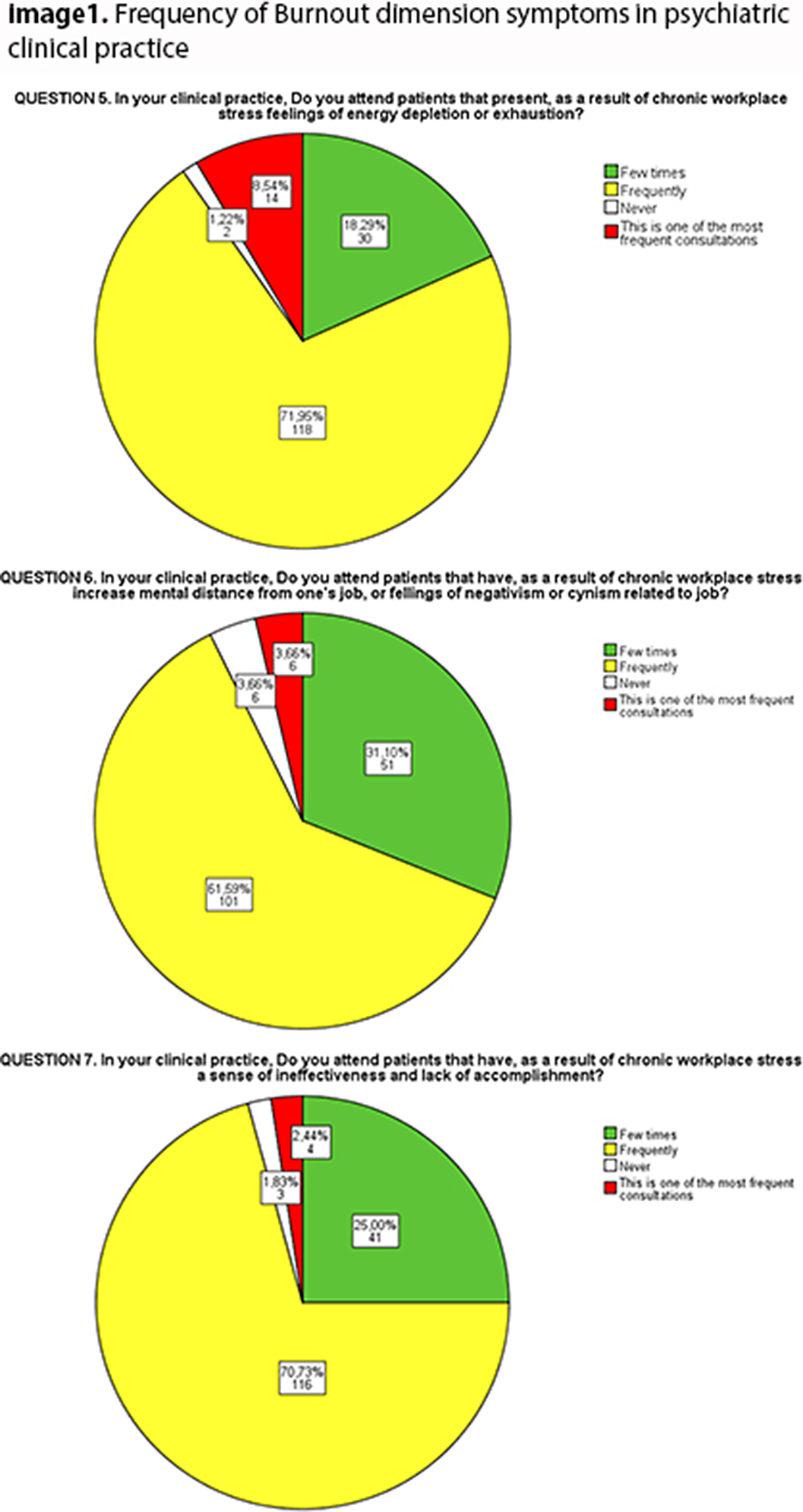
Image 2:
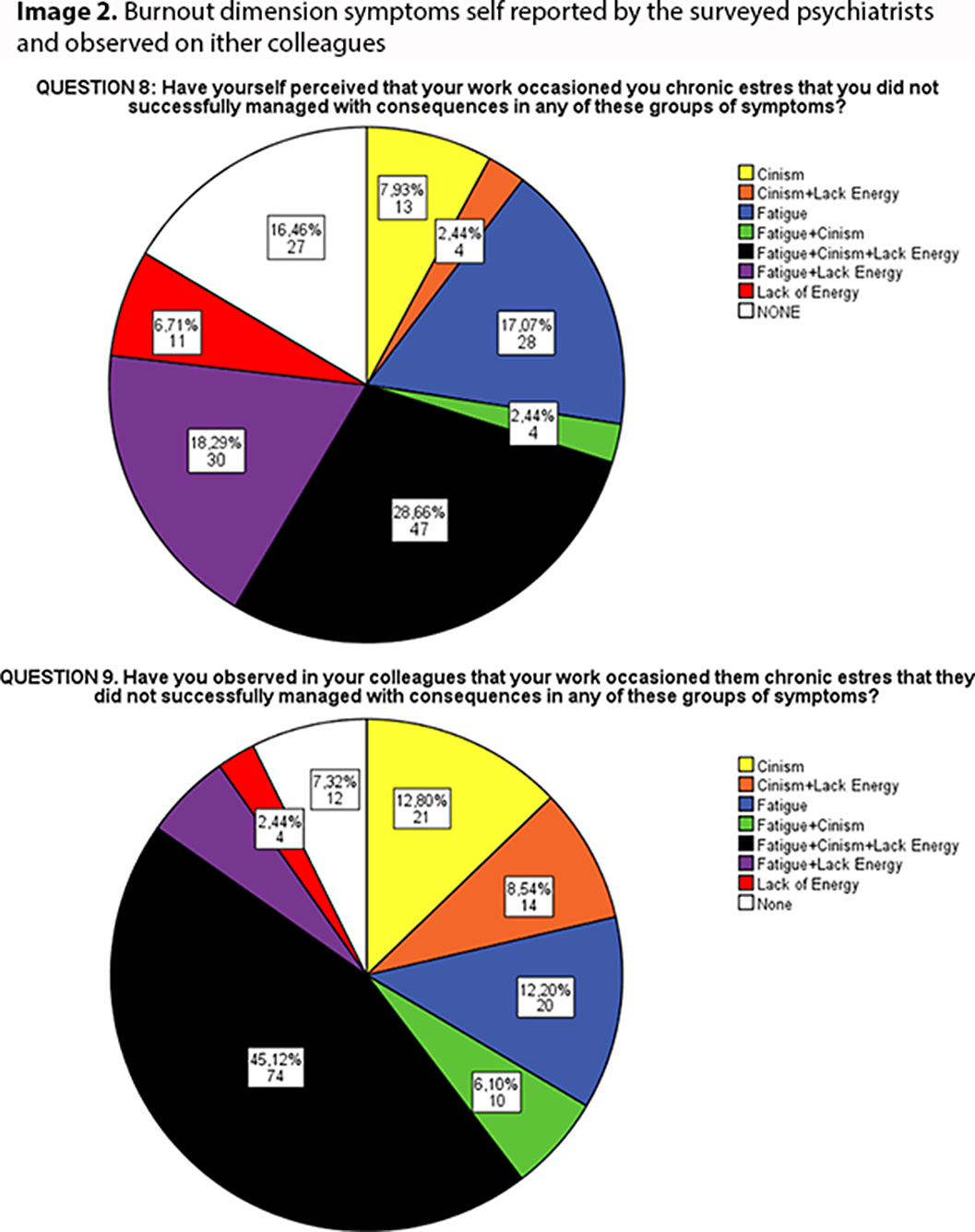
Image 3:
Conclusions
Psychiatrists’ concept of burnout is diverse but the main construct is convergent with ICD definition, not a medical illness but a condition related to work.
The three classic dimensions of burnout are common in clinical conditions and also in the laboral environment of psychiatrists themselves. Psychiatrists tend to recognized more easily burnout in other colleagues, particularly cinism symptoms. Cinism and ineffectiveness appear to be related to younger age that can be associated to an imbalance between work demands and individual resources.
These results highlight the challenge of preventing, detecting and addressing burnout syndrome in psychiatric services.
Although over 100 million pregnant women worldwide are at risk of infection with SARS-CoV-2, little data exists on the impact of COVID-19 and related treatments on maternal/neonatal health.
Objectives
1) To quantify the prevalence of medication use in pregnancy to treat COVID-19; 2) To quantify and compare the risk of adverse pregnancy/neonatal outcomes in those with and without COVID-19.
Methods
In the Canadian Mother-Child population-based cohort (CAMCCO), two key sub-cohorts were identified using prospective data collection of medical services, prescription drugs, hospitalization archives data, and COVID-19 surveillance testing program (02/28/2020-2021). The first cohort included all pregnant women with at least one completed trimester of pregnancy during the study period regardless of pregnancy status (delivery, induced/planned or spontaneous abortion); this cohort was further stratified on COVID-19 status. The second cohort included all non-pregnant women (aged 15-45) with a positive COVID-19 test. COVID-19 infection in pregnant or non-pregnant women was assessed using COVID-19 test results or ICD-10CM codeU07.1 from hospital data. COVID-19 severity was categorized based on hospital admission. Women were considered exposed to COVID-19 medications if they filled at least one prescription for a medicine included in the WHO list in the 30 days pre- or 30 days post-COVID-19 positive test/diagnosis. Considering potential confounders, association between COVID-19 during pregnancy, treated vs not, and perinatal outcomes were quantified using log-binomial regression models.
Results
150,345 pregnant women (3,464 (2.3%) had COVID-19), and 112,073 non-pregnant women with COVID-19 diagnoses were included. Pregnant women with COVID-19 were more likely to have severe infections compared to non-pregnant women with COVID-19 (11.4% vs 1.6%, p< 0.001). The most frequent medications used in pregnancy to treat COVID-19 were antibacterials (13.96%), psychoanaleptics (7.35%), and medicines for obstructive airway disease (3.20%). In pregnancy COVID-19 was associated with spontaneous abortions (adjRR 1.76, 95%CI 1.3, 2.25), gestational diabetes (adjRR 1.52, 95%CI 1.18, 1.97), prematurity (adjRR 1.30, 95%CI 1.01, 1.67), NICU admissions (adjRR 1.32, 95%CI 1.10, 1.59); COVID-19 severity was increasing these risks but COVID-19 treatment with study medications reduced all risks.
Conclusions
Severity of COVID-19 was greater in pregnancy. Antibacterials, psychoanaleptics, and medicines for obstructive airway disease were the most used overall. Severe COVID-19 in pregnancy was associated with higher risks of adverse maternal, and neonatal outcomes.
♦Over the last 10 years, the number of cancer patients in the world has increased by almost 23%, and the number of cancer deaths has also increased by about 10%. Malignant neoplasms still remain as one of the main causes of mortality in the population. Patients with oncopathology are characterized by a high level of depression which leads to inadequate attitudes towards the disease and its treatment, and this may further act as a risk factor for disease susceptibility and aggravate its course (Schulz-Kindermann, 2021). It is relevant to search for variables that act as a personal resource in coping with cancer. It is hypothesized that one such personal resource is the specificity of attitudes towards death.
Objectives
To conduct a comparative analysis of the relationship between the level of depression and the peculiarities of the attitude to death in cancer patients in Russia and Germany.
Methods
▪ Beck Depression Inventory to determine the level of depression severity.
▪ Death Attitude Profile-Revised to determine the type of attitude to death.
For statistical processing of data, the SPSS 23.0 statistical package was used with a preliminary check for normality of distribution using the Kolmogorov-Smirnov statistical criterion.
SELECTION
The sample consisted of a total number of 50 cancer patients with 25 each undergoing treatment in Russia (Moscow) and in Germany (Munich). The study was based on the sample obtained from the P. A. Herzen Moscow Research Oncological Institute and the Helios Munich-West Clinic. Overall, the sample was relatively gender-balanced.
Results
The following results were obtained from the study:
1. The mean value of depression level in cancer patients is higher in Russia than in Germany.
2. The level of depression in cancer patients in both the countries is correlated with:
▪ marital status (p=0.36)
▪ stage of disease (p=0.001)
▪ type of treatment (p=0.001)
▪ belief in God (p=0.024)
▪ adherence to a particular religious denomination (p=0.008)
3. The level of depression was correlated with a certain type of attitude towards death: a higher level of depression was associated with scores on the “fear of death” scale (p=0.000), and a lower level (or lack of) with the “neutral acceptance of death” scale (p=0.000)
4. The fear of death is seen to be most common in the sample of patients from Russia, while the neutral acceptance of death is more prevalent in the sample from Germany.
Conclusions
The results suggest that a positive attitude to death (neutral as one of these types) is correlated, along with other factors, with lower levels of depression, which may be a personal resource in coping with the disease.
This allows us to make the assumption that when providing psychological support to cancer patients, it is necessary to pay attention not only to the attitude to life and illness, but also to the attitude to death.
Children and adolescents with thalassemia suffer from chronicity of the disease and its treatment, including transfusion dependence and complications of iron overload.
Objectives
To investigate the quality of life of children and adolescents with Beta Thalassaemia.
Methods
This study is a cross-sectional study conducted at the Greek public Children’s Hospital. PedsQL ™ 4.0 Generic Core Scale (Greek version) was used to evaluate HRQOL in 41 thalassemia patients aged between 5 and 18 years and in 41 healthy controls of the same age range. For the analysis, the Statistic Package (SPSS ver.24) was used. Using Spearman’s correlation coefficient, t-test and MannWhitney tests were used, while for variables with three or more levels the Anova and Kruskall-Wallis. In order to investigate the relationship between two quantitative variables, Spearman’s correlation coefficient was used, while the relationship between two qualitative variables was used to control x2. As a statistical significance level, α = 5% was defined.
Results
Of the 41 children with beta Thalassemia who participated in the study, 48.8% (n = 20) were boys and 51.2% (n = 21) girls. The mean age of children was 10.02 ± 4.10 years. For healthy children who participated in the study 51.2% (n = 21) were boys while 48.8% (n = 20) were girls. The mean age of the children was 9.63 ± 3.77 years. Children with Beta Thalassaemia have a lower quality of life in Physical Health and Activity(<0,001), Emotional Health(0,031), School Activities(0,008), Psychosocial Health(0,014), and the overall PedsQL 4.0 (<0,001)questionnaire compared to healthy children. Children between the ages of 5 and 7 have higher levels of quality of life in physical health and activity than older children(<0,001). In addition, children aged 5 to 7 have higher quality of life and overall PedsQL 4.0 score than older children(0,033) Children receiving combination therapy show better quality of life than children receiving subcutaneous therapy (total PedsQL 4.0 <0,001).
Conclusions
Children and adolescents in all five categories had a better quality of life, after improved iron chelating methods and other psychosocial interventions.
Substance use disorders (SUDs) are associated with high rates of comorbid depression. Finding effective treatments for many of the substances of abuse is still an area of developing research. Repetitive transcranial magnetic stimulation (rTMS) is an established treatment for depression, but its effects in SUDs are less conclusive.
Objectives
Therefore, we aimed to investigate the effect of rTMS in patients with SUDs and comorbid major depressive disorder (MDD).
Methods
We conducted a retrospective observational study of 55 patients with SUDs and comorbid MDD who were eligible for rTMS. Craving was measured using the Brief Substance Craving Scale (BSCS). Severity of MDD was measured using the Clinical Global Impression-Severity (CGI-S) scale.
Results
We found a statistically significant difference between baseline and posttreatment scores in patients receiving rTMS on both CGI-S scores and BSCS scores. The number of rTMS sessions significantly predicted increased days of abstinence in the community, even after controlling for confounders.
Conclusions
Patients with SUDs and MDD who received rTMS significantly improved in the areas of severity of depression and craving. The number of rTMS sessions significantly predicted increased abstinence.
