To save content items to your account,
please confirm that you agree to abide by our usage policies.
If this is the first time you use this feature, you will be asked to authorise Cambridge Core to connect with your account.
Find out more about saving content to .
To save content items to your Kindle, first ensure no-reply@cambridge.org
is added to your Approved Personal Document E-mail List under your Personal Document Settings
on the Manage Your Content and Devices page of your Amazon account. Then enter the ‘name’ part
of your Kindle email address below.
Find out more about saving to your Kindle.
Note you can select to save to either the @free.kindle.com or @kindle.com variations.
‘@free.kindle.com’ emails are free but can only be saved to your device when it is connected to wi-fi.
‘@kindle.com’ emails can be delivered even when you are not connected to wi-fi, but note that service fees apply.
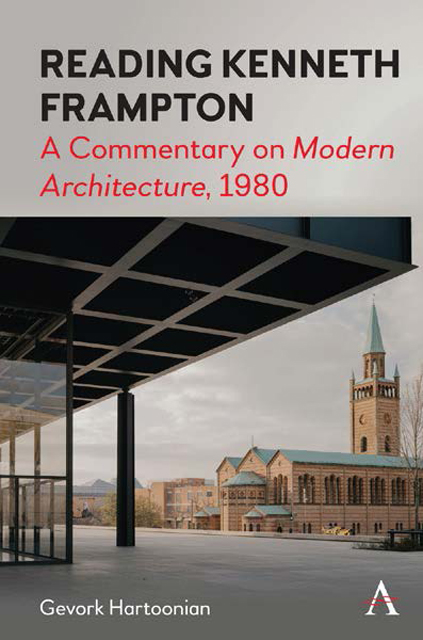
This book focuses on the first edition of Kenneth Frampton’s Modern Architecture: A Critical History, published in 1980. It searches for clues and positions that will provide the reader with an unprecedented insight into the significance of Frampton's historiography of modern architecture. It explores selected themes in line with Frampton's many-faceted contribution, certain aspects of which can be noted between the lines of his ongoing criticism of the present-day architecture, which inevitably lead us to a critical understanding of the past, the modernity of architecture's contemporaneity.
The compiled chapters attempt to open a window onto the constellation of themes that allowed Frampton to hold on to his anteroom view of history even amidst the flow of time and flood of temporalities spanning 1980–2020. The book elucidates how Frampton's critical presentation of the history of modern movement architecture and the book's classificatory mode contribute to our understanding of the contemporaneity of architecture today.
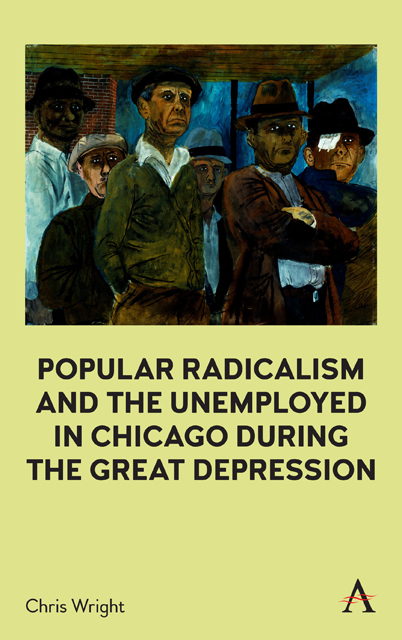
In a time when mass joblessness and precarious employment are becoming issues of national concern, it is useful to reconsider the experiences of the unemployed in an earlier period of economic hardship, the Great Depression. Focusing on the bellwether city of Chicago, this book reevaluates those struggles, revealing the kernel of political radicalism and class resistance in practices that are usually thought of as apolitical and un-ideological. From communal sharing to 'eviction riots', from Unemployed Councils to the nationwide movement behind the remarkable Workers' Unemployment Insurance Bill, millions of people fought to end the reign of capitalist values and usher in a new, more socialistic society. Today, their legacy is their resilience, their resourcefulness, and their proof that the unemployed can organize themselves to renew the struggle for a more just world.
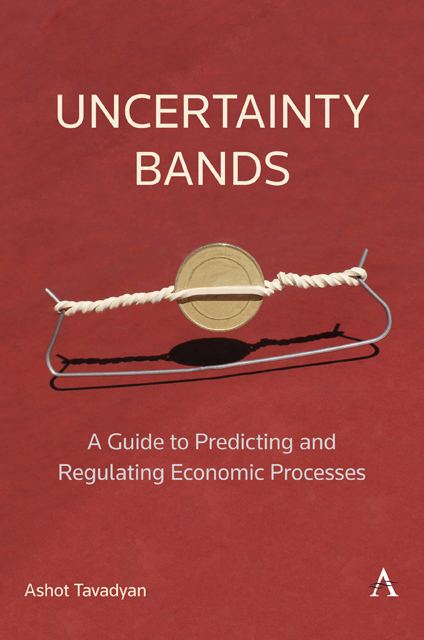
With the increasing role of economic uncertainty, improving the efficiency of forecasts is ever so important. This book makes suggestions on how to evaluate the key economic indicators under uncertainty. It presents the interval method to study economic indicators, which will allow us to understand the possibilities of forecasting and the irregular nature of the economy. It is shown that with the accumulation of negative phenomena in a seemingly stable situation the effect of a compressed spring may snap into action. The book outlines the uncertainty relations in the economy, the minimal uncertainty interval, the effect of an expanding uncertainty band, sensitivity thresholds, as well as the principles of systematization and forecasting of economic indicators. The book presents ways to facilitate economic development, assess the quality of a forecast, and increase the efficiency of forecasts and decision-making in conditions of uncertainty.
This anthology explores the relationships and interdependencies between literary production and distinctions of taste by examining how the material aspects of literary texts, such as the cover, binding, typography and paper stock, reflect or even determine their cultural status. In many cases, for example, the distinctions between 'highbrow' and 'lowbrow' taste have little to do with the content of the texts themselves, as books often function as markers of socioeconomic status, like clothing or home décor. One might even go so far as to say that the concept of literary taste is more closely related to fashion sense than critical judgment. The anthology seeks to address this claim by examining how the tensions between consumerism and prestige reflect fundamental historical changes with regard to the development of technology, literacy and social power.
Julia Tanney’s Meaning, Mind, and Action challenges widely held presuppositions within philosophy in its classical 'analytic', 'naturalist', and 'cognitivist' forms. Beginning with canonical views in the philosophy of language and logic, the arguments are then applied to discussions of knowledge, action, causation, the nature of the mental, consciousness, and thinking.
Responding to a tradition that harks back to Plato and was resurrected by Mill, Frege, Russell, Moore, and the early Wittgenstein, Meaning, Mind, and Action challenges today's orthodoxy on its own terms, beginning with canonical views in the philosophy of language and philosophical logic. The arguments of these early chapters are then applied to the theory of knowledge, action, and causation, followed by those on the nature of the mental, consciousness, and thinking. The final section, on the logic of the mental, widens the arguments to include the subject of animal minds, the postulation of mental representations in cultural anthropology, the author's intention in literary theory, and the philosophical problem of irrationality in psychiatry.
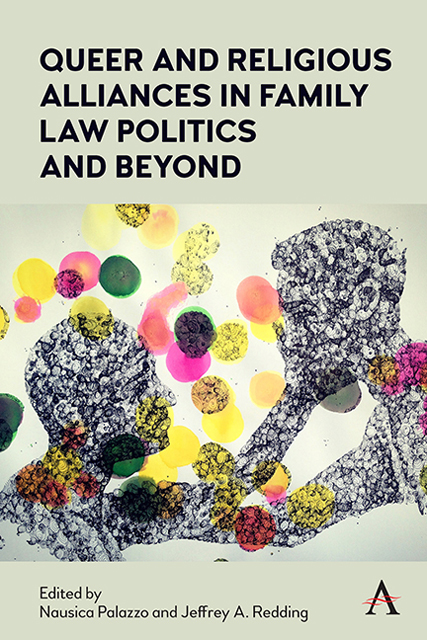
Family law is a site of social conflict and the erasure of non-traditional families. This book explores how conservative religious and progressive queer groups can cooperatively work together to expand family law's recognition beyond the traditional state-sponsored family. Various religious groups have shown an interest in promoting alternative family structures. For example, certain Muslim and Mormon communities have advocated for polygamy, thereby aligning with queer groups' interest in overcoming the engrafting of monogamy into state law. Advocacy by North American religious conservatives for reforms in favor of non-conjugal families and against same-sex marriage overlaps with certain queer efforts to legitimize friendships and non-traditional families more generally.
This book explores these potential areas of queer and religious political cooperation-including limitations and principled reservations to such cooperation. It then looks at additional future arenas of queer and religious political cooperation going beyond family law.
To what extent should religion be taught in classrooms? Should lessons also cover non-religious beliefs? Should the teaching of religion be compulsory or should it be a matter of choice by the parents or the child? Should faith schools be allowed to teach their religious beliefs? Should religious worship be compulsory for all pupils?
Questions of how religion operates within schools prove controversial and divisive. This book explores radical changes that are being made in Wales and the lessons that can be learnt. It examines the historical development of the law in this area, the new Welsh law, its potential shortcomings and areas that the new law leaves untouched, namely the rules on religious worship. The book is written by a leading authority on the interaction of law and religion whose work fed into Welsh parliament debates on the Curriculum and Assessment (Wales) Act 2021.
Transpacific Connections: Literary and Cultural Production by and about Latin American Nikkeijin is a cross-cultural work combining Latin American and Japanese studies. It contains original research on social and cultural relations between Japan and Latin America, ranging from Japanese inspirations in one of the Mexican most renowned poets, Brazilian dekasegi (temporary workers in Japan) described in a variety of testimonials, Japanese community in Brazil and its literary production, and a Mexican telenovela, inspired by the Japanese culture to European inspirations in a Nikkei Peruvian writer, Higa Oshiro.
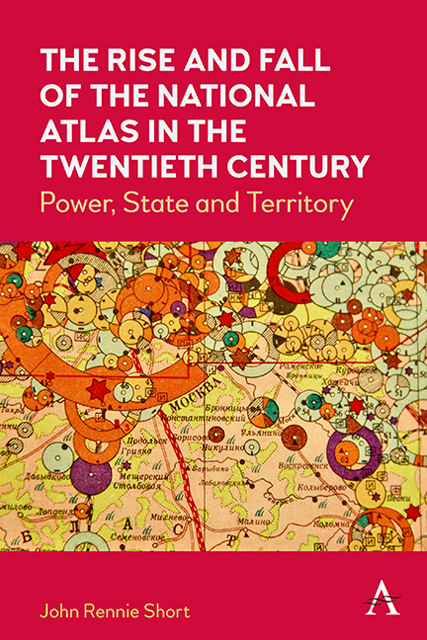
Between 1900 and 2000, more than seventy countries produced a national atlas, an official or quasi-official rendering of the nation-state in maps and accompanying text. This book considers the reasons behind and characteristics of this state-sponsored cartographic explosion. These national atlases mirror and embody some of the important themes of this turbulent century, including the complex connections between nation, state and territory, the rise of state-sponsored science; the growth of nation-states; colonialism and postcolonialism; and the geography of biopolitics.
This is the first book-length study of Sydney-based Horwitz Publications, the largest and most dynamic Australian pulp publisher to emerge after World War II. Although best known for its cheaply produced, sometimes luridly packaged, softcover books, Horwitz Publications played a far larger role in mainstream Australian publishing than has been so far recognised, particularly in the expansion of the paperback from the late 1950s onwards.
Horwitz Publications, Pulp Fiction and the Rise of the Australian Paperback examines the authorship, production, marketing and distribution of Horwitz pulp paperbacks. It includes ground-breaking material on the conditions of creative labour: the writers, artists and editors involved in the production of Horwitz pulp. The book also explores how Horwitz pulp paperbacks acted as a local conduit for the global modern: the ideas, sensations, fascinations, technologies, and people that came crashing into the Australian consciousness in the 1950s and 1960s.
The book, anchored in stimulating debates about the enlightenment ideas of publicness, analyses historical changes in the core phenomena of publicness: possibilities, conditions and obstacles to developing a public sphere in which the public reflexively creates, articulates and expresses public opinion. It is focused on the historical transformation from 'public use of reason' through the identification of 'public opinion' in opinion polls to contemporary opinion mining, in which the Enlightenment idea of public expression of opinion has been displaced by the technology of extracting opinions. It heralds a new critical impetus in theory and research of publicness at a time when critical social thought is sharply criticising and even abandoning the notion of the public sphere, much like the notion of public opinion decades ago, due to its predominantly administrative use.
This volume brings together thirteen papers on hinge epistemology written by Annalisa Coliva and published after her influential monographs Moore and Wittgenstein: Scepticism, Certainty and Common Sense (2010), and Extended Rationality: A Hinge Epistemology (2015). By mixing together Wittgenstein scholarship and systematic philosophy, they illuminate the significance of hinge epistemology for current debates on skepticism, relativism, realism and anti-realism, as well as alethic pluralism, and envision its possible extension to the epistemology of logic. Along the way, other varieties of hinge epistemology, such as Moyal-Sharrock's, Pritchard's, Williams' and Wright's, are considered, both with respect to Wittgenstein scholarship and in their own right.
Margot Norris has defined a generation in Joyce studies in at least two senses of the term. She has been, for upward of four decades, an exemplary voice on Joyce's oeuvre, the ideal reader of our title. Invited to keynote more Joyce conferences than anyone in the history of the field, and by a wide margin, Margot Norris has combined preeminence as a theoretician, an exegete, and a historical critic of all things Joyce. She has anchored what has come to be known as the “Joyce industry” like no other figure since the heyday of Hugh Kenner. But she has also defined a generation of Joyce studies in the sense of delineating the outline or form of our collective project, of simultaneously marking and pushing the boundaries of the field in all directions. No approach to Joyce's work has been foreign to Norris’ imagination or intractable to her powerfully prehensile intellect. To trace her career, accordingly, from the mid-1970s to recent times, is to follow the march of our investment in and engagement with Joyce's literary creation and its critical heritage—not that she has followed the prevailing footsteps, but that she has led the parade.
Appearing two years before Colin McCabe's James Joyce and the Revolution of the Word, widely credited with initiating the post-structuralist turn in Joyce studies, Margot Norris’ The Decentered Universe of Finnegans Wake had already executed that paradigm shift with respect to Joyce's most challenging, experimental opus, a foray beyond not only the avant-garde bourne of modernism, but beyond the pale of a postmodernism yet to be born. In her own words, Joyce's last work assaulted “not only the conventional literary modes but also many of the epistemological presuppositions of our culture.” Its means for accomplishing this radical demarché, on Norris’ account, is to enact a narrative anatomy of the infrastructure of language as such, in which our “empirical belief in the separation of inner and outer, subjective and objective, mental and physical—completely disintegrates.” By casting this Wakean “colliderscape,” an environment where human characters are periodically “melting into their landscape to become river and land, tree and stone,” Norris not only captures Joyce's disruption of the logic of identity at its most cosmic, but anticipates today's ecocritical indictment of the Enlightenment construction of the Anthropocene.
One of my first memories of Margot Norris is of her plenary address at the Copenhagen Joyce Symposium, in 1986, in which, as in the article it became, she tracks “the riddle of desire” through the overdetermined helio-trope. That the upward movement of the figure is not always uplifting corresponds to her critical sensibility—a light narratological touch with an exquisitely sharp edge. Another essay I invariably return to in teaching “The Dead” is Norris's essay on “back-answers,” where she mobilizes (Althusserian) ideas of relative autonomy and Lacanian theories governing desire to make a claim for the narrative's canny and uncanny use of suspect ideological propositions: as she describes it, “Joyce's dramatization of the politics of art's determination to conceal its own politically oppressive functions.”1 Her topic there is gender, in particular, but she continues to demonstrate the sometimes tricky balance between complicity and exposure in the subjects Joyce treats. In her Introduction to Suspicious Readings of Joyce's Dubliners (2003) (the volume in which that essay on “The Dead” has finally been collected), Margot refers to herself as a “bricoleur, taking this or that tool as it comes to hand and as it fits the purpose of reading whatever story is before” her. She elaborates: “my theoretical inspirations […] have in common an oppositional, or dialectical, or dialogical logic that I find necessary for reading the stories otherwise rather than simply as reinforcements or paraphrases of the narrations themselves.”2 In approaching Joycean texts in these ways, Dubliners in particular, she posits the “problem” of multiple interpretations as both generous and intolerably ambiguous. Margot Norris talks about how she herself may be intolerant of such ambiguity, coming down on one side or another in her readings, but acknowledges the ethical stance in such toleration (e.g., Derek Attridge's refusal to fill in the gaps in reading for Clay, for example, in order to respect the other as other), and, at the same time, the ethical challenge to being a detective, enthralled still by the search for answers.3 As Margot Norris's readers, we thrill in her search.
In her article on “Fact, Fiction, and Anti-Semitism in the ‘Cyclops’ Episode of Joyce's Ulysses,” Margot Norris offers a scrupulous study of how “anti-Semitic stereotypes are consolidated and disseminated into a community as true.” This essay will take its inspiration from what Norris identifies as the “narratological anatomy of anti-Semitism” (171) unfolding in “Cyclops,” and from her preoccupation with the circulation of gossip and the authentication of information. It will contend that this “narratological anatomy” is complemented in Ulysses with a philological anatomy of anti-Semitism, which Joyce further pursues in the diasporic linguistic program of Finnegans Wake, and which must be met by a diasporic response from his readers.
The episode that displays the most explicit level of anti-Semitism in Ulysses is also that which explores the limits of unreliable narration, with a narrator who has variously been called by critics a “barfly,” “the Nameless One,” or a “dun” (Norris's choice, 164), and who in our day and age would probably be termed a troll. Joyce himself explained that he was influenced by the character of Thersites, from Shakespeare's Troilus and Cressida, a malevolent, envious Greek warrior who insults and systematically attributes the most cynical motivations to the legendary heroes appearing on stage. The “Cyclops” narrator reacts similarly to the characters appearing in the pub, and his voice is further foregrounded, since his narrative and interpretation are the only ones provided. In Shakespeare as in Joyce, this riling speaker is allowed to have the last word, and in “Cyclops,” apart from the parodic interpolations—which are but interpolations and never narrate new events in the pub—he is never interrupted or contradicted.
The “Cyclops” narrator is an expert at circulating unreliable narratives, and therefore his connection with anti-Semitism—defined by Theodor Adorno as “the rumour about the Jews”—should not come as a surprise. The anti-Semitic narratives circulated in “Cyclops” are founded on stereotypes about Jews. Into these stereotypes, what is known—or what is believed to be known—is reorganized to fit in: reality is bent to correspond to set phrases and hackneyed formulas, whose only pretension to the truth are that they have been heard before and are part of a general store of cliches. Only a philological approach may deconstruct these linguistic forms.
Why do some critical works on film not receive their proper acknowledgement until years after their publication? Many essays have appeared on Joyce and film, and quite a few books on the subject. But what does “Joyce and film” mean here? It could mean James Joyce and film adaptations, the use of Joycean techniques in the history of film, the ways films influence our reading of Joyce, Joyce's own attempts to launch a movie house, Joyce's associations with early cinematic giants, the filmic qualities of Joyce's writing, allusions to films and film stars in Joyce, or the medium of film and the (moving) art of Joyce. It could also mean applying a specific film (or critical) theory to the works of Joyce, or perhaps a digital archive devoted to updating references pertaining to film and Joyce. It could even be a title of a course: Joyce and film. None of these meanings captures the uniqueness of Margot Norris’ book Ulysses, a work that surpasses each of the individual meanings listed. Yet, other than scattered references to her short book in later books on the topic(s), there needs to be what I will call an inheritance of Norris on Ulysses/film.
The opening dedication to Norris’ gem of a book suggests the kind of autobiographical and self-reflective (philosophical) musings and recollections of Stanley Cavell: “For my son, Josef Norris, whose love of films and filmmaking when he was young inspired me” (v). This non-saccharine dedication addresses an other's love, a clear distinction between films and filmmaking, the memory of youth, and personal inspiration. In her “Acknowledgements” (a Cavellian term in other discourses), Norris once again invokes her memory of her own youth and inspiration: “I first saw the 1967 Joseph Strick film of James Joyce's Ulysses while I was an undergraduate at the University of Florida, and before I had yet read the novel. The film inspired me to read the book, and set me on my way to becoming a life-long scholar of the works of Joyce” (ix ): Strick's Ulysses prior to Joyce's Ulysses, prior to Norris’ Ulysses.
The personal intensifies when Norris tells us that she was “in touch with Joseph Strick […] [which] allowed me to ask hundreds of questions by e-mail, to which I received full, interesting, often funny replies” (ix).
Few literary scholars have thought as restlessly or as generously as Margot Norris has about novels and the world. We might look at how her Joyce's Web (1992) torques its author's early deconstructivist reflexes toward feminist, historicist, and political accounts of Joyce. Or we could consider how Writing War in the Twentieth Century (2000) brings the ethical demand of action and intervention to bear on the scene of reading war novels, lighting up literature's capacity to shape “the ideological constructions that legitimate attitudes that inform public policy.” In both these books, and in many others, we find Norris wrestling fiction, alongside other modes and media, into different angles of engagement with the world. Her work's restlessness inheres in how often we find a given project rounding on, probing, and complicating the central impulses of those that precede it. Its generosity lies in the rich intellectual sustenance it sets before its readers and in the openings created by its internal twists and rotations—the pockets of air where new impulses and projects can get their start.
In the mid-2000s, Norris's work began to address world as a theoretical term by engaging with possible worlds theory, an interdisciplinary precipitate of philosophy-of-language and narratology that formed in the early 1990s. As possible worlds theorist Lubomír Doležel put it, this approach shifted attention from “narrative as story to narrative as fiction”—that is, from narrated events and their emplotted sequence to the ontologies of fictional worlds. Possible worlds theory places special emphasis on how a work of fiction may host many “non-actual” worlds (in the shape of characters’ plans, wishes, fantasies, etc.) while typically designating one world as “actual” within the fiction. Joyce's Ulysses offers a vividly illustrative example: even as it offers us multiple “non-actual” worlds (from characters’ daydreams and hallucinations to episode-long stylistic distortions), the novel implies the baseline existence of an “actual” June 16, 1904, which in turn differs ontologically from the historical June 16, 1904. Norris's possible worlds scholarship to date has been drawn primarily to this rich literary example, culminating in Virgin and Veteran Readings of “Ulysses” (2011), whose methodology is rooted in possible worlds theory. But in one essay, Norris has also brought possible worlds theory to bear on Finnegans Wake, whose liquidation of novelistic realism makes it an unlikely object for a theory grounded in the realist novel.
The woman reader and the conventions of women's sentimental and romance fiction are at the nub of “Nausicaa,” at once determining and skewing interpretations of this interlude which takes place at twilight on Sandymount strand. Since Gerty MacDowell's reading is conspicuously on display in the narrativization of her inner thoughts, she is destined as a character always to be measured in accordance with the values assigned to her cultural choices, whether enforced or imagined. Joyce's well-known comments on his artistic purposes for this episode, though decked out with bravado, are contradictory and opaque. His bold announcement of the “specially new fizzing style” of “Nausicaa” in a letter to Frank Budgen in late 1919 is somewhat undercut by a further declaration to him in January 1920 that the episode will be “written in a namby- pamby jammy marmaledy drawersy (alto là) style with effects of incense, mariolatry, masturbation, stewed cockles, painter's palette, chitchat, circumlocutions, etc. etc.”
This catalogue suggests not only that “Nausicaa” is a pastiche pieced together from heterogeneous sources, but also that it hinges on the appropriation and mimicry of a feminine style that is viewed as cloying, comic, and childish. Yet, this dismissive stance is belied by the recognition that, as Jed Deppman has revealingly contended, Joyce relished the linguistic experimentation in “Nausicaa” and its exercise in overblown intertextuality and flamboyantly mocking portrayal of femininity to such a degree that he conspicuously mined it in the composition of the Tristan and Isolde passages in Finnegans Wake, modelling Isolde in particular on aspects of Gerty. The style of “Nausicaa” became, in sum, an abiding part of his toolkit as an innovating modernist. His breezy insouciance about his undertaking in episode thirteen masks a serious intent.
Notoriously, the much beset serialization of Ulysses in The Little Review was brought lastingly to a halt in 1920 when objections were made to the section of “Nausicaa” in which Bloom masturbates. Not only was Bloom's immorality found offensive, but so too was Gerty's sexual knowingness. The complaint against the July–August 1920 issue was initiated by the young daughter of a New York lawyer who had fortuitously read it; he referred the matter to John S. Sumner, Secretary of the New York Society for the Suppression of Vice. In 1921, the New York Court of Special Sessions found Jane Heap and Margaret Anderson guilty of publishing obscenity.