To save content items to your account,
please confirm that you agree to abide by our usage policies.
If this is the first time you use this feature, you will be asked to authorise Cambridge Core to connect with your account.
Find out more about saving content to .
To save content items to your Kindle, first ensure no-reply@cambridge.org
is added to your Approved Personal Document E-mail List under your Personal Document Settings
on the Manage Your Content and Devices page of your Amazon account. Then enter the ‘name’ part
of your Kindle email address below.
Find out more about saving to your Kindle.
Note you can select to save to either the @free.kindle.com or @kindle.com variations.
‘@free.kindle.com’ emails are free but can only be saved to your device when it is connected to wi-fi.
‘@kindle.com’ emails can be delivered even when you are not connected to wi-fi, but note that service fees apply.
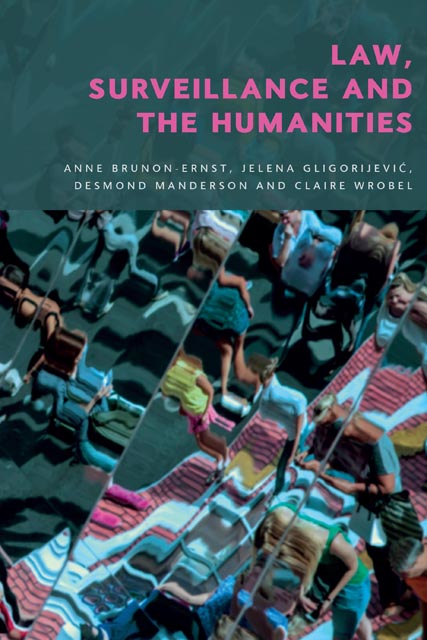
The growing sophistication of surveillance practices has given rise to concerns and discussions in the public sphere, but has also provided a popular theme in literature, film and the arts. Bringing together contributors across literary studies, law, philosophy, sociology, and politics, this book examines the use, evolution, legitimacy, and implications of surveillance.
Drawing on a range of resources including literary texts, chapters explore key issues such as the use and legitimacy of surveillance to address a global health crisis, the role of surveillance in the experience of indigenous peoples in post-colonial societies, how surveillance interacts with gender, race, ethnicity, and social class, and the interaction between technology, surveillance, and changing attitudes to expression. It shows how literature contributes innovative ways of thinking about the challenges posed by surveillance, how philosophy and sociology can help to correct biases and law and politics can offer new approaches to the legitimacy, use and implications of surveillance.
Taiwan New Cinema (first wave, 1982-1989; second wave, 1990 onward) has a unique history regarding film festivals, particularly in the way these films are circulated at major European film festivals. It shares a common formalist concern about cinematic modernism with its Western counterparts, departing from previous modes of filmmaking that were preoccupied with nostalgically romanticizing China's image.
Through utilising in-depth case studies of films by Taiwan-based directors: Tsai Ming-liang, Zhao Deyin and Hou Hsiao-hsien, Tsai discusses how Taiwan New Cinema represents a struggling configuration of the 'nation', brought forth by Taiwan's multilayered colonial and postcolonial histories. Taiwan New Cinema at Film Festivals presents the conditions that have led to the production of a national cinema, branding the auteur, and examines shifting representations of cultural identity in the context of globalization.
This volume deals with a tumultuous yet transformative era in Greek history. During the twentieth century, most Greeks abandoned the countryside for the cities or the expanding global diaspora. Greek and Cypriot societies became urbanised, secularised and more 'western'. Since the Balkan Wars they have also lurched from crisis to crisis, having experienced two destructive war decades (1912-1922 and 1940-1949), the Turkish invasion of Cyprus in 1974 and the economic crises of the 2010s.
Focusing on the relationship between state and society, as well as on Greeks' place in the wider world, this book considers how Greeks have engaged with global change and the impact of international factors on their lives.
Shyam Benegal is widely perceived as one of the most influential Indian filmmakers, yet his voluminous body of work remains relatively under-studied in contemporary film scholarship.
To help fill this critical lacuna, ReFocus: The Films of Shyam Benegal undertakes a closer look at Benegal's films, a trailblazing auteur who successfully redefined the contours of non-commercial Hindi language cinema. This addition to ReFocus: The International Directors Series will consider how Benegal, over the course of his forty year career, used cinema as a potent medium to narrate the story of a nation in continuous transition.
The thirteen essays in the volume will explore how Benegal's films articulate his concerns over caste, class, gender, religion, and other allied social, economic and political problems characterizing the Indian subcontinent. This collection also includes a full-length interview with Shyam Benegal that investigates his perspectives on the art of film-making.
This book argues that the rapid development of anti-vagrancy laws in the late nineteenth century, which were written alongside widespread public fascination with 'tramps', facilitated a transatlantic dialogue between sources eager to modernize the state's ability to describe, catalogue, and manage this roving population. Almost always depicted as white, solitary, and artistic, the tramp character was once a menacing threat to society only to disappear from the public eye by the postwar period. This book brings to light the often-surprising lines of influence between authors, sociologists, and government authorities who alike seized on the social panic around tramping in order to reimagine the relation of work to national citizenship.
This book retraces the process through which, at the turn of the twentieth century, the Japanese went from a racial anomaly to honorary members of the White race. It explores the interpretation of the Japanese race by Western powers, particularly the United States, during Japan's ascension as a great power between 1853 and 1919. Forced to cope with this new element in the Far East, Western nations such as the US had to device a negotiation zone in which they could accommodate the Japanese and negotiate their racial identity. In this book, Tarik Merida, presents a new tool to study this process of negotiation: the Racial Middle Ground.
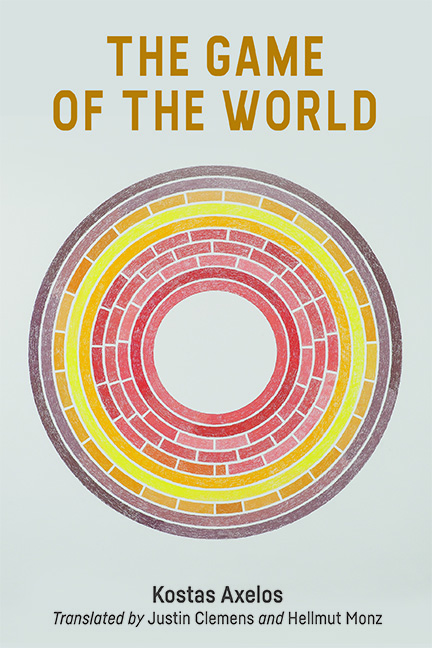
Drawing on philosophies of gaming and play from Heraclitus and Plato through to Marx, Nietzsche and Heidegger, Kostas Axelos outlines an extraordinary, unique vision of our contemporary world. Originally published in 1969, The Game of the World brilliantly anticipates a twenty-first century in which ever-accelerating technological transformations coincide with a world at play and in play, at once fragmentary and totalised, disordered and hyper-organised. In the midst of this paradoxical and deranging becoming-planetary of the world, Axelos offers a sequence of profound meditations on play and playing, games and gaming, directing us towards new means of thinking and action that may enable us to face the world-historical challenges of our own present.
In the context of twenty-first century Arab uprisings, women invoke the complexity of their experiences as citizens, revolutionaries, women and writers through a range of narrative strategies. Autobiographical discourses that emerge as part of national revolutionary struggles make audible Arab women's voices and experiences, foregrounding women as active social and political agents and redefining conventions of self-representation and narration.
Drawing on autobiographical and postcolonial theories, Contemporary Arab Women's Life Writing and the Politics of Resistance examines contemporary Arab women's life writing as sites for the articulation of resistance to interlocking power structures and sociocultural and representational norms. Looking comparatively at subgenres of memoir, auto-portrait, testimony, diary and digital life writing across different linguistic and national contexts, this book explores why resistance is important when writing about the self for Arab women and how it is articulated through experimental formal and thematic approaches to the autobiographical genre.
There were significant points of contact and similarities in the ways in which the laws of Scotland and Norway developed. The Treaty of Perth of 1266 was of significance in the state formation of both countries, and in the determination of their territorial boundaries. The laws and customs applicable in the Orkneys and the Shetlands remain distinctive due to Norse influence, centuries after those islands became subject to Scottish sovereignty. The extensive trading links between two countries united by the North Sea raises the question of how trade between the territories was regulated.
This book brings together experts in Norwegian and Scottish legal, economic and political history to explore these points of contact. It breaks new ground, considering Scots law in terms of its historical interactions and similarities with another national legal system, rather than in terms of its place at the intersection between the common law and the civilian traditions.
Satyajit Ray belonged to a category of filmmakers and artists from newly independent countries whose work was used to define 'national culture'.
Failed Masculinities: The Men in Satyajit Ray's Films argues that a study of his films will give us a purchase on the moral trajectory of India in its first few decades of independence, particularly through examination of his male characters and their narratives. Films discussed by Sanyal include the Apu Trilogy, Shakha Prasakha, Ghare Baire and Kapurush.
Critics regularly use the term 'provocateur' to describe controversial film directors. Although most individuals who attract this term are men, there is a long and largely unexamined history of female auteurs who shock and unsettle their viewers. Provocation in Women's Filmmaking: Authorship and Art Cinema investigates how women directors participate in the tradition of provocative art cinema. Focusing on the post-millennium films of auteurs such as Lisa Aschan, Catherine Breillat, Jennifer Kent, Isabella Eklöf, Lucile Hadžihalilović, Claire Denis, Anna Biller and Athina Rachel Tsangari, this book considers the aesthetics and strategies of women's provocative filmmaking in contemporary cinema. Challenging the gendering of provocation as a hyper-masculine mode of authorship, the book uncovers an enticing and complex array of divisive works by women.
All authors try to do something new, or tell an old story in a new way; but for Katharine Bradley and Edith Cooper, who wrote as Michael Field and called themselves 'Poets and Lovers', rewriting old stories, history and traditional literary forms with extraordinary innovation was nothing short of high art. Offering new readings of a wide range of Michael Field texts, this book asks: how do ambitious experiments with a joint diary, closet drama, ekphrasis, elegy and nature, devotional and love poetry help these women navigate the paradox of looking backward in order to achieve their goal 'to make all things new'? How do their revisionary poetics help the co-authors, as queer, female Aesthetes, cope with late-Victorian modernity? Through an interdisciplinary approach to their passionate and sometimes eccentric life and work, this book provokes thought about the fin-de-siècle and invites readers, like Michael Field themselves, to engage the past in order to create transtemporal community and to make sense of the present.
What is a reference to an Italian Egyptologist doing in Louisa May Alcott's portrait of domesticity in Little Women? Why does Elizabeth Stuart Phelps's painter protagonist Avis Dobell know - and care - that her red shawl is dyed with desiccated beetles? Why might W. E. B. Du Bois's fictional sharecropper display a reproduction of a painting by William-Adolphe Bouguereau near his cotton field? These questions, and more, are answered by Consuming Empire in US Fiction, 1865-1930. An interdisciplinary study of references to internationally-traded commodities in US fiction, this book assembles an integrated geopolitical analysis of Americans' material, gendered, and aesthetic experiences of empire at the turn of the twentieth century. Examining allusions to contested goods like cochineal, cotton, oranges, fur, gold, pearls, porcelain, and wheat, it reveals a linked global imagination among authors who were often directly or indirectly critical of US imperial ambitions. Furthermore, the book considers the commodification of art itself, interpreting writers' allusions to paintings, sculptures, and artists as self-aware acknowledgments of their own complicity in global capitalism. As Consuming Empire in US Fiction, 1865-1930 demonstrates, literary texts have long trained consumers to imagine their relationship to the world through the things they own.
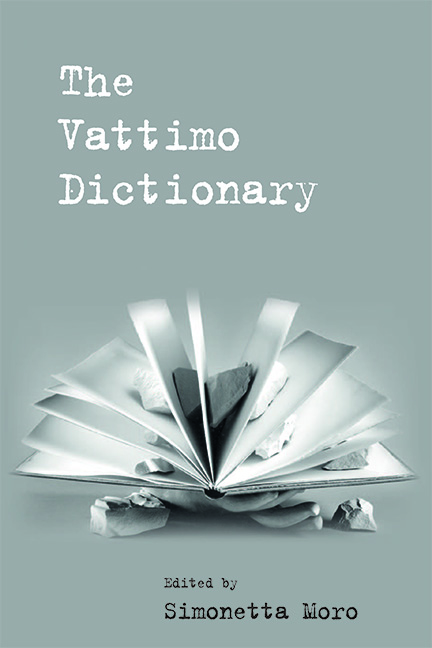
A-Z entries provide coverage of more than one hundred of Vattimo's most important concepts and themes, as well as entries for other thinkers he cites. Key criticisms of Vattimo's work are included by prominent authors in the field, from Eduardo Mendieta, Franca D'Agostini, Santiago Zabala, Silvia Mazzini, Carmelo Dotolo, Federico Vercellone to Robert Valgenti.
This new translation is based on the Akademie Edition and its variant apparatus, which tracks all the changes Leibniz made to his text. Christopher Johns translates these changes (placing them in footnotes) and shows how they relate to the main text, adding interesting - and sometimes essential - detail to your understanding of the main text. Johns also compares the Akademie to Leibniz's handwritten manuscript, correcting some errors. Additionally, a chronicle of Leibniz's activities during the years 1685 and 1686 is included, as are several letters previously unpublished in English that shed light on the intellectual context of the time. The result is a truly scholarly, complete and reliable translation and commentary.
One of the most important philosophical works of the seventeenth century, Leibniz's Discourse on Metaphysics brings together key parts of his system: God's perfections, individual substances, the relation of substances to each other, physical laws, the nature of minds and material bodies, innate ideas and the degrees of knowledge, free will and necessity, sin, grace, and the criteria for the best possible world - in sum, a metaphysics of nature and religion.
Combining historiography and political theory, this book compares different strands of Machiavelli's reception in South and North America, and between Hispanic America and Spain. It provides new insight into Machiavelli's writings and how they have been read in different contexts. The book analyses these readings focusing on some specific themes including: the relationship between politics and morals; the links between political power and freedom; debates about political realism; reflections on liberalism and republicanism; and conceptions of time and history. The book argues that Machiavelli had a significant impact on both liberal and anti-liberal authors from Argentina and Spain. For liberals, he represented a synonym of tyranny but also, in opposite way, he had offered a synthesis between republicanism and liberalism. For anti-liberals, he was associated with Modernity and liberalism.
Abject Pleasures in the Cinematic examines the cinematic strategies that elicit visceral pleasure - tears, goosebumps, sexual arousal, laughter-even in the face of content that is crass, politically problematic, or unethical.
While there might be a progressive predisposition within our discipline, affect pledges no allegiance to any particular political inclination. Progressives, or progressive content, does not hold a monopoly on affect. The beautiful has no inherent bond to the good (i.e., morally good, or having cultural merit), rather it is an affective experience, and it might come to us in the most unlikely and unsavory places. Pornography, even with the most regressive content, wields the possibility to be sexually arousing even despite our own ethical objections. While well-intended academics routinely claim that watching people get hurt is not funny, and we might appreciate the gesture to cultivate our better angels, but such assertions do not necessarily align with our lived-experience.
British cinema has been in the shadow of Hollywood for over a hundred years, constantly attempting to define itself in an effort to challenge its dominance. During the 1920s, a small group of intellectuals argued that injecting a level of 'art' into the medium was the way to do this, a view strongly opposed by the industry's commercial forces.
Using the experiences of Adrian Brunel, Josephine Botting demonstrates how this clash affected the careers of filmmakers attempting to prove their theory. Brunel was cultured yet financially insecure, caught between the creative Bohemianism of 1920s London and a conventional, conservative film industry.
Tracing the ups and downs of Brunel's biography with detailed reference to his personal papers, Adrian Brunel and British Cinema of the 1920s exposes the various forces controlling the production, distribution and exhibition of films in Britain as Brunel tried to negotiate them and find a niche in the insecure and competitive arena of British film.
Alasdair J. Macleod examines the life and ministry of John Kennedy (1819-84), minister of Dingwall Free Church of Scotland. Drawing on Kennedy's notebooks and published writings, and on source material including unpublished Gaelic poetry, this book explores how Kennedy became the effective leader of the Highland Evangelicals through his preaching, writing and public speaking. Macleod addresses current debate on the divergence in Scottish Evangelicalism and how far Kennedy may have helped to steer the trajectory of Evangelicalism in the Highlands in a conservative direction.
This book is the first scholarly edition of the most popular Native American captivity narrative published in eighteenth-century Britain. In this fully annotated modern version, Timothy J. Shannon re-acquaints modern readers with this popular North American captivity narrative, featuring a Scottish protagonist. He tells the story of Peter Williamson, a native of Aberdeen, who claimed he was kidnapped into indentured servitude in North America, lived as a captive among Indians there, and then fought as a soldier in the Seven Years' War until he was taken prisoner by the French. After returning to Britain, Williamson peddled his tale while dressed in Indian costume, and he eventually settled in Edinburgh, where he became known as 'Indian Peter'.