To save content items to your account,
please confirm that you agree to abide by our usage policies.
If this is the first time you use this feature, you will be asked to authorise Cambridge Core to connect with your account.
Find out more about saving content to .
To save content items to your Kindle, first ensure no-reply@cambridge.org
is added to your Approved Personal Document E-mail List under your Personal Document Settings
on the Manage Your Content and Devices page of your Amazon account. Then enter the ‘name’ part
of your Kindle email address below.
Find out more about saving to your Kindle.
Note you can select to save to either the @free.kindle.com or @kindle.com variations.
‘@free.kindle.com’ emails are free but can only be saved to your device when it is connected to wi-fi.
‘@kindle.com’ emails can be delivered even when you are not connected to wi-fi, but note that service fees apply.
Chapter 4 brings the student fully into today’s LOAC with details of 1977’s Additional Protocol I and Protocol II. It explains why there was a need to update the 1949 Geneva Conventions and why A.P.s I and II, initially favored by the US, turned out not to be what the US and her allies had anticipated. There were positive changes and additions in both Protocols, as well as regrettable LOAC modifications. Both sides of that coin are examined, with discussion of the lasting results of both the positive and negative changes. It is significant to note that US self-interest did not always prevail, and to explain the basis of that lack of international consensus. Relaxing the requirements for prisoner of war status continues to block US ratification of either Protocol. In the A.P. negotiations the US paid a price for its somewhat ill-advised Vietnam venture but America has, by and large, learned to live with the AP I and II provisions it initially fought. Additional Protocol III (2005), far less significant than the earlier Protocols I and II, is also discussed, if briefly.
There are various calculational methods beyond the perturbation theory of thethat can be applied in specific circumstances to give either exact or approximate results. In this chapter some of the most common methods are explained. We start with the Rayleigh–Ritz variational method that can be used to obtain an upper-bound estimate of the ground-state energy of a quantum-mechanical system. Next we examine multi-electron atoms. In such a case simple application of perturbation theory becomes difficult and more needs to be done.
Formal Models of Domestic Politics offers a unified and accessible approach to canonical and important new models of politics. Intended for political science and economics students who have already taken a course in game theory, this new edition retains the widely appreciated pedagogic approach of the first edition. Coverage has been expanded to include a new chapter on nondemocracy; new material on valance and issue ownership, dynamic veto and legislative bargaining, delegation to leaders by imperfectly informed politicians, and voter competence; and numerous additional exercises. Political economists, comparativists, and Americanists will all find models in the text central to their research interests. This leading graduate textbook assumes no mathematical knowledge beyond basic calculus, with an emphasis placed on clarity of presentation. Political scientists will appreciate the simplification of economic environments to focus on the political logic of models; economists will discover many important models published outside of their discipline; and both instructors and students will value the classroom-tested exercises. This is a vital update to a classic text.
A lively introduction to morphology, this textbook is intended for undergraduates with relatively little background in linguistics. It shows students how to find and analyze morphological data and presents them with basic concepts and terminology concerning the mental lexicon, inflection, derivation, morphological typology, productivity, and the interfaces between morphology and syntax on the one hand and phonology on the other. By the end of the text students are ready to understand morphological theory and how to support or refute theoretical proposals. Providing data from a wide variety of languages, the text includes hands-on activities designed to encourage students to gather and analyse their own data. The third edition has been thoroughly updated with new examples and exercises. Chapter 2 now includes an updated detailed introduction to using linguistic corpora, and there is a new final chapter covering several current theoretical frameworks.
Teaching Secondary History provides a comprehensive introduction to the theory and practice of teaching History to years 7–12 in Australian schools. Engaging directly with the Australian Curriculum, this text introduces pre-service teachers to the discipline of History. It builds on students' historical knowledge, thinking and skills and offers practical guidance on how to construct well-rounded History lessons for students. From inquiry strategies and teacher- and student-centred practice, to embedding the cross-curriculum priorities in planning and assessment, this text supports the learning and development of pre-service History teachers by connecting the 'big ideas' of teaching with the nuance of History content. Each chapter features short-answer and Pause and think questions to enhance understanding of key concepts, Bringing it together review questions to consolidate learning, classroom scenarios, examples of classroom work and a range of information boxes to connect students to additional material.
Build on the foundations of elementary mechanics of materials texts with this modern textbook that covers the analysis of stresses and strains in elastic bodies. Discover how all analyses of stress and strain are based on the four pillars of equilibrium, compatibility, stress-strain relations, and boundary conditions. These four principles are discussed and provide a bridge between elementary analyses and more detailed treatments with the theory of elasticity. Using MATLAB® extensively throughout, the author considers three-dimensional stress, strain and stress-strain relations in detail with matrix-vector relations. Based on classroom-proven material, this valuable resource provides a unified approach useful for advanced undergraduate students and graduate students, practicing engineers, and researchers.
This concise textbook, designed specifically for a one-semester course in astrophysics, introduces astrophysical concepts to undergraduate science and engineering students with a background in college-level, calculus-based physics. The text is organized into five parts covering: stellar properties; stellar structure and evolution; the interstellar medium and star/planet formation; the Milky Way and other galaxies; and cosmology. Structured around short easily digestible chapters, instructors have flexibility to adjust their course's emphasis as it suits them. Exposition drawn from the author's decade of teaching his course guides students toward a basic but quantitative understanding, with 'quick questions' to spur practice in basic computations, together with more challenging multi-part exercises at the end of each chapter. Advanced concepts like the quantum nature of energy and radiation are developed as needed. The text's approach and level bridge the wide gap between introductory astronomy texts for non-science majors and advanced undergraduate texts for astrophysics majors.
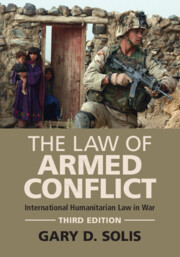
Newly revised and updated, The Law of Armed Conflict, introduces students to the law of war in an age of terrorism. What law of armed conflict (LOAC) or its civilian counterpart, international humanitarian law (IHL), applies in a particular armed conflict? Are terrorists bound by that law? What constitutes a war crime? What (or who) is a lawful target and how are targeting decisions made? What are 'rules of engagement' and who formulates them? How can an autonomous weapon system be bound by the law of armed conflict? Why were the Guantánamo military commissions a failure? Featuring new chapters, this book takes students through these topics and more, employing real-world examples and legal opinions from the US and abroad. From Nuremberg to 9/11, from courts-martial to the US Supreme Court, from the nineteenth century to the twenty-first, the law of war is explained, interpreted, and applied with clarity and depth.
Chapter 1 provides an overview of the Ice Age in North America. It covers the issues and controversies surrounding the Ice Age peopling of the continent, and introduces the volume chapters and key dating methods with which archaeologists can tell time. It then provides a summary overview of human evolutionary history in order to bring people to Northeast Asia, their jumping-off point for the move into the Americas.
Chapter 8 provides a detailed look at the Clovis complex, the earliest, most widespread occupation in the Americas, exploring Clovis adaptations to a highly varied landscape and one changing rapidly as the Ice Age waned. It focuses on the possible role of Clovis hunters in one of the most perplexing whodunits of science: the extinction of some thirty-eight different genera of Ice Age giant mammals from mammoth and mastodon, to saber-toothed cats.
Chapter 7 turns to the question of how, having made it to the Americas, the first people spread with what appears to be archaeologically breathtaking speed across a continent about which they knew nothing of its climate, resources, or routes. Although highly skilled hunter-gatherers, how did the first people learn to adapt to this utterly unknown land, and do so as successfully as they did?
Chapter 6 seeks to bring together the various threads from previous chapters on glacial geology, archaeology, linguistics, anatomy and genetics to synthesize what we know of who the first peoples were, where they came from and when, and how they travelled to the continent. More broadly, it examines the degree to which there is (or ought to be) convergence among these very different lines of evidence.
Chapter 2 sets the Ice Age (Pleistocene) environmental stage for the peopling of the Americas. It provides a history of glaciation in North America, and the consequences of the Ice Age for the continent’s land, plants and animals, on the routes that may have been used and when by the first peoples. It covers the climate changes over time that would have impacted people and their environment, including the extinction of the Pleistocene megafauna.