Refine search
Actions for selected content:
10 results
Polarization of lattices: Stable cold spots and spherical designs
- Part of
-
- Journal:
- Forum of Mathematics, Sigma / Volume 14 / 2026
- Published online by Cambridge University Press:
- 19 February 2026, e25
-
- Article
-
- You have access
- Open access
- HTML
- Export citation
-
We consider the problem of finding the minimum of inhomogeneous Gaussian lattice sums: Given a lattice $L \subseteq \mathbb {R}^n$ and a positive constant $\alpha $, the goal is to find the minimizers of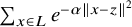 $\sum _{x \in L} e^{-\alpha \|x - z\|^2}$ over all $z \in \mathbb {R}^n$.
By a result of Bétermin and Petrache from 2017 it is known that for steep potential energy functions—when $\alpha $ tends to infinity—the minimizers in the limit are found at deep holes of the lattice. In this paper, we consider minimizers which already stabilize for all $\alpha \geq \alpha _0$ for some finite $\alpha _0$; we call these minimizers stable cold spots.
Generic lattices do not have stable cold spots. For several important lattices, like the root lattices, the Coxeter-Todd lattice, and the Barnes-Wall lattice, we show how to apply the linear programming bound for spherical designs to prove that the deep holes are stable cold spots. We also show, somewhat unexpectedly, that the Leech lattice does not have stable cold spots.


Finite element approximations for stochastic control problems with unbounded state space
- Part of
-
- Journal:
- Journal of Applied Probability / Volume 62 / Issue 1 / March 2025
- Published online by Cambridge University Press:
- 03 October 2024, pp. 367-394
- Print publication:
- March 2025
-
- Article
-
- You have access
- Open access
- HTML
- Export citation
The Bruss–Robertson–Steele inequality
- Part of
-
- Journal:
- Journal of Applied Probability / Volume 60 / Issue 3 / September 2023
- Published online by Cambridge University Press:
- 13 March 2023, pp. 1112-1114
- Print publication:
- September 2023
-
- Article
- Export citation
-
The Bruss–Robertson–Steele (BRS) inequality bounds the expected number of items of random size which can be packed into a given suitcase. Remarkably, no independence assumptions are needed on the random sizes, which points to a simple explanation; the inequality is the integrated form of an $\omega$-by- $\omega$ inequality, as this note proves.


RATIONAL AND GENERALISED RATIONAL CHEBYSHEV APPROXIMATION PROBLEMS AND THEIR APPLICATIONS
- Part of
-
- Journal:
- Bulletin of the Australian Mathematical Society / Volume 107 / Issue 2 / April 2023
- Published online by Cambridge University Press:
- 13 January 2023, pp. 349-350
- Print publication:
- April 2023
-
- Article
-
- You have access
- HTML
- Export citation
POINTWISE RESIDUAL METHOD FOR SOLVING PRIMAL AND DUAL ILL-POSED LINEAR PROGRAMMING PROBLEMS WITH APPROXIMATE DATA
-
- Journal:
- The ANZIAM Journal / Volume 62 / Issue 3 / July 2020
- Published online by Cambridge University Press:
- 12 January 2021, pp. 302-317
-
- Article
-
- You have access
- Export citation
SOLVING A SPECIAL CLASS OF MULTIPLE OBJECTIVE LINEAR FRACTIONAL PROGRAMMING PROBLEMS
-
- Journal:
- The ANZIAM Journal / Volume 56 / Issue 1 / July 2014
- Published online by Cambridge University Press:
- 09 October 2014, pp. 91-103
-
- Article
-
- You have access
- Export citation
A PRIMAL-DUAL INTERIOR-POINT ALGORITHM BASED ON A NEW KERNEL FUNCTION
-
- Journal:
- The ANZIAM Journal / Volume 51 / Issue 4 / April 2010
- Published online by Cambridge University Press:
- 03 February 2011, pp. 476-491
-
- Article
-
- You have access
- Export citation
-
We propose a new primal-dual interior-point algorithm based on a new kernel function for linear optimization problems. New search directions and proximity functions are proposed based on the kernel function. We show that the new algorithm has
 and
and  iteration bounds for large-update and small-update methods, respectively, which are currently the best known bounds for such methods.
 and
and  iteration bounds for large-update and small-update methods, respectively, which are currently the best known bounds for such methods.
A SELF-REGULAR NEWTON BASED ALGORITHM FOR LINEAR OPTIMIZATION
-
- Journal:
- The ANZIAM Journal / Volume 51 / Issue 2 / October 2009
- Published online by Cambridge University Press:
- 05 February 2010, pp. 286-301
-
- Article
-
- You have access
- Export citation
Stationarity in the simplex method
-
- Journal:
- Journal of the Australian Mathematical Society. Series A. Pure Mathematics and Statistics / Volume 43 / Issue 1 / August 1987
- Published online by Cambridge University Press:
- 09 April 2009, pp. 137-142
-
- Article
-
- You have access
- Export citation
Driving from degeneracy
-
- Journal:
- Journal of the Australian Mathematical Society. Series A. Pure Mathematics and Statistics / Volume 47 / Issue 2 / October 1989
- Published online by Cambridge University Press:
- 09 April 2009, pp. 236-239
-
- Article
-
- You have access
- Export citation
