To save content items to your account,
please confirm that you agree to abide by our usage policies.
If this is the first time you use this feature, you will be asked to authorise Cambridge Core to connect with your account.
Find out more about saving content to .
To save content items to your Kindle, first ensure no-reply@cambridge.org
is added to your Approved Personal Document E-mail List under your Personal Document Settings
on the Manage Your Content and Devices page of your Amazon account. Then enter the ‘name’ part
of your Kindle email address below.
Find out more about saving to your Kindle.
Note you can select to save to either the @free.kindle.com or @kindle.com variations.
‘@free.kindle.com’ emails are free but can only be saved to your device when it is connected to wi-fi.
‘@kindle.com’ emails can be delivered even when you are not connected to wi-fi, but note that service fees apply.
The Introduction explains the collection’s argument, structure, and its interventions in the field. We challenge the fetishization of firsts in early modern drama studies, first performances, and first editions and highlight problems with privileging “maiden” performances and print “inceptions” of Renaissance plays over their ghost-like “afterlives” on the stage and page. Engaging with recent work in theatre and book history and editorial studies, the Introduction explores the idea that plays are indelibly marked and transformed by their transhistorical movement through different cultural sites of production and reception. We argue, in short, that the social, political, and aesthetic meanings of Renaissance drama were shaped by processes of renewal.
Although book historians have tended to date the beginnings of an established market for printed plays to the mid 1590s, the first year of play publication, 1584, saw four plays printed, two of them in multiple editions. More plays were printed in this year than the rest of the decade combined; it would be another sixteen years before a play went into multiple editions in a single year. This chapter asks what this strange year tells us about plays as printed, reprinted, and revived commodities. The four plays discussed are John Lyly’s Campaspe and Sappho and Phao, Robert Wilson’s The Three Ladies of London, and George Peele’s The Arraignment of Paris. All four plays have things to say about reviving stories and performance, and three went on to be reprinted. Attending to them as a kind of corpus, this chapter investigates their place in the histories of revival, reprinting, and dramaturgy.
Law, with its seemingly endless paperwork, is almost overwhelmingly textual. From contracts to briefs to opinions to treatises, law lives in its texts. Simultaneously, law requires performances to produce authenticity and authority. Witness testimonies, pleadings, and trials all enact the law through participants’ bodies. There is no law without text. There is no law without performance. Legal texts and performances produce and reproduce each other: Legal texts record or script legal performances; legal performances generate or stage legal texts. Because law entwines text and performance, this chapter considers the law’s material textuality and its theatricality in tandem by probing how law brings performance to book. Drawing on theater studies and the history of dramatic texts, I offer methods for reading legal texts as scripts that precede or follow legal performances. Examples from Anglo-American law reveal that legal documents’ typographical conventions uncover law’s reliance on performance and its anxiety about deviating from textuality. More sophisticated legal attention to the relationship between text and performance would better serve law and, more importantly, justice.
Studies of early modern English drama in print and performance have often prioritized – or even fetishized – first editions and first performances. Challenging ingrained assumptions about chronology, this collection focuses critical attention on the various ways that Renaissance drama was repeated and renewed. Ranging widely across the period, from the 1580s to the early 1700s, the chapters examine canonical plays and authors-including Shakespeare and Ben Jonson-outside of the contexts in which they are ordinarily viewed. The chapters also demonstrates the significance of texts, authors, and forms of evidence that have been critically neglected, from lost plays and music manuscripts to playgoers' diaries and multi-author 'nonce' anthologies. As a whole, the collection opens up new areas of study and offers fresh perspectives on questions of temporality, commerce, aesthetics, agency, and canon-formation.
The Epilogue reflects on the ways that nineteenth-century texts consistently acknowledge the post-lapsarian state of human existence. The literary works discussed in this book all, to some extent, either recreate the events of Milton’s epic in a world that is fallen or tell the story of what happens after the expulsion. Drawing on Christopher Ricks, the Epilogue identifies a single word – ‘error’ – as emblematic of Milton’s nineteenth-century legacy. ‘Error’ points to its post-lapsarian meanings even when used to describe Eden before the Fall. After opening with the 1790 disinterment of Milton’s corpse, the Epilogue turns to another disturbing anecdote to illustrate the complexity of Milton’s nineteenth-century reception: the history of a Victorian edition of Milton’s poetry, bound in tanned human skin. The skin in question belonged to George Cudmore, executed for murder in the 1830s. This instance of anthropodermic bibliopegy reveals that Milton’s works, while revered and respected by the Victorians – his body parts were treated as relics – were also open to disruption and reinterpretation.
This book begins by foregrounding that the material form of Kant’s 1785 essay could be analysed to critique the myth of proprietary authorship that presently prevails across copyright regimes. After reviewing four faces of Kant in authorship and copyright studies, I advance a medial rethinking of Kant by drawing on the intersecting traditions of book history, media theory and literary studies. In particular, Gérard Genette’s poetics informs my paratextual reading of Kant’s 1785 essay to uncover the historical and medial-material conditions of literary production.
When two people read together, what do they stand to learn not just about the book, but about each other? Representations of people reading together in Romantic literature often describe the act of sharing a book as a kind of litmus test of sympathy. Frequently, however, fictional readers end up misreading the text, or each other, or both. Stacey McDowell shows how Romantic writers, in questioning the assumptions lying behind the metaphorical sense of reading as sympathy, reflect on ideas of reading – its private or social nature and its capacity to foster fellow feeling – while also suggesting something about the literary qualities intrinsic to sympathy itself – its hermeneutic, narrative, and rhetorical strategies. She reveals what the literary portrayal of shared reading adds to histories of the book and moral philosophy, and how the effects of form and style aim to reproduce the shared experience of reading described.
This book retraces the emergence of conceptions of authorship in late-eighteenth-century Germany by studying the material form of Immanuel Kant's 1785 essay, 'On the Wrongfulness of Reprinting'. Drawing upon book history, media theory, and literary studies, Benjamin Goh analyses the essay's paratexts as indices of literary production in the German Enlightenment. Far from being an idealist proponent of intellectual property, Kant is shown to be a media theorist and practitioner, whose critical negotiation with the evolving print machinery in his time helps illuminate our present struggle with digital technology and the mounting pressures borne by copyright as a proprietary institution. Through its novel perspective on established debates surrounding authorship, this book critiques the proprietary conception of authorship in copyright law, and proposes an ethical alternative that responds to the production, circulation, and reading of literature. This title is also available as open access on Cambridge Core.
Widening the perspective offered by the traditional canon, this history reveals the poetry of Italy between 1200 and 1600 as a site of plurality of genre, form and even language, including not just written texts but also those presented in performance. Within this inclusive framing, poetry's content, its cultural and geographical contexts and its material media of transmission are given equal weight. Decentring major figures and their texts while recognising their broad influence, the innovative theoretical and methodological framework complements the variety and liveliness of poetic activity on the Italian peninsula over four centuries, from the first manuscript experiments in verse through to sophisticated print productions and elaborate performance media. Offering original, multidisciplinary insights into current debates and discoveries, this history enlarges the scope of what we understand Italian premodern poetry to be.
What does 'Irish romanticism' mean and when did Ireland become romantic? How does Irish romanticism differ from the literary culture of late eighteenth- and nineteenth-century Britain, and what qualities do they share? Claire Connolly proposes an understanding of romanticism as a temporally and aesthetically distinct period in Irish culture, during which literature flourished in new forms and styles, evidenced in the lives and writings of such authors as Thomas Dermody, Mary Tighe, Maria Edgeworth, Lady Morgan, Thomas Moore, Charles Maturin, John Banim, Gerald Griffin, William Carleton and James Clarence Mangan. Their books were written, sold, circulated and read in Ireland, Britain and America and as such were caught up in the shifting dramas of a changing print culture, itself shaped by asymmetries of language, power and population. Connolly meets that culture on its own terms and charts its history.
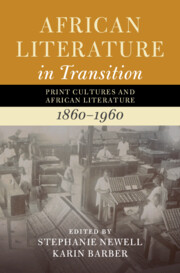
This book offers a compelling vision of the dynamism of local printing presses across colonial Africa and the new textual forms they generated. It invites a reconceptualisation of African literature as a field by revealing the profusion of local, innovative textual production that surrounded and preceded canonical European-language literary traditions. Bringing together examples of print production in African, Europea and Arabic languages, it explores their interactions as well as their divergent audiences. It is grounded in the material world of local presses, printers, publishers, writers and readers, but also traces wider networks of exchange as some texts travelled to distant places. African print culture is an emerging field of great vitality, and contributors to this volume are among those who have inspired its development. This volume moves the subject forward onto new ground, and invites literary scholars, historians and anthropologists to contribute to the on-going collaborative effort to explore it.
This chapter explores the significance of a bookshop set up in Bloomsbury in 1919 by the writers David Garnett and Francis Birrell. Drawing upon archival material at the Bodleian, Oxford – including catalogues, order histories, correspondence, and financial documents – it deepens and nuances the emerging understanding of modernist bookshops as private enterprises that were also public spaces of intellectual, artistic, and cultural exchange. The first part outlines the bookshop’s links with its Bloomsbury customers and, most notably, the Hogarth Press. The second part then turns to the international custom base and professional networks to show how the bookshop, like the Hogarth Press, challenges narratives of the Bloomsbury group as an insular clique. In considering how friendship and business mixed, the chapter therefore demonstrates two key features of modernist bookshops set out by Huw Osborne in his edited volume The Rise of the Modernist Bookshop (2015), whereby they exist “on the threshold of commerce and culture,” and where they are “locally fixed in cities and towns and yet tied into transatlantic and global networks” that complicate the very division between the local and the global.
This chapter provides an overview of the history of books and printing in English, in four sections defined by time period. Each section briefly surveys the technological innovations of that period and discusses how the changing print industry influenced and reflected developments of English between 1476 and the present. After an introduction (7.1), Section 7.2 discusses the rise of print in England during the incunabula and early print period (1476–1640). Section 7.3 then follows the continued expansion of print across England and North America during the hand-press period (1641–c. 1800), and Section 7.4 considers the explosion of printed texts during the nineteenth and early twentieth centuries. The final section culminates with an overview of the rise of digital reading platforms and a discussion of how the ongoing evolution of text technologies continues to influence the development of English today.
Scholarship on the role of precedents and precedential reasoning in law has tended to focus on questions concerning a commitment to stare decisis and the nature of analogy and justification. This chapter, by contrast, examines the use of rhetorical and formal techniques to convey an opinion’s precedential status. Lord Mansfield, Chief Justice of the Court of King’s Bench from 1756 to 1788, used a range of such techniques to indicate that he was changing the law and to signal that a given decision should govern future cases. His law reporter, James Burrow, credited as the creator of the headnote, complemented these efforts through his use of typography and page layout. Burrow’s ideas about clearer, fuller, and more focused reporting of legal decisions probably owed a considerable amount to his long-standing involvement with the Royal Society, whose published Transactions exhibit a series of generic changes, anticipating in some respects those that Burrow would adopt.
The 'Pamphlet Wars' of the seventeenth century, the activist texts of the Labour Movement, and the recent campaigns for climate justice have all drawn on the affordances of pamphleteering to advance their cause: pamphlets circulate across geographical boundaries and social divides, they attract a readership that is usually excluded from the classical public sphere, they can be produced at low cost, and they often provide anonymity to their authors. This Element provides a brief history of short-form polemical literature from the Reformation to the present. It argues that popular dissent and popular political agency must be understood in light of the material and, more recently, digital history of polemical literature. It makes the case that current online polemic is best understood as a late infrastructural transformation of classical and modern pamphleteering. This title is also available as Open Access on Cambridge Core.
This article presents a print history of the International African Service Bureau journal International African Opinion and its little-known editor Ras T. Makonnen. In doing so, it makes the case for a reassessment of how we think about anti-colonial movements in interwar Britain. It argues that Pan-Africanism can be viewed as a loose network of anti-colonial activists, where political ideas were fluid and often in competition with one another, yet still operated harmoniously under the wider banner of Pan-Africanism. By analysing the place of print in this competition it demonstrates the role of the history of print within wider histories of empire and anti-colonialism, as well as functions as an engagement with Black British history and histories of Black internationalism.
The sociology of the text has been instrumental in the development of the discipline of book history, but it has also had (and is still having) an impact on genetic criticism. This chapter argues that a rapprochement between both disciplines can be mutually beneficial, exploring a sociology of writing. Joyce was well aware of the ‘human agency’ involved in his literary enterprises. He had a knack for finding all kinds of textual agents to help him produce his works. The increased attention to human agency beyond the myth of solitary authorship has had quite an impact on textual scholarship, including in Joyce studies. The chapter discusses how this development impacts on our study of the writing, reading, revising, editing, and archiving of Joyce’s works, as well as on the ways in which we present them in the digital age, enabling a next generation of Joyce scholars to examine not only the teleological development of Joyce’s works towards a published text but also the dysteleological dead ends, the ‘vestigial’ notes that did not make it into Joyce’s published texts yet played a discreet, but no less valuable, role in the creative ecology of Joyce’s writing practice.
Human beings build their worlds using metaphors. Just as computer technology has inaugurated a massive metaphorical transformation in the present era, in which we can 'reboot' social causes or 'program' human behaviour, books spawned new metaphorical worlds in the newly print-savvy early modern England. Pamphleteers appealed to books to stage political attacks, preachers formulated theological claims using metaphors of page and binding, and scientists claimed to leaf through the 'Book of Nature'. Jonathan P. Lamb shows how, far from offering a mere a linguistic tool, this astonishingly broad lexicon did no less than teach entire cultures how to imagine, giving early modern writers – from Shakespeare to Cavendish, and from the famous to the anonymous – the language to describe and reshape the worlds around them. He reveals how, at a scale beyond anything scholars have imagined, bookish language shaped religious, political, racial, scientific, and literary questions that remain alive today.
The Cambridge Edition of the Complete Fiction of Henry James provides, for the first time, a scholarly edition of a major writer whose work continues to be read, quoted, adapted and studied. Confidence is one of James's least-known novels, but its handling of point of view and the ethics of observing other people, its succession of often vividly-evoked settings – Siena, Baden-Baden, New York City, Paris, London – and its fascinating similarities to other of James's works make it deserving of serious attention. The story of its composition, publication and reception is also told here, illuminating how James negotiated his establishment as a major writer, including a readiness for radical revision at the manuscript stage. At its heart, Confidence offers a compelling portrait of a deracinated group of leisured Americans in a new era of global travel, tracing the twists and turns of a moral-psychological experiment in relations between the sexes.
The chapter explores the economics of translating Virgil, examining the role of patrons, printers, publishing houses and presses. I first explore the relationships of translators with their patrons, publishers and printers, in France, Italy and Britain during the first two centuries of the print era. I reveal the tension between the desire to satisfy the elite’s need for exclusive badges of culture and the impulse to extend the vernacularization of Virgil by producing accessible translations for less educated readers. I investigate the power relations involved in initiating or commissioning translations, with examples from Cinquecento Italy, and the funding of expensive folio editions in France and England. In Victorian England, translations published in low-priced series of books, including Everyman’s Library, flourish alongside ambitious luxury productions. The chapter concludes with a study of Virgil’s works in the Penguin Classics series in the twentieth and twenty-first centuries.