To save content items to your account,
please confirm that you agree to abide by our usage policies.
If this is the first time you use this feature, you will be asked to authorise Cambridge Core to connect with your account.
Find out more about saving content to .
To save content items to your Kindle, first ensure no-reply@cambridge.org
is added to your Approved Personal Document E-mail List under your Personal Document Settings
on the Manage Your Content and Devices page of your Amazon account. Then enter the ‘name’ part
of your Kindle email address below.
Find out more about saving to your Kindle.
Note you can select to save to either the @free.kindle.com or @kindle.com variations.
‘@free.kindle.com’ emails are free but can only be saved to your device when it is connected to wi-fi.
‘@kindle.com’ emails can be delivered even when you are not connected to wi-fi, but note that service fees apply.
The three major sections of Genesis 12–50 focus on the ancestral narratives of Abraham, Jacob, and Joseph. We know little of the historical details, although archaeological data suggests a plausible context for these stories in the Middle Bronze Age. We will see that the narratives themselves hint at even earlier traditions, suggestive of oral traditions preserved and woven into the texts. In these narratives we will also encounter the social structure of kinship-based tribal societies. The “father’s house” and the larger clan formed the subunits of the geographically based organization of the tribe.
This portion of Genesis narrates Yahweh’s provision of hope for the divine–human relationship so tragically marred by human rebellion (Genesis 1–11). Moreover, God chooses an individual, Abraham, to partner in a covenant. This covenant, shaped by God’s promises of land, descendants, and worldwide blessing, is the lasting hallmark of Israelite religion. Abraham’s descendants include not only those named in the Old Testament but those in the three monotheistic religions for which Abraham is acknowledged as the “father of faith.”
We will now focus our attention on the final book of the Pentateuch, Deuteronomy. We will discover that, even as the book recounts what has come before for the sake of Israel poised to enter the promised land, it does so in a new setting, in an innovative literary format, and with distinctive emphases that speak to generations present and yet to come.
Deuteronomy consists of four collections of speeches given by Moses, set off by literary superscriptions. Scholars have determined that the book is organized in the form of an ancient international treaty. Following a historical prologue, the speeches reiterate and affirm Torah instruction, institute a covenant renewal that links blessings with covenant fidelity, and detail provisions for Israel after Moses’ death (recounted in the final chapter of the book). Deuteronomy is distinctive in the Pentateuch for its focus on the centralization of Israel’s religious cult at the place where Yahweh will cause his name to dwell, the great statement of faith known as the Shema (Deuteronomy 6:4), and the first explicit statements of monotheism in the Old Testament.
In previous chapters, we focused on the structure and content of the books in the Pentateuch. Here, we will explore the religion of Moses that emerges from these materials. Specifically, we will observe the way in which divine revelation developed from direct communication with individuals such as Abraham and Moses to mediated revelation through a written Torah and the priesthood. We will explore the significant concepts of holiness, covenant, and practical monotheism, particularly as compared to the religion of the ancestral narratives (Genesis) and that of surrounding ancient Near Eastern cultures.
It will be important that we consider the characteristics of Mosaic religion against the backdrop of the ancient Near East at a time when certain polytheistic cultures are known to have elevated a single deity above their other gods – known as a “theology of exaltation.” Furthermore, we will explore some possible influences and origins for the Yahwistic faith – the religion so foundational for the remaining Old Testament and whose roots belong to monotheistic religions down to the present.
In this final chapter, we will summarize the Old Testament and explore its lasting contributions to world history, society in general, and the monotheistic religions of Judaism, Christianity, and Islam. Specifically, we will explore four particular aspects of the Old Testament and examine how each functions to create a cohesive and living whole.
This overview in turn will remind us that the Old Testament’s central message communicates, in a host of ways, what it perceives as Israel’s life in covenant relationship with God, obeying God’s Torah, and living morally and ethically in right relationship with other human beings. Within this overarching concern of the Old Testament, we have already observed the continual thread of a monotheistic worldview in process. The development toward the Old Testament’s conviction of the singularity of God is indeed among the most enduring contributions to human history.
Similarly, the Old Testament’s contribution to civil society cannot be underestimated. Thus, in conclusion, we will explore three core values in particular that are rooted, not in secularization as often is assumed, but in the rich and enduring legacy of the Old Testament.
The Hebrew Bible with its strident championing of the oppressed is frequently associated with the development of human rights. Renowned for its bold account of the emancipation of the Israelite slaves from Egypt, its impact on the later beliefs in freedom and human dignity is immense. Yet is it appropriate to associate its laws with the origin of this principle, since the term itself (זכויות אדם in Hebrew) is absent in the Pentateuch – and where it is anachronistic to impose this post-Enlightenment concept on these ancient sources?
Hobbes argues that in a “condition of meer nature,” lacking a common power, reason requires that we appoint one, lest our lives be “solitary, poore, nasty, brutish, and short.” No covenant of peace can be effective without a Sovereign arbiter to enforce it. Therefore, reason requires each of us to surrender the natural right to judge for ourselves, and to appoint a Sovereign. An effective Sovereign must have authority to determine religious practice and to raise an army – precisely the powers the “Roundhead” rebels had denied Charles I.
Starting with three good ideas – natural equality, government resting on consent, and government limited by the terms of that consent – Hobbes derives distressing conclusions. Reason requires submission to the Sovereign even in matters of conscience. The Sovereign can do subjects no injustice. Mixed government must lead to civil war. This chapter traces and tests Hobbes’s reasoning.
This chapter explores the priestly theology of space within the tabernacle and how this expands to the holy land where Israel will dwell. The tabernacle and God’s abiding presence are the center of all holiness for the priestly authors. Only ordained priests may approach his holiness. The consecration of the altar is a high point in the theology of Leviticus and has an impact on its theology of the land and the Jubilee.
Ownership entitles owners to assign away some lesser property rights and retain other such rights. This chapter studies the cases for and against these lesser rights, called in this chapter “component” rights. Component rights may and should be limited when they help owners and the likely assignees of component rights use the resources more productively. The rights may and should be limited when they interfere with the clarity of property rights and when they interfere with opportunities of people who are not assignees to have sufficient access to resources. Property’s productive use requirement also justifies correlative doctrines between people who hold component rights in the same resource. This chapter studies leases, servitudes, security interests, present possessory estates, and future interests. To study limits on component rights, this chapter studies formalities requirements, standard terms of art for different component rights, the numerus clausus principle, the Rule Against Perpetuities, and the doctrine terminating servitudes for changed conditions. To study correlative rights, this chapter studies the doctrine of ameliorative waste.
The second book of the Bible, Exodus, is the subject of this essay, covering the growth and enslavement of the Israelite nation, early career of Moses, rescue from Egypt, and covenant on Sinai.
Covenant, community and communion are ways in which God’s means and God’s ends are identical. Covenant is not the ‘Plan B’ after the failure of creation in the fall; it is the fulfilment of the reason for creation, and the anticipation of the true covenant, the incarnation itself. God’s love for Israel goes far beyond any instrumental goodwill: Israel is God’s child, God’s spouse, God’s companion forever. Communion is the centre of the Christian faith: being with but also being together. Communion and community name the two aspirations of church. The one is about being in, and bringing others into, relationship with God; the other is about relating civilly, cordially and sacrificially with one another, and attending to the things that need doing to function humanly. When Jesus talks of the realm of God, he is talking about this communion and community becoming a reality for all people.
The counterfactual question of whether Christ would have come had there been no fall turns out not to be the most helpful way of investigating the matter. The real question is whether God’s means are consistent with God’s ends – whether the story of God’s purpose to be with us now and always is a more encompassing narrative than the smaller story of evil, sin, suffering and death, and whether there is utter consistency between the Jesus who is with us in the incarnation and the Jesus who is with us always. In this chapter I investigate Karl Barth’s proposal and, while appreciating its very significant contributions to my project, find it finally wanting on these grounds. Barth helpfully renarrates election as the election of Jesus Christ, but his account of salvation is inconsistent with his Christocentrism and his eschatology is thin.
Why did Jesus come? The traditional argument is that he came to redeem us from sin and destroy death, and thus reverse the fall. Many have long found this unsatisfactory, because it centres human deficit, rather than divine abundance. In this study, Samuel Wells traces his notion of 'being with' right into the Trinity itself, and in dialogue with Maximus the Confessor, Duns Scotus and Karl Barth, among others, articulates a truly Christocentric theology in which God's means and God's ends are identical. In the process, Wells not only greatly expands the compass of 'being with,' showing its scriptural and doctrinal significance, but also offers a constructive account of the incarnation, cross and resurrection of Jesus that out-narrates conventional atonement theories. Wells correspondingly proposes an account of sin, evil, suffering and death that accords with this revised understanding. The result is a compelling and transformational proposal in incarnational theology.
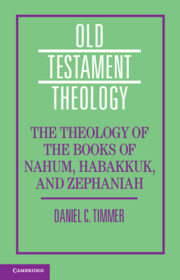
150 words: The books of Nahum, Habakkuk, and Zephaniah contain oracles that address problems in and around ancient Judah in ways that are as incisive and critical as they are optimistic and constructive. Daniel C. Timmer’s The Theology of Nahum, Habakkuk, and Zephaniah situates these books in their social and political contexts and examines the unique theology of each as it engages with imposing problems in Judah and beyond. In dialogue with recent scholarship, this study focuses on these books’ analysis and evaluation of the world as it is, focusing on both human beings and their actions and God’s commitment to purify, restore, and perfect the world. Timmer also surveys these books’ later theological use and cultural reception. Timmer also brings their theology into dialogue with concerns as varied as ecology, nationalism, and widespread injustice, highlighting the enduring significance of divine justice and grace for solid hope and effective service in our world.
50 words: This volume examines the powerful and poignant theology of the books of Nahum, Habakkuk, and Zephaniah. Daniel C. Timmer situates these books’ theology in their ancient Near Eastern contexts and traces its multifaceted contribution to Jewish and Christian theology and to broader cultural spheres, without neglecting its contemporary significance.
20 words: This volume draws out the theology of Nahum, Habakkuk, and Zephaniah, attending to their ancient contexts, past use and reception, and contemporary significance.
The books of Nahum, Habakkuk, and Zephaniah address problems in and around ancient Judah in ways that are as incisive and critical as they are optimistic and constructive. Daniel C. Timmer's The Theology of the Books of Nahum, Habakkuk, and Zephaniah situates these books in their social and political contexts, examining the unique theology of each as it engages thorny problems in Judah and beyond. In dialogue with recent scholarship, this study focuses on these books' analysis and evaluation of the world as it is, focusing on both human beings and their actions, and God's commitment to purify, restore, and perfect the world. Timmer also surveys these books' later theological use and cultural reception. His study brings their theology into dialogue with concerns as varied as ecology, nationalism, and widespread injustice. It highlights the enduring significance of divine justice and grace for solid hope and effective service in our world.
This study of Paradise Lost, interpreted through the lens of John Milton's treatise De doctrina Christiana, argues that the poet seeks to breathe new life into the tropes of orthodox Christian theodicy by radicalising concepts chosen eclectically from both Reformed and Arminian schools of thought, integrating them within the patchwork of his own idiosyncratic heterodoxies and thus catalysing a fundamentally new theology propelled by his narrative priorities. This approach makes the drama that Milton intuits itself the driver of dogma, which drama allows him to bring God and reader into the same story, under the spell of his own theodical narration.
This article concerns the role of covenant in early rabbinic literature in relation to biblical and especially Second Temple-era predecessors. The first part establishes that the Qumran sectarians and earlier circles were drawn to the concept of covenant because it represented, especially through the mechanism of covenant renewal, a powerful tool for defining and supporting group identity. The second part shows that for the rabbis, the importance of covenant lay chiefly, instead, in its capacity to conceptualize the notion of Israel as a collective body defined by corporate responsibility. The third part suggests that this novel deployment of covenant arose in part to counter the individuating force of halakah as law, another innovation of the rabbis.
Edited by
Seth Davis, University of California, Berkeley School of Law,Thilo Kuntz, Heinrich-Heine-Universität Düsseldorf,Gregory Shaffer, Georgetown University Law Center, Washington DC
The aim of this chapter is twofold. First, it is a comparative study on the potential benefits and limitations of applying fiduciary law in a “hard case.” This analysis is inductive in nature. It aims at contributing to a better understanding of fiduciary law doctrines in both common and civil law jurisdictions. Second, the chapter focuses on specific transnational processes that may shape fiduciary norms. In particular, it analyzes the influence of transnational private ordering on the establishment of fiduciary duties in state law.
Chapter 8 first provides an overview of the stipulations regarding how things held in tenancy in common (the most common co-ownership form of property around the world) should be administered and sold, as well as co-owner agreements not to partition. Then, Chapter 8 addresses whether the several types of rules lead to underuse or overuse — that is, whether tenancy in common may lead to tragedy of the commons or anticommons. The prevalent doctrine that provides one co-owner with a unilateral power to call for partition avoids a long-term tragedy but underinvestment and underuse of co-owned resources are still likely. This chapter ends with a proposed solution to ameliorate the underinvestment and underuse problems.
In this book, Matthew Levering unites eschatologically charged biblical Christology with metaphysical and dogmatic Thomistic Christology, by highlighting the typological Christologies shared by Scripture, the Church Fathers, and Aquinas. Like the Church Fathers, Aquinas often reflected upon Jesus in typological terms (especially in his biblical commentaries), just as the New Testament does. Showing the connections between New Testament, Patristic, and Aquinas' own typological portraits of Jesus, Levering reveals how the eschatological Jesus of biblical scholarship can be integrated with Thomistic Christology. His study produces a fully contemporary Thomistic Christology that unites ressourcement and Thomistic modes of theological inquiry, thereby bridging two schools of contemporary theology that too often are imagined as rivals. Levering's book reflects and augments the current resurgence of Thomistic Christology as an ecumenical project of relevance to all Christians.