To save content items to your account,
please confirm that you agree to abide by our usage policies.
If this is the first time you use this feature, you will be asked to authorise Cambridge Core to connect with your account.
Find out more about saving content to .
To save content items to your Kindle, first ensure no-reply@cambridge.org
is added to your Approved Personal Document E-mail List under your Personal Document Settings
on the Manage Your Content and Devices page of your Amazon account. Then enter the ‘name’ part
of your Kindle email address below.
Find out more about saving to your Kindle.
Note you can select to save to either the @free.kindle.com or @kindle.com variations.
‘@free.kindle.com’ emails are free but can only be saved to your device when it is connected to wi-fi.
‘@kindle.com’ emails can be delivered even when you are not connected to wi-fi, but note that service fees apply.
This chapter argues that Hobbes’s appreciation of Galileo’s principles of motion occurred in stages by focusing on a principle that Hobbes introduces in Leviathan 2.1 to explain the imagination: “when a thing lies still, unlesse somewhat els stirre it, it will lye still for ever, is a truth that no man doubts of. But that when a thing is in motion, it will eternally be in motion, unless somewhat els stay it, though the reason be the same, namely, (that nothing can change itself) is not so easily assented to.” Although there is evidence that Hobbes became aware of the importance of this principle in early criticisms of Thomas White and in early notes for De corpore, he did not incorporate it into his account of the imagination in Elements of Law (1640). However, in later works, such as the English and Latin versions of Leviathan and De corpore, conceiving of unhindered motion as continuing eternally provided Hobbes with the ability to explain more aspects of human cognition related to the imagination. Furthermore, thinking of the passion "curiosity" as an infinite endeavor enabled Hobbes to explain why human scientific endeavors can persist even in the face of failure or apparent uselessness.
I argue that through his account of the meaning of, and need for, solidarity, Rorty offers a non-juridical vision of liberal community built upon a political ethos of hope. This political ethos of hope is necessary to combat the threat posed by pathological individualism to contemporary liberal democratic societies. This ethos is characterised by attention to the cruelty that we inadvertently cause to others through the exercise of our private freedoms. It involves an explicit commitment to curiosity and an implicit demand for humility in our interactions with our fellows. These values have radical and far-reaching implications for Rorty’s account of political conversation – how we approach our dialogues with others, and the language that we use therein – in his idealised liberal community. I contrast these implications with deliberative democratic norms and put distance between Rorty’s view of political conversation and J. S. Mill’s account of free expression in a liberal society and the accounts of epistemic injustice offered by Fricker and Medina. I attempt a nuanced interpretation of Rorty’s understanding of the relevance of identity to politics.
Exploration involves gathering and assimilating information. Exploratory motivation and play are linked. Curiosity is associated with novelty seeking. Links are described with boredom. The orienting reflex is a form of exploratory behaviour. Exploratory behaviour involves whole-body movement. High levels of fear are antagonist to exploratory behaviour. The link with latent learning and cognitive maps is described. Problems with the application of drive theory to exploratory behaviour are discussed. The link to competence is discussed. Exploration acts in a hierarchical mode of control, involving incentive salience attribution. The chapter discusses the neuroscience of exploration (e.g. the hippocampus). Motivation of exploration involves the pathway from the VTA to the NAcc, which is excited by novelty. An amplification of exploratory motivation is seen in sensation seeking. The chapter concludes with a discussion of the developmental factors that underlie exploratory motivation. A focus is upon the role of environmental complexity in individual differences.
Creativity and innovation involve moving beyond conventional solutions, preconceptions, disciplinary boundaries, and assumptions about materials. They rely on a style of thinking termed open-minded engagement: playful, nimble, and cognitively flexible, and receptive to and embracing of new ideas, values, beliefs, lifestyles, and cultures, but in a critical and bounded way. This chapter surveys philosophical and empirical literature to explore how such thinking is engaged and developed through the arts. It suggests that if you can embrace and accept that you may not quite know what could happen, pause on projecting your preconceptions, be open to what the artwork is saying to you on its own terms, you will surely engage more fully, come to understand more about the artworks and artist themselves, and deepen your own capacity for continued openness.
This article will argue that Sor Juana develops a revisionary virtue epistemology in her Reply to Sor Filotea in order to counter the oppressive dogmas of her time. Sor Juana’s epistemological reorganization of Catholic Scholasticism helps her epistemically ground and morally justify her lifelong passion for learning. Sor Juana’s virtue responsibilist epistemology posits that properly oriented humility actually motivates studying, even for women; subtly reworks the scope of the supposed vice of curiositas so as to endorse curiosity about the created world as a virtue; and underscores the equal importance of moral and intellectual virtues for persons of any gender. Furthermore, Sor Juana’s system emphasizes grounds for epistemic justification that are accessible third-personally to allow her to move beyond the discriminatory debate about women’s intellectual capacities and demonstrate her epistemic agency through externally observable markers.
This chapter explores practical strategies for sparking students’ interest and curiosity in statistics as lectures and classes commence, and for sustaining their engagement throughout the learning journey. It focuses on the benefits of capturing attention at the outset, encouraging open discussions, and creating a supportive environment where students feel confident to ask questions and seek help. By setting the scene for active participation and fostering a sense of curiosity, the chapter demonstrates how inclusive and student-centred teaching can transform statistics into a subject that feels relevant, accessible, and even enjoyable. Student perspectives highlight what truly makes a difference in their learning experience.
Many young artists try their hand at a variety of creative forms. Even those who know their passion early on may still dabble a bit in related domains, often fueled by the need to explore different artforms and endless curiosity. Many artists might use insights or skills learned in one domain throughout their career, even if they ultimately do not keep creating in that area. Some artists whose stories are told in this chapter kept shifting areas into college and young adulthood. Most stayed within the arts, but some found their way to the arts from other areas from sports to science. Other times, artists will work across multiple domains for their whole career.
Some philosophers have recently argued that one should not be curious about a question whose answer one knows. This norm is said to follow from the fact that curiosity aims at knowledge. This article contends that the view that curiosity is inappropriate when directed at what is known, though attractive, is false. In fact, we are frequently curious about questions whose answers we know, and this curiosity is entirely appropriate because, along with metacognitive judgments about the contents of memory, it plays an important role in the process by which we successfully retrieve knowledge from memory. If this argument is successful, it reveals that some curiosity-driven inquiries target knowledge that lies within one’s own mind and raises important questions about the status and interpretation of the claim that curiosity aims at knowledge.
Characterizing the structure and composition of clay minerals on the surface of Mars is important for reconstructing past aqueous processes and environments. Data from the CheMin X-ray diffraction (XRD) instrument on the Mars Science Laboratory Curiosity rover demonstrate a ubiquitous presence of collapsed smectite (basal spacing of 10 Å) in ~3.6-billion-year-old lacustrine mudstone in Gale crater, except for expanded smectite (basal spacing of 13.5 Å) at the base of the stratigraphic section in a location called Yellowknife Bay. Hypotheses to explain expanded smectite include partial chloritization by Mg(OH)2 or solvation-shell H2O molecules associated with interlayer Mg2+. The objective of this work is to test these hypotheses by measuring partially chloritized and Mg-saturated smectite using laboratory instruments that are analogous to those on Mars rovers and orbiters. This work presents Mars-analog XRD, evolved gas analysis (EGA), and visible/shortwave-infrared (VSWIR) data from three smectite standards that were Mg-saturated and partially and fully chloritized with Mg(OH)2. Laboratory data are compared with XRD and EGA data collected from Yellowknife Bay by the Curiosity rover to examine whether the expanded smectite can be explained by partial chloritization and what this implies about the diagenetic history of Gale crater. Spectral signatures of partial chloritization by hydroxy-Mg are investigated that may allow the identification of partially chloritized smectite in Martian VSWIR reflectance spectra collected from orbit or in situ by the SuperCam instrument suite on the Mars 2020 Perseverance rover. Laboratory XRD and EGA data of partially chloritized saponite are consistent with data collected from Curiosity. The presence of partially chloritized (with Mg(OH)2) saponite in Gale crater suggests brief interactions between diagenetic alkaline Mg2+-bearing fluids and some of the mudstone exposed at Yellowknife Bay, but not in other parts of the stratigraphic section. The location of Yellowknife Bay at the base of the stratigraphic section may explain the presence of alkaline Mg2+-bearing fluids here but not in other areas of Gale crater investigated by Curiosity. Early diagenetic fluids may have had a sufficiently long residence time in a closed system to equilibrate with basaltic minerals, creating an elevated pH, whereas diagenetic environments higher in the section may have been in an open system, therefore preventing fluid pH from becoming alkaline.
What does Heidegger mean by “curiosity” and why does he characterize it as a kind of epistemic vice, when most contemporary accounts view it as a virtue? Being and Time disparagingly notes that curiosity “concerns itself with a kind of knowing, but just in order to have known” (BT 217/172); the curious person busies herself with “entertaining ‘incidentals’” (BT 358/310). Building on previous work – wherein I argue that virtues are best understood as tendencies to cope well with existential obstacles to flourishing (McMullin 2019) – I show that curiosity as Heidegger frames it is an epistemically vicious misunderstanding of self and world arising in large part from our tendencies toward impatience, arrogance, and fear. Because Heidegger’s account of curiosity in Being and Time is not well-developed, we will look at nearby texts to get a better understanding of this sometimes-overlooked concept in Heidegger’s corpus.
TOT states have a subjective phenomenology to them that is worthy of investigation in and of itself. Although examining the mechanisms of word-retrieval failure is an important part of fully understanding TOT experiences, the mechanisms of word-retrieval failure are not the complete picture. For one thing, not all instances of word-retrieval failure result in a TOT state. For another, TOT states are an inherently subjective phenomenon with a potentially unique set of phenomenological qualities that distinguish them from other metacognitive states of awareness and experiences. Understanding the subjective phenomenology of TOTs could help to elucidate important facets of metacognition as well as human consciousness more broadly.
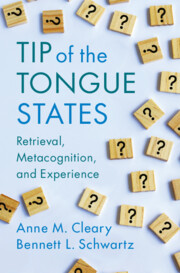
The tip-of-the-tongue state-the feeling that something that we cannot recall is close to coming to mind-is a window onto many facets of the human mind. It lies at an intersection where memory mechanisms, language processes, attention, metacognition, conscious awareness, goal-driven behaviours, curiosity, and even decision-making and risk-taking all seem to cross. In this book, Anne Cleary and Bennett Schwartz explain how tip-of-the-tongue states fit into our overall cognitive systems and what they tell us about the nature of cognition and consciousness. The tip-of-the-tongue state can wield enormous power over our attentional focus and what we choose to do next, regardless of what we had been doing before the onset of the feeling. In short, it wields the ability to redirect our mind. Cleary and Schwartz's text will appeal to students and researchers interested in the workings of the mind and brain.
The chapter lays out the motivation for this particular study on discovery through reference to the cross-disciplinary nature of this inquiry and its potential for deepening our understanding of how new knowledge is generated beyond a focus on single or allied disciplines. Classical studies on discovery are acknowledged, and their contributions to the subject are described in appreciation. However, what happens when discovery is pursued across disciplines from the social, natural, and biomedical sciences?
The main focus of this chapter is on another class of actions (in addition to the habits discussed in Chapter 2) that don’t result from decision-making processes. So in that sense they aren’t intentional and don’t fit the standard belief-desire model. These are actions that are directly caused by affective states (emotions, desires, and so on). Some of these actions are merely expressive, whereas others give the appearance of being instrumental, and are generally (but mistakenly) interpreted as goal-directed. But the chapter begins with a review of some basic findings from affective science and neuroscience. This is to set up the discussion in this and later chapters.
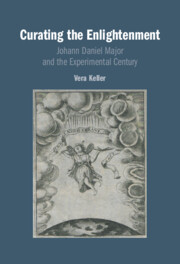
How did the research universities of the Enlightenment come into being? And what debt do they owe to scholars of the previous era? Focusing on the career of German polymath Johann Daniel Major (1634–93), Curating the Enlightenment uncovers how late seventeenth-century scholars crafted the research university as a haven for critical inquiry in defiance of political and economic pressures. Abandoning the surety of established intellectual practice, this 'experimental century' saw Major and his peers reshaping fragments of knowledge into new perspectives. Across new disciplines, from experimental philosophy to archaeology and museology, they reexamined what knowledge was, who it was for, and how it was to be stored, managed, accessed, judged, and transformed. Although later typecast as Baroque obstacles to be overcome by the Enlightenment, these academics arranged knowledge in dynamic infrastructures that encouraged its further advancement in later generations, including our own. This study examines these seventeenth-century practices as part of a continuous intellectual tradition and reconceptualizes our understanding of the Enlightenment.
This Element argues for an interpretation of Nietzsche on virtue according to which he believes that because different people have different constellations of instincts and other drives, and because instincts and drives can only be shaped and redirected within boundaries, he recommends different virtues as fitting and conducive to flourishing for different types of people. In his own way, these include curiosity, intellectual courage, the pathos of distance, having a sense of humor, and solitude. This interpretation is supported by both a digital humanities methodology and close readings of passages from Nietzsche's middle, mature, and late works.
The inclination to withdraw himself from the public as far as possible is regarded as one of Virgil’s most salient characteristics: this at least is the impression given by the few testimonia and numerous anecdotes of his life. The guiding principle of Virgil’s life as a poet of the res publica Romana could be described as an ‘art of disappearing’, which becomes evident in different ways. By means of this Virgil sometimes succeeds in withdrawing himself spatially even from Augustus, the mightiest designer of space, and in establishing certain limits to his ‘topotactic’ power. To present the ‘withdrawing technique’ practised by Virgil, this chapter draws on information gathered from biographical texts on Virgil as well as on relevant passages of Virgil’s work, naturally without ignoring the documentary fragility of the texts considered. Nevertheless there are conspicuous correspondences between the texts about Virgil and the poetological messages within his literary works, which give an impression at least of his effective seclusion. His reception by his contemporaries and immediate successors proves his greatest success in this respect.
This Element posits that questions are the heart of leadership. Leaders ask hard questions that spark creative solutions and new understandings. Asking by itself isn't enough - leaders must also help find answers and turn them into effective action. But the leader's work begins with questions. This Element surveys the main traditions of leadership thought; considers the nature of the group and its questions; explores how culture and bureaucracy serve to provide stable answers to the group's questions; and explores how leaders offers disruptive answers, especially in times of change and crisis. It uses the lens of questions to consider two parallel American lives, President Abraham Lincoln and General Robert E. Lee.
We propose that the processes underlying insight problem solving in humans depend on two distinctly different forms of curiosity: Curiosity1 (which is associated with a habit-based, goal-centered, reinforcement learning processing system), and Curiosity2 (which depends on the discursive, default mode, medial-temporal-lobe based processing system). The former kind of curiosity is goal directed and increases with approach to the rewarding answer. The latter is exploratory and goal averse: “twiddling.” The possibility of insight, we suggest, depends upon the individual initiating a deliberate system switch upon apprehension of an impasse. Problem solving involves engaging in a habitual mode of responding and motivation by Curiosity1. With insight problems, however, this normal mode fails to lead to a solution, and impasse results. Acknowledgment of the impasse may trigger a strategic switch to a different kind of curiosity and information processing system: the discursive, default mode Curiosity2 system, wherein the solution that was previously unavailable may be found. This view is consistent with traditional stages posited to be involved in insight problem solving. However, several paradigms used to study creativity or investigate 'Aha!' reactions do not fit easily with this view of insight. Using this perspective, we evaluate the evidence for insight in nonhuman animals.
What makes us durable in alone time is a combination of background, personality, mindset, approach, and mental tools. It may come as no surprise that adaptable, confident, and optimistic people are better at alone time, because those traits are important for resilience in any context. But we are also learning that those who are able to stop and introspect, who are generally curious and self-reliant, flourish when they’re alone. Perhaps more importantly, how we perceive solitude can make or break that time. Being able to see value or meaning in it, even when we must be alone, is critical. Feeling that we have interesting and challenging activities in that space also makes it more enjoyable.