To save content items to your account,
please confirm that you agree to abide by our usage policies.
If this is the first time you use this feature, you will be asked to authorise Cambridge Core to connect with your account.
Find out more about saving content to .
To save content items to your Kindle, first ensure no-reply@cambridge.org
is added to your Approved Personal Document E-mail List under your Personal Document Settings
on the Manage Your Content and Devices page of your Amazon account. Then enter the ‘name’ part
of your Kindle email address below.
Find out more about saving to your Kindle.
Note you can select to save to either the @free.kindle.com or @kindle.com variations.
‘@free.kindle.com’ emails are free but can only be saved to your device when it is connected to wi-fi.
‘@kindle.com’ emails can be delivered even when you are not connected to wi-fi, but note that service fees apply.
Disability is an unspoken aspect that is overshadowed by larger issues in Aboriginal and Torres Strait Islander education. Young Aboriginal and/or Torres Strait Islander people with a disability often fall through the cracks in the education system, with their disability not recognised or not supported. The presentation of their disability in the classroom is routinely mis-characterised as behavioural issues rather than a learning disability requiring specific support, an assumption that leads to excessively high rates of suspension and expulsion when disability is a factor in the education of Aboriginal and/or Torres Strait Islander children and young people.
Inclusion is a term used frequently, but what does it really mean? Inclusion in its simplest term is ‘the action or state of including or of being included within a group or structure’ (Oxford Dictionary). This is a fundamental right of all people, but unfortunately when diversity exists, this is not a right afforded to everyone. The Oxford Dictionary has an alternate definition which elaborates on this initial one. Inclusion is also defined as ‘the practice or policy or providing equal access to opportunities and resources for people who might otherwise be excluded or marginalized, such as those who have physical or intellectual disabilities and members of other minority groups’. As recognised in this definition, inclusion is about opportunities for all, including those with disability, developmental delay, neurodivergence, mental health difficulties, cultural diversity, variations in socio-economic status, LGBTQIA+ people, gender diversity, people experiencing trauma, unique family structures, and Aboriginal and Torres Strait Islanders, just to name a few! While there are differences in what every individual needs to be included, the principles of inclusion and the foundation of everyone having the same rights, should not change.
Collaboration is essential to inclusive practice, ensuring that children with disabilities, developmental differences and neurodivergence receive holistic, coordinated and high-quality support. A collaborative, team-based approach allows children to experience inclusive, responsive learning environments where interventions are seamlessly integrated into their everyday experiences. Research has demonstrated that when educators, allied health professionals, and families work together, children’s learning and development are enhanced, leading to greater participation, engagement and wellbeing.
When we think about inclusion in early childhood education, our minds often turn immediately to children with disabilities. While supporting children with diverse abilities remains crucial, true inclusion extends far beyond this single lens. Inclusion is fundamentally about creating environments where every child, regardless of their cultural background, family circumstances, language or life experiences, can belong, participate and thrive.
Since the 19th century, the U.S. military has grown increasingly adept at saving the lives of troops injured in combat. Yet rising survivability rates, coupled with social attitudes linking disability to diminished manhood and economic dependency, contributed to a perceived national crisis about what came to be known as the “problem of the disabled veteran” (PDV). What is U.S. federal policy toward disabled veterans? What is its aim—to keep veterans alive or to help them reintegrate into postwar society? And how might the U.S. military curb disability in future conflicts? Drawing upon works in disability studies, military history, and war and society studies, this chapter surveys the evolution of U.S. efforts to solve the PDV, from the colonial era to the present. In World War I, when the term originated, anxieties about war disability prompted the federal government to embrace the policy of veterans’ rehabilitation. In later years, the military would explore other ways to limit U.S. wartime casualties, disabled or otherwise. Ultimately, this chapter argues that the PDV stems from the United States’ failure to come to terms with the violence and trauma of military conflict.
Throughout human history, individuals with impairments have encountered significant challenges, often living in hardship with limited opportunities for social, economic and cultural participation. Societies have responded to impairment with superstition and prejudice, which have contributed to marginalisation and exclusion. Disability identity is a complex concept; for some, it is a personal journey, while for others, it represents a political statement. Māori do not typically identify with the Western biomedical notion of disability. Instead, they prefer to frame their experiences through a cultural lens, using terms such as whānau hauā or Mana whaikaha. However, it is important to acknowledge that the term Mana whaikaha was introduced without broad consultation within the Māori disabled community. Other iwi and hapū may have their own terms; Māori should be free to self-identify in ways that align with their lived realities, without imposed terminology.
This chapter offers readers perspective on ideals and practices that shaped health-related treatment of former service members from the Revolutionary period through the end of the Cold War. Studying how veterans fought for and accessed health services over two centuries offers a compelling view of the wide-ranging impacts of military endeavors on policy and politics and on the individual lives of service members and civilians. It also brings into sharp relief the extent to which norms of civilian society – for example, changing perceptions of how diseases are classified and what constitutes proper care – influence wars and perceptions of them. Broadly, the chapter shows that, while veterans’ care became more bureaucratized and institutionalized over time, some realities were constant: the nature and extent of available services, and the ways people interpreted them, were dictated by former service members’ advocacy, as well as prevailing notions about governmental responsibility, illness and disease, disability, and medical practice. Most broadly, the history of veterans’ experiences related to health care reveals that war and society are inextricably and intricately linked.
Human flourishing is a fundamental goal of most societies, and various theories have approached this concept, including the International Classification of Functioning, Disability, and Health (ICF), the job demands-resources (JD-R) model, self-determination theory (SDT), and the integrative model of behavioural prediction (IMBP). These theories focus on different aspects of well-being and the factors that influence an individual’s ability to lead a fulfilling life. This chapter aims to explore the capability approach (CA) and examines how it complements and connects with these existing theories. This chapter demonstrates how, by emphasising the importance of individual capabilities and human agency, the CA broadens the applicability of these theories. Unlike classical models that focus primarily on analysing situations, the CA highlights the broader context, aiming to enhance flourishing by considering situational determinants and the impact of contextual factors on an individual’s ability to make meaningful choices. This chapter contributes to a more nuanced understanding of human flourishing by illustrating the synergies between the CA model and other theoretical models. It argues that to be truly comprehensive and effective in the real world, theories must embrace the transformative potential of the CA.
I argue against John, Millum and Wasserman’s position that telic prioritarianism justifies morally acceptable discrimination against persons with disabilities. I propose alternative considerations that explain why disability discrimination in the lifesaving cases JMW discuss is morally problematic.
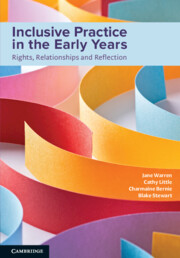
Inclusion is about recognising the rights of every person and ensuring that equitable opportunities exist for all. Inclusive Practice in the Early Years provides pre-service and in-service early childhood teachers and educators with theoretical guidance and practical strategies to allow all children to participate meaningfully in learning. Inclusive Practice in the Early Years focuses on the inclusion of children with disability, developmental delay and neurodivergence from birth to five years. The book also highlights the importance of recognising inclusive principles that apply to a wider range of diversity including Aboriginal and Torres Strait Islander children, refugee and migrant children, children who have experienced trauma and families experiencing disadvantage. Developed by authors with extensive experience across early childhood education, disability, community, and allied health, this text provides valuable information and strategies to support both pre-service and in-service teachers and practitioners to develop an inclusive practice.
The judge delegate system continued throughout the late Middle Ages and into the early modern period. The documents examined in the chapter reveal it in operation in the fifteenth and sixteenth centuries: a marriage case; a request for the dispensation required for ordination; a dispute between an exempt monastery and the local bishop; a case in which the plaintiff feared violence if the trial were held in his home town; an administrative innovation designed to facilitate demand for delegated justice; and the system of synodal judges established by the Council of Trent.
This chapter argues that throughout his prose works, Wilde demonstrates ambivalence regarding the significance of fashion in relation to flesh, and this chapter traces that ambivalence through texts including The Picture of Dorian Gray, De Profundis, and “The Birthday of the Infanta.” Treating ugliness and beauty, monstrosity and martyrdom, this chapter demonstrates Oscar Wilde’s continued fascination with beautiful flesh that is betrayed as such flesh decays, rots, and becomes loose and baggy, like an ill-fitting garment. Wilde writes against the backdrop of eugenicist discourse, which proves a foil to his aesthetic project while simultaneously animating his response to criminal charges against him for gross indecency. But Wilde also looks to an earlier precedent to work out questions of flesh and fashion, particularly that of baroque painting and sculpture by artists such as Guido Reni and Gianlorenzo Bernini in their representations of the flesh of martyrs. The world remains unsure whether Wilde was a monster or a martyr; this chapter shows that Wilde himself shared those concerns.
This paper draws on feminist disability scholarship on care to examine the figure of a sacrificial mother located within the moral unit of family, which is identified as central to the public discourse of disability around the Kasargod-endosulfan episode. It is an instance of pesticide poisoning that resulted in the acquisition of disabilities by the populations living in the region. The paper argues that the figure of the sacrificial mother who forsakes her job and social life is discursively constructed by feminised notions of care, absence of formal care structures, and the state’s imagination of care as a packageable/givable product. Caregiving has often been thought of as a linear process or mobilised as a moral force to organise familial structures or care containments. By reflecting on the ethnographic fieldnotes and interviews with mothers of endosulfan-affected people at a private care home in the Indian state of Kerala, the study attempts to locate ways in which disability-care destabilises these containments. It also deliberates on the possibilities of socialities and solidarities enabled by disability-care, forming newer spatialities.
Chapters 2 and 3 form the ethnographic heart of the book, exploring the economic niches that form an informal welfare system largely reserved for disabled people. Chapter 2 considers brokering at the Kinshasa-Brazzaville border, an activity viewed by some as ‘given’ by the state as a form of compensation for the lack of social welfare. Examining in detail the dynamics of community and the activities performed at the border, the chapter shows how the social values underpinning personal relationships were tested in the moral dilemmas over a common rhetoric of individualism: ‘fending-for-yourself’ rather than caring for mutually dependent relationships. A moral emphasis on the value and nature of professional relationships was shaped by the knowledge that life and work at the border might only ever be a temporary arrangement, as the most dramatic incarnations of ’crisis’ (mpiaka) drew attention to the temporal frame in which these value debates took place.
In the previous chapter we looked at how we use and understand language, now let’s look at the ways that people lose language and also experience language difficulties of various kinds. These aren’t the normal errors and mistakes we’ve already discussed, but are the result of disability, disease, disorder, brain injury, and other factors that can affect speech use and understanding and further impair the ability to read and write. In the US alone, between five to ten percent of the population have various types of communication disorders. The figures are even higher for learning disorders such as dyslexia. All in all, this amounts to millions of people who live with language differences. This chapter discusses how both developmental and acquired disorders affect language processing and production.
Chapter 4 examines local concepts of right(s), dissecting the ways in which brokering and begging were viewed as charitable compensations for the lack of government protection for disabled people, but claimed by the recipients as forms of work. Aspiring to have their activities recognised as rights, they spoke a local language of entitlement that conflated the value of independent work with the ethical and political right to care, asserting obligatory rights or taxes, against the donors’ perception of gifts. The language of ‘rights’ is a space of mutual evaluation, a rich and powerful language for discussing issues of inequality, membership, personhood, welfare, and power in Kinshasa today. It is perhaps most significant as a claim for distribution than as a legal premise of entitlements. Here, the question of a rightful share becomes pertinent, as givers and receivers evoked differing views on the same transaction that expressed contradictory aspirations and values. In the absence of formal institutions to enforce informal disability privileges, people had to recognise the right to be beggars or brokers on an interpersonal level, requiring constant value tests on whether claims to assistance were legitimate. The chapter thus disrupts the classic Maussian focus on giving and production to consider the moral and political controversies associated with asking and distribution.
Chapter 3 considers another prominent economic activity, the particular form of begging known as ‘doing documents’. Examining the performances and invocations of this practice, the chapter considers how the documents produced by these beggars attempted to legitimate the act of begging through formalisation and bureaucracy. This reflected an ideal of a valuable form of dependency, but conflicted with a moral logic of the dignity of independence and honest work. As such, the sentiment of conviviality and official regularity conveyed by the document was frequently at odds with the practice of exchange itself: donors frequently viewed disabled people as suspect and aggressive. This chapter examines the debates that ‘doing documents’ provokes on who is ‘deserving’, what kind of work is ‘honest’, and whether or not begging is truly work. Desiring shallow relationships with many donors, the beggars aimed to build ‘contractual dependencies’ with them, deploying the symbolism of the bureaucratic (social) contract both to enforce and limit the relationship.
The first chapter provides an orientation in the lives of disabled people in Kinshasa through a consideration of how the interlocutors were identified and identified themselves as disabled, as handicapé – a relatively narrowly defined and recently agreed-upon category of persons. People sometimes overtly pursued this identity for the occasional advantages it could provide, but recognition as an handicapé, and enforcing associated privileges, is far from straightforward. Rather than a depoliticised knowable fact of the body, making handicapé into a recognised identity continues to be politically contested and destabilised, among others through internal rivalries among disabled people and between their organisations. The chapter thus considers the role of a wide variety of disabled peoples’ organisations, and especially the bureaucracy represented by their membership cards, as means of establishing disability status. ‘Real’ membership and leadership was ultimately uncertain and based on constant mutual evaluation. Keeping uncertainties alive allows for an expression of values on the distribution of resources, while creating a productive uncertainty around the question of membership itself.
The Conclusion urges us to consider practices that lead to becoming ‘valuable people’ as something that goes beyond overcoming stigma to changing the evaluations that define what is good. It brings the discussions about values together with a final example of how my interlocutors pursued valued inclusion, by embracing a biomedical model of personhood where people are judged on their minds rather than on their bodies. This draws attention to the wider relevance of questions of entitlement, distribution, and values: wherever my interlocutors went, discussions of values followed.
The Introduction combines a contextual introduction to disability in Kinshasa with an outline of the research problem as the tension between exceptionality and normality in a city that has long defined itself as in ‘crisis’. The interlocutors, their city, the times in which they lived, and their livelihood activities were all subject to ambiguous judgements as to whether they stood out as a negative or positive example, or if they were better viewed as simply part of the general experience of life in the wider community. The Introduction thus outlines the focus on mobility-impaired people in the grey area between work and welfare, where ‘crisis’ (mpiaka) opens a discursive space for experimentation, critique, and evaluation. The unpredictability that marks life in Kinshasa, in this respect, leads people to constantly reckon their social and economic value projects in relation to time. The Introduction introduces how crisis confronts people with choices of realising the short-term values of ‘fending for yourself’ or the long-term values of cultivating dependent relationships.