Refine search
Actions for selected content:
71 results
3: - Staging Race in Greek Drama
- from Part I - Race and the Premodern Era
-
-
- Book:
- The Cambridge Companion to Classics and Race
- Published online:
- 07 May 2026
- Print publication:
- 21 May 2026, pp 73-97
-
- Chapter
- Export citation
ODYSSEUS’ CHOICE OF LIFE IN THE MYTH OF ER: EURIPIDEAN PRECEDENT AND OLIGARCHIC LANGUAGE
-
- Journal:
- The Classical Quarterly , First View
- Published online by Cambridge University Press:
- 17 April 2026, pp. 1-14
-
- Article
-
- You have access
- Open access
- HTML
- Export citation
Zacchaeus Baccheus. The Jericho Episode in Luke 19.1–10 and Euripides’ Bacchae
-
- Journal:
- New Testament Studies , First View
- Published online by Cambridge University Press:
- 27 March 2026, pp. 1-7
-
- Article
- Export citation
Chapter 7 - Master of Clarity: The Utterances of Zeus Dodonaios in Fifth-Century Tragedy
- from Part II - Consultation and Cognition
-
-
- Book:
- Visiting the Oracle at Dodona
- Published online:
- 26 February 2026
- Print publication:
- 12 March 2026, pp 147-168
-
- Chapter
-
- You have access
- Open access
- HTML
- Export citation
TREASON AND ATIMIA IN FIFTH-CENTURY ATHENS: THE EVIDENCE FROM TRAGEDY
-
- Journal:
- Greece & Rome / Volume 73 / Issue 1 / April 2026
- Published online by Cambridge University Press:
- 10 March 2026, pp. 123-148
- Print publication:
- April 2026
-
- Article
- Export citation
EURIPIDES, PROTESILAVS FR. 646A KANNICHT
-
- Journal:
- The Classical Quarterly , First View
- Published online by Cambridge University Press:
- 29 January 2026, pp. 1-4
-
- Article
- Export citation
Chapter 16 - Aeschylus, Sophocles, and Euripides
- from Part III - Individuals
-
-
- Book:
- Personal Religion in the Ancient Greek World
- Published online:
- 25 November 2025
- Print publication:
- 11 December 2025, pp 361-386
-
- Chapter
- Export citation
Chapter 5 - Tragedy and the Best Life in the Gorgias
-
- Book:
- Plato on Comedy and Tragedy
- Published online:
- 24 October 2025
- Print publication:
- 13 November 2025, pp 164-187
-
- Chapter
- Export citation
Chapter 1 - Fragmenting the Chorus
-
- Book:
- Playing the Chorus in Greek Tragedy
- Published online:
- 23 October 2025
- Print publication:
- 06 November 2025, pp 26-95
-
- Chapter
- Export citation
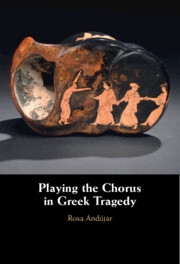
Playing the Chorus in Greek Tragedy
-
- Published online:
- 23 October 2025
- Print publication:
- 06 November 2025
P.Oxy. 2456 and the chronology of Euripides
-
- Journal:
- The Journal of Hellenic Studies / Volume 145 / November 2025
- Published online by Cambridge University Press:
- 20 October 2025, pp. 232-245
- Print publication:
- November 2025
-
- Article
-
- You have access
- HTML
- Export citation
Chapter 3 - Theos Apo Mēchanēs
- from Part I - Greek Tragedy and Mechanical Epiphany
-
- Book:
- Technologies of the Marvellous in Ancient Greek Religion
- Published online:
- 04 September 2025
- Print publication:
- 24 July 2025, pp 64-102
-
- Chapter
-
- You have access
- Open access
- HTML
- Export citation
οὔκουν OR οὐκοῦν? MANUSCRIPTS, EDITORS AND PRAGMATICS
-
- Journal:
- The Classical Quarterly / Volume 75 / Issue 1 / May 2025
- Published online by Cambridge University Press:
- 05 September 2025, pp. 93-109
- Print publication:
- May 2025
-
- Article
- Export citation
RETHINKING CLEMENT’S EURIPIDES: SOURCE AND SPECTACLE
-
- Journal:
- The Classical Quarterly / Volume 75 / Issue 1 / May 2025
- Published online by Cambridge University Press:
- 04 June 2025, pp. 454-470
- Print publication:
- May 2025
-
- Article
-
- You have access
- Open access
- HTML
- Export citation
EURIPIDES, HECUBA 1045
-
- Journal:
- The Classical Quarterly / Volume 75 / Issue 1 / May 2025
- Published online by Cambridge University Press:
- 21 May 2025, p. 498
- Print publication:
- May 2025
-
- Article
-
- You have access
- Open access
- HTML
- Export citation
Chapter 2 - The Double in Antiquity
-
- Book:
- Doppelgänger
- Published online:
- 13 March 2025
- Print publication:
- 20 March 2025, pp 18-32
-
- Chapter
- Export citation
DEATH, RESURRECTION, AND REALISM IN EURIPIDES’ ALCESTIS
-
- Journal:
- Greece & Rome / Volume 72 / Issue 1 / April 2025
- Published online by Cambridge University Press:
- 18 March 2025, pp. 109-125
- Print publication:
- April 2025
-
- Article
-
- You have access
- Open access
- HTML
- Export citation
EURIPIDES, HERACLES 767
-
- Journal:
- The Classical Quarterly / Volume 74 / Issue 2 / December 2024
- Published online by Cambridge University Press:
- 09 May 2025, pp. 776-779
- Print publication:
- December 2024
-
- Article
- Export citation
VIRGIL AND THE RHESVS ATTRIBUTED TO EURIPIDES: AN UNNOTICED ALLUSION AT AENEID 1.25–7?
-
- Journal:
- The Classical Quarterly / Volume 74 / Issue 2 / December 2024
- Published online by Cambridge University Press:
- 07 March 2025, pp. 611-617
- Print publication:
- December 2024
-
- Article
-
- You have access
- Open access
- HTML
- Export citation
Chapter 3 - “What is Greece if you draw back?”
- from Part II - “I don’t want to write it”
-
- Book:
- Modernist Hellenism
- Published online:
- 21 November 2024
- Print publication:
- 28 November 2024, pp 135-195
-
- Chapter
- Export citation
