To save content items to your account,
please confirm that you agree to abide by our usage policies.
If this is the first time you use this feature, you will be asked to authorise Cambridge Core to connect with your account.
Find out more about saving content to .
To save content items to your Kindle, first ensure no-reply@cambridge.org
is added to your Approved Personal Document E-mail List under your Personal Document Settings
on the Manage Your Content and Devices page of your Amazon account. Then enter the ‘name’ part
of your Kindle email address below.
Find out more about saving to your Kindle.
Note you can select to save to either the @free.kindle.com or @kindle.com variations.
‘@free.kindle.com’ emails are free but can only be saved to your device when it is connected to wi-fi.
‘@kindle.com’ emails can be delivered even when you are not connected to wi-fi, but note that service fees apply.
This chapter explores Allen Ginsberg’s stay at the now-famous Beat Hotel. Ginsberg, along with his lover Peter Orlovsky and fellow Beat poet Gregory Corso, spent an important sojourn at this spot in Paris. Located in the Latin Quarter, this run-down hotel would come to house other Beats such as William S. Burroughs and Harold Norse as well. Ginsberg’s time there was productive. He produced “At Apollinaire’s Grave” while in Paris and began his long poem “Kaddish” as well, while simultaneously seeing the sights and meeting a variety of famous French poets and artists.
This chapter examines Sadr’s Falsafatuna and Iqtisaduna as seminal Islamic responses to the ideological and philosophical upheavals of mid-twentieth-century Iraq. Against the backdrop of the radical political transformations that culminated in the 1958 July Revolution and the subsequent contest over Iraq’s national identity – between Pan-Arab and territorial nationalists, communists, and Islamists – Sadr sought to articulate a civilizational project rooted in Islamic metaphysics, social ethics, and epistemology. Through a rigorous critique of Marxist materialism, Western empiricism, and behavioral psychology, he constructs a modern Islamic philosophy grounded in rationalist epistemology and natural theology. Engaging with Sunni revivalist thought, Arab existentialism, and emerging discourses in psychology and economics, Sadr formulated elements of an Islamic moral economy and philosophical paradigm that confronted the ideological pluralism of his time. His work repositions metaphysics within the intellectual struggle for decolonization and articulates a modern Islamic worldview aimed at promoting theism, spiritual renewal, and social justice.
In Chapter 4, I (a) explore three alternative perfectionist theories and show where they fall short. I then (b) move on to three critiques of perfectionism, arguing that they all fail. (a) Tom Hurka’s perfectionist theory jettisons teleological essentialism, yet tacitly relies on it. It advocates an ‘intuitive’ and ‘explanatory’ elucidation of the human essence, though these are not demonstratively superior to Aristotle’s rival method. George Sher’s ‘poor man’s Aristotelianism’ proves similarly unconvincing, yielding (by his own admission) an incomplete roster of perfections. Richard Boyd’s ‘homeostatic cluster’ theory, for its part, also falls short, relying on an intuitionistic and question-begging notion of ‘human need’. (b) Dale Dorsey’s critique of perfectionism fails to grasp the teleological nature of Aristotelian essentialism and relies on a defeasible set of counter-examples. Philip Kitcher’s critique centres on a ‘reductivist challenge’, which assumes (wrongly, I argue) that human nature must be characterisable in a wholly ‘value-free’ way. Last, I tackle the ‘analytic existentialist’ critique, which relies too heavily (I argue) on metaphor and normative abstraction.
This chapter explores the approach of the Italian Thomist and Kierkegaard scholar, Fr. Cornelio Fabro (1911–1995), to move contemporary scholarly discussions toward consensus regarding the dialogue between Thomism and continental philosophy, which centers on the question of the meaning of being (esse) and contingency. The central observation is that what is now taken as the canonical Thomist view of creation and freedom is indebted to Fabro’s research on the metaphysics of participation. For Fabro, the forgetfulness of being that Heidegger rightly identifies loses its way with the forgetfulness of the act of being. By distinguishing esse from existentia with Fabro’s notion of participation and act of being (actus essendi), Fabro’s Thomism avoids Cartesian dualism and phenomenological monism, which opens a constructive dialogue with continental thought. Briefly rehearsing Fabro’s metaphysical distinction between factical existence (existentia) and being (esse) illuminates Fabro’s critical evaluation of continental thought as a speculative scheme of necessary emanation or pure immanence. The chapter concludes that the best way to approach this question is not to limit it to the empirical realm of factical existence (existentia) but rather to open up the existential question to the metaphysics of creation ex nihilo.
This manifesto argues that education should incorporate philosophical exploration to help young people address existential questions and find meaning and purpose in their lives. The manifesto suggests that to understand the meaning of one’s life, one must consider personal existence and consciousness and the reality beyond the here and now. It proposes that education should provide a neutral forum for discussing these big questions, without bias towards any particular belief system, and incorporating both scientific and spiritual perspectives. By engaging in such philosophical discourse, young people can develop a clearer sense of self and purpose, fostering resilience, mental well-being and a commitment to values and moral behaviour. This can support them to survive and thrive through the opportunities and challenges of the future.
Although the concept of concept did not play a central role in twentieth-century phenomenology, what Heidegger and Merleau-Ponty thought about concepts can be inferred indirectly from what they did say about understanding, cognition and judgement. Heidegger’s approach to cognition by way of a phenomenology of assertion, for example, implies an identification of concepts with the meanings of words. Similarly, Merleau-Ponty stresses the dependence of conceptual thought on perceptual experience and bodily skill. Concepts play a more prominent role in Gadamer’s philosophical hermeneutics, particularly in his distinction between the essential ongoing formation of concepts in the interpretation of texts, and their methodical application in the natural sciences.
The concern of this chapter is with varieties of philosophical humanism and their own conceptions of the nature and significance of science. After an initial characterization of major themes in Renaissance humanism, it describes three main varieties that are evident in twentieth-century European philosophy – humanism as essentialism, humanism as rational subjectivity, and existential humanism. Different varieties of humanism are associated with different conceptions of science, some allied to the sciences, others antipathetic to them, while yet others offer subtler positions. The upshot is that there are different tales to tell about the relationship of (varieties of) philosophical humanism to (conceptions of) science, only some of which fit popular modern celebratory claims about a necessary alliance of humanism and science. If we take a wider look at the history of philosophy, we find ongoing experimentation with forms of humanism and explorations of diverse ways of understanding and evaluating scientific knowledge and ambitions. What we find is what we ought to expect of social, creative, epistemically sophisticated, self-expressive creatures: endless variety.
Part of the fascination of Being and Time is that it seeks to weave together so many different strands of thought. But unsurprisingly, its readers also worry that such a work must subject itself to such strain that ultimately it itself must unravel. Key tensions are between the outlooks of three figures: Heidegger the pragmatist, Heidegger the existentialist, and Heidegger the philosopher of being. Seeing how openness to our concerns as a whole is both necessary for authenticity and reveals a unified horizon against which entities with different ways of being show themselves, dissipates these apparent tensions. Recognition of the mediating role played by a conception of the good – that Heidegger’s reading of Aristotle and Augustine inspired – helps make clear that authenticity is both compatible with the practical embeddedness of our concerns and reveals a form of understanding necessary for ontology to be possible.
This chapter explores the connection between Heidegger’s existentialism and fundamental ontology. Specifically, and contra John Haugeland who argues that existentialism is a key feature of fundamental ontology insofar as taking responsibility for our existence entails getting the being of entities right, this chapter argues that taking responsibility for our existence explicitly exhibits the temporal horizon that is fundamental for all our purpose activities and our understanding of entities, generally.
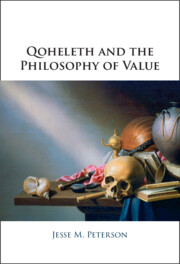
The book of Ecclesiastes is the Bible's problem child. Its probing doubts, dark ruminations, self-reflexive dialogues, and unflinching observations have simultaneously puzzled and fascinated readers for over two millennia. Some read the book's message as hopelessly pessimistic, while others regard the text as too contradictory to bear any consistent message at all. In this study, Jesse Peterson offers a coherent portrait of the book and its author—the early Jewish sage known as Qoheleth—by examining both through a philosophical lens. Drawing from relevant contemporary philosophical literature on meaning in life, death, well-being, and enjoyment, Peterson outlines a clear and compelling portrait of Qoheleth and his philosophical assumptions about what is good and bad in the human experience. As Peterson argues, Qoheleth's grievances concerning the pursuit of meaning in life are paired with a genuine affirmation of life's value and the possibility of a joy-filled existence.
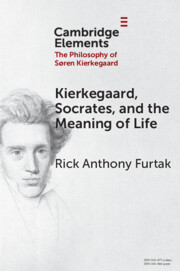
Kierkegaard's lifelong fascination with the figure of Socrates has many aspects, but prominent among them is his admiration for the way Socrates was devoted to his divinely ordained mission as a philosopher. To have such a destiny, revealed through what one loves and is passionate about as well as through a feeling of vocation, is a necessary condition of leading a meaningful life, according to Kierkegaard. Examining what Kierkegaard has to say about the meaning of life requires looking at his conception of 'subjective truth,' as well as how he understands the ancient ideal of 'amor fati,' a notion that Nietzsche would subsequently take up, but that Kierkegaard understands in a manner that is distinctly his own, and that he sought to put into practice in his own existence. Our life is a work of art, but we are not the artist.
Chapter 6 sets out in detail Paul Tillich’s formulation of the doctrine of salvation. Particular focus is placed upon Tillich’s existentialist framing of fallenness and his understanding of personal salvation as a transformation from Old Being to New Being.
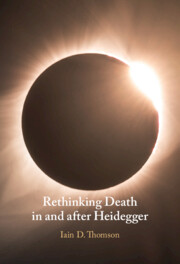
Iain D. Thomson is renowned for radically rethinking Heidegger's views on metaphysics, technology, education, art, and history, and in this book, he presents a compelling rereading of Heidegger's important and influential understanding of existential death. Thomson lucidly explains how Heidegger's phenomenology of existential death led directly to the insights which forced him to abandon Being and Time's guiding pursuit of a fundamental ontology, and thus how his early, pro-metaphysical work gave way to his later efforts to do justice to being in its real phenomenological richness and complexity. He also examines and clarifies the often abstruse responses to Heidegger's rethinking of death in Levinas, Derrida, Agamben, Beauvoir, and others, explaining the enduring significance of this work for ongoing efforts to think clearly about death, mortality, education, and politics. The result is a powerful and illuminating study of Heidegger's understanding of existential death and its enduring importance for philosophy and life.
George Lamming’s novels (1953–1972) are legible as novels of ideas in at least three senses. All six devote substantial space to exchanges of ideas or solitary philosophical reflection. All feature characters who allegorize ideas or serve as vehicles for their enunciation. And all are narratively propelled by figures intensely devoted to an aspiration, cause, model, or imagined destiny. Lamming’s own remarks on his attraction to the novel of ideas, along with his representation of Toussaint L’Ouverture in the nonfictional Pleasures of Exile, underscore how in Lamming ideas are not (as has been asserted of other novels of ideas) decorative or disconnected from mundane existence. Rather, they emerge from the enduring matrix of colonialism in a way that renders obsessives different in degree, rather than kind, from (post)colonial subjects whose daily experience shapes them in less evidently striking ways.
This chapter endeavors to explain Heidegger’s intertwined thinking about death and “the nothing” and explore the ontological significance of this connection. As we have seen, “death” (Tod) is Heidegger’s name for a stark and desolate phenomenon in which Dasein (that is, our world-disclosive “being-here”) encounters its own end, the end “most proper” to the distinctive kind of entity that Dasein is. Being and Time’s phenomenology of death is primarily concerned to understand Dasein’s death ontologically. Heidegger is asking what the phenomenon of our own individual deaths reveals to us all about the nature of our common human being, that is, our Dasein (and what that discloses, in turn, about the nature of being in general). Understood ontologically, “death” designates Dasein’s encounter with the end of its own world-disclosure, the end of that particular way of becoming intelligible in time that uniquely “distinguishes” Dasein from all other kinds of entities (BT 32/SZ 12).
This introductory chapter seeks to answer the question of what Heidegger means by “death” (Tod) in Being and Time – and begin to justify that answer. I take up this weighty topic with some trepidation (if not quite fear and trembling) in part because to say that the meaning of “death” in Being and Time is controversial is to strain the limits of understatement. In addition to the emotionally freighted nature of the topic itself (to which we will return), I think four main factors contribute to and perpetuate this controversy: (1) Heidegger’s confusing terminology; (2) the centrality of the issue to the text as a whole; (3) the demanding nature of what is required to adjudicate the matter; and (4) the radically polarized scholarly literature on the subject. One of my main goals here is to suggest a way to move beyond the controversy that currently divides the field, so let me begin by saying a bit about its four main contributing factors.
Moral and pragmatist sociology has studied capitalism as a set of institutions that require justification, which has historically been offered through forms of rewarding and meaningful work, anchoring the human life course in a narrative of individual and collective progress. However, emerging with neoliberalism, then becoming explicit after 2008, contemporary capitalism has become organised around the logic of assets and wealth as opposed to labour and production. This provokes a vacuum of justification. Once all actors are (as Minsky argued) balance sheet actors and profit becomes a function of sheer temporality, the economy ceases to function as a moral order and instead becomes imbued with existential concerns of temporality, durability, survival, and finitude. Possessed only of certain contingently acquired assets and liabilities, the self becomes wholly contingent in the sense described by Heidegger; that is, as ‘thrown’ into having had a past and into a relationship of ‘care’ towards the future. The article identifies symptoms of this existential condition in empirical studies of wealth elites, for whom (in the absence of conventional liberal and production-based measures of worth) problems of meaning, purpose, and finitude are endemic.
In the aftermath of the atomic bombings of Hiroshima and Nagasaki and under the growing threat of planetary cataclysm, an array of prominent intellectuals grappled with the significance of nuclear war for the human condition and reflected upon the possibilities of escaping its peril. Following on the early interventions of Albert Camus and Jean-Paul Sartre, the collected thoughts of Karl Jaspers, Hans Morgenthau, and Günther Anders outline a philosophical current of ‘nuclear existentialism’ preoccupied with the nihilistic ‘being-towards-species-death’ entailed by the advent of the Bomb. Faced with the apparent negation of reason in bringing about the means of its own destruction through the scientific piercing of nature’s innermost workings, the nuclear existentialists end up reaffirming, however precariously, a teleological conception of history in which the apocalyptic fear of the Bomb figures as the necessary condition for the ultimate realisation of human freedom. In the light of the contemporary resurgence of nuclear anxiety, this article surveys and critically assesses the corpus of nuclear existentialism, drawing upon the distinctive existential phenomenology of Emmanuel Levinas to trace a potential alternative for thinking life and death under the Bomb.
In this concluding chapter, I draw conclusions about several important aspects of nature of science by drawing on the topics discussed in the various chapters of the book. Such conclusions include: that individual brilliance and creativity can make a difference; the historical milieu of the individual is equally crucial; that scientists are humans with weaknesses and concerns like all of us; and that gender may influence one’s opportunities to contribute to science.