Refine search
Actions for selected content:
8 results
Small-time asymptotics and the emergence of complex singularities for the KdV equation
-
- Journal:
- Journal of Nonlinear Waves / Volume 2 / 2026
- Published online by Cambridge University Press:
- 05 March 2026, e6
-
- Article
-
- You have access
- Open access
- HTML
- Export citation
-
While real-valued solutions of the Korteweg–de Vries (KdV) equation have been studied extensively over the past 50 years, much less attention has been devoted to solution behaviour in the complex plane. Here we consider the analytic continuation of real solutions of KdV and investigate the role that complex-plane singularities play in early time solutions on the real line. We apply techniques of exponential asymptotics to derive the small-time behaviour for dispersive waves that propagate in one direction, and demonstrate how the amplitude, wavelength and speed of these waves depend on the strength and location of double-pole singularities of the initial condition in the complex plane. Using matched asymptotic expansions in the limit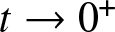 $t\rightarrow 0^+$, we show how complex singularities of the time-dependent solution of the KdV equation emerge from these double-pole singularities. Generically, their speed as they move from their initial position is of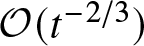 $\mathcal{O}(t^{-2/3})$, while the direction in which these singularities propagate initially is dictated by a Painlevé II (P $_{\mathrm{II}}$) problem with decreasing tritronquée solutions. The well-known $N$-soliton solutions of KdV correspond to rational solutions of P $_{\mathrm{II}}$ with a finite number of singularities; otherwise, we postulate that infinitely many complex-plane singularities of KdV solutions are born at each double-pole singularity of the initial condition. We also provide asymptotic results for some non-generic cases in which singularities propagate more slowly than in the generic case. Our study makes progress towards the goal of providing a complete description of KdV solutions in the complex plane and, in turn, of relating this behaviour to the solution on the real line.


A new asymptotic regime for the KdV equation with Wigner–von Neumann type initial data
- Part of
-
- Journal:
- Journal of Nonlinear Waves / Volume 1 / 2025
- Published online by Cambridge University Press:
- 20 November 2025, e20
-
- Article
-
- You have access
- Open access
- HTML
- Export citation
Exponential decay for the KdV equation on ℝ with new localized dampings
- Part of
-
- Journal:
- Proceedings of the Royal Society of Edinburgh. Section A: Mathematics / Volume 153 / Issue 4 / August 2023
- Published online by Cambridge University Press:
- 05 April 2022, pp. 1073-1098
- Print publication:
- August 2023
-
- Article
- Export citation
-
In this paper, we prove several results on the exponential decay in $L^{2}$
 norm of the KdV equation on the real line with localized dampings. First, for the linear KdV equation, the exponential decay holds if and only if the averages of the damping coefficient on all intervals of a fixed length have a positive lower bound. Moreover, under the same damping condition, the exponential decay holds for the (nonlinear) KdV equation with small initial data. Finally, with the aid of certain properties of propagation of regularity in Bourgain spaces for solutions of the associated linear system and the unique continuation property, the exponential decay for the KdV equation with large data holds if the damping coefficient has a positive lower bound on $E$
 , where $E$
 is equidistributed over the real line and the complement $E^{c}$
 has a finite Lebesgue measure.


14 - From Partial Differential Equations to Groups
-
-
- Book:
- Analysis and Geometry on Graphs and Manifolds
- Published online:
- 14 August 2020
- Print publication:
- 20 August 2020, pp 368-381
-
- Chapter
- Export citation
7 - Nonrelativistic Examples:WaterWaves and Surface Growth
- from Part I - General Properties of Fields; Scalars and Gauge Fields
-
- Book:
- Classical Field Theory
- Published online:
- 04 March 2019
- Print publication:
- 14 March 2019, pp 65-73
-
- Chapter
- Export citation
Analysis of an Implicit Fully Discrete Local Discontinuous Galerkin Method for the Time-Fractional Kdv Equation
-
- Journal:
- Advances in Applied Mathematics and Mechanics / Volume 7 / Issue 4 / August 2015
- Published online by Cambridge University Press:
- 29 May 2015, pp. 510-527
- Print publication:
- August 2015
-
- Article
- Export citation
On Numerical Solution of the Gardner–Ostrovsky Equation
-
- Journal:
- Mathematical Modelling of Natural Phenomena / Volume 7 / Issue 2 / 2012
- Published online by Cambridge University Press:
- 29 February 2012, pp. 113-130
- Print publication:
- 2012
-
- Article
- Export citation
Unique continuation and decay for the Korteweg-de Vries equation withlocalized damping
-
- Journal:
- ESAIM: Control, Optimisation and Calculus of Variations / Volume 11 / Issue 3 / July 2005
- Published online by Cambridge University Press:
- 15 July 2005, pp. 473-486
- Print publication:
- July 2005
-
- Article
- Export citation
