To save content items to your account,
please confirm that you agree to abide by our usage policies.
If this is the first time you use this feature, you will be asked to authorise Cambridge Core to connect with your account.
Find out more about saving content to .
To save content items to your Kindle, first ensure no-reply@cambridge.org
is added to your Approved Personal Document E-mail List under your Personal Document Settings
on the Manage Your Content and Devices page of your Amazon account. Then enter the ‘name’ part
of your Kindle email address below.
Find out more about saving to your Kindle.
Note you can select to save to either the @free.kindle.com or @kindle.com variations.
‘@free.kindle.com’ emails are free but can only be saved to your device when it is connected to wi-fi.
‘@kindle.com’ emails can be delivered even when you are not connected to wi-fi, but note that service fees apply.
This paper presents a corpus-based investigation of Latin volo ‘to want’, arguing that it exhibits previously overlooked reportative uses from at least the 1st century BCE, whereby speakers attribute beliefs, opinions, or statements to an external source. Focusing on third-person present-tense forms (vult, volunt) across a corpus spanning from the 3rd century BCE to the 2nd century CE, the study analyses the semantic, pragmatic, and morphosyntactic properties of these constructions, as well as their diachronic development. Reportative volo is shown to emerge from ambiguous contexts where volition and doxastic stance overlap – especially in small-clause constructions with subject coreferentiality or passive infinitives of verbs of opinion. Diachronically, it is proposed that the doxastic component – implicit in volitional uses and anchored in the volitional subject – becomes explicit, when the anchoring of an external doxastic source shifts from outside (i.e. the opinion of others) to the volitional subject, who is then reinterpreted as an evidential source. Comparisons with German wollen (and to a lesser extent with French vouloir) contextualise this development within a broader grammaticalisation path from volition to evidentiality. While wollen is already grammaticalised as a reportative marker, Latin volo offers novel diachronic and structurally distinct evidence for this cross-linguistic trajectory.
This chapter offers a new outlook on the history of Scots, a minority language related to English, up to 1700. Scots and its history have been a subject of pioneering work in historical linguistics, especially in historical dialectology and digital approaches to language change. The chapter takes stock of previous scholarship and the extra-linguistic events which shaped the linguistic situation in Scotland from the medieval period till the early eighteenth century. It then highlights problematic areas and questions related to constructing a narrative for a history of an unstandardised minority language, with special focus on defining Scots as a language of written communication, its family tree, periodisation and status, as well as metalinguistic perspectives. The discussion finishes with an overview of the most recent research on various aspects of structure and language use, and a summary of available resources for the study of historical Scots.
Scholarship on Scandinavian linguistics has long recognised an indigenous metalinguistic tradition, rooted in runic writing and skaldic poetry, that developed independently of Latin influence. This tradition coexisted with Latin learning in a dynamic interplay often termed ‘two cultures’, culminating in the Icelandic grammatical treatises (12th to 14th centuries). While debates persist over the treatises’ indigenous versus foreign influences, the methods of Latin teaching in medieval Iceland remain underexamined. Though recent work has addressed Latin textual presence and educational structures, the pedagogical techniques themselves – how Latin was taught – have yet to be explored. This study aims to fill this gap, analysing methods and techniques of teaching Latin in medieval Iceland and offering new insights into the negotiation of vernacular and Latin traditions.
The article discusses why Classics is important and why its study benefits not just university students but also young children. It was runner-up in the Intermediate Category for a Classical Association competition in 2025. The article explores the value of Classics as a wonderfully diverse subject involving the study of history, archaeology, architecture, art, and literature. Classics enables students to study over a thousand years of history, to uncover cultural values, to discover how language operates, to develop critical analysis skills, and to delight in its timeless literature. The article explores how the study of Classics can benefit young students’ reading and writing proficiency and can be especially beneficial for those with special educational needs. It explores how Latin translation builds code cracking and cognitive skills, not only developing grammatical knowledge but also encouraging problem-solving suited to science, technology, engineering, and mathematics (STEM)-based subjects such as computer science and maths. The article looks at the interdisciplinary nature of the subject and the benefits of learning Latin and Greek vocabulary for language learning and science.
Drawing on their classroom experiences, five secondary school language educators present how training in linguistics has positively impacted their pedagogical practices and increased student engagement, enjoyment, and motivation. These teachers of French, German, Latin, and Spanish describe how they bring linguistics into the L2 classroom, giving concrete examples of how the metalinguistic and social awareness that comes with “doing linguistics” can help students learn new languages by drawing on their L1 strengths, as well as gain an appreciation of the beauty and complexity of language, contributing to a welcoming classroom for students of all language backgrounds. These examples, alongside the student feedback described in the chapter, demonstrate that training teachers in linguistics has the potential to keep students curious and motivated, improving both student retention and learning outcomes in secondary L2 classes.
Latin poetry has always been defined by its relationships with poetry in other languages – first with poetry in ancient Greek, more recently with poetry in the European vernaculars. The Introduction defines the book less as a literary history of Latin poetry across languages, as such, than as a set of essays that offer test cases, sometimes limit cases, for such a literary history. What is promised is a book of intertextual juxtapositions, moving between extreme close-ups and broader treatments of intercultural relationality. A special interest is expressed in the possibilities of two-way poetic conversation across languages. The Introduction concludes with trailers for the book’s seven chapters.
The use of Latin alongside Greek in Roman soldiers’ private documents on papyrus or tablet has already been approached by modern scholarship. However, new evidence allows a further exploration of this topic and a reassessment of some of the results reached so far. Therefore, this chapter investigates three case studies based on this new evidence: the use of the tribal designation, the use of Latin in marriage agreements, and the use of Latin in Roman testaments. The following questions are addressed: What kind of Latin did Roman soldiers and veterans use? Under what circumstances? And why? What can we learn from new evidence? Does it strengthen or challenge traditional hypotheses? The investigation contributes to our understanding of the significance of written documentation in the daily lives of Roman soldiers and veterans and of the usages of the Latin language, script, or culture in their private documents. The new evidence considered sometimes strengthens and at other times challenges traditional hypotheses, showing how complex the relationship was between the Latin and Greek languages, scripts, and cultures in the Graeco-Roman eras.
The twelfth century witnessed an unprecedented scholarly effort to access and assimilate new corpora of knowledge by translating Greek as well as Arabic sources into Latin. This chapter surveys the various translations, discusses the role of those who mediated them to the Latin tradition, and finally focuses on the reception of the texts at the University of Paris during the first decades of the thirteenth century.
This article investigates the syntactic properties of deponents in finite and nonfinite contexts in several Indo-European languages (Vedic Sanskrit, Ancient Greek, Latin, Hittite, Modern Greek) and proposes a novel definition of deponency: deponents are morphologically nonactive verbs with noncanonical agent arguments that are merged below VoiceP. Since VoiceP is spelled out with nonactive morphology in those languages if it does not introduce an external argument itself, the result is a surface mismatch between morphological form and syntactic function. This proposal predicts that only certain nonfinite forms of deponents will surface with the syntax/morphology mismatch, namely, those that include VoiceP. Nominalizations without VoiceP will appear to suspend the voice mismatch. These predictions are shown to be correct with respect to the behavior of deponent participles in the languages under study.
This article explores a novel approach to Latin instruction grounded in the principles of the natural semantic metalanguage (NSM) and the Minimal Languages framework. Whilst recent developments in Latin pedagogy have increasingly embraced communicative methods, the selection of appropriate target vocabulary remains a critical challenge, especially when traditional frequency lists prioritise terms ill-suited for active use. This, in turn, complicates the implementation of communicative approaches, which depend on accessible and contextually relevant language. We propose Minimal Latin (ML), a minimal language based on a universal lexicon derived from NSM principles and governed by a simplified grammar. ML offers a principled solution for vocabulary selection and lexical sequencing. It also facilitates in-language definitions and the explanation of cultural concepts without recourse to translation. The article outlines the theoretical foundations of NSM and Minimal Languages, presents a Latin version of NSM, and proposes ML as a pedagogical tool for Latin teaching across multiple instructional contexts.
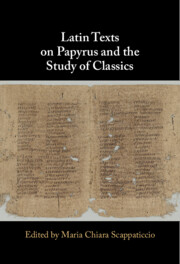
This volume gathers 25 chapters focused on Latin texts on papyrus, exploring them from multi- and cross-disciplinary perspectives. It serves as a companion to the texts published in The Corpus of Latin Texts on Papyrus (Cambridge, forthcoming). The chapters provide in-depth analyses of the chosen texts from literary, philological, linguistic, and historical perspectives, or offer methodological reflections on Latin texts on papyrus, promoting innovative approaches. They cover topics ranging from palaeography and philology to Latin literature and from ancient law to ancient and medieval history, and brilliantly demonstrate the potential of Latin texts on papyrus to inspire and illuminate the field of Classics.
This paper discusses the benefits of prose and free composition following the implementation of both styles in Year 7 Latin classrooms. While prose composition is an optional feature in GCSE and A Level exams in the UK, free composition is rarely part of Latin teaching in the UK – and yet it can have benefits for students equal to or exceeding those of prose composition. Any composition is a useful diagnostic tool for grammar, but free composition seems a more enjoyable and creative experience for students. For this research, I experimented with both styles of composition and observed the teaching implications as well as the students’ reception of both.
This article explores an innovative case study in classical language education, focusing on a high school student who independently designed an educational video game inspired by Greek mythology. The project illustrates how digital creativity can effectively support the teaching and learning of Latin and ancient Greek. Three key aspects are examined: student autonomy and creativity in classical studies, the educational potential of merging classical content with digital media, and the implications for reimagining the role of Classics in modern curricula.
The initiative combines classical themes with interactive gameplay, transforming the learning process into an engaging, active experience. Rather than simply transmitting knowledge, the game reinterprets ancient content through digital storytelling and mechanics. This approach promotes critical thinking, interdisciplinary skills, and aligns with science, technology, engineering, art, and maths (STEAM) education principles. The teacher’s role shifts from traditional instructor to facilitator, enabling authentic and student-driven learning. Overall, the study demonstrates how digital tools can foster immersive and meaningful engagement with classical languages and cultures. It presents a replicable model for curriculum innovation, showing that integrating technology with humanistic content can revitalise Classics education. The project positions ancient languages not as static relics, but as dynamic fields open to reinterpretation and creativity through contemporary digital means.
The numerous multilingual texts from medieval to modern times have only recently received the recognition as serious linguistic data that they deserve. They provide important testimony of medieval and early modern multilingualism and have increasingly been seen as written records of early code-switching and language mixing, which can be analysed on the basis of modern code-switching theories. This chapter discusses this assumption with historical data from England, addressing questions like syntactic, functional and visual approaches to the data, the distinctiveness of languages in multiligual texts. A related, but special type of multilingualism is attested in medieval mixed-language administrative texts which show a principled but variable use of Latin, French and English. Other issues are the increasing use of manuscripts and electronic corpora as data for linguistic analysis. The chapter finishes with a small selection of multilingual historical texts from England with brief comments to illustrate some of the issues discussed.
The sixteenth- and seventeenth-century English vocabulary witnessed a sort of revolution due to the massive influx of new words and coinages primarily from classical languages. They were largely introduced by scholars to supply English with an appropriate terminology for fields traditionally dominated by Latin, but also to provide the richness of vocabulary (copia verborum) considered the hallmark of a literary language and Renaissance rhetoric as well as a sign of education or social superiority. Their ‘artificiality’ and ‘abstruseness’ provoked a fierce debate among purists and innovators, and made necessary the production of dictionaries that explain such ‘hard words’, and often attest them for the first time. A sign of the creativity of these centuries, most of them remained in the language and contributed to shaping the structure vocabulary, thanks also to the role played by monolingual dictionaries. A text-corpus analysis of new coinages derived from ‘hard words‘ dictionaries in a so-far neglected genre – namely early modern street literature texts (pamphlets, broadsheets and ballads) devoted to monstrous births – will shed light on the mechanisms of their diffusion.
This chapter explores the link between education and linguistic innovation in the early history of English, by looking at the evolution of the school system and the languages of school instruction. Varieties of spoken and written Latin and Latin as a second (and third) language are among the other sociolinguistic anchors of this chapter. The turning points are located at about 650 CE, the spread of Christianity and formal schooling in Latin among the Anglo-Saxons, at 1066, the introduction of French as a second vernacular and language of school instruction, and at 1349, the reversal of the latter situation in the wake of the socio-demographic changes caused by the Black Death. The survey starts on the eve of the Germanic migration to Britain and ends around 1500; it is illustrated with a selection of lexical and structural features introduced into English through contact with Latin.
This chapter presents one of the most recent additions to the historical sociolinguistic toolkit, a community of practice (CoP). The discussion of definitions and delimitations of this concept places it in the ‘three waves’ of sociolinguistic research and builds comparisons and contrasts with two neighbouring frameworks: social networks and discourse communities. The focus moves on to the applications of CoPs in historical sociolinguistics. The dimensions of practice – joint enterprise (or domain), mutual engagement, and shared repertoire – are redefined for the purpose of historical sociolinguistics and illustrated with examples from studies which engage with the sociohistorical and cultural context of communication. We show how language change – or, indeed, resistance to change – may be observed through a CoP lens. Prolific contexts where the concept of a CoP has been fruitfully employed include letter writing, the production of manuscripts and early prints, professional discourse, trial proceedings, multilingual practices and online blogging.
This chapter provides an overview of the language of religious texts in Old, Middle and Early Modern English. We divide religious language into three spheres: Bible language, the language of prayers and the language of texts of religious instruction and discussion. We then discuss the language of religious texts against the background of the impact of the language of the vernacular Bible, particularly before 1500. We argue that, prior to the publication of the King James Bible, there was no specific ‘religious register’ in Old and Middle English, and even in Early Modern English a typically ‘religious style’ is found only as an additional layer in religious texts, which, by and large, follow the general standardising tendencies of the language at the time.