To save content items to your account,
please confirm that you agree to abide by our usage policies.
If this is the first time you use this feature, you will be asked to authorise Cambridge Core to connect with your account.
Find out more about saving content to .
To save content items to your Kindle, first ensure no-reply@cambridge.org
is added to your Approved Personal Document E-mail List under your Personal Document Settings
on the Manage Your Content and Devices page of your Amazon account. Then enter the ‘name’ part
of your Kindle email address below.
Find out more about saving to your Kindle.
Note you can select to save to either the @free.kindle.com or @kindle.com variations.
‘@free.kindle.com’ emails are free but can only be saved to your device when it is connected to wi-fi.
‘@kindle.com’ emails can be delivered even when you are not connected to wi-fi, but note that service fees apply.
As unprecedented as the Declaration was, it was not without intellectual antecedents. The Declaration interacted with and built upon recent expressions of European Enlightenment political philosophy in its focus on “Nature and Nature’s God,” and in its reliance upon the normative principles of “laws of Nature” as well as natural or “unalienable” rights. European Enlightenment political philosophers themselves stood in complex and varied relationships with their ancient and medieval predecessors; sometimes adding to, sometimes transforming, and sometimes rejecting these preceding ideas. The Declaration brilliantly navigates this complex web of intellectual antecedents by treating the ideas of laws of nature, natural rights, the social contract, and republicanism in such a way that the points of tension between their different interpretations are minimized and subsumed within a shared understanding of the importance of nature for political life. In so doing, the Declaration provides an intriguing hint of how the deep fault lines between these political philosophical traditions might ultimately be bridged. The Declaration’s succinct statement of political principles may be viewed as a transformative distillation of a few of its most important European antecedents.
This essay explores the deep and longstanding relationship between African Americans and the Declaration of Independence. From the 1770s to the present, black activists and thinkers have consistently excoriated the paradox of an American democracy that proclaims inalienable rights while systematically denying black citizens’ rights. Drawing on figures such as Frederick Douglass, Sojourner Truth, Frances E. W. Harper, Anna Julia Haywood Cooper, and Shirley Chisholm, the text illustrates how African Americans have employed the Declaration as a foundation for their demands for the abolition of slavery, civil rights, and equality. It examines black protest rhetoric’s critique of white supremacy, hypocrisy, and the failure of the United States to live up to its foundational principles. And it emphasizes the crucial role black women have played in advancing black liberation and expanding the scope of equality to include gender and race. Through the centuries, African Americans have called for the United States of America to reconcile its practices with its founding document’s principles of equality and justice for all.
This chapter aims to provide an introductory account of conceptions of natural rights in the sixteenth and seventeenth centuries. That is, of how human beings were considered to hold certain rights by virtue of their human nature or as conferred by natural law. It will show how conceptions of natural rights differed, as embedded in different theoretical frameworks, and were put to different political, social, and religious uses. At the same time, in several instances conceptions of natural right were used ‘in action’ in similar ways, despite the different theological or philosophical frameworks in which they were imbedded. Despite differences, then, early modern conceptions of natural rights shared some features, and were put to uses, that may seem counterintuitive to the modern reader.
Rights, in the Early Modern era, were conceived in terms of divine and natural law. They were understood to be powers, or faculties, belonging to an individual, or to communities, that had existed from the beginnings of time. The intellectual underpinnings of rights theory were derived from the moral theology of the scholastics, and lay in the idea that rights were a God-given power of the soul, and an expression of active virtue. This was true in the Medieval era, and it remained so in the Early Modern, when the origins of ideas about natural rights lay in the poverty controversies of the mendicant orders in the thirteenth and fourteenth centuries. The appeal to the concept of a natural right was first and foremost a moral endeavour.
Adam Smith seeks to explain in the Wealth of Nations and Lectures on Jurisprudence the persistence of slavery as an institution. In order to accomplish this, he also draws on arguments he had developed in The Theory of Moral Sentiments. The result is a sophisticated explanation that bridges economic, psychological, and moral considerations. After presenting Smith’s explanation, I will consider a discussion of the moral wrong of slavery in the work of Ottobah Cugoano, author of the incisive criticism of the slave trade Thoughts and Sentiments on the Evil of Slavery. I will suggest that Cugoano’s account of what is morally wrong in slavery shows an important lacuna in Smith’s views.
A study of the notion of rights in classical Greek thought naturally focuses on Aristotle’s ethics and politics. Plato’s ethics shows a much greater concern with people’s interests than with their rights. In Plato, too, these interests are identified with reference to the community as a whole; that is, it is the good of the community that comes first in order of justification. As Julia Annas remarks in her Introduction to Plato’s Republic, in Plato’s ideal city “all classes are protected in freely having and doing what is necessary for them best to fill their social role.” At the same time, Plato believes that interests justified in this way (that is, identified and determined with reference to their contribution to the common good) are people’s true interests: his politics and ethics are therefore paternalistic and illiberal. As such, they do not allow for a theory of subjective rights as morally or legally sanctioned entitlements that are concerned with the individual qua individual, independently of the contribution that they might make to the common good. Plato’s predecessors, for their part, had mainly focused on the relation between morality and self-interest and the potential conflict between the two.
Is there anything in the ancient world that deserves to be called a “right” in the subjective sense? The philosopher Alasdair MacIntyre stated quite apodictically that “there is no expression in any ancient or medieval language correctly translated by our expression ‘a right’ until near the close of the middle ages: the concept lacks any means of expression in Hebrew, Greek, Latin or Arabic, classical or medieval, before about 1400,” concluding from this that even if there were such rights, “no one could have known that there were.” Until relatively recently, historians would have agreed with MacIntyre. The prevailing view was that in antiquity we look in vain for what has come to be called subjective rights – that neither the concept of rights nor the word “right” could be encountered in the ancient world in its subjective sense.
This chapter considers the nature of human rights and its critiques. The language of human rights has become the common lexicon of social justice and the critical standard for assessing political institutions. Yet, whilst human rights law occupies a central place in our moral and legal discourse, there are many aspects of the human rights project which are contested. This chapter introduces the key debates as to the origins of human rights rights and the justifications advanced for the existence of human rights. This includes examining institutional critiques which focus on how rights should be enforced; as well as ideological critiques, which argue that the gaps in what is protected and who is protected mean that human rights law is itself part of the problem.
This viewpoint examines The Dying Negro, A Poem (London, 1773). The poem was directly inspired by a May 1773 newspaper account of an unnamed enslaved man who had sailed to London with his enslaver, emancipated himself, and was subsequently recaptured; he died by suicide while imprisoned in a ship anchored in the River Thames awaiting transport back to the Americas. Authors John Bicknell and Thomas Day used this tragic event to wage a poetic protest against slavery in the British empire. As the American Revolution neared, the authors revised the poem, including its title, to fortify its antislavery message. Subsequent editions condemned the hypocrisy of American slave-owning Patriots, using their embrace of slavery to assert English moral superiority in the Revolutionary conflict. The Dying Negro was published in multiple editions and sparked popular engagement in debates over slavery and the meaning of freedom in the era of the American Revolution.
The Grandee and Agitator factions of Cromwell’s New Model Army debate what is to come after the English Revolution. Equality, government by consent, and the artificial nature of property are agreed. Disagreement centers on the property qualification for the vote, and the role of natural rights.
This article presents a critique of Sergei Sazonov’s entrepreneurial theory of ownership. The article first reconstructs Sazonov’s response to the private duty imposition objection. It then demonstrates that Sazonov’s theory cannot overcome this objection because it is based on an ambiguity in the meaning of the word ‘use’. The entrepreneurial theory of ownership understands ‘use’ in a rather narrow and contradictory sense, which differs from the meaning in which this concept appears in objections to theories of original appropriation.
The state of nature in social contract theories tells us two stories, one about who the main political actors are, and another one about the supra-juridical normativity and principles those actors use to judge and act politically once they are in the civil state. In my chapter I focus on the latter matter by contrasting Kant’s approach to the state of nature and its role in his social contract theory as given in the Feyerabend lectures with the conceptions of the state of nature in Hobbes, Locke, Achenwall, and Rousseau. Following the thesis that pre-juridical normativity functions as supra-juridical normativity once in the state, my main question is: how is "natural", in the sense of "pre-political", normativity generated? With this I am referring not only to the source of normativity, but mainly to how pretensions of normativity arise when people interact in the state of nature, and if these are or are not regulated by a moral-legal order independent from that interaction.
Chapter 2 introduces the normative theory on which the book relies. Principles of natural law are guides for practical human action. The principles are “natural” because they are knowable through human reason and valid guides to action whether they have been accepted in any community’s laws. They are “law” in that they supply reasons or justifications for action. Natural law theory focuses human action on survival and on flourishing understood rationally. Natural law justifies reasoning with interests, understood as distinct components of a person’s well-being. Natural law also justifies reasoning with rights, understood as entitlements to act and be free from interference backed by claims against others. Natural rights focus social and political life on desirable, low, and uncontroversial goals like survival and freedom. Natural rights also help specialize – around distinct fields of human activity organized around people’s bodies, their capacities to make livings, their capacities to associate, and their capacities to use property.
This chapter attempts two tasks, conceptual and normative. First, I argue that constitutions need not include rights as a matter of logic: it is possible for a set of laws and conventions to qualify as a genuine constitution of a state or legal system, even if they do not contain any rights – or almost none. Nonetheless, secondly, I argue that rights-free constitutions miss out on something valuable: it is hard to see non-rights constitutions as intended to serve citizens qua individuals. In particular, I argue that there are strong reasons in favour of constitutional rights on both natural rights and democratic grounds. I end by explaining the way in which rights function as limits on government power: we will see that they need not be the limits that constitutionalists endorse.
Chapter 2. The removal of James II from the throne in 1688 and the settlement of the crown jointly on William and Mary gave rise to an extensive debate about the legitimacy of the new regime. Many wrote to celebrate the ending of arbitrary rule. Some commentators (notably James Tyrrell) focused on the final securing of the fundamental rights of the people in the manner promised by the ancient constitution of England. But others (notably John Locke) preferred to appeal to the natural rights of the people as the only sound basis for guaranteeing freedom under government. At the same time, however, many rejected the settlement of 1688. The Jacobites objected that William and Mary were merely usurpers, while in the course of the 1690s a group of ‘commonwealth’ writers began to argue that the crown and executive were failing to keep their promise to outlaw the use of arbitrary power. The chapter concludes by discussing the contributions of Molesworth, Trenchard and Toland to the development of ‘commonwealth’ claims about the policies that will need to be followed if the freedom of the people from subjection and dependence is to be secured.
Europe’s revelation of hitherto latent human powers had negative faces too, of which imperial expansion was one. The domination of weaker peoples brought suffering and destruction everywhere, often worsened by the limits to European power that placed stable rule over conquered populations out of reach, so that the dominators had regular recourse to brutal exemplary punishments, often justified by the racist discourse generated by the need to justify the whole system. The capacity of formal imperialism to endure was undermined by the seeds it bore of its own overcoming: first, the violent and expensive wars between imperial rivals and then the disclosure to dominated peoples of the knowledge and techniques employed to subject them. But from the beginning these horrors generated internal protests and critiques, often based on a heightened realization of and respect for cultural difference. By the middle of the eighteenth century a phalanx of distinguished and influential voices was raised against the system, never strong enough to rein it in, but testimony to the persistence of the more humane and generous attitude manifested earlier.
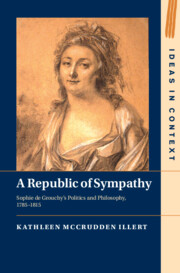
Sophie de Grouchy was a political philosopher and activist practising at the centre of Revolutionary events in France between 1789 and 1815. Despite this, her contributions to the development of political thought are often overlooked, with Grouchy commonly falling under the shadow of her husband Nicolas de Caritat, the marquis de Condorcet. A Republic of Sympathy instead situates Grouchy as a significant figure among her contemporaries, offering the first complete exploration of her shifting thought and practice across this period of societal upheaval. Kathleen McCrudden Illert analyses texts newly attributed to Grouchy and examines her intellectual collaborations, demonstrating how Grouchy continued to develop a unique philosophy which placed sympathy as the glue between the individual and the political community. The study also explores Grouchy's connections with her peers and interlocutors, from Adam Smith and Jean-Jacques Rousseau, to Thomas Paine and Jacques Pierre Brissot. In doing so, it argues powerfully for Grouchy's reintegration into the history of European political thought.
Chapter 3 describes Grouchy’s thought during the first four years of the French Revolution. It explores both the philosophical foundations for and the results of the strong political and intellectual partnership that developed with her husband, Condorcet, from around 1790. Grouchy took advantage of the symbolic political power with which marriage was imbued in revolutionary discourse to use her own union as a microcosm of the polity she and Condorcet were advocating. They demonstrated that sentiment not only allowed individuals to reason rights, but created bonds that enabled independent people to work together for the advancement of political goals beyond their basis self-interest. This created the basis from which citizens could contribute to the creation of a just constitution. The state, in turn, had a central role in fostering the emotional faculties of the citizenry. Women, moreover, had an identical capacity for moral and political judgement as men. They made this argument both in the public display of their collaboration, and in texts that they co-authored together. This Chapter makes the case for Grouchy’s co-authorship of Condorcet’s influential 1791 Cinq mémoires de l’instruction publique and argues for her centrality to Condorcet’s revolutionary thinking and career.
Chapter 2 discusses the adaptations that Grouchy made to her initial draft of the Letters on Symapthy between 1786 and 1789. It explores her interest, during this period, in the affair of the trois roués, a court case that had captured the attention of her uncle Dupaty and Condorcet. This constituted her first sustained exposure to the political injustices of ancien régime. By engaging with the work of these two men, and the ideas of other eighteenth-century natural rights thinkers, Grouchy developed her own ideas as to how injustice could be combatted. This resulted in various additions to the Letters. Building on her original ideas about sympathy-based morality, she elaborated her own definition of natural rights. She went on to argue that these rights, and justice as a whole, could only exist in society when a minimal degree of social and economic equality was guaranteed by the state. This Chapter argues that this was the period when the Letters changed from a moral treatise to a text concerned with political theory.
Chapter 4 explores Grouchy’s first elaboration of a specifically republican political philosophy during the French Revolution. It describes how, together with Condorcet, Paine, Brissot and others, she founded the first explicitly republican journal of the Revolution in 1791: Le Républicain. It explores the context for her declaration of republicanism: the flight of Louis XVI from Paris in June 1791. It demonstrates how, in the articles she contributed to this journal and other anonymously published pieces, Grouchy elaborated on the theory she had been developing between 1786 and 1791. She added an unambiguously anti-royal element to her thought, arguing that a king can never feel sympathy with his people, and can therefore never be a just ruler. This Chapter explores how she drew, in particular, on the ideas of Paine, but also describes a major intellectual and political fissure that developed between Grouchy and her ‘Brissotin’ allies during this period. While they advocated an offensive European war after 1791, she argued against one. Due to her reliance on mutual sentiment between ruler and ruled as the basis of political society, she opposed, on philosophical grounds, the sending of ‘armed missionaries’.