To save content items to your account,
please confirm that you agree to abide by our usage policies.
If this is the first time you use this feature, you will be asked to authorise Cambridge Core to connect with your account.
Find out more about saving content to .
To save content items to your Kindle, first ensure no-reply@cambridge.org
is added to your Approved Personal Document E-mail List under your Personal Document Settings
on the Manage Your Content and Devices page of your Amazon account. Then enter the ‘name’ part
of your Kindle email address below.
Find out more about saving to your Kindle.
Note you can select to save to either the @free.kindle.com or @kindle.com variations.
‘@free.kindle.com’ emails are free but can only be saved to your device when it is connected to wi-fi.
‘@kindle.com’ emails can be delivered even when you are not connected to wi-fi, but note that service fees apply.
Fifteen years ago, Rydgren (Scand Polit Stud 25(1):27–56, 2002) asked why no electorally successful radical right-wing party had yet emerged in Sweden. In this respect, Sweden was a negative case. Rydgren posited four main explanations: (1) social class mattered more in Sweden than elsewhere. Working-class voters identified strongly with their social class and with the Social Democratic party, making them largely unavailable to radical right-wing mobilization; (2) socioeconomic issues still structured most politics in Sweden, and issues belonging to the sociocultural dimension—most importantly immigration—were of low salience for voters; (3) voters still perceived clear policy alternatives across the left-right divide; and (4) the leading radical right-wing alternative, the Sweden Democrats, was perceived as being too extreme. Since 2010, however, Sweden can no longer be considered a negative case, and in this article, we argue that in order to understand the rise and growth of the Sweden Democrats, we should focus on changes in the factors enumerated above.
While Carmines and Stimson's work on issue evolutions has prompted research showing the dynamics and effects of new party alignments on abortion, religion, gender and cultural issues, this research has all centred on the United States. This article examines issue evolution in Britain. Using evidence on the timing of changes in elite positions from Comparative Manifestos Group data, and survey data on public attitudes to the European Union with a longer historical sweep than heretofore, the article finds strong evidence that the European issue has followed an issue evolution path, though with distinct dynamics contingent on the pace of elite re‐positioning. Thus, this article extends the theory of issue evolution to a parliamentary political system and demonstrates the responsiveness of the public to elite cues, while also providing additional insights from a unique case in which elites have staked out distinct positions not once, but twice.
Leading Organizational Change highlights how a volatile, uncertain, complex, and ambiguous (VUCA) environment challenges preexisting mindsets and moves companies into the “Age of Agile.” Change scenarios that companies face depending on their current performance are described: anticipatory, reactive, and crisis. The change process (assessing the readiness for change, initiating and adopting the change, and reinforcement and realignment) explains how the process of change unfolds, facilitated by a design thinking approach. The dilemma of excessive persistence versus premature abandonment is discussed, suggesting that the trade-offs of staying on or leaving a course of action must be carefully considered. IBM’s change trajectory, which fundamentally altered the company, is described.
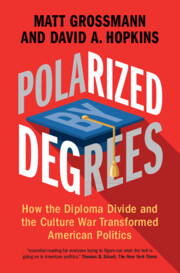
Over the past several decades, American society has experienced fundamental changes – from shifting relations between social groups and evolving language and behavior norms to the increasing value of a college degree. These transformations have polarized the nation's political climate and ignited a perpetual culture war. In a sequel to their award-winning collaboration Asymmetric Politics, Grossmann and Hopkins draw on an extensive variety of evidence to explore how these changes have affected both major parties. They show that the Democrats have become the home of highly-educated citizens with progressive social views who prefer credentialed experts to make policy decisions, while Republicans have become the populist champions of white voters without college degrees who increasingly distrust teachers, scientists, journalists, universities, non-profit organizations, and even corporations. The result of this new “diploma divide” between the parties is an increasingly complex world in which everything is about politics – and politics is about everything.
The biggest change in the party coalitions since the 1980s has been the movement of high-education whites into the Democratic Party and the defection of low-education whites to the GOP. Drawing on evidence from opinion surveys, election returns, and demographic data, Chapter 3 documents the parties’ changing voters and geographic constituencies. These trends continued in the 2020 election despite Democratic efforts to reverse the party’s declining popularity among noncollege whites, with some signs educational divides will spread to other racial and ethnic groups. Candidates, activists, political appointees and staffers, judges, party leaders, and campaign workers all demonstrate the same increasing divisions as rank-and-file voters. Democrats may suffer electorally because the Electoral College and apportionment of the Senate grants noncollege whites disproportionate voting power, but college-educated citizens punch above their weight in other forms of influence: as thought leaders, interest group activists, educators, media figures, scientific experts, candidates, political professionals, lawyers, and financial donors.
How should we best characterise the UK party system in the wake of nearly a decade and a half of Conservative government? Has it undergone a significant and enduring realignment, or merely amounted to passing turbulence, after which things have returned to the seemingly eternal verities of stable two-party competition? The question for us to consider in this chapter is whether we can regard the period since 2010 in such terms: in particular, does the general election of December 2019 constitute a moment of critical realignment? Or is it more sensible to view this as the mere culmination of a relatively prolonged period of Conservative Party ascendancy based on a regular swing of the electoral pendulum – a swing which will inevitably reverse itself as the centre of electoral gravity shifts in favour of Labour once more? In other words, a simple affirmation of the age-old dynamics of the two-party system.
Comme l'illustrent Bélanger et Nadeau (2009), l'axe identitaire traditionnel au Québec apparait de moins en moins prédominant sur la scène politique québécoise. Cette situation impose l'adoption d'une stratégie différente de la part des divers partis dits souverainistes. Comment se sont articulées ces tentatives de repositionnement au sein du Bloc québécois? Afin d'explorer cette question, nous avons amassé plus de 7500 communiqués de presse diffusés par le parti entre 2002 et 2021. À l'aide de méthodes d'analyse automatisées et une approche de Latent Semantic Scaling développée par Watanabe (2020), nous illustrons et discutons de la prédominance de l'enjeu souverainiste à travers cette période, ainsi que le ton du parti quant à cet enjeu. Les résultats indiquent que les élections et les résultats de celles-ci jouent un rôle crucial dans la stratégie communicationnelle du Bloc québécois à l’égard de la souveraineté. De façon plus générale, nous observons certaines fluctuations importantes de l'attention accordée à cet enjeu et des variations importantes quant au cadrage de cet enjeu autour des élections. Cette note de recherche apporte un éclairage méthodologique nouveau quant aux théories entourant le réalignement politique en cours au Québec et la saillance qu'occupe le clivage de la souveraineté.
This study uses prediction market data from the nation’s historical election betting markets to measure electoral competition in the American states during the era before the advent of scientific polling. Betting odds data capture ex ante expectations of electoral closeness in the aggregate, and as such improve upon existing measures of competition based on election returns data. Situated in an analysis of the 1896 presidential election and its associated realignment, I argue that the market odds data show that people were able to anticipate the realignment and that expectations on the outcome in the states influenced voter turnout. Findings show that a month ahead of the election betting markets accurately forecast a McKinley victory in most states. This study further demonstrates that the market predictions identify those states where electoral competition would increase or decline that year and the consequences of these expected partisanship shifts on turnout. In places where the anticipation was for a close race voter expectations account for a turnout increase of as much as 6%. Participation dropped by 1%–6% in states perceived as becoming electorally uncompetitive. The results support the conversion and dealignment theories from the realignment literature.
This chapter maps the development of the electorate of the mainstream right (and its subfamilies) in Western Europe between 2002 and 2016 based on the European Social Survey. It does so in terms of sociodemographics (education, income, occupation, age and gender) and attitudes (immigration, European integration, moral issues and redistribution). Special attention is given to factors setting the mainstream right electorate apart from that of the populist radical right. The chapter shows that the mainstream right electorate has a rather stable and broad social base, (still) characterized above all by (higher status) occupations and income levels rather than by education. In terms of attitudes, too, economic conservativism remains a stronger predictor than views on cultural issues. These and other chapter findings suggest that, despite underlying shifts in Western European social structure and party competition, the mainstream right’s electoral coalition shows a relatively high level of resilience.
What motivates politicians and political parties to shift their positioning on an issue? Focusing on the case of trade policy in countries with advanced economies and plurality electoral systems, I argue that the relative positioning of parties on an existing issue can change even when the preferences of the key actors (voters and politicians) are held constant, and even when party leaders continue to represent the same constituencies. In advanced plurality countries, college-educated voters support free trade, and high-density constituencies are predominantly represented by Left incumbents. As college-educated workers migrate to high-density constituencies in pursuit of higher wages, Left incumbents increasingly embrace free trade, while Right incumbents take more protectionist positions. I provide empirical support for several observable implications of my theory.
In most accounts, the modern American “tax revolt” begins with Proposition 13, passed by California voters in June 1978. In this telling, the revolt represents an antigovernment, antiliberal shift among white homeowners instrumental in the “rise of the right” and the fall of the “New Deal order” that culminated in Ronald Reagan’s election in 1980 and his subsequent tax cuts. This article challenges that account by demonstrating that the revolt began more than a decade before Prop 13 as approval rates for local levies and bonds reached all-time lows. This local revolt was not limited to whites, nor did it portend rising conservatism. Instead, it was rooted in lower- and middle-income Americans’ frustrations with steep rises in unfair, regressive taxes during the post–World War II decades. The Kennedy-Johnson “Growth Liberals,” who were busy cutting progressive federal taxes at the same time that regressive state and local taxes were soaring, missed this pocketbook squeeze, thereby setting the stage for later events like Prop 13.
President-elect Barack Obama will take office after a campaign that was pathbreaking on many levels. The argument here, necessarily somewhat speculative, is that Obama's management of his racial identity and of racial politics is roughly predictive of his soon-to-begin management of executive power in the United States. Obama is characterized as a “practical idealist,” a true pragmatist in the deeply grounded, philosophical (as opposed to vulgar) sense of that term. Attention is directed to the way Obama has handled or may be likely to handle the racial politics of the election itself, the ongoing realities of structural racism in the United States and the problem of exercising executive power in an endemically racial state, the role of race in national politics, and the role of race in global politics. The uniqueness of this new administration—headed by a preternaturally skilled and intellectually prepared Black politician—is not chiefly located in the symbolism of Obama's Blackness, important as that is. Rather it is Obama's formation as a Black intellectual and politician that may be expected to guide his thought and action in the White House.
Recommend this
Email your librarian or administrator to recommend adding this to your organisation's collection.