To save content items to your account,
please confirm that you agree to abide by our usage policies.
If this is the first time you use this feature, you will be asked to authorise Cambridge Core to connect with your account.
Find out more about saving content to .
To save content items to your Kindle, first ensure no-reply@cambridge.org
is added to your Approved Personal Document E-mail List under your Personal Document Settings
on the Manage Your Content and Devices page of your Amazon account. Then enter the ‘name’ part
of your Kindle email address below.
Find out more about saving to your Kindle.
Note you can select to save to either the @free.kindle.com or @kindle.com variations.
‘@free.kindle.com’ emails are free but can only be saved to your device when it is connected to wi-fi.
‘@kindle.com’ emails can be delivered even when you are not connected to wi-fi, but note that service fees apply.
Chapter Four explores the politics of sectarianism and statecraft within the context of the triangular relationship among the Ottoman state, the Safavid state, and the Qizilbash communities situated between them. The chapter examines how the Ottoman state and its Qizilbash subjects devised diverse strategies to navigate their religious sensitivities, sociopolitical realities, and fiscal imperatives. A new set of questions is introduced to challenge the prevailing notion that the relationship between the “Sunni Ottoman” state and its “non-Sunni Qizilbash” subjects was inherently irreconcilable and characterized by continuous persecution of these supposedly powerless, defenseless religious nonconformists. It reveals the existence of a range of policies and approaches adopted by the Ottoman state, from providing financial support to establishing quid pro quo arrangements, from accommodating Qizilbash subjects to resorting to surveillance and heavy-handed suppression and persecution of the very same populations. The chapter emphasizes that the Ottoman Qizilbash, as significant powerholders during this period, exerted their influence not only through practices of conversion and reconversion but also through negotiation, migration, intervention, and at times rebellion.
The chronicle of European social democracy is often told from the perspective of the party leader. If the party triumphs at the polls, it is surely because the leader is a visionary. If, on the other hand, the party loses elections, weak leaders are held responsible for that misfortune. Clearly, leadership matters but perhaps not in the top-down manner it used to. Drawing on the literature on political leadership and the Europeanisation of public policy, this chapter argues that the collaborative approach to statecraft deployed by the Portuguese Prime Minister António Costa in the period 2015–2019 paved the way for a period of political stability and electoral victory of the Socialist Party. Using the method of process-tracing to analyse official documents, parliamentary debates, and media reports, the chapter shows that collaborative statecraft enabled Costa to get four budgets approved, to complete a four-year mandate while leading a minority government, and to win the elections of 2019. The chapter also shows that the abandonment of collaborative statecraft in the period 2019–2023 resulted in greater political uncertainty and contributed to the socialists’ defeat at the 2024 elections.
Examining sectarian divergence in the early modern Middle East, this study provides a fresh perspective on the Sunni–Shi'i division. Drawing on Ottoman Turkish, Persian, and European sources, Ayşe Baltacıoğlu-Brammer explores the paradox of an Ottoman state that combined rigid ideological discourses with pragmatic governance. Through an analysis of key figures, events, periods, and policies, Boundaries of Belonging reveals how political, economic, and religious forces intersected, challenging simplistic sectarian binaries. Baltacıoğlu-Brammer provides a comprehensive historical account of Ottoman governance during the long sixteenth century, focusing on its relationship with non-Sunni Muslim subjects, particularly the Qizilbash. As both the founders of the Safavid Empire and the largest Shiʿi-affiliated group within the Ottoman realm, the Qizilbash occupied a crucial yet often misunderstood position. Boundaries of Belonging examines their role within the empire, challenging the notion that they were merely persecuted outsiders by highlighting their agency in shaping imperial policies, negotiating their status, and influencing the Ottoman–Safavid rivalry in Anatolia, Kurdistan, and Iraq, and western Iran.
Native American worldviews suggest that humans create the world through story; storytelling is central in oral societies. Storytelling was embodied in artworks made at and disseminated from Cahokia, and it was also embodied in the landscape. Cosmological, goddess, and hero stories were told, but heroes depicted in Braden-style artworks found far from Cahokia suggest that the story of a Birdman wearing human-head earrings and braid was a charter myth at Cahokia. As the foundation of ideology and ritual, stories drew people to Cahokia, but the heroic epic was a new type of story critical to the spread of Cahokian ideologies.
Some common themes emerge from these lessons about strategy and bureaucracy. The statesman and strategist also need wisdom to take the long view, prudence to discern what is practical, persistence and fortitude in implementation, courage to overcome groupthink and pride and bureaucratic resistance, temperance and humility to toil in unglamorous details. Above all the strategist must have a passion to pursue justice and peace. Statesmen and stateswomen need wisdom, courage, temperance, and justice. If that is true, such timeless principles do not apply only to the individual policymaker. They apply to the nation we serve. American foreign policy should be characterized by wisdom, courage, temperance, and justice; our role in the world should serve those principles. Our grand strategy should take the long view, be practical and aware of our limits yet also courageous and visionary, fearless and uncompromising in the face of obstacles. Above all it must aim at justice – which means it must serve American interests, but it must do so with an awareness of how our interests are entwined with others.
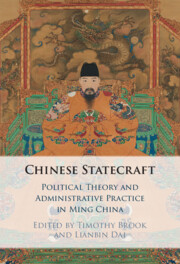
Engaging the writing of the fifteenth-century Confucian theorist and chancellor of the Imperial Academy, Qiu Jun, these essays enlarge our grasp of both Confucianism and the Chinese state, exploring what educated Chinese imagined as best practice in meeting the challenges of administering the realm. Rediscovering statecraft in the Ming period allows us to think about the tradition of applied Confucian duty without the moralism dominating conventional Chinese intellectual history, redirecting that history away from purely philosophical terms. As Qiu reminded Emperor Hongzhi, this 'is not empty talk. I humbly hope that your enlightened majesty will give these ideas your careful attention when you have the leisure to reflect. The people of the realm have no greater wish.' Drawing together a team of leading historians, this volume provides a vivid sense of the day-to-day policy calculations of Ming government, and brings Chinese political thought into the mainstream of comparative political theory.
This article examines how statecraft (jingshi 經世) policies were implemented in the Late Qing period. It focuses on Dai Zhaochen, a prefect who served in Shandong and Guangdong in the 1860s. Dai was from a noted family of officials and had numerous “weak ties” with prominent jingshi officials. One of his handbooks, this paper shows, drew primarily on the Collected Statecraft Writings from the Qing Dynasty (Huangchao jingshi wenbian 皇朝經世文編). In office, Dai adapted policies from it and other collections, appealing to practicability and simplicity as the criteria for policymaking. More generally, he insisted that he was just a humble practitioner of the art of governance. The conclusion reflects on that disavowal, arguing that existing definitions of “statecraft” do not attend to Dai’s core concerns. I propose, therefore, that we stop seeking an essential definition of “statecraft” and instead pursue a broader socio-intellectual history of policy in the Qing.
To examine prerogative is to reflect on how constitutions recast and reshape the story of their own creation. I argue that the term ‘prerogative’ specifies the rudimentary command function that underpins all constitutional order - or, more precisely, what remains of that command function once institutions of law and government have developed and stabilised around it. So understood, the central question becomes how best to understand the place of prerogative within the order of rules that the constitution provides. One answer presupposes the existence of a ‘sovereign prerogative’, that is, an ‘original’ authority inherent to government that is prior to and in some sense superior to law. I show how this model fails analytically and normatively. Another answer constructs prerogative as a set of general executive powers that are derived, enumerated and limited (‘constitutional prerogative’). This second model brings conflicting sources of normative authority into conceptual alignment. While this configuration does much to prohibit recourse to open-ended discretion - so reducing the likelihood of arbitrariness and disruption that tends to result from its exercise - it does not in itself prevent the rise of a prerogative disposition among ruling elites and their client groups.
We are living through cruel and frightening times. How should a progressive policy studies respond? Critique undoubtedly plays a role: the task of exposing the structural conditions, political interests and power asymmetries that lie beneath the ‘prosaic surface’ of policy is an urgent one. But are these primarily deconstructive efforts enough? Can they lead us out of this quagmire, alone? In this article, we argue that something additional – something more generative and hopeful – is also required. In response, we introduce ‘critical utopian policy analysis’ (CUPA) a methodological elaboration of critical policy analysis (CPA) designed to support its use in both deconstructive and reconstructive policy efforts. This approach builds on the theoretical offerings of critical policy analysis, utopianism and prefiguration, to posit a methodological embrace of critique, imagination, enactment and play. It seeks to mobilise a complex nexus of affect – including heartbreak and hope – to motivate and support a range of intellectual undertakings and emancipatory politics.
The chapters assembled in this part turn to the key question of how the exercise of power was subject to a broad array of performative practices, in places as diverse as the administration of the state, public spectacles, agricultural production, and literature. Taco Terpstra kicks off with the performative dimension of statecraft. Due to their substantiated degree of structured hierarchies, standardized procedures, and the ability to employ officials with specific assignments, the imperial administrations of Rome and Han China capture, in exemplary fashion, the design of premodern statehood. Yet both governments looked rather different. While the Chinese relied on a large apparatus of officials who were appointed and paid by the state, Rome governed via a notoriously narrow pool of magistrates whose bureaucratic powers quintessentially built on the support of countless unsalaried local elites. Terpstra’s discussion of these differences departs from an analysis of how administrative rank and agency were expressed through clothing and other symbols of power. Prima facie minor aspects of the grand scheme of empire, the study of Sima Biao’s (third century CE) Treatise on Carriages and Robes, and On the Magistracies of the Roman State by John the Lydian (sixth century CE) offer exciting insight into the ways in which state power was conceived of and articulated throughout the empire. The chapter then segues into the question of state formation and the emergence of bureaucratic structures. Terpstra discloses how, in China, the thrust toward performance-based appointments and promotions preconditioned the rise of a professional bureaucratic corps, whereas the Romans, he argues, actively discouraged such a development. Both dispositions had eminent consequences for the longue durée of state power.
In Plato’s Statesman , the stranger compares the statesman to a weaver. The modern reader does not know a priori how the statesman and the weaver resemble one another and therefore could be compared, but Socrates the younger reacts as if the comparison is natural. This note suggests, with reference to the gender division of labour in ancient Greece, that the male ‘weaver’ did not do much weaving but was a supervisor, which means that the fundamental similarity between a statesman and a weaver is that both managed subordinates. This cultural knowledge explains why the comparison seems natural to Socrates the younger.
I introduce the topic, theme, central argument of the study, and its setting in Gulf petro-monarchies. I discuss the relevant scholarly literature, especially as it concerns ways in which religion (and specifically, Islam) has been used by political actors to advance particular interests. I provide a detailed elaboration of the argument and its various parts, as well as the method of analysis and justification for the choice of cases. I then discuss the context and cases in greater detail, with attention to key features of the historical development of the petro-monarchies from their pre-oil contact with the British imperial power, the arrival of oil companies, the importation of labor, the definition of borders and emergence of “modern” states. I illustrate noteworthy structural peculiarities of each of the four states. Finally, I outline the architecture of the manuscript, with an overview of each chapter.
This chapter deals with all manner of state-derived prohibitions. Ancient states prohibited a broad variety of behaviours, threatening punishment for those who would transgress boundaries. The logic of prohibition was wide-ranging: from the marking of spaces, objects and officials as somehow distinct from the rest of ‘society’, leading factions within ancient states sought to preserve and protect their individual prerogatives. They also sought to reinforce their claims to leadership by incentivizing subjects to settle their disputes in state-sanctioned venues. The evidence for such prohibitions is extensive, but did they add up to something that we might legitimately call ‘social control’? Did ancient states succeed at inducing subject populations to accept their claims to rule? If so, how? This chapter suggests that the logic of prohibition was a site of contestation for both statecraft and subject-craft.
Chapter 12 concludes the Cambridge Comparative History of Ancient Law by drawing out a set of fundamental comparisons, both differences and similarities, from the volume’s previous chapters, in addition to offering further reflections on the field of ‘ancient law’ itself. The chapter opens by comparing and contrasting the Cambridge Comparative History of Ancient Law to earlier historiography, underscoring its unique contribution to existing scholarship: developed through collaborative work and drawing upon numerous specialist traditions and technical expertise, across a pan-Eurasian research field. The chapter then moves on to a broader discussion of ‘Mapping the Ancient Legal Cosmos’ and ‘Ordering Ancient Associations’, pinpointing the specific connections between ethics, law and statecraft that can be observed across the ancient source material. The chapter concludes by suggesting several answers to a provocative, but fundamental, question: What is ‘Ancient’ about ‘Ancient Law’?.
Diplomacy is a political performing art that informs and determines the decisions of other states and peoples. It shapes their perceptions and calculations, so that they do what we want them to do, because they come to see that doing so is in their own best interests. Sometimes diplomacy rearranges their appraisal of their strategic circumstances–and, when needed, the circumstances themselves. Ultimately, it aims to influence their policies and behavior through measures short of war. Diplomacy succeeds best when it embraces humility, and respects and preserves the dignity of those to whom it is applied. Most of what diplomats do is unseen, and it is relatively inexpensive. Diplomacy’s greatest triumphs tend to be preventing bad things from happening, but gaining credit for something that was avoided is difficult.
The state concept is one of the oldest in the study of politics. It features prominently in the analysis of the founders of modern social science, Max Weber and Karl Marx, the former focusing especially on its inner workings (i.e., the state as organization), the latter on its relation to society. Since the early days of social science research on the state, the focus in Comparative Politics has been on both its role in economic development and in nation-building, resulting in the emergence of two research traditions, one centred on statecraft, the other on statehood. Much of the state literature has assumed the presence of an already cohesive political community, the nation-state. State formation in Europe and Asia was the outcome of the dissolution of empires. The emerging states in the early 20th century were all grounded in specific national identities. African states were also born as empires vanished, but they were not formed around nationalities. The colonial powers had assembled multiple pre-agrarian societies into territories with the purpose of conquest and development. Thus, when Africans gained independence, they had to accept a statehood that was not aligned to nationhood. Because the African state-nation is still a project in the making, the exercise of power relies heavily on such means as co-optation and mutual transactions. African leaders must balance the conflicting pressures from tribe and the larger political community, which limits the capacity of the instruments the state to conduct their business. Instead, it encourages modes of governance that are either rivalrous or monopolistic. Lasting political settlements tend to be transactional compromises involving power-sharing, rather than institutional arrangements that facilitate the conduct of state business. Success in the pursuit of such compacts often involves the use of informal institutions that help overcome the rigidity of formal rules.
A new literature on housing and financialization has emerged in recent years, but scholars have yet to examine how political actors shape national trajectories of housing financialization. In this article, we address this shortcoming by examining the cases of Russia and Poland in the 1990-2018 period. We argue that in both contexts political elites implemented a radical market-oriented reshaping of housing finance. However, by pursuing distinct statecraft strategies and modes of integrating the domestic economy into global markets, Russian and Polish political elites created two divergent trajectories of housing financialization. Russian political elites pursued patrimonial statecraft strategies and a mode of global economic integration based on raw material exports. The Putin administration channeled revenues from raw material exports into the securitization-based housing finance system and used this infrastructure as an instrument of hegemonic power. In doing so, the Russian government shielded homeowners from exposure to financial risk. In contrast, Polish political elites pursued liberal statecraft strategies and a mode of global economic integration based on foreign capital inflows. Polish political parties therefore enabled foreign banks to dominate the housing finance system and sell foreign currency mortgages, which exposed homeowners to considerable financial risk. In light of these findings we call for further research into the political factors that shape the process of housing financialization, both in the post-socialist space and beyond.
Despite China's leading role in the construction of infrastructure over the past decades, the most influential paradigms for the study of infrastructure in the social sciences originate from research conducted elsewhere. This introduction to the special section “Chinese Infrastructure: Techno-politics, Materialities, Legacies” seeks to address this apparent gap, and contributes to building an innovative research agenda for an infrastructural approach in the China studies field. To do so, it pushes forward an understanding of infrastructure as both an empirically rich material object of research and an analytical strategy for framing research questions. We draw from two strands of inquiry: recent efforts to rethink the materiality of infrastructures not as an inert or stable basis upon which more dynamic social processes emerge, but rather as unstable assemblages of human and non-human agencies; and scholarship that explores the often hidden (techno-)political dimensions of infrastructures, through which certain intended and unintended outcomes emerge less from the realms of policy and implementation and more from the material dispositions and effects of infrastructural formations. These strands of inquiry are brought together as part of our effort to recognize that the infrastructural basis of China's approach to development and statecraft deserves a more concerted theorizing of infrastructure than we have seen thus far.