To save content items to your account,
please confirm that you agree to abide by our usage policies.
If this is the first time you use this feature, you will be asked to authorise Cambridge Core to connect with your account.
Find out more about saving content to .
To save content items to your Kindle, first ensure no-reply@cambridge.org
is added to your Approved Personal Document E-mail List under your Personal Document Settings
on the Manage Your Content and Devices page of your Amazon account. Then enter the ‘name’ part
of your Kindle email address below.
Find out more about saving to your Kindle.
Note you can select to save to either the @free.kindle.com or @kindle.com variations.
‘@free.kindle.com’ emails are free but can only be saved to your device when it is connected to wi-fi.
‘@kindle.com’ emails can be delivered even when you are not connected to wi-fi, but note that service fees apply.
Rydenfelt begins by considering how some classical pragmatists approached the question of the relationship between human beings and the natural environment. With that background in place, Rydenfelt proceeds to argue that pragmatism provides a unique perspective on questions within contemporary environmental philosophy and ethics. Influenced by idealism but rejecting its invidious distinction between humans and nonhumans, appropriating the worldview of post-Darwinian science but refusing to see philosophy as just another one of the special sciences, pragmatism makes room for a distinct approach to philosophical questions about the environment. One of the most important of those questions is that of the value of nature, and environmental pragmatism understands the pursuit of such normative questions as empirical and experimental, thus attempting to connect normative theory with social practice. Still, it offers no quick and easy solutions but instead recognizes that the pursuit of philosophical questions about nature, like philosophical inquiry generally, and like scientific inquiry even more generally, is a long-term endeavor.
This chapter begins with the Phenomenology’s brief critique of Kantian moral theory. Hegel credits Kant with reconciling the objective validity of rational criteria with their status as self-authored, while failing to make good on his own insight. Since, on Hegel’s diagnosis, Kant’s conception of the will is a reified abstraction from social ‘actuality’, he assigns it a spurious self-sufficiency, leading to an unsatisfactory picture of the nature of practical reason. The chapter then turns to Hegel’s strategy for undoing this conception, namely by traveling the two paths Kant opened up but did not take. Taking the first path means appreciating that rational criteria cannot have their basis in features of the individual agent considered in isolation; instead, criteria must be those agents can act upon in institutional actuality while still recognising themselves as their authors. Taking the second entails seeing resistance and alienation as productive phenomena, symptoms not of structural deficits of the human will, but of conflicts between what freedom seems to demand at a given socio-historical juncture and what it really does. Taking both paths, therefore, entails a recognition that what counts as respectively internal and external to free subjectivity is subject to both synchronic and diachronic variation.
This chapter charts the evolution of Kant’s thinking about theodicy and explains the fundamental shifts in his attitude towards the project. It begins by examining his pre-critical sketch for a theodicy that remains firmly within the Leibnizian mould while repairing its structural inconsistencies and gaps. At the heart of his reparative measures is a different conception of divine freedom, one that Kant will retain throughout his critical period. The chapter ends with a consideration of his late essay On the Miscarriage of All Philosophical Trials in Theodicy of 1791, in which he rejects the entire tradition of rationalist theodicy, whilst still maintaining the importance of an ‘authentic’ alternative. The basis of his rejection of previous theodicies is moral: the very pursuit of such a theodicy involves sacrificing individual freedom and rejecting an autonomous stance. Accordingly, the central sections of the chapter explain Kant’s critical concept of autonomy and how the theory of normativity it entails is fundamentally incompatible with a rationalist conception of value.
Philosophy is not only about beliefs but also decisions and desires. This chapter explores Pascal’s ideas about the human condition, how our desires can make us miserable even when they are satisfied, and how this condition leads us to seek distractions that only make us more miserable. Again we find Pascal’s views and prescriptions stem from the heart, as our fallen state is the source of this sad situation. At the same time, by thinking well about it we can arrive at the conclusion that life could be great, and that the fact that it is not so great confirms the theology of the Fall (and doesn’t confirm other religions, which do not predict our actual predicament). The heart, then, is the key to all of our engagement with the world: not only our beliefs about it but also our desires and happiness. Remarkably, some of the problems Pascal wrote so eloquently about seem especially applicable today, as his descriptions of the need to display a fake identity predict and diagnose TikTok culture, and his rejection of the project to “find your true self,” “love yourself,” and “go with your heart” challenges the typical self-help advice one finds today.
The introduction outlines the historical problem central to this book. Namely, the question of what it meant to possess. The question loomed large in the eighteenth century because more people owned more things (particularly moveable property), the social function of movable property was shifting and in the commercial age, the law was often uncertain as to what could be owned and how. The introduction shows how the book seeks to explore the problem of what it meant to possess by examining how people responded to the loss of possessions.
This chapter explores different strands of the theory of two-player zero-sum games and equilibrium concepts for general multiplayer games. The conventional viewpoint is that equilibrium is an extension of the concept of value (and its associated optimal strategies) to non-zero-sum games, and the value is just a special case of an equilibrium payoff. However, it is argued that a number of important concepts apply only to one of these concepts.
This chapter examines the debate among neo-Kantian thinkers about the origin, function, and reach of concepts. Neo-Kantianism inherits from Kant a series of dualisms, and that between concept and intuition attracted especially intense critical scrutiny. Cohen, Rickert and Cassirer can be understood as proposing a ‘functionalization’ of cognitive concepts that avoids a sharp and static distinction between ‘concept’ and ‘intuition’, and defending Kant’s transcendental project against naturalization and psychologization. The temporalization of concepts, in their constitutive role for experience, is thereby accentuated in different ways. This functionalization of concepts must, however, be situated against the emergence of the notion of value and the question raised by Nietzsche of the value of concepts, or knowledge, for life. The relation between concepts and values points to their historical and cultural embeddedness with reference to different worldviews, and hence reveals the relation between concepts, the unity of a world, and forms of life.
Chapter 6 begins the work of examining why people expended so much time, effort, money and skill on reclaiming their lost possessions. It explores this question by looking to the rewards offered in ‘lost’ and ‘runaway’ notices and using them to investigate the different values at stake in possessions. It finds that ‘possessions’ such as watches, financial instruments, dogs and people held a range of values in the eighteenth century. Rather than marked by market values as the use of rewards might suggest, these ‘things’ were also valuable for the roles they fulfilled and the emotional or cultural importance they held. As with the previous chapter, by looking to the question of value, we begin to understand how ‘possessions’ were differentiated in this period. Such an insight becomes more apparent when the chapter explores not only the rewards offered, but also what they were offered for.
What did it mean to possess something – or someone – in eighteenth-century Britain? What was the relationship between owning things and a person's character and reputation, and even their sense of self? And how did people experience the loss of a treasured belonging? Keeping Hold explores how Britons owned watches, bank notes and dogs in this period, and also people, and how these different 'things' shaped understandings of ownership. Kate Smith examines the meaning of possession by exploring how owners experienced and responded to its loss, particularly within urban spaces. She illuminates the complex systems of reclamation that emerged and the skills they demanded. Incorporating a systematic study of 'lost' and 'runaway' notices from London newspapers, Smith demonstrates how owners invested time, effort and money into reclaiming their possessions. Characterising the eighteenth century as a period of loss and losing, Keeping Hold uncovers how understandings of self-worth came to be bound up with possession, with destructive implications.
This chapter reflects on a case involving a pediatric patient with a rare neurogenerative disease whose medical team requested an ethics consultation when his parents disagreed with the medical recommendation to remove his breathing tube, knowing that this could lead to his death. The ethics consultation explored what at first appeared to be conflicting beliefs about the facts of this patient’s condition and quality of life: his medical team believed he had an irreversible, neurodegenerative condition that would become progressively more debilitating and uncomfortable; his parents believed that he may still recover from his disease and survive. Yet on deeper analysis, we came to see that this was not a case of a medical team holding true beliefs and a family holding false beliefs about the clinical facts of the matter, but rather a difference between ways of being in and seeing the world, particularly as it relates to reasoning from a position of faith in what might be. This case shows the importance of differentiating between claims about facts and assertions of values, and how biomedical expectations of evidence can influence perceptions of relevant information during a clinical ethics consultation.
Transparency has become a ubiquitous presence in seemingly every sphere of social, economic, and political life. Yet, for all the claims that transparency works, little attention has been paid to how it works – even when it fails to achieve its goals. Instead of assuming that transparency is itself transparent, this book questions the technological practices, material qualities, and institutional standards producing transparency in extractive, commodity trading, and agricultural sites. Furthermore, it asks: how is transparency certified and standardized? How is it regimented by 'ethical' and 'responsible' businesses, or valued by traders and investors, from auction rooms to sustainability reports? The contributions bring nuanced answers to these questions, approaching transparency through four key organizing concepts, namely disclosure, immediacy, trust, and truth. These are concepts that anchor the making of transparency across the lifespan of global commodities. This title is also available as Open Access on Cambridge Core.
Many of the most significant goods in human life are fleeting, fragile, and subject to loss. But this aspect of such goods, what I call their preciousness, is undertheorized. Here I provide an account of the nature of precious goods, and argue that this category of goods is significant. I argue that while the preciousness of goods is not a consistent contributor to their intrinsic value, preciousness nevertheless calls for a distinct attitudinal response on the part of rational agents: a focused, joyful attention I refer to as cherishing.
This essay investigates the meaning of “nominal prices” in Adam Smith’s the Wealth of Nations, its contraposition to “real prices,” and the impact of Smith’s nominal prices upon his assessment of the prices of wheat over the centuries. I also consider measure and value in the Wealth of Nations as well as Smith’s threefold standard of measure: labor, wheat, money. Smith chose an unusual measure to investigate prices over time, with nominal prices being referred to a specific quantity of silver. This raises questions about the possible impact of centuries-old debates over debasement and the value of money on Smith’s measurement of value across times.
Chapter 6 looks at how money acts both as an element in the moral concretion of the revolution’s moral project – one that here takes the form also of a ‘moral economy’ – but also a prime catalyst for its deterioration in the face of the pervasive condition of moral-cum-material decline Cubans call necesidad, intimating a sense of destitution that is felt to exert itself as an uncontrollable force. The relation between the revolution and what lies beyond it, then, is seen here through the prism of the duality of money as both a qualitative token of value and quantitative scale for commensuration. The former is central to the way pesos (Cuba’s national currency, issued by the revolutionary state) operate as moral concretions of the revolution, marking out the scope of its moral economy. The latter, however, comes into its own with the use of US dollars and locally issued currencies pegged to it, which have become increasingly pervasive in everyday consumption since the 1990s. In its capacity to commensurate all values quantitatively, the dollar rubs out the distinction between the state’s moral economy and the variously licit and informal realms of transaction that have grown alongside it in Cuba. Crucially, in this way, it tends to trump the revolution’s effort to position itself as transcendental condition of possibility for life, encompassing it with its own transcendental scope.
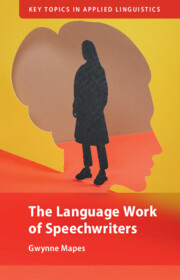
The work of speechwriters is prominent in political discourse, yet the writers themselves remain in the shadows of the powerful, public figures they work for. This book throws the spotlight on these invisible wordsmiths, illuminating not only what they do, but also why it matters. Based on ethnographic research in the US American speechwriting community, it investigates the ways in which speechwriters talk about their professional practices, and also the material procedures which guide the production of their deliverables. Relying on a robust collection of various genres of discursive data, Mapes focuses on the primary rhetorical strategies which characterize speechwriters' discourse, neatly exposing how they are beholden to a linguistic marketplace entrenched in ideological and socioeconomic struggle. Providing fascinating insights into an understudied and relatively misunderstood profession, this book is essential reading for academic researchers and students in applied linguistics, discourse studies, linguistic and cultural anthropology, and sociolinguistics.
The brain faces an array of behavioral control challenges varying in complexity, abstraction, and temporal scale. Leveraging multiple decision-making strategies offers a clear advantage, allowing for adaptability to different contexts. Even when solving a single problem, the selection from or combination of different strategies can enhance the likelihood of success. Consequently, the brain faces the critical task of arbitrating between experts effectively. Here, we review theories of multiple controllers in value-driven decision-making, the mechanisms of arbitration between them, and the neural correlates of such processes. Although these theories have provided meaningful explanations for observed behavior and neural activity, fundamental questions persist regarding the precise nature of these controllers, their interactions, and their neural underpinnings. Notably, the role of subjective states in these computations has been largely overlooked, despite their obvious importance in the experience of making decisions.
This short chapter discusses the impact of lab-grown diamonds on the traditional diamond industry and the value of a diamond and uses it as an allegory for AI’s potential impact on intellectual property. Additionally, the chapter touches upon consumer preferences and the growing trend towards alternative gemstones, as well as the implications for the future of the diamond industry, again drawing parallels to the IP system.
Fifth-century Greek tragedy and visual art centres on interaction between people, including antithetical relations, reflecting a society shaped by monetised exchange and commerce. Platonic metaphysics is focused on unchanging being, placing supreme value on the possession of money and devaluing or excluding exchange and interaction. Although dialogues such as the Phaedo contain the idea of the unity of opposites, and binary opposites such as body and soul, Platonic metaphysics aims at the negation of opposites, and thus of antithesis. The contrast between being and seeming emerges in fifth-century tragedy and philosophy, but it is given much greater prominence by Plato and is linked with the theory of Forms. One of the Platonic accounts of the relationship between Forms and particulars is in terms of original (Form) and copy or image (particulars). Plato is the first to offer a theorization of the idea of the image (in the Sophist) and to define the idea of mere image (not reality). Plato’s treatment of the being-seeming relation, like the theory of Forms generally, expresses the reification of the value of money, treated as the basis of possession, excluding exchange.
Chapter 1 establishes the primary intrigue surrounding professional speechwriters and other sorts of invisibilized language workers: namely, the complication of an author who is never animator nor principal of their labor (Goffman 1981). Here Mapes also lays out the theoretical cornerstones of her research: language in institutional and professional contexts; language work and wordsmiths; metadiscourse; and reflexivity and semiotic ideologies. This framework serves to address not only the ways in which workplace communication both establishes and contests particular communities of practice but also how larger issues related to metalinguistic awareness and political economy are implicated in these processes. Next, Mapes briefly maps the history of speechwriting as well as the relatively scant scholarly engagement with practitioners. She then turns to the specifics of her project, documenting the details of her data collection, method, and analytical process. The chapter concludes with an overview of the rest of the book, as well as an explanation of the three primary rhetorical strategies (invisibility, craft, and virtue) which arise in speechwriters’ metadiscursive accounts of their work.
Chapter 2 introduces readers to the three interconnected concepts which are key to speechwriters’ practices: 1) frontstage and backstage; 2) participation framework; and 3) production format (Goffman 1959, 1981). Next, Mapes maps the profession of speechwriting, using descriptive analysis to document practitioners’ education and career trajectories, production of deliverables, and day-to-day practices. This is followed by a second analytical section which outlines the rhetorical strategies of invisibility, craft, and virtue. First, Mapes uses interview data to unpack the specifics of invisibility as a point of professional pride and skill, demonstrating how speechwriters understand and even embrace the erasure of their authorship. Second, she documents the constructions of expertise and skill which characterize speechwriters’ craft, and which allow them to claim status as “creatives.” Lastly, Mapes details how virtue features across the dataset, arguing that it is necessarily tied to the cultural indexicalities associated with “impact.” In sum, this chapter sets the groundwork for understanding how speechwriters engage in the status competition characteristic of contemporary capitalism.