To save content items to your account,
please confirm that you agree to abide by our usage policies.
If this is the first time you use this feature, you will be asked to authorise Cambridge Core to connect with your account.
Find out more about saving content to .
To save content items to your Kindle, first ensure no-reply@cambridge.org
is added to your Approved Personal Document E-mail List under your Personal Document Settings
on the Manage Your Content and Devices page of your Amazon account. Then enter the ‘name’ part
of your Kindle email address below.
Find out more about saving to your Kindle.
Note you can select to save to either the @free.kindle.com or @kindle.com variations.
‘@free.kindle.com’ emails are free but can only be saved to your device when it is connected to wi-fi.
‘@kindle.com’ emails can be delivered even when you are not connected to wi-fi, but note that service fees apply.
This chapter analyses how attitudes towards Brexit and expectations and evaluations of its consequences have changed since the 2016 referendum. It begins by charting how people have responded when asked by pollsters how they would vote if there were another referendum on the UK’s membership of the EU. It then examines how expectations and evaluations of the consequences of Brexit have evolved in respect of the three issues that were central to the choices voters made in 2016 – the economy, immigration and Britain’s sovereignty. It then further assesses how far these evaluations enable us to understand how support for Brexit has evolved over the last decade. The chapter concludes by assessing whether the 2016 referendum provided what is likely to prove a decisive and enduring outcome, thereby settling the debate about Britain’s relationship with the EU.
It was supposed to be a relaxing holiday, a week away cruising the Adriatic in a chartered yacht as the guest of a friend with far deeper pockets, and thus a lifestyle more sumptuous than I had ever experienced. There were just ten of us aboard, some meeting for the first time but, as one day slid into the next under the hot June sun, we started to bond, confide and laugh over the wine-fuelled meals stretching over hours. And so it was that one lunchtime, as the conversation was providing nothing more than a soft and sociable soundtrack to the stunning Croatian coastline, suddenly everything changed. Brexit came up.
The first decades of the twenty-first century were very different from the manufacturing revolution of the twentieth, when whole new industries, such as making cars, televisions and a myriad of new household appliances, created huge numbers of new, well-paid, skilled jobs. Instead, recent times have been more like the early stages of the industrial revolution two centuries ago, when living standards and life expectancy both fell. Around twenty years ago we started sending emails instead of letters, following news online rather than buying newspapers, ordering goods online rather than going to high street shops. Following the hollowing out of the old industries from the 1980s onwards, well-paid careers in imposing factories, familiar shops, banks and traditional post offices ended up being replaced by low-paid jobs staffing anonymous call centres, packing online orders, delivering take-away meals and driving Amazon vans. Not quite the dark satanic mills of 200 years ago, but not glad confident morning either. Previous generations assumed that steady growth would ensure better lives for their children. That confidence has evaporated across Western Europe and North America.
This volume serves as an introduction to the principles and applications of analytical chemistry to archaeological materials. Accessible to students without a comprehensive background in chemistry, it will enable them to draw meaningful interpretations from analytical data in order to facilitate a deeper understanding of the beliefs of people in the distant past. The second edition has been thoroughly revised to include the cutting-edge developments in analytical chemistry that have occurred over the last two decades. It offers a detailed explanation of the principles behind the analytical techniques, allowing archaeologists to appreciate the strengths and limitations of data generated through analysis of archaeological objects. The volume also includes interdisciplinary perspectives, showing how the interaction between a range of disciplines enables a deeper understanding of human behaviour and beliefs in the past. Importantly, the book provides basic information on laboratory procedures and safety that fosters an understanding of the practicalities of laboratory science.
The Nonet for Winds and Strings follows a four-movement “sonata cycle” design that had become standard in the Classical chamber music tradition by the 1840s: A sonata-form first movement in a fast tempo is followed by a slow movement and an upbeat Scherzo, then a sonata-form finale. Farrenc’s sonata forms demonstrate the influence of her teacher Anton Reicha, whose treatises provide a guide to the informed study of her works. Farrenc’s innovations include continuous development in these movements and colorful harmonic narratives that deviate from later “textbook” explanations of form. Her use of contrapuntal writing, learned variation techniques, and references to familiar pieces from the wind chamber repertoire (Septets by Beethoven and Hummel) demonstrate her compositional mastery. Throughout the Nonet, she writes expertly for the instruments and incorporates playful dialogue and brilliant-style writing for all nine players in every movement. The Nonet became her most popular work, in part, because it balances virtuosity with craftsmanship, and the fun interactions between friends within the ensemble create an atmosphere of learned play for listeners and performers alike.
In 1974 Geoffrey Chew, building on work by H. C. Robbins Landon, established that Haydn quoted a melody that has come to be known as the ‘night watchman’s song’ on at least seven occasions. Most of these works date from the earlier part of the composer’s career – divertimentos and pieces with baryton, as well as Symphony No. 60, ‘Il Distratto’, of 1774. A canon from the 1790s, ‘Wunsch’, represents a late engagement with the tune, while it is also used in the minuet-finale of the Sonata in C Sharp Minor, one of a set of six sonatas published in 1780. The melody has been found in many sources dispersed over a wide area of central Europe, principally Austria, Bohemia, and Moravia, dating at the least comfortably back into the seventeenth century.
Joseph Haydn’s Il ritorno di Tobia (Hob. XXI:1) has had a complicated reception since its first performance on 2 April 1775 at the semi-annual concerts of Vienna’s Tonkünstler-Societät. Despite its highly praised ‘fiery’ choruses and virtuosic arias, the work was criticised for its length, difficulty, and even monotony. Haydn and others attempted to correct the work’s ‘faults’ – leading to the oratorio’s existence in multiple versions. It seems unfair, however, to critique Haydn’s Tobia oratorio in isolation, without considering local precedents and its original multifaceted context: an audience following a libretto (with stage directions) based on a well-known biblical story; an event raising funds for musicians’ families; a musical dramatisation exploiting through demanding arias the virtuosity of its vocal soloists; and performance in a nearly five-hour ‘multimedia’ concert that included other works.
Chapter 1 starts the book proper with a thorough discussion of to what critical thinking actually refers, with respect to its definition, conceptualisation and its various components. Specifically, with respect to definition and conceptualisation, the chapter details past debate regarding conceptualisation, current issues with educator conceptualisation and facilitation understanding. The chapter progresses in discussion of critical thinking skills and dispositions, as well as reflective judgment and how these components interact.
Boulez’s prolific writings, of which Stocktakings, Orientations and Music Lessons are representative in English (originally in French, 1966, 1981 and 2005, respectively), show his preoccupation with the dialectical and the deductive, his passion for creativity in all its forms and his focus on the craft of ‘écriture’ (‘writing’ in the sense of composing). He detested archaism, hence his notorious critique of Schoenberg’s dodecaphony, and rejected the concept of schools of composition or interpretation. In the mid 1960s, he turned to ‘formalism’ in all his activities, aiming at the comprehensibility of transitory truths, including music – analytically in his commentaries covering a century and a half of musical works by others. The dialectic between system and idea infuses all his writings. Challenging though it is to embrace such a large collection of outputs, Boulez’s unity of thought and purpose is evident throughout.
Adopting a wide-angled view of the wealth of music-theoretical literature on Stravinsky’s score for The Rite of Spring that has emerged across the past century, this chapter surveys what has been a noisy corner of music scholarship. Much of the scholarly ink devoted to the work – specifically, to its status as a self-contained, purely musical structure – explores the business of pitch: principally, whether or not Stravinsky’s music can be heard as tonal or atonal, incoherent in its pitch organization or the result of some kind of secret musical code or unifying system, there to be deduced by the all-knowing and expert music analyst. Considering Stravinsky’s own statements on the matter, alongside a succession of highly nuanced music-analytical studies (Allen Forte, Richard Taruskin, Pieter van den Toorn), this chapter provides a detailed synopsis of how and why The Rite’s music has been approached by scholars, and what the resulting literature about the work’s internal genetics can reveal about trending academic perspectives over time.
Edited by
Rebecca Leslie, Royal United Hospitals NHS Foundation Trust, Bath,Emily Johnson, Worcester Acute Hospitals NHS Trust, Worcester,Alex Goodwin, Royal United Hospitals NHS Foundation Trust, Bath,Samuel Nava, Severn Deanery, Bristol
This chapter presents material on statistics, from the basic principles of the classification of data to normal distribution. We go on to discuss types of the null hypothesis, types of error and different methods of statistical analysis depending on the type of data set presented.
In 1980, the fledgling Entertainment and Sports Programming Network delivered the first live television coverage of the NFL draft. The draft would become one of the biggest events on ESPN’s and the NFL’s calendars and demonstrate to the emerging cable industry that talk sold – sometimes better than the thing being talked about. Chapter 5 recounts how ESPN, for years the leading cable channel, built a multibillion-dollar business by nurturing an obsession with scouting athletic giftedness. The talent talk allowed the network to bridge the two dominant racial ideologies of the time, color blindness and multiculturalism, and model for other cable networks and media how to turn commentary into mass entertainment.
True crime podcasts are one of the most popular products in the landscape of media production: whether professionally produced or the fruit of amateur work, they rank highly in different charts, with a variety of topics and approaches. This article aims at starting the research on the kind of language these podcasts (might) have in common, with a particular interest in the features that might be found in so-called ‘amateur’ podcasts, which tend to have a more flexible, and colloquial, style and register. In particular, the research has focused on a sample podcast and on two representative episodes, which have been transcribed and analysed, in order to obtain an initial corpus of typical discourse markers. The focus has been specifically on pragmatic markers such as right, you know and other typical interjections of spoken interactions, which identify the register as spoken and colloquial. By using two corpus tools, the study has been able to highlight the frequency of these markers and their typical use in collocation.
Building on work by Karol Berger, this chapter analyses the lengthy final scene of Act 1 from Wagner’s Die Walküre (starting at Sieglinde’s re-entry right before ‘Schläfst du, Gast?‘) through the lens of the formal pattern common in Italian operas of the first half of the nineteenth century and known as la solita forma. The model not only serves to identify the various formal types Wagner uses over the course of this scene but also reveals an intense interaction between form and drama: the formal cues of the different stages of la solita forma, each with its specific dramaturgical implications, are shaped by the shifting dynamics in the game of seduction and recognition between the enamoured siblings Siegmund and Sieglinde.
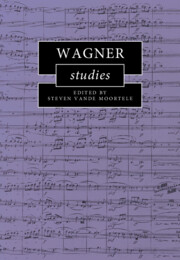
While the music of Richard Wagner has long served as a touchstone for music-theoretical and analytical models both old and new, music analysts have often been intimidated by the complexity of his works, their multi-layeredness, and their sheer unwieldiness. This volume brings together ten contributions from an international roster of leading Wagner scholars of our time, all of which engage in some way with analytical or theoretical questions posed by Wagner's music. Addressing the operas and music dramas from Die Feen through Parsifal, they combine analytical methods including form-functional theory, Neo-Riemannian theory, Leitmotiv analysis, and history of theory with approaches to dramaturgy, hermeneutics, reception history, and discursive analysis of sexuality and ideology. Collectively, they capture the breadth of analytical studies of Wagner in contemporary scholarship and expand the reach of the field by challenging it to break new interpretative and methodological ground.
This chapter argues for an approach to teaching History rooted in the ethical position foundational to the discipline. That approach is based on respect for our students and for the discipline; in it instructors encounter and learn from their students in the same way that they encounter and learn from historical subjects, and instruction in History, just like research in History, focuses not on controlling outcomes but on engaging in an ethically authentic process. It offers six approaches to instruction that can help build this kind of relationship between instructors and students, and between students and the discipline. These include consulting our students regarding their interests and aims; building instruction around the process of inquiry; making pedagogical use both of the breadth of the discipline and of its complexity, diversity, and epistemological and methodological divisions; focusing on teaching analysis, critical thinking, and interpretation; and bringing students to see their engagement with History not only as a process by which they master specific bodies of knowledge and methods of thinking but also as an open-ended intellectual adventure.
This conversation explores how technology changes the way disputes are solved. The focus is on the impact of artificial intelligence. After reporting on a competition, in which lawyers and an artificial intelligence competed to accurately predict the outcome of disputes before the UK Financial Ombudsman, the speaker explains how artificial intelligence is practically used in dispute resolution. Such use cases include the production of information, the creation of focused analyses, the finding of decisions and the generation of communication. The speaker then presents research projects using artificial intelligence to predict dispute outcomes in the courts of different countries. The conversation also addresses the ethical questions arising from different use cases of artificial intelligence in conflict resolution. In conclusion, the potential of artificial intelligence to improve access to justice is identified together with the ethical challenges that need to be addressed.
This chapter reviews the perspectives and levels of an analysis that inform how an observation is made. This is done by demonstrating that there are two perspectives (language use and the human factor) and five levels (summation, description, interpretation, evaluation, and transformation) of analysis in discourse analysis. These perspectives and levels can be used to understand the frameworks of established methodologies, such as conversation analysis, critical discourse analysis, and narrative analysis. After reading this chapter, readers will know that the analytic process can combine different perspectives and levels of analysis.
This chapter summarizes the main points established in prior chapters and reviews how research questions factor into doing discourse analysis. The aim of the chapter is to help readers synthesize the different aspects of conducting discourse analysis research into a coherent set of principles. This is done by introducing a practical model for doing discourse analysis. After reading this chapter, readers will be able to recall the mains points of doing discourse analysis; be capable of using a model for doing discourse analysis to conduct research; know a number of practical tips for doing discourse analysis; and be able to construct research questions that are relevant to discourse analysis research.
Since its founding in 1987, the political and ideological dimensions of the terror organization Hamas have been well discussed by scholars. In contrast, this innovative study takes a new approach by exploring the entire scope of Hamas’s intelligence activity against its state adversary, Israel. Using primary sources in Arabic, Hebrew, and English, the author analyzes the development of Hamas’s various methods for gathering information, its use of this information for operational needs and strategic analysis, and its counterintelligence activity against the Israeli intelligence apparatus. The Hamas Intelligence War against Israel explores how Hamas’s activity has gradually become more sophisticated as its institutions have become more established and the nature of the conflict has changed. As the first full-length study to analyze the intelligence efforts of a violent non-state actor, this book sheds new light on the activities and operations of Hamas, and opens new avenues for intelligence research in the wider field.