To save content items to your account,
please confirm that you agree to abide by our usage policies.
If this is the first time you use this feature, you will be asked to authorise Cambridge Core to connect with your account.
Find out more about saving content to .
To save content items to your Kindle, first ensure no-reply@cambridge.org
is added to your Approved Personal Document E-mail List under your Personal Document Settings
on the Manage Your Content and Devices page of your Amazon account. Then enter the ‘name’ part
of your Kindle email address below.
Find out more about saving to your Kindle.
Note you can select to save to either the @free.kindle.com or @kindle.com variations.
‘@free.kindle.com’ emails are free but can only be saved to your device when it is connected to wi-fi.
‘@kindle.com’ emails can be delivered even when you are not connected to wi-fi, but note that service fees apply.
Between World War II and independence, roughly 1945 to 1960, anticolonial activists successfully elucidated a link between the spread of Europhone education and freedom from colonial rule. This chapter frames African decolonization as also a Black Atlantic emancipation to reveal why educational aspirations were so central to mid twentieth-century anticolonial imaginings.
Despite his support for the creation of the West Indies Federation in the late 1950s, the anticolonial activist and political thinker CLR James expressed severe reservations regarding the process that led to its creation. While his criticisms are brief, this paper reconstructs a Jamesian critique of the plebiscite as a means of anticolonial self-determination. Situating his discussion of the plebiscite in the broader arc of his political thought from the 1930s to the 1960s, I identify three lines of critique that revolve around broad questions of mass leadership and the reproduction of colonial domination. First, drawing on his discussion of the tragic flaw of Toussaint L’Ouverture’s leadership during the Haitian Revolution, James argued that the plebiscite enabled popular leaders to skirt their responsibility to effectively communicate with the revolutionary masses. Second, James feared that the plebiscite fixed the principle of territorial sovereignty in place in advance of the process of decolonization by tethering popular authority to clearly bound territorial constituencies. Third, by giving the people a simple choice between two options, James worried that the plebiscite would undermine radical processes of democratic self-constitution. Against conventional critiques of the plebiscite as a means of consolidating dictatorial power under the guise of vox populi, James reveals how ostensibly popular political forms, such as the plebiscite, undercut the enactment of popular agency in colonial contexts.
This article argues that the India League’s 1942–47 anticolonial campaign for a Constituent Assembly for India played a constitutive role in Indian independence. It examines the Constituent Assembly not as an institution that followed the decision to offer India independence but as an anticolonial idea that helped produce it. A necessary part of this was the dissolution of the ‘minority veto’ placed on Indian constitutional progress, mainly by the Conservative Party. It traces the transmission of the Constituent Assembly idea through the India League’s transnational networks until it became a Congress demand in India and a Labour Party initiative in Britain, leading to the Cripps Mission and the policy of the 1945 Labour government. In doing so this article challenges the historiography of geopolitical decolonization by finding Indian independence to be the product of an anticolonial campaign that operated through solidarity and elective affinities with the global left. This was contested by both the Conservative Party and the Muslim League, and the article also examines how Muslim League opposition to being ‘minoritized’ within the Constituent Assembly contributed to the Partition of India.
The Introduction opens with a (personal) precursor to the writing of the book. It discusses the methodological, normative, and theoretical basis of the book. It offers an overview of the argument and the chapters, and outlines sources employed in the research.
This chapter examines the progressive Arabic literary roots of Mizrahi fiction with a focus on its founding genre, the literature of the transit camps (sifrut hama’abara). I trace the participation of writers such as Shimon Ballas and Sami Michael in the Palestinian and Arab Jewish communist periodicals al-Jadid and al-Ittihad in the 1950s. This repressed cultural history reveals that the magazine’s popular literary campaign first launched the transit camp stories in Arabic. The chapter then looks at the elision of these Arabic sources by literary critics who framed Mizrahi literature as a Hebrew and Israeli literary development. By putting the foundational Mizrahi and transit camp novel, Shimon Ballas’s Ha-ma’abara (The Transit Camp), into conversation with the author’s Arabic works, I challenge the scope and coloniality of the Hebrew criticism. In the novel, Ballas continued to engage with themes of social and economic justice, his focus in the 1950s. While the novel broke with institutional communism of that decade, it proposed other working-class community-organizing models based on mutual aid. The power of community is presented as a product of intensive collective care and an anticolonial spirit, clearly inspired by the popular writing of al-Jadid. The chapter proposes freeing Mizrahi literatures from the Israeli national silo and placing them in renewed conversation with both Arabic literatures and Global left cultures.
This article proposes a definition of the concept of postcolonial justice in view of elaborating a fruitful theoretical framework for connecting distinct demands for racial, cultural, epistemic, memorial, and spatial justice that have been emerging on a global scale in the last two decades. The article conceives postcolonial justice as both critical and reparative, maintaining that reparation claims must be considered a crucial pillar in a theory of postcolonial justice. It also argues that postcolonial justice is better understood as a complement to a radically egalitarian conception of global social justice, which is anti-capitalist and anti-colonial. Finally, it concludes that while reparations are relevant for an anti-capitalist and anti-colonial theory of global social justice, the reparative grammar of postcolonial justice is not sufficient to target current distributive inequalities that depend on existing infrastructures of domination. The latter cannot be repaired and should instead be abolished.
Can civil disobedience be transnationalized? This question presumes civil disobedience to be a fundamentally domestic concept—one constitutively tied to both the nation-state and the normative underpinnings of liberal, constitutional democracies. This article shows how this assumption mistakes one version of civil disobedience's twentieth-century intellectual history for the whole of it, and risks reproducing binaries (domestic vs. international, democracies vs. non-democracies) that trouble attempts to theorize the transnational. Turning to an alternative intellectual history—a network of civil rights and anticolonial activists—reveals a novel theory of civil disobedience as decolonizing praxis, as well the stakes of these binaries: the disavowal of white supremacy as pervasive and durable global structure of governance, linking the domestic to the international, and democratic rule to domination.
This chapter explores the place of empire and imperialism in the British literature of the Popular Front period (1934–40). During this period, left-aligned writers responded to the Communist International’s call for broad antifascist alliances built on national cultural traditions with an outpouring of works of fiction, poetry, and drama, as well as critical reevaluations of literary history. These contributions are characterized by an evocation of “the people” as a diverse, progressive, antifascist subject, but one always national in character and therefore fraught with ambiguities and contradictions. The chapter considers the ways that writers based in Britain negotiated the connections between antifascism, anticolonialism, and anti-imperialism in this late interwar moment. It focuses first on the literary milieu around the influential journal Left Review, and second on the interlinked work of Ralph Fox, Mulk Raj Anand, and Sajjad Zaheer. In concludes by suggesting that the Spanish Civil War provided the occasion for some leftist writers from Scotland and Wales to imagine the continuities between working-class history, anticolonialism, and antifascism in their work.
Are there objective criteria that we can use to discern if an act of violence constitutes terrorism, or is such labeling always a subjective and political decision? Wherein lies the boundary between domestic versus international terrori and is that a meaningful distinction to make? How do individuals get radicalized, and how do they reach the point of committing violent acts? In this chapter, we tackle these questions (and others) and the issue of terrorism in international security. There are no easy, agreed upon answers to most of them, and terrorism continues to be a highly contested and politically charged concept, while constituting a very real and pressing security threat in many countries around the world. But that is even more reason to look closely at the controversies surrounding its definition, its historical evolution and patterns, and its contemporary manifestations in the twenty-first century as well as approaches to countering terrorism and attempts at international cooperation.
This Element offers the first comprehensive study of Hegel's views on European colonialism. In surprisingly detailed discussions scattered throughout much of his mature oeuvre, Hegel offers assessments that legitimise colonialism in the Americas, the enslavement of Africans, and British rule in India. The Element reconstructs these discussions as being held together by a systematic account of colonialism as racial domination, underpinned by central elements of his philosophy and situated within long-overlooked contexts, including Hegel's engagement with British abolitionism and Scottish four-stages theories of social development. Challenging prevailing approaches in scholarship, James and Knappik show that Hegel's accounts of issues like freedom, personhood and the dialectic of lordship and bondage are deeply entangled with his disturbing views on colonialism, slavery, and race. Lastly, they address Hegel's ambivalent legacy, examining how British Idealists and others adopted his pro-colonial ideas, while thinkers like C. L. R. James and Angela Davis transformed them for anti-colonial purposes. This title is also available as open access on Cambridge Core.
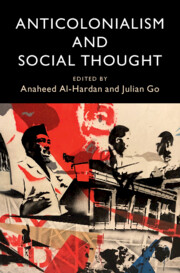
This chapter introduces the main themes of the volume, Anticolonialism and Social Thought. It provides a brief overview of the history of anticolonialism and argues that anticolonialism in history generates social thought and social theory.
This chapter examines a group of anticolonial and anti-imperialist intellectuals of different political persuasions thinking on Palestinian anticolonial national liberation at key moments in Palestinian history. It argues that central to these thinkers in their analysis of Palestine is a collapse in distinction between 1948- and 1967-occupied Palestine in Zionist settler-colonial ambitions in Palestine; the umbilical relationship between Zionism and US–Euro imperialism; as well as the centrality of Arab ruling classes to Zionist hegemony in Palestine.
Not only did the anticolonial movements of the past two centuries help bring down the global order of colonial empires, they also produced novel, innovative and vital social thought. Anticolonialism has been largely ignored in conventional Europe-centered social thought and theory, but this book shows how our sociological imagination can be expanded by taking challenges to colonialism and imperialism seriously. Amidst their struggles to change the world, anticolonial actors offer devastating critiques of it, challenging the racism, economic exploitation, political exclusions and social inequalities central to imperialism and colonialism. Anticolonial thinkers and activists thereby seek to understand the world they are struggling against and, in the process, develop new concepts and theorize the world in new ways. Chapters by leading scholars help uncover this dissident tradition of social thought as the authors discuss an array of anticolonial thinkers, activists and movements from Palestine, India, South Africa, Brazil, Algeria and beyond.
The twentieth-century quest for individual freedom was pursued not merely in Europe proper but also at its boundaries. This had much to do, in the first instance, with a desire for liberation from metropolitan societies that many identified with an excess of constraints and conventions. It also reflected a strong sense of European superiority over both Americans and colonized peoples. But, as the century wore on, uncertainties arose from the growing power of the United States and the increasing criticism and various reforms to which colonial rule was subject. American popular culture appealed to youth across the continent, to the dismay of many adults, while colonized subjects increasingly claimed the status of free individuals, both in overseas colonies and as immigrants to Europe. This chapter discusses whether there was autonomy or conformism in America, at a time when its supposed freedoms were so attractive to many Europeans though they appalled others; how colonial self-reliance was loudly claimed and staunchly defended against indigenous demands and more liberal forms of European rule; and, finally, what colonized subjects’ perspectives were on the individual freedom they were denied but were seeking as part of their efforts to become decolonized.
This chapter takes as its starting point Mulk Raj Anand’s literary interest in what he describes as “earthiness”, and argues that it is neither a simplistic yardstick of social realism, nor simply a derivation of Anglo-American modernism, but something in between, something different, and perhaps something more. In common with many of the other chapters in this volume, I make the case that Mulk Raj Anand was neither a modernist nor a realist, and that for a more satisfactory evaluation of Anand-the-novelist, we need to follow an entirely different literary tradition. Focusing on the dirtiness and squalor that is present in much of Anand’s writing, I argue that Anand deploys this trope to make the novel into neither a realist depiction of the world, nor a disaffected, alienated exercise in aestheticism, but as a vehicle to explore what it might mean to be modern, what it might mean to be anti-colonialist and what it might mean to be nationalist.
As represented by the title, this chapter unpacks how the British colonial administration left indelible legacies on the Nigerian state and how those legacies killed the sociopolitical fabric of the region before the institution of colonial rule. Through the concept of regionalism, which the chapter understands as “the systemic division of governmental control where a central or federal government holds clearly defined authority and power,” the colonial administration hamstrung Nigeria’s political and economic growth by creating ethnic mistrust and conflict, the marginalization of minorities and agitation among ethnicities after the development of ethnic nationalism. Self-serving interests of colonialists aimed to partition the country along arbitrary lines, disregarding the complex web of pre-existing linguistic and ethnic communities for ease of administration. The effects of these colonialist policies fueled the ethnopolitical and social conflict (and other marginalization of minority groups only possible after the creation of a state) within Nigeria, thus stymieing the development of Nigeria’s internal and independent sociopolitical structures.
Godwin Mbikusita-Lewanika, the founding president of Zambia’s first nationalist organisation, is now remembered as a staunch supporter of colonial rule. Such figures are not uncommon and are often termed “loyalists,” a term that is usually understood in the literature as a fixed category that either dwindled in the face of racial oppression or was a choice shaped and hardened by conflict. Lewanika, however, moved easily between different sides, reinventing himself as an anticolonial nationalist, trade unionist, colonial loyalist, and Lozi traditional monarchist as circumstances warranted. The tumult of the mid-twentieth century opened up new opportunities and Lewanika seized roles that were not previously available. Biographies of anticolonial nationalists often argue they turned to political action when their education and ambitions clashed with the highly-circumscribed roles available under colonialism. Lewanika’s life was the opposite. He carved out a prominent place for himself in the colonial order and then in independent Zambia.
This article explores the 1932 visit to India of a delegation of Labour party figures associated with the India League, a prominent anticolonial organisation based in London, charged with investigating the colonial state violence unleashed by ‘Ordinance Rule’. It also examines efforts taken by the Government of India, India Office and Indian Political Intelligence to suppress their findings, through which it explores a dialectic between anticolonial knowledge-making and agnotological imperialism, which often took the form of the latter ‘exceptioning’ examples produced by the former of excessive colonial state violence. It offers the conclusion that the contradictions between liberal imperialism and the rule of colonial difference and repression in the age of mass nationalism in India and mass democracy in Britain meant that liberal imperialism in India increasingly flowed, paradoxically, from illiberalism in Britain.
In Chapter 4, the third case study investigates how martyrdom discourse was deployed by Sikhs during World War I. It begins with an analysis of the social and cultural situation at the turn of the twentieth century in Punjab, from where the majority of Sikh sepoys hailed, and the resulting relationships with the imperialist British Raj. After examining the socioeconomic conditions that led Sikhs to enlist in the British Indian Army, I discuss how a military mindset constructed a particular idea of Sikh character. The chapter proceeds with an analysis of Sikh traditions of martyrdom and the way the British Empire was colored as a prophesized entity, and therefore actions in its service construed as a sacred duty. Simultaneously, I describe the antagonism felt for the British Empire by emigrant Sikh communities especially in North America, creating a bifurcation of perspectives reflected in approval or dismissal of the self-sacrifice of Sikh soldiers and the creation of anticolonial martyr forms. The chapter concludes with an examination of how the failed promises of the British government following the war marginalized those Sikh martyrs who fell in their ranks during World War I.