To save content items to your account,
please confirm that you agree to abide by our usage policies.
If this is the first time you use this feature, you will be asked to authorise Cambridge Core to connect with your account.
Find out more about saving content to .
To save content items to your Kindle, first ensure no-reply@cambridge.org
is added to your Approved Personal Document E-mail List under your Personal Document Settings
on the Manage Your Content and Devices page of your Amazon account. Then enter the ‘name’ part
of your Kindle email address below.
Find out more about saving to your Kindle.
Note you can select to save to either the @free.kindle.com or @kindle.com variations.
‘@free.kindle.com’ emails are free but can only be saved to your device when it is connected to wi-fi.
‘@kindle.com’ emails can be delivered even when you are not connected to wi-fi, but note that service fees apply.
Waheed Hussain’s Living with the Invisible Hand argues that, although the market economy is valuable for efficiently coordinating production and consumption, it is morally problematic because it draws us into patterns of activity that bypass our own judgment as rational beings. This makes the market potentially “authoritarian.” But what exactly does it mean to say that the market “bypasses our judgment”? In this article, I seek to clarify this idea and suggest that Hussain has actually identified a few separable senses in which it might be true. These different senses are important to distinguish because they call for different remedies.
In the conclusion, we review the book’s chapters and argue that Latin America has experienced a resurgence of conservative forces in recent years. We analyze the supply and demand of a broad set of conservative alternatives, paying special attention to the processes of party-building, adaptation, and rebranding. We find that new right-wing forces often have weak organizations, but have been able to mobilize voters along noneconomic cleavages, including security, gender politics, and reproductive rights. The adoption of a highly conservative profile has allowed parties to access lower-class constituencies and mobilize mass support among them. The politicization of cultural issues, such as LGBT rights and religious identities, has contributed to polarization and the rise of populist radical right parties. These parties have flourished within the context of political and economic shocks and benefited from cultural backlashes and the crises of traditional right-wing parties. In these situations, politics becomes a zero-sum game and the stakes get higher. Democratic stability in the region is arguably at its most tenuous state since the age of military dictatorships. Interrupted presidencies have become realities in many countries over the past fifteen years, raising concerns about democratic stability and potential threats to democratic institutions.
This chapter explains why right-wing strategies of adaptation and survival had varying degrees of success during and after the left turn. It argues that right-wing parties were most likely to survive and remain competitive in national elections when they relied on strong party brands and organizations. These strong party brands and organizations depended, in turn, on when the parties were founded and whether they had roots in an authoritarian regime.
This chapter starts by summarising an experiment showing how the brain’s emotion circuitry responds to a set of words signalling threat. The main emotion activated in Brexitspeak is fear; the triggers are both linguistic and visual. They include representation of alarming scenarios, and factual misrepresentations capable of causing various negative emotions. The chapter analyses three well-known cases that illustrate such effects. The first is Vote Leave’s propaganda displayed on the side of a red bus: the slogan was an inaccurate statement that could evoke feelings of attachment, resentment and anger. This is also analysed in terms of speech acts, ambiguous and deniable assertions, and lying. The second case, the rightly controversial ‘breaking point’ poster displayed by Leave.EU had the avowed goal of emotion arousal. The visual element is analysed with reference to cognitive image schemas, and their potential for activating fear reactions. The third case, the most effective of the Vote Leave campaign, was crafted in order to prompt the fear of losing agency. This, too, likely activated the brain’s fear circuitry.
For the thousands of children and teenagers who returned to Turkey with their parents during the mass exodus of 1984, the very concept of “return” was fraught. For many children, leaving West Germany in the 1980s was not a return or a remigration, but rather an immigration to a new country as emigrants from West Germany. The struggle of these archetypical “return children” was especially pronounced because they bore the burden of another label: “Almancı children,” or “Germanized children.” These children had particular difficulties reintegrating into the Turkish school system, and both the Turkish and West German media regularly emphasized the “liberal,” “democratic” education in Germany in contrast to an allegedly “authoritarian” education in Turkey. Although West German policymakers were initially relieved to export the burden of integrating these children to Turkey, they soon developed sympathy. Though twisted in the service of racism, this sympathy for the children’s plight compelled a rare relaxation of West German immigration policy. In 1989, just five years after kicking them out, Kohl’s government permitted the children to return once again – this time, not to their parents’ homeland but to the one that many considered their own: Germany.
In the past decade, the Vietnamese lesbian, gay, bisexual, transgender, and other sexual orientations and gender identities (LGBT+) movement has succeeded in repositioning this population from the stigmatising label of “social evils” to a more positive social representation. Despite the limited space for civil society in this authoritarian environment, Vietnamese activists and non-governmental organisations (NGOs) have effectively changed public attitudes, improved visibility, and gained legal recognition for this marginalised community. This study uses qualitative data from interviews with twelve activists and fieldwork observations to explain how activist strategies in this setting align with the “service delivery” function of civil society. By examining how activists have addressed healthcare and education deficits, I demonstrate that activism in authoritarian regimes can be effective when it assists instead of challenges the government. The findings contribute to scholarship on global queer activism by demonstrating how a service delivery approach can achieve social change, highlighting the role of NGOs and international development in this process. Additionally, the findings expose existing challenges that hinder these activists’ efforts, showing how funding dependency and inadequate legal recognition can significantly limit the creativity and autonomy of grassroots activist groups.
This chapter critically examines the history of Singapore’s policing system, and argues that while Singapore may be seen as an authoritarian state, its system of policing – save for the existence of preventive detention laws – is largely democratic. During the colonial period, the police force was always short of money and policemen poorly paid, inept, and corrupt. Notwithstanding various reforms, the colonial police were unable to deal with the secret societies – the biggest threat to public order and safety – and relied on a mix of welfare, cooperation, and selective coercion. It was only after Singapore’s independence that local politicians introduced draconian preventive detention laws that succeeded in breaking the backs of the secret societies. Even so, the state did not rely only on these laws to police the population but also invested heavily in strengthening and boosting the police force, reforming it towards a more community-oriented form of policing.
Political democratization does not necessarily lead to democratic policing; rather, authoritarian legacy always poses a challenge for the integration between democracy and coercive policing. This chapter presents a case study of Taiwan to unveil such authoritarian legacy. After its democratization in the late 1980s, Taiwan has been gradually transformed its authoritarian policing into democratic policing subject to judicial review. However, as Taiwan’s peaceful democratic transition did not come with radical political changes, authoritarian legacy persists and continues to affect policing practices. Nonetheless, throughout both authoritarian and democratic periods, the police in Taiwan have obtained strong legitimacy and been perceived as one of the most trustworthy government agencies. As such, questions to explore in this chapter include: Why has authoritarian policing been this adaptive in Taiwan? How has the coexistence between authoritarian legacy and liberal democracy been made possible? What are the impacts on democratic governance and efficacy of legal reforms?
Growing fiscal challenges and ageing populations have made pension reform a pressing issue. Two particularly salient areas of pension reform have been: raising the retirement age; and structural reforms like the adoption and reversal of pension privatisation. The authors compare two very similar cases: Russia and Hungary in the post-communist period. Both countries faced growing demographic and fiscal challenges prompting pension reform, but at the time of reform Hungary was democratic and Russia was authoritarian. Some scholars predicted that authoritarian governments would be better able than democratic ones at enacting unpopular, but arguably necessary, economic reforms. Others argue that democratic governments can more easily enact policy changes because of greater confidence about public opinion. Additionally, authoritarian policymaking can be uniquely slowed by bureaucratic in-fighting. The authors find support for the position that democratic governments can be more flexible: thus offering important insight into how regime type shapes policymaking.
Authoritarian nationalism is on the rise in many countries around the world, threatening liberal democracies. Many on the left rightly fear that any and all celebrations of national identities risk heightening these dangers. It is questionable, however, whether illiberal nationalism can be defeated politically without some reliance on progressive stories of national identity that advance themes of equality, freedom, and inclusion in ways that resonate with many of the traditions in which those whom progressives seek to mobilize have been raised.
Payne offers an account of the unsettling effects of confessions of violence by armed left guerillas or revolutionary fighters in Argentina in two moments in Argentine history. The chapter considers how the timing of these confessions shaped responses to them. In the years shortly after the transition from authoritarian rule, contentious debate moved toward a full accounting on the left for its role in past violence. In recent years, this proved less possible. As the right reconsolidated its political power, the confessional narratives from the Argentine armed left fueled fears of a backlash against the left, reinforcing a view of the left’s shared responsibility with the authoritarian regime for human rights violations, and a call for its prosecution. This silencing of open debate over the left’s past actions prevented the process of condemning violations regardless of who committed them. The prescriptive dimension to this observation highlights the need for urgency in thinking self-critically, to reflect broadly on the motives and consequences of violence, and to use moments of political advantage to condemn those parts of the (temporarily) dominant power’s past that deserve condemnation.
In Chapter 6, we find evidence that opposition successor parties from more closed opportunity structures experience centrifugal strains caused by the amalgamation of ideological orientations and perspectives that they represent. These strains lead to elite polarization that cause movement fracture and collapse. Conversely, opposition successor parties from more open opportunity structures are ideologically more coherent and thus do not suffer the same centrifugal tensions. Second, we see that nearly all opposition successor parties experience a dramatic decline in popularity after founding elections, due the ephemerality of symbolic resources in general (oppositional credibility, in this context). The positive reputations that helped opposition groups persuade citizens to vote for them in founding elections break down under economic strain and political disfunction that so frequently plague new democracies. Finally, we see that in contexts in which authoritarian state institutions persist beyond the transition, the resurgence of state repression against opposition successor parties becomes more likely, while authoritarian successor parties, in contrast, can integrate former regime members into the new democratic political system.
This article proposes a measure of the social structuration of political parties. The measure has some distinctive virtues. It assesses the social bases of partisanship from the standpoint of the political party, and it provides a simple and transparent method for assessing the relative weight of social-structural and behavioral factors for party composition. We illustrate the power of this measure through a comparison of political parties in 30 European countries since 1975.
We may not always want citizens to care so much about retributive justice since these concerns pave the way for populist, authoritarian, and illiberal trajectories. But instead of indulging in the comfortable assumption that democracy naturally results in effective governance, we need to recognize and understand when and why these concerns come to the fore so that we can understand how best to work toward the political outcomes that we deem normatively desirable. This chapter discusses recent democratic backsliding, the dangers of anti-corruption politics, and what liberal democrats can learn from authoritarians through the lens of retributive justice.
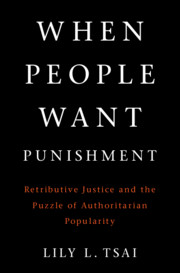
Under what circumstances do ordinary people prefer to elect illiberal leaders they know will violate individual rights? Why do people sometimes view authoritarian leaders as fair, just, and morally upstanding? This book aims to demonstrate that retributive justice concerns matter for how citizens judge government and how they make decisions about when to engage and comply with government authorities. While economic performance, public goods provision, democratic institutions, and redistribution matter as well, this book argues that retributive justice matters as much and sometimes more than these other criteria. A retributive justice model of citizen engagement has important implications for understanding the conditions under which we might expect populism to increase, interventions promoting citizen participation and government accountability to fail, and state building to succeed. Bridging behavioral and institutional approaches, this book’s retributive justice theory of citizen engagement accounts for authoritarian resilience as well as democratic fragility within a new, unified framework.
Against the backdrop of rising populism around the world and democratic backsliding in countries with robust, multiparty elections, this book asks why ordinary people favor authoritarian leaders. Much of the existing scholarship on illiberal regimes and authoritarian durability focuses on institutional explanations, but Tsai argues that, to better understand these issues, we need to examine public opinion and citizens' concerns about retributive justice. Government authorities uphold retributive justice - and are viewed by citizens as fair and committed to public good - when they affirm society's basic values by punishing wrongdoers who act against these values. Tsai argues that the production of retributive justice and moral order is a central function of the state and an important component of state building. Drawing on rich empirical evidence from in-depth fieldwork, original surveys, and innovative experiments, the book provides a new framework for understanding authoritarian resilience and democratic fragility.
Somalia’s years of postcolonial independence are marked by disputes over how to build a stable, modern, and functioning legal system – and what to do with shari‘a. From the start of the transition to independence in 1950 until the disintegration of the Somali state in 1991, state actors adopted an instrumental view of state law and shari‘a.
This chapter sets up theoretical framework for the entire book. The effectiveness of China’s own development and its engagements in Africa cannot be plausibly explained by the existing theories on the China Model. Researchers’ efforts to define tenets and patterns of “Beijing Consensus” all fail to grasp the dynamic complexity in practice. By analyzing the implication of Chinese pragmatism in the market reform, this chapter points out that the essence of modern development, in the form of industrial capitalism, lies in shifting from traditional cultural and religious values to the pursuit of sustainable productivity growth. The change of societal targets requires comprehensive sociopolitical transformation to enable sophisticated division of labor and massive market distribution. However, the simultaneous changes of numerous factors in a society tend to create a chicken-egg dilemma, hindering smooth structural transformation. China was able to escape this trap by having the whole country experiment flexibly and gradually to achieve synergism of development. The coevolutionary pragmatism has also been adopted in China’s cooperation with Africa. Aiming at achieving overall economic growth for partners, Chinese government and enterprises do not stick to definite models, but have open attitude to promote commercial practices in Africa’s diverse conditions.
This chapter examines Hong Kong perspectives on the rule of law and argues that concern with maintaining the rule of law has been at the heart of the battle over political reform. In these political clashes a rather hardline Beijing approach to rule by law is juxtaposed against the very liberal Hong Kong perspective developed under British rule. As deLisle points out inand Cullen and Campbell elaborate on, there is a wide gap between Hong Kong and Beijing on the rule of law. With Beijing’s perceived lack of the rule of law, Hong Kongers have generally viewed the promised high degree of autonomy and noninterference by the central government as crucial to maintaining the rule of law and avoiding arbitrary rule in Hong Kong’s separate system. Such hands-off approach was clearly understood in formulating the “one country, two systems” model for Hong Kong under the Sino-British Joint Declaration and the Basic Law, though application has fallen short. Starting with the historical commitments, this chapter critically examines the series of official reports and decisions surrounding the 2014 clashes over political reform in Hong Kong and considers their relevance to the rule-of-law debate.