To save content items to your account,
please confirm that you agree to abide by our usage policies.
If this is the first time you use this feature, you will be asked to authorise Cambridge Core to connect with your account.
Find out more about saving content to .
To save content items to your Kindle, first ensure no-reply@cambridge.org
is added to your Approved Personal Document E-mail List under your Personal Document Settings
on the Manage Your Content and Devices page of your Amazon account. Then enter the ‘name’ part
of your Kindle email address below.
Find out more about saving to your Kindle.
Note you can select to save to either the @free.kindle.com or @kindle.com variations.
‘@free.kindle.com’ emails are free but can only be saved to your device when it is connected to wi-fi.
‘@kindle.com’ emails can be delivered even when you are not connected to wi-fi, but note that service fees apply.
This chapter considers the evolution of English policy towards Ireland from the sixteenth century onwards. It argues how, at the beginning of the seventeenth century and the important reign of James VI and I, there was a renewed emphasis on religion, specifically Protestant evangelisation, as a key part of colonial projects, with Ireland part of wider trends in developing English imperialism. This resulted in policies of ‘converting and civilising’, with concepts of civility becoming inextricable with the Protestant religion. This was made visible in the planning and requirements of plantation schemes such as Ulster, which is contrasted with earlier schemes’ more lax religious requirements. The stress on religion, in turn, generated Irish Catholic resistance, which also drew on religious arguments, justifications and imagery in resisting the dispossession, displacement and loss of power that plantations represented. The Catholic clergy were crucial actors in articulating this religiously inflected opposition. The effect of both plantation and challenges to it was the increasing voicing of grievances, across a range of issues, in religious terms and through religious categories.
Violence against religious objects is the chief subject of this chapter. It considers Irish Catholic violence against the Protestant Bible, arguing that its status as a heretical object was central in explaining hostility and destruction; however, its anglicising power was also targeted, with implications touching language, the law, imperialism and more. Protestant iconoclasm also receives some attention, though the chapter notes its relative paucity in the sources; when it occurred however, it was a powerful statement against perceived idolatry, superstition and the believed inherent violence of Catholicism, especially the clergy. The chapter concludes with a reconsideration of massacre in light of iconoclasm and material violence, arguing that the body could be understood as a form of ‘sacred image’, and thus, interpersonal attacks must be viewed and understood as part of a continuum of violence against symbols of faith, giving a new perspective to long-running debates concerning massacre in the rebellion.
This chapter considers sacred space and the battles surrounding its possession, uses and understandings of the sacred more generally, including the wider significance of the landscape itself as a sacred space. Irish Catholic approaches were nuanced, such as the distinctions drawn between newly-built Protestant churches and older buildings that could be ‘re-catholicised’. The numerous rites and practices that this entailed are explored, showing that while notions of the holy and control of space were important to Irish Catholics, there was, nonetheless, great variety in how that was expressed. Spaces such as churches and churchyards are also examined as locations where both sacrality and ethnic tensions overlapped, with disputes surrounding burial showcasing Irish Catholic hostility to Protestants and Protestantism as heresy but also as foreign bodies contaminating Irish soil. The politics of church possession is another theme, which is shown to have explosive potential for intra-confessional conflict, as Irish Catholics debated and fought over the control of churches as a central demand of their cause, leading to conflict among themselves.
We were on opposite sides of the Brexit divide, perhaps the most divisive issue since 1945. Steve publicly campaigned hard to end the jurisdiction of EU law and institutions in the UK. Paul voted Remain but was much less concerned about the issues. Steve is sometimes lauded, but still widely hated for his efforts. Many of Paul’s colleagues were shocked that he didn’t care very much about an issue they saw as existential. We met on Zoom during Covid, when we shared similar concerns about the harms of lockdowns. The libertarian MP and the leftie academic didn’t expect the call to last very long. But we agreed on much more than we expected to – and we liked one another. We wrote against ‘vaccine passports’ in The Times. Paul was astonished by comments on the article, which were overwhelmingly about Steve’s work on Brexit, which had nothing to do with vaccine passports. Paul was attacked by several colleagues not only for disagreeing with lockdowns, but also for collaborating with a horrible Brexiteer.
Chapter 4 turns towards the role of women’s work in reproducing the household, focusing on the labour of relation-making in the neighbourhood as a means of creating economic networks through which material assistance can be sought. Commenting on anthropological literature that frames African contexts as ones of ‘mutuality’ and ‘obligation’, the chapter discusses the difficulty of finding assistance for aspirational projects (especially school fees) in an atomised neighbourhood where families compete for the prestige of economic advancement. It remarks upon the possibilities and limits of caring labour as a means through which women enter into economic relations of mutual support with others.
Civicness and civility are discussed as intertwined notions. To the degree they flourish, societies can be seen as civil societies. Providing some reflection on them may make a difference to the usual civil society and third sector debates. These concepts are not based on or confined to a specific sector like the third sector; basically all social sectors can contribute to and be marked by them, depending on their constellations and interplay. Therefore, a mediating public sphere and democratic governance have a key role to play. However, beyond an overlapping consensus, civicness and civility can mean different things and the dominant meanings change over time. This is discussed with respect to changing discourses on welfare as they have crystallized in the field of social services. Despite the contested meanings of civility and civicness shown here, introducing these points of reference could help to enrich concerns with the quality and overall designs of personal services in a civil society.
This paper argues that the current academic debate about global civil society has reached a point where some assessment or reflection could be useful for informing the course of future research in the field. Behind this call for an assessment is the very nature of the debate and emerging gaps and weaknesses that together produce a potential slow-down in generating new knowledge and understanding of global civil society. There are several shortcomings to the current research approach: the failure to take account of other civil society traditions; the failure to address the relationship between global civil society, conflict, and violence; and, most critically, the neglect of the notion of civility, both conceptually and empirically. The balance of the paper then explores the implications of this new assessment of global civil society research.
Activities in civil society, seen as the sphere of society in which voluntary associations are dominant, are considered an important source of civility in modern society. By interacting and finding solutions for common problems, members of associations turn into citizens with a broader perspective and interest in the common good. The evidence for these positive roles is at best mixed, however. Not voluntarily associating in a separate sphere of civil society, but combining associational with public and commercial modes of social coordination, appears to offer a more promising option for civilizing modern society. Examples of hybridity are discussed. The paper concludes with a plea for a clearer recognition in social research of civicness as a normative perspective.
The article examines problematic aspects of contemporary theoretical thinking about civil society within a Western liberal-democratic context. The impact of neo-liberalism upon narratives of civil society, the assumption that civility resides more conspicuously within the world of associational life, and the tendency to conflate ‘civil society’ with the ‘third sector’ are areas critically discussed. Such conceptual incongruities, it is argued, obscure the path to a more radical theoretical understanding of civil society. In the second part of the article an alternative model of civil society is proposed. Supporting Evers premise that ‘every attempt to narrow down civil society to the third sector seriously impoverishes the very concept of civil society’ (Evers, Voluntary Sector Review 1:116, 2010), it is argued that civil society is best understood as a normative political concept, as being contingent in nature and distinct from the third sector.
As they deliver services, organizations have to deal with conflicts over competing and sometimes irreconcilable values, especially at a time when they are facing competitive pressure and diminishing resources. The civicness of organizations expresses itself in how they enable positive interaction over such conflicts between their members. This paper focuses specifically on the relationship between professionals and their managers. By infusing social behaviour with civil values, organizations can contribute to a wider culture of citizenship.
This piece examines Gunn’s Superman through a historical perspective, placing it within the context of Superman’s appeal and place in American culture since his first appearance in 1938. I argue that Gunn draws on the work of numerous versions of Superman to craft a cinematic version that hews closely to creator Jerry Siegel’s naive New Deal liberalism while speaking to the need of the moment. In essence, the film’s appeal to “Truth, Justice, and the Human Way” replicates the ideologically slippery “American way” that Superman fought for after Pearl Harbor. Gunn’s spin is that we must invest hope in humanity, and the capacity for empathy and kindness, in the face of soulless amoral power. That such an appeal seems radical says something of the Trumpian moment and the hyper reliance on technology and the devaluing of humanities, which is to say what makes us human.
Although the United States was established with a distinctly Christian framework, over time the religious landscape has changed. American civil religion has adapted to make room for growing religious pluralism and the rise of secularism.
Chapter 5 discusses the custom of hat honour, a crucial marker of status in the early modern period, in which men took off their hats as a gesture of civility to social equals or deference to social superiors. The importance of hat honour is underlined by the Quaker challenge to it in the 1650s and 1660s. This was a refusal to observe the norms of civility, but also part of a radically unorthodox bodily habitus which provoked intense disquiet among the Quakers’ opponents as well as division among the Quakers themselves. The central focus of the chapter, however, is on hat honour in church. In the sixteenth century it was the custom for men to wear their hats in church, only removing them at certain points in the service in accordance with the biblical injunction to uncover their heads when ‘praying or prophesying’. But the 1604 Canons ordered that ‘no man shall cover his head in the church or chapel in the time of divine service’, effectively treating the church as a place apart where the normal rules of hat honour did not apply. This exposed an underlying disagreement over the nature of sacred space.
This uninhibited book of Collingwood’s rounds off his contribution to philosophy in a fiercely personal style. Declaring his unbounded admiration for the Leviathan of Hobbes and following its fourfold structure, Collingwood offers a systematic account of man, society, civilization, and “barbarism” – the last being understood as active hostility towards civilization, or revolt against it. Collingwood’s thoughts on the meaning of “society” and “civility,” as well as on questions of peace and war, remain very much alive; of particular interest here are his distinction between “eristic” and “dialectical” approaches to disagreement, and his conception of a body politic as the scene of a “dialectical” relationship between social and non-social elements. Other discussions impose greater distance on a modern reader – among them his briskly affirmative treatment of the role of a “ruling class,” of our entry into a presumed “social contract,” and of the “intelligent exploitation of nature.”
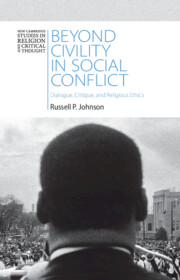
How can one speak and act in ways that overcome entrenched social conflicts? In polarized societies, some insist that the survival of democracy depends on people abiding by rules of civility and mutual respect. Others argue that the political situation is so dire that one's values need to be fought for by any means necessary. Across the political spectrum, people feel like they need to choose between the morality of dialogue and the effectiveness of protest. Beyond Civility in Social Conflict makes an important intervention in this debate. Taking insights from nonviolent direct action, it provides a model for advocacy that is both compassionate and critical. Successful communicators can help their opponents by dismantling the illusions and unjust systems that impede human flourishing and pit people against one another. The final chapter turns specifically to Christian ethics, and what it means to 'love your enemies' by disagreeing with them.
Chapter Nine explores Rogers’ humor, which was the common denominator in his wide-ranging endeavors as a public figure . It argues that he was the heir of a homespun, cracker-box tradition of comic commentary dating back to Benjamin Franklin and continuing through Artemus Ward, Petroleum V. Nasby, Mr. Dooley, and Mark Twain. Rogers presented a comic persona composed of common sense, a puncturing of pretense and pomposity, and a head-shaking, chuckling exposure of the absurdities of modern values and traditional prejudices alike. He did not tell jokes but offered witty reflections on the conundrums of modern life, appearing as a rustic sage cracking wise at the local general store. Moreover, while Rogers took pains to present his humor as spontaneous, it was actually meticulously prepared. Ultimately, by joking about the tensions, incongruities, and dislocations of a rapidly modernizing society, he helped Americans come to terms with enormous changes affecting their lives. Their rapturous reception made Rogers the leading American humorist of early twentieth-century America.
This chapter surveys and critiques the three major viewpoints on the ethics of communication, which I label Civility, Victory, and Open-mindedness. For Civility, activism must be governed by a set of rules for respectful engagement. For Victory, the ends justify the means, and for the sake of one’s political goals, one may need to mislead audiences, dismiss opponents, and use ad hominem attacks. For Open-mindedness, it is violent and immoral to impose one’s views on others. I argue that all three perspectives have serious shortcomings, but that each voice expresses a valuable concern. People want their advocacy to be moral, effective, and nonviolent, but often feel like it is impossible to have all three.
Martin Luther King Jr. argues that means and ends must be commensurable. If one wants to bring about a more equitable society, one must do so by equitable means. This means-ends principle is reiterated in the writings of Gandhi and King, but it has often been treated as something mysterious. A pragmatic case can be made for it if we pay attention to the dynamics of communication. Gandhi and King argue for an approach to social conflict that combines compassion for the needs of their opponents with a resolute opposition to the injustices these opponents perpetrate. Respect and respectability without challenge and protest will not contribute to the development of a more equitable society. But neither will challenge and protest without respect and respectability. By attending to how nonviolent direct actionists combine these two pressures, I develop an alternative to the dominant perspectives in communication ethics, but one that shares their concerns for morality, effectiveness, and nonviolence.
Most people believe there are rules of civility that ought to govern our discourse in moral and political disagreements. These rules operate like the rules of just-war theory: easy to adhere to in theory, but in practice routinely abandoned by all parties for the sake of winning. Drawing on conflict theory and social psychology, I explain how social conflicts make it possible for people to break their own rules of engagement without recognizing that they are doing so. Indeed, the same public figures who speak of the need for civility and unity are often the ones most willing to resort to uncivil and intentionally divisive speech. In any “us versus them” conflict, the perceived necessity for “us” to prevail over “them” tends to outweigh other ethical considerations. The rules of civility, whatever their merits as an ethical theory, are largely ineffective at constraining immoral practices when the chips are down.
In appreciating the institutional perpetuity of war, while simultaneously acknowledging the historically informed, inherent limitations of attempts to bound its conduct by international law, this chapter introduces the three interrelated questions that serve as the organising themes of this volume: first, is there a historical continuity with legal protections in war being informed by notions of ‘civility’ and ‘barbarity’?; second, what is the relationship between the ideals and operational realities in international humanitarian law (IHL)?; and third, what are the limitations of international laws designed to restrain excess in war? Via a brief overview of the divergent evolutions of jus ad bellum and jus in bello law, this introductory chapter further explores the sub-themes present in this volume: universalism and its shortcomings; problems with punishing violations of IHL; and the degree to which modern laws of war legitimate activities that should otherwise be prohibited.