To save content items to your account,
please confirm that you agree to abide by our usage policies.
If this is the first time you use this feature, you will be asked to authorise Cambridge Core to connect with your account.
Find out more about saving content to .
To save content items to your Kindle, first ensure no-reply@cambridge.org
is added to your Approved Personal Document E-mail List under your Personal Document Settings
on the Manage Your Content and Devices page of your Amazon account. Then enter the ‘name’ part
of your Kindle email address below.
Find out more about saving to your Kindle.
Note you can select to save to either the @free.kindle.com or @kindle.com variations.
‘@free.kindle.com’ emails are free but can only be saved to your device when it is connected to wi-fi.
‘@kindle.com’ emails can be delivered even when you are not connected to wi-fi, but note that service fees apply.
Affect makes us vulnerable to attention capture. William Burroughs explored the aesthetic functions of playing with and capturing attention through his comic routines, his writing and his performances. This chapter shows how the outrageousness of Burroughs’ routines and his iconic performances in “Chappaqua,” “Drugstore Cowboy” and “The Black Rider” break down defensiveness through laughter and expose the enablers and drivers of addiction, challenging us to rethink our vulnerabilities in the face of drugs, social institutions, and new forms of media. His comic routines and performances reveal the social drivers of addiction, such as the health system’s involvement in the opioid crisis and the War on Drugs’ investment in social control, and anticipate the capture and resale of attention leading to the contemporary “attention economy,” the profits of surveillance capitalism and engineered addiction to social media.
Comedy’s commercialization, political role, and media domination mark its American evolution. Initially, humorists like Mark Twain reigned. But comedy’s move into mass media emphasized anarchic energy and gags until1920s radio and movies incorporated sound to expand humorous storytelling, witty dialogue. From these developments appeared the sitcom, a genre seized upon by early TV. Vaudeville’s comedic legacy also infiltrated TV variety shows that, by the 1960s, incorporated more provocative humor. Late-night talk shows emerged as a “gateway” for stand-up comedians. TV comedy became better known for expressing changing American values in Norman Lear’s 1960s sitcoms and Saturday Night Live’s 1975 parody sketches. Although most movie and TV comedy was not socially engaged, The Simpsons and other 1990s prime-time animation refashioned cultural parody while The Daily Show popularized the satirical newscast. Contemporary comedies embrace wider diversity highlighting gay, non-White, and female characters and narrative experimentation now that digital media compete for audiences.
Chapter 6 outlines the ways different practitioners of peithō’s arts managed her ambiguity through expressions and performances of piety toward her divinity. The chapter examines diverse figures from ancient Greek comedy and oratory who used prayerful reverence toward Peithō to bolster their own ēthos and secure success for their rhetorical projects. The chapter surveys the persuasive work of characters from the Aristophanes’ Lysistrata and Menander’s Epitrepontes as well as historical speeches from Demosthenes and Isocrates. Each of the orator-like figures examined reveals both the advantages and pitfalls of partnering with Peithō and the degrees to which the coercive or corrupting qualities of her influence might be deflected. These performances offered the ancient audience a variety of educational models for how one might productively harness Peithō’s assistance in rhetorical speech: by cultivating respectful deference toward her divinity and reconciling oneself to a lack of complete control before her power.
Jews have always participated in popular culture, but positive Jewish images rarely occurred until the 1990s. Jewish insider/outsider status shaped the film industry, radio and television, comic books, and stand-up comedy. A few Jewish characters were prominent in the 1960s–1970s (e.g., Barbra Streisand, Woody Allen). With the rise of the Internet and media industries targeting niche audiences, Jewish imagery now highlights Latinx Jews, Black Jews, Asian American Jews, Indigenous Jews, Sephardic Jews, and LGBTQ+ Jews. For example, Transparent (2014–2019) about a Jewish father who comes out as a transgender woman, routinely incorporates religious rituals. Broad City (2014–2019) celebrates the escapades of sexually fluid twenty-something Jewish friends. Drake and Tiffany Haddish, both Black Jews, repackaged their Bar/Bat Mitzvahs for comic effect. Explicit intra-Jewish diversity within wider American experiences disrupts historical tensions between Jewish presence and erasure in pop culture that were fueled by anti-Semitism.
Quintilian suggests that law be learned in significant part a comicis, from the usages, customs and comedies of everyday life. Starting out from the theatrical and foundational form of a legal dialogue between sovereign and philosopher on pedagogy, the body, letters and images, this chapter examines the fabrication of common law in terms of what the barrister Blount coined as comediography (comœdiographus). In whirl and jig, lawyers and playwrights of comedies share a trajectory from conflict to resolution, disruption to decision, that provides a harmonious conclusion for the audience if not necessarily the actors.
Characters curse storms, power blackouts and climate change sceptics in twenty-first century drama as the destructive force of climate change is theatrically represented across comic farce, realist tragedy and dystopian horror. While these theatrical forms differ in their affective and emotional impact, they commonly predict ecological disaster in the future. Disaster is broadly understood as the combination of historical and social determinants interacting with natural hazards and forces over time. Climate change disaster is framed in scenarios that range from humorous to terrifying and with a growing dramatic genre of futuristic climate fiction (cli-fi) about ecological collapse and political dystopia. Twenty-first century dramatisation presents both the absurdity of humanity’s inability to reduce carbon emissions and global warming and the tragedy of predicted disaster on a geological scale in the Anthropocene. At the same time, contemporary performance illuminates turning points in time turning points in time including a different outcome within the present including within the present.
This essay analyses Elizabeth Bowen’s comedy. It first focuses on the influence of English and Irish comic traditions on Bowen’s humour, especially her debts to Jane Austen and Maria Edgeworth. It then considers the historical and theoretical contexts that inform her comic fiction, written in the shadow of two world wars and a period of conflict and immense change in Ireland, and in the wake of important developments in the theory of humour itself, including interventions by Henri Bergson and Sigmund Freud. Bowen’s humour forms an intrinsic part of how she situates herself within literary traditions, and how she engages with themes of class and social tension, cross-cultural encounter and conflict. Bowen’s self-reflexive, ironic style employs modes such as comedy of manners, dark humour, gothic parody, mechanical humour, and satire.
Chapter 5 thus turns to the “old quarrel between philosophy and poetry”. Whereas my starting point in Chapter 4 was the paradox of the written critique of writing, here I begin with the apparent contradiction of Plato’s mimetic critique of mimesis in the Republic. For Gadamer, Strauss, and Krüger, this is key to understanding Plato’s critique of poetry: Plato does not condemn mimesis entirely. Instead, he subordinates the imaginative and persuasive powers of imitative poetry to philosophical goals and thus weaves poetry and imitation into his own masterful compositions. All three readings point differently but decisively to the limits of autonomous or unaided philosophical discourse, and therewith anticipate some of Heidegger’s insights on the necessity of something like poetic thinking.
This article examines three key debates about Black humor during the Harlem Renaissance, framing them as public “symposia” that reflect conflicting views on comedy’s role in Black cultural and political life. It argues that Harlem Renaissance comedy can be grouped into three categories: repression, rebellion, and revision. While scholars often interpret Black humor as a tool for survival or subversion, this article contends that it is rooted in cynicism—a “Black cynical reason” aware of the illusions of racial capitalism but skeptical that self-aware satire could resist them. Harlem Renaissance comedy critiqued white supremacy but also created internal tensions within the Black community, highlighting the complex relationship between resistance and complicity. The article explores this dynamic through three debates: the 1926 Crisis exchange between W. E. B. Du Bois and Carl Van Vechten, reflected in Jessie Redmon Fauset’s Comedy: American Style; the 1926 Nation debate between Langston Hughes and George Schuyler, explored through Schuyler’s Black No More; and Ralph Ellison’s 1958 exchange with Stanley Edgar Hyman in the Partisan Review, examined through Ellison’s essays. The article concludes that while Harlem Renaissance comedy advanced sharp critiques and inspired future activism, comedy itself struggles to produce putative political or social change.
This pithy Introduction justifies the existence of the volume and explains why its contributors do not apply the term “minor works” to Ennius’ corpus. It then provides an overview of the diversity of this corpus, zooming in on the remains of his comedy as an example of what is not quite lost, and briefly shows that Ennius deeply influenced the Roman literary tradition as a multiform author (not just as an epicist). The Introduction closes by explaining the dispensation of the volume and what its contributors achieve.
There is a modern expectation that since Shakespearean theatre is in some respects a popular art form, it should represent ordinary people in a positive or sympathetic light. This hope is frustrated at many points by the hierarchical structure of early modern culture, and its consequent tendency to identify the common people with whatever is ignoble and disorderly – an identification which is deepened, in plays as in society more generally, by the conventional image of the people as a nameless, fickle, and latently rebellious crowd. The pejorative force of these associations is complicated, however, by the fact that something like that very crowd is present in the theatre itself, watching, even co-creating, the show. It is as a formal dimension of the entertainment that ‘the people’ most tellingly take possession of Shakespeare’s stage.
During the first year of the global COVID-19 pandemic, Ghana’s creative arts communities captured its complex facets through various art forms. In Chapter 8, I focus on how these spontaneous artistic responses afforded the opportunity to examine in real time how grassroots arts and bottom-up social responses to health crises influenced health communication. Artists channelled ‘creative practices of the imagination’ regarding COVID-19, highlighting a mutually constitutive relationship between lay responses to the pandemic and what artists produced. The COVID arts they produced functioned in three arts and health domains: health education and knowledge production, disease prevention, and (indirectly) contributing to COVID-19 policy development. These intersecting functions converged on the science, culture and politics of COVID-19. I outline the subtle and radical ways artists translated the science, culture and politics of the COVID-19 pandemic to Ghanaian communities at home and abroad. I reflect on the insights these new art forms present for health communication during the COVID-19 pandemic and beyond.
In this chapter, I provide an interpretation of the famous claim at the end of the Symposium that “the same man” ought to be able to write both comedy and tragedy, and a speculative reconstruction of the arguments that Socrates might have used to secure that claim in his discussion with Agathon and Aristophanes. I argue that ideal comedy and tragedy are unified in at least three ways. First, they constitute a teleological unity, in that their ethical imitations both aim at moral improvement; second, they constitute an ethical unity, in that they both rely on, and endorse, a single theory of value, according to which wisdom and virtue are good and ignorance and vice are bad; and third, they constitute an epistemic unity, in that the objects that they imitate – ridiculousness and seriousness in agents and actions – form opposite parts of the same branch of knowledge, such that one cannot know one without knowing the other. I further argue that actual comedy and tragedy are unified but in a much weaker sense that does not involve any knowledge. In the end, I discuss the possibility of tragicomedy and consider in what sense it might be correct to understand Plato’s dialogues as tragicomedies.
In this chapter, I show how Plato’s conception of and norms for comedy provide a framework for understanding the Euthydemus as an ideal comedy, and I argue that Plato employs techniques of comedic characterization, in particular borrowing from Aristophanes’ Clouds, in order to portray the enemies of philosophy as ridiculous and self-ignorant. In particular, I argue that he portrays the sophist brothers, Euthydemus and Dionysodorus, as imposters, who wrongly believe that they possess deep and important wisdom because of their skill in eristic argumentation, that is, argument that uses any means necessary to win. Socrates inhabits the role of the ironist, who ironically praises his interlocutors and then ultimately exposes them as ridiculous and self-ignorant. My analysis of the dialogue in terms of the interplay of these comedic character types not only allows us to see the nature, scope and function of Socratic irony in a new light, but it also shows how the dialogue’s overt concern with fallacy and argument ultimately is a question of character and virtue. In the end, I assess the dialogue in light of the constraints on ideal comedy articulated in Chapter 1.
In this chapter, I interpret Plato’s Cratylus as an ideal comedy and argue that Plato employs the comedic technique of parody in order to expose rival methodologies as sources of ridiculous self-ignorance. Socrates’ extended parody of etymology shows that words cannot be a guide to the nature of being, since we have no reason to think that their analysis can teach us anything about reality. Etymology is, in short, a source of laughable self-ignorance because it provides its practitioners with the illusion of wisdom. Parody generally involves the use of an imitation that exaggerates or distorts some feature of the original, often in order to undermine its claim to authority. In the case of etymology, Plato’s parody not only exposes etymology as a false path to wisdom, but it also articulates specific criticisms of etymology regarding its methodology, its scope and its alleged systematicity. The function and purpose of the very long etymological section has proved highly puzzling to interpreters who are generally unsure what to make of it, and my account reveals the etymologies to be playing a central, and previously unnoticed, role in the overall argument of the dialogue. In the end, I assess the dialogue in light of the constraints on ideal comedy articulated in Chapter 1.
In this chapter, I argue, drawing primarily on passages from the Philebus, the Republic and the Laws, that Plato understands comedy to be, in essence, an imitation of laughable people, where the notion of the laughable, or to geloion, is a normative one that picks out what genuinely merits laughter, and not necessarily what people actually laugh at. According to Plato, the only thing that merits laughter is moral vice, in particular the vice of self-ignorance. I formulate four constraints on ideal comedy on Plato’s behalf: the veridical constraint, which holds that only what is genuinely laughable, that is, moral vice, should be imitated as laughable; the educative constraint, which holds that comedic imitation must aim at educating the audience by encouraging them to reject vice in their own lives; the emotional constraint, which holds that the comedic imitation should cause appropriate and appropriately moderate emotional reactions; and the political constraint, which holds that only moral and political enemies should be portrayed as laughable.
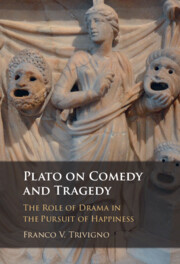
For Plato, tragedy and comedy are meaningful generic forms with proto-philosophical content concerning the moral character of their protagonists. He operates with a distinction between actual drama, the comedy and tragedy of the fourth and fifth centuries BCE, and ideal drama, the norm for what comedy and tragedy ought to be like. In this book Franco Trivigno reconstructs, on Plato's behalf, an original philosophical account of tragedy and comedy and illustrates the interpretive value of reading Plato's dialogues from this perspective. He offers detailed analyses of individual dialogues as instances of ideal comedy and tragedy, with attention to their structure and philosophical content; he also reconstructs Plato's ideals of comedy and tragedy by formulating definitions of each genre, specifying their norms, and showing how the two genres are related to each other. His book will be valuable for a range of readers interested in Plato and in Greek drama.
The first example of mechanical epiphany that the book sets forth is that of the well-known ‘god on the machine’ (deus ex machina) employed in the ancient Greek theatre. Moving beyond interpreting the theatrical crane as a plot device, this chapter forefronts the mēchanē’s material qualities to explore the theological potential of the object as a mode of visual epiphany. Vital to the success of this mode of epiphany was the challenge to the viewer to recognise divine intervention as well as the mechanics that constructed and enabled it. The evidence of Old Comedy, both fragmentary and the fuller plays of Aristophanes, help demonstrate how uses of the comic crane (kradē) undercut the interpretative symbiosis between man, machine, and divine agency on which tragedy was predicated. The chapter closes by exploring how the theatre as a form of mass media made it fertile ground for development and exploration of theological ideas, not just a reflection of literary norms.
O’Casey’s three most famous plays, those of his ‘Dublin Trilogy’, were subtitled as tragedies, yet the playwright had little time for academic theorizing and at one stage declared Aristotle was ‘all balls’. Early critics tended to set aside O’Casey’s definitions of his three famous plays as tragedy, preferring terms such as ‘tragi-comedy’, and, aside from Rónán McDonald, most later critics have ignored the issue. This chapter does not start from a specific formal model of tragedy, but instead examines The Shadow of a Gunman, Juno and the Paycock, and The Plough and the Stars to see how the audience or reader’s experience of these plays might relate to tragedy.
This article responds to Laura A. Marshall’s argument that Socrates does not compare himself to a gadfly in Plato’s Apology but rather to a spur on the side of a horse directed by Apollo. In revisiting the evidence for the canonical reading, this article argues that ‘gadfly’ or some other irritant insect is the only plausible translation for μύωψ in the Apology. Scrutinizing the source of the contemporary notion of the Western philosopher is pressingly important—not only for its own sake, but because the ‘spur reading’ has made its way into public circles and even the Cambridge Greek Lexicon.