To save content items to your account,
please confirm that you agree to abide by our usage policies.
If this is the first time you use this feature, you will be asked to authorise Cambridge Core to connect with your account.
Find out more about saving content to .
To save content items to your Kindle, first ensure no-reply@cambridge.org
is added to your Approved Personal Document E-mail List under your Personal Document Settings
on the Manage Your Content and Devices page of your Amazon account. Then enter the ‘name’ part
of your Kindle email address below.
Find out more about saving to your Kindle.
Note you can select to save to either the @free.kindle.com or @kindle.com variations.
‘@free.kindle.com’ emails are free but can only be saved to your device when it is connected to wi-fi.
‘@kindle.com’ emails can be delivered even when you are not connected to wi-fi, but note that service fees apply.
In the final chapter, the general account of the artifactual paradigm at work in Hegel’s thinking is extended to explain the shape of his overall philosophical position. Speaking loosely, Hegel sometimes suggests that everything is conceptual. However, it is here contended that Hegel’s idealism essentially involves an asymmetry in the domains of Geist and nature that is rooted in Hegel’s theory of concepts. Geist is that which is conceptually constituted; nature is that which is not conceptually constituted. This asymmetry between the two domains is the “inversion” of philosophy that Hegel’s concept-centric metaphysics inspires. In this chapter, evidence is assembled from Hegel’s so-called Realphilosophie – specifically his works on political philosophy, natural philosophy, and aesthetics – to show that Hegel’s treatment of these topics indeed demonstrates an inverted conception of philosophy, one that is rightly considered a humanism.
'Humanism' is among the most powerful terms in historical and contemporary political, religious, and philosophical debates. The term serves to position itself in ideological conflicts and to cement a claim to interpretation, but is highly contradictory. This Element addresses 'humanism' in its striking contradictions. Contemporary definitions are confronted with the historical contexts the term 'humanism' is applied to. Based on Niethammer's invention of 'humanism' as an anti-enlightenment pedagogical concept (1808), the book does not present a mere conceptual history, but rather a theoretically oriented discourse, an examination of the front positions, between which humanism has been constructed. In this way, its 'impossibility' is shown, which is rooted in its strict contextuality. Secondly, historiographical alternatives to this dilemma are pointed out, in order to finally give suggestions not only for an ethical-normative work of the historian of humanism, but for dealing with 'humanism' in general, in connection with discourse-theoretical suggestions. This title is also available as open access on Cambridge Core.
Hegel's philosophy is often presented as a reconciliation between thought and the world, and thus logic and metaphysics. But what is the basis of this reconciliation? In this book, Clark Wolf argues that the key to Hegel's transformation of philosophy lies in his recognition of the special logical basis of the humanly made world. Human artifacts and institutions are not merely represented by concepts; concepts are necessary for their very existence. For this reason, Hegel sees the human world, the world of spirit or Geist, as more central in philosophy than the mind-independent world of nature. Hegel's philosophy is thus a humanism. Wolf argues that this humanistic conception of philosophy is justified in Hegel's Science of Logic, since its logical basis is his theory of concepts. Through a detailed interpretation of the Doctrine of the Concept, this book sheds new light on Hegelian idealism.
This chapter examines how active citizenship or political participation, and representation were understood in Europe from the early sixteenth century to the mid seventeenth century. There are two central arguments which I put forward and seek to defend it what follows. First, there was a noticeable shift from direct participation to representation as the main form of political involvement during this period. Second, and more importantly, whereas in the early part of the period political participation was understood mainly as a duty, by the mid seventeenth century, when representation was conceived as the chief form of participation, it was increasingly comprehended as a right. The chapter begins by discussing Niccolò Machiavelli’s notion of direct participation of the people, before moving to Northern Europe, where the idea of active citizenship was understood in more restrictive terms. Shunning popular political participation, citizenship was reserved for the elite.
This chapter traces the history of Renaissance Italy’s long and passionate love affair with the textual and material remnants of classical antiquity, exploring classical influences within literary and intellectual history, art history, and material culture. The classicizing movement known as humanism is charted here from its origins in the early 1300s to the moment sometimes called the High Renaissance in early sixteenth-century Rome. The chapter argues that past paradigms have often over-emphasized the secular leaning of Renaissance humanism or posited a sharp transition from a medieval, other-worldly to an earthly, human-focused world-view. Countering this, the chapter examines the ways in which a society and culture still deeply invested in Christianity responded to the philosophical challenges posed by pagan antiquity and the strategies it developed to reconcile the two.
This chapter examines the ways in which classical influences intersected in Italian Renaissance culture with modernizing impulses in an era of rapid social and material change. The early sixteenth century in Italy brought a series of devastating wars and a loss of political independence at the same time that Italian culture was absorbing significant novelties, such as the introduction of printing in Europe and the geographical ‘discoveries’ of the period, especially that of the transatlantic New World. The chapter foregrounds the sense of novelty and progress that was a marked feature of the later Renaissance in Italy, balancing humanism’s reverence for classical antiquity. This dialectic is examined through detailed case studies of the histories of geography and cartography, of the theory and practice of anatomy, of art-historical writing and conceptions of artistic progress, and of the social and cultural impact of print.
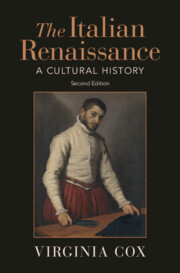
The extraordinary creative energy of Renaissance Italy lies at the root of modern Western culture. In this magisterial study, Virginia Cox offers a fresh vision of this iconic moment in cultural history. Her lucid and absorbing book explores key artistic, literary and intellectual developments, as well as histories of food and fashion, map-making, exploration and anatomy. Alongside towering figures from Petrarch and Boccaccio to Leonardo, Machiavelli, and Isabella d'Este, Cox unveils lesser-known Renaissance protagonists including printers, travel writers, actresses, courtesans, explorers-even celebrity chefs. This extensively revised and expanded edition includes an incisive overview of Italy's relationship with the European and non-European worlds, embracing ethnic and religious diversity within Italy, the global dissemination and hybridization of Italian Renaissance culture, and Italian global encounters, including Jesuit missions to Asia. Pulling together the latest scholarship with original research and insight, Cox's book speaks both to general readers and specialists in the field.
Like a puppy playing with the long stick which is the risk-uncertainty conundrum, we chew energetically on the risk end, letting the uncertainty end drag in the dust. The stick is shaped, I argue, by Newtonian humanism. It combines the scientific and humanist stances that have co-evolved in modern times, constituting a commonsensical, internally inconsistent, worldview. And that view bends the analysis of the political world toward controllable risk, sidestepping or silencing unruly uncertainty.
This chapter tracks the way the accumulation of capital in the colonial metropole enabled a cross-cultural dialogue among certain poets from the East and the West in London in the 1920s and 1930s, one that gradually diminishes in the postcolonial period. Poetry, in the modernist period, sought to dismantle the binary between authenticity and derivation, a binary which has been given new life in our own moment and has, therefore, blinded us from seeing these poets as participating in a common enterprise, even if it is one beset with many conceptual pitfalls resulting from the colonial relation. Nevertheless, poets as distinct as Rabindranath Tagore, Sarojini Naidu, and Una Marson – and thinkers such as C. L. R. James – wished to construct a universal humanism out of the uneven terrain of imperial modernity, an impulse they shared with such complicated figures as W. B. Yeats and even the violently reactionary Ezra Pound. Ultimately, this unstable humanism gives way to the starker divides of the period of decolonization.
The chapter provides an overview situating the literatures produced or circulated in Britain and the racialized, classed, and gendered imaginaries of empire. English literature was informed by imperial concerns and anti-capitalist critique alike since the sixteenth century, even as England was a minor player among European imperial powers. Contemporary scholarship, while attending to marginalized authors, such as women, immigrants, minorities, and the working class, demonstrates that diverse literature, prose especially, but also drama and verse, were shaped by expanding trade, global markets, territorial appropriations, military conquests, human emigration, and cultural contact. A mix of ideologies spawned in the nineteenth century to rationalize British presence as not only inevitable but beneficial for the colonized; for colonized intellectuals, on the other hand, literature fostered alternative visions of resistance. Diasporic writers in twentieth-century Britain introduced readers to the vocabulary and memory of colonized lands. The chapter contends that many themes of contemporary culture are not unique to the present but variations of older, far-flung contests. Literature, in its ability to articulate shifts in perception, sensibilities, and relations before such changes are actualized, is an indispensable site of analysis and study.
Chapter 1 motivates a Kantian analysis of climate change by examining early criticisms against Kant in the field of animal ethics. If Kant’s philosophy is ill-suited for justifying concern for nonhuman animals, its suitability for broader environmental issues remains unclear. After evaluating passages from Kant’s critical texts that motivate these criticisms, I assess a classic set of objections to the standard reading of Kant’s theory from Christina Hoff. After analyzing attempts by contemporary Kant scholars to respond to her challenge, I conclude with the merits of the standard reading of Kantian ethics for the sixth mass extinction debate.
The cataclysm of World War I shook European academic culture: How could European culture have produced such barbarity? The greatest scientific culture the world had ever seen had used science and technology for catastrophically inhumane purposes. Cultural pessimism and nihilism were options that many took. Other academically inclined Europeans responded by rethinking the place of history and philosophy of science in academic and social life. Some of these new projects, such as George Sarton’s New Humanism, explicitly linked them to humanism. In others, such as the logical empiricism that developed in Vienna and Berlin, the connections to humanism were more implicit but no less real. This chapter considers some of the main themes of Sarton’s New Humanist history of science and Rudolf Carnap’s and Hans Reichenbach’s logical empiricism as they relate to questions of the unity of knowledge, the unity of humanity, and the responsible use of scientific knowledge.
This chapter explores an often-overlooked religious group in the United States: those who are not affiliated with religion. The chapter discusses the quantitative and qualitative challenges in measuring religious “nones” and considers historical patterns of stigma and prejudice against the religiously unaffiliated. The number of secular Americans is growing and they need a seat at the table of civil religion.
This chapter summarizes the aims, scope, and contents of the book. Both science and humanism have evolved over hundreds of years, and both are associated with influential forms of inquiry into the world. Throughout this evolution, humanism and science have been intimately connected, in ways that are crucial for thinking about whether, as a significant strand of humanist thought contends, the sciences can (or can be relied upon to) enhance the welfare of humans, other life, and the environment. It is clear that there is no necessary connection between scientific inquiry and social or moral progress; the sciences have facilitated both significant goods and significant harms. Faced today with pressing challenges to the well-being of people and the planet, our attitudes toward science call for renewed scrutiny. With chapters spanning the history of entanglements of forms of humanism and science up to the present, and case studies of the value implications of the sciences, this book asks us to think about what relationships between science and humanism we should build for the future.
The concern of this chapter is with varieties of philosophical humanism and their own conceptions of the nature and significance of science. After an initial characterization of major themes in Renaissance humanism, it describes three main varieties that are evident in twentieth-century European philosophy – humanism as essentialism, humanism as rational subjectivity, and existential humanism. Different varieties of humanism are associated with different conceptions of science, some allied to the sciences, others antipathetic to them, while yet others offer subtler positions. The upshot is that there are different tales to tell about the relationship of (varieties of) philosophical humanism to (conceptions of) science, only some of which fit popular modern celebratory claims about a necessary alliance of humanism and science. If we take a wider look at the history of philosophy, we find ongoing experimentation with forms of humanism and explorations of diverse ways of understanding and evaluating scientific knowledge and ambitions. What we find is what we ought to expect of social, creative, epistemically sophisticated, self-expressive creatures: endless variety.
This chapter argues against an interpretation of scientism according to which science determines the limits of objective thinking. Central to the argument is Kuhn’s distinction between normal and extraordinary science. Understanding science as normal science makes science the plausible basis for an “ism” that delimits what counts as objective thinking because normal science has epistemologically and sociologically attractive features. But understanding science this way undermines the idea that a fundamental part of science, extraordinary science, involves objective thinking. Understanding science in a way that includes extraordinary science vindicates extraordinary science. But science understood this way no longer possesses the attractive epistemological and sociological features which made science understood as normal science the plausible basis of an “ism.” So, science cannot constitute an “ism” that determines the limits of objective thinking without undermining a fundamental aspect of itself. The argument is placed within a larger frame, about how to understand the connection between science and humanism. The view that humanism should take the form of scientism is rejected in favor of a view of humanism that takes the presence of interpretation and criticism as fundamental but that embraces science by finding interpretation and criticism within science itself.
Humanism, conceived as a worldview concerning, among other things, how we understand ourselves and our relationships with others, and science, conceived as a family of forms of inquiry into the world, are deeply interwoven over our intellectual and cultural histories. This chapter considers their co-evolution as a prelude to the present, reviewing formative aspects of Renaissance humanism and deepening associations of values central to the Enlightenment with precursors to modern science, en route to an arguably peculiar situation today. While some past, humanist conceptions of the aim of science seem intimately connected to the idea of making a better world – one featuring better and more widespread human and planetary flourishing – contemporary thinking seems largely devoid of normative discussions of what science itself is for. This chapter offers reflections on a possible return to a humanist conception of the role and promise of science.
Historically and conceptually, influential traditions of thought and practice associated with humanism and science have been deeply connected. This book explores some of the most pivotal relations of humanistic and scientific engagement with the world to inspire a reconsideration of them in the present. Collectively, its essays illuminate a fundamental but contested feature of a broadly humanist worldview: the hope that science may help to improve the human condition, as well as the myriad relationships of humanity to the natural and social worlds in which we live. Arguably, these relationships are now more profoundly interwoven with our sciences and technologies than ever before. Addressing scientific and other forms of inquiry, approaches to integrating humanism with science, and cases in which science has failed, succeeded, and could do more to promote our collective welfare, this book enjoins us to articulate a compelling, humanist conception of the sciences for our times. This title is also available as Open Access on Cambridge Core.
Although the merchants under study spent much of their career in commerce or in positions associated with it, they also evidenced cultural interests and accomplishments that signaled their membership in the broader culture of the Renaissance. In addition to interest in music, philosophy, and literature, they also invested in dress and the rituals of gift-giving in ways that were characteristic of Renaissance society.
From 1493 to 1507, Hernando de Talavera, the first archbishop of Granada after the Spanish Reconquista, ran a residential school for Morisco noble boys in his palace. This article argues that Talavera’s school set the foundation for the long history of residential schooling as a tool to transform or eradicate a conquered culture through the cultural assimilation of children. A champion of Christian humanism, Talavera thought that cultivating good manners (that is, adopting Spanish customs) was the main marker of a true Christian. Thus, his pedagogy aimed to educate everyone, particularly Morisco children, in what he considered the most reasonable and natural ways of living. By examining Talavera’s spiritual pedagogy, his humanist influences, and the educational experiences of Morisco boys at his palace, this paper lays the groundwork for a genealogical study of modern European colonial residential schooling for non-European children.