To save content items to your account,
please confirm that you agree to abide by our usage policies.
If this is the first time you use this feature, you will be asked to authorise Cambridge Core to connect with your account.
Find out more about saving content to .
To save content items to your Kindle, first ensure no-reply@cambridge.org
is added to your Approved Personal Document E-mail List under your Personal Document Settings
on the Manage Your Content and Devices page of your Amazon account. Then enter the ‘name’ part
of your Kindle email address below.
Find out more about saving to your Kindle.
Note you can select to save to either the @free.kindle.com or @kindle.com variations.
‘@free.kindle.com’ emails are free but can only be saved to your device when it is connected to wi-fi.
‘@kindle.com’ emails can be delivered even when you are not connected to wi-fi, but note that service fees apply.
The Introduction frames the book’s research within the local histories and sociopolitical dynamics of the Chinese–Russian border region, which have fostered the creation and popularisation of the ‘Russian brides’ village myth in Northeast China. It explores how Chinese–Russian marriages have come to symbolise an idealised form of transnational union in Chinese media narratives. This chapter also outlines the book’s theoretical and methodological approaches, introducing the concepts of hyperreality and intimate and embodied geopolitics. It provides a roadmap for its central arguments, guiding the reader through its interdisciplinary analysis.
This chapter examines the visual narratives through which China’s ‘China Dream’ of global rise idealises a particular type of international marriage: a union between a Chinese man and a white woman who is transformed into an obedient daughter-in-law absorbed into Chinese patriarchal structures. Analysing three Chinese TV dramas and a fiction film that highlight pivotal moments in Chinese–Russian relations across three decades of reform (1990–2010s), the chapter explores how these cultural products construct a consistent portrayal of the white woman – strong, intelligent, beautiful and independent – who ultimately submits to Confucian patriarchal values under the guidance of a Chinese man. By connecting televised portrayals of Chinese–Russian romance with broader political and public discourses on China’s foreign relations, this chapter uncovers the role of cinematic geopolitics in creating a hyperreality that bridges fantasy and the everyday.
The final chapter ends the book with a discussion about when do images still matter despite their abundance and why images have an ambivalent relationship with reality. Can we distinguish between images that reflect reality, manipulate reality, or help us imagine an alternative reality? Can we talk of a ‘good’ image, a powerful one that lives on, and invites dialogue? Can we talk of a ‘just’ image? We want images that do us justice, whether it is for our personal memories or grieving, or for our collective identity and society.
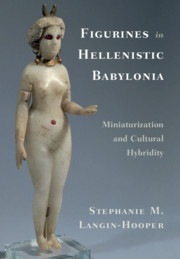
In this volume, Stephanie M. Langin-Hooper investigates the impact of Greek art on the miniature figure sculptures produced in Babylonia after the conquests of Alexander the Great. Figurines in Hellenistic Babylonia were used as agents of social change, by visually expressing and negotiating cultural differences. The scaled-down quality of figurines encouraged both visual and tactile engagement, enabling them to effectively work as non-threatening instruments of cultural blending. Reconstructing the embodied experience of miniaturization in detailed case studies, Langin-Hooper illuminates the dynamic process of combining Greek and Babylonian sculpture forms, social customs, and viewing habits into new, hybrid works of art. Her innovative focus on figurines as instruments of both personal encounter and global cultural shifts has important implications for the study of tiny objects in art history, anthropology, classics, and other disciplines.
Recommend this
Email your librarian or administrator to recommend adding this to your organisation's collection.