To save content items to your account,
please confirm that you agree to abide by our usage policies.
If this is the first time you use this feature, you will be asked to authorise Cambridge Core to connect with your account.
Find out more about saving content to .
To save content items to your Kindle, first ensure no-reply@cambridge.org
is added to your Approved Personal Document E-mail List under your Personal Document Settings
on the Manage Your Content and Devices page of your Amazon account. Then enter the ‘name’ part
of your Kindle email address below.
Find out more about saving to your Kindle.
Note you can select to save to either the @free.kindle.com or @kindle.com variations.
‘@free.kindle.com’ emails are free but can only be saved to your device when it is connected to wi-fi.
‘@kindle.com’ emails can be delivered even when you are not connected to wi-fi, but note that service fees apply.
Students are challenged to stay ahead in today's ever-changing political environment. This third edition comprehensive and accessible casebook, designed specifically for undergraduates, integrates both the political science and legal perspectives of American constitutional law. Covering developments from the constitution's drafting through to the presidency of Donald Trump, the book balances doctrinal analysis with historical and political context. Key updates include expanded discussions of judicial review, judicial power, nationwide injunctions, and the elimination of Chevron deference in administrative law. New material addresses Native American sovereignty, congressional investigatory powers, presidential authority and criminal liability, and the evolving balance of power in foreign affairs and war powers. Additional coverage explores presidential and congressional budget authority, impeachment, and state power within the federal system. The text examines pressing contemporary issues such as public health, property rights, substantive due process, and eminent domain, providing students with the essential tools to critically analyze constitutional law.
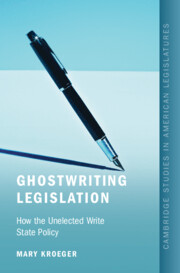
State legislators introduce more than 100,000 bills per year and the resulting statutes that become law govern every aspect of life and business in those states. But who exactly writes these laws? In Ghostwriting Legislation, Mary Kroeger delves into the central and often-overlooked role that interest groups, think tanks, companies, and bureaucrats play in writing state law. While legislators are not expected to draft and pass legislation without the input of outside actors, Kroeger argues that a democratic defect may arise if elected officials must rely substantially on non-legislators to craft high-quality bills. Ghostwriting Legislation explores the disconnect between legislative power and legislative capacity, providing key data and insights for those who care about democracy and the separation-of-power dynamics in state legislatures.
This introduction outlines a comprehensive study of the U.S. Constitution’s structure, marking its 237th year as the oldest modern constitution. It aims to equip readers – from law students to everyday Americans – with tools to understand its framework of representation, separation of powers, checks and balances, federalism, and the Bill of Rights, addressing enduring questions like the legitimacy of secession, the scope of national powers, presidential authority in foreign affairs and war, judicial review’s origins, and Congress’s taxing and spending powers. The book challenges myths, such as the existence of a “general welfare clause,” and critiques both originalist and living constitutionalist views, arguing, for instance, that enumeration limited executive, not just national, power, and that functionalism fuels the imperial presidency. Organized into seven parts and eighteen chapters, the book explores the Constitution’s compound republic, the distribution of legislative, executive, and judicial powers, and federal-state dynamics. By engaging recent scholarship, it seeks to clarify the Constitution’s original design while advocating its continued relevance today.
This chapter examines the legislative veto, allowing Congress to override executive actions without bicameralism and presentment, tracing its rise amid broad twentieth-century delegations. Textually and structurally, the Constitution assigns distinct powers to each branch and specifies how each power can be exercised. INS v. Chadha (1983) rightly held that legislative vetoes are unconstitutional because, if such vetoes are legislative in nature, they do not satisfy bicameralism and presentment. If the veto were an executive or judicial act, it would be unconstitutional because Congress possesses neither executive nor judicial power. The chapter introduces the concept of “nonexclusive functions,” recognizing that some governmental actions, like agency rulemaking, can be achieved through legislative or executive power; others, like resolving claims against the government, can be resolved by any of the three branches exercising its respective power. Each branch must, however, exercise its power according to the constitutional requirements. Despite the unconstitutionality of legislative vetoes, the chapter advocates a constitutional amendment to permit such vetoes for regulatory actions, offering a practical solution to balance executive rulemaking with legislative authority and aligning with the Constitution’s original design.
This chapter examines presidential emergency powers and the framework for analyzing separation of powers disputes between Congress and the President. It argues that the Constitution grants no inherent authority for the President to act beyond or against statutory law in crises. Analyzing the Steel Seizure Case (1952), where the Supreme Court rejected Truman’s unauthorized steel mill seizure, it critiques Justice Jackson’s tripartite framework, particularly its vague “twilight zone” of congressional silence, as conceptually muddled. It proposes a formalist framework: presidential power is limited to executing Congress’s laws or acting within enumerated presidential authorities, but Congress and the President have some overlapping or concurrent powers. The chapter then rejects claims to emergency powers, arguing that historical examples like Lincoln’s habeas corpus suspension were extraconstitutional actions that may have been justified but were not legal, requiring public or legislative indemnity. This originalist approach, opposing functionalist expansions of an “imperial presidency,” advocates a restrained presidency faithful to the law-execution role that the Vesting and Take Care Clauses assign to the chief executive.
What it means for a provision to be “incompatible” with Convention rights is crucial in determining whether courts with the power to do so ought to make a declaration of incompatibility under section 4 of the Human Rights Act 1998 (“HRA”). A clear understanding of incompatibility is also necessary for the proper operation of statements of compatibility under section 19 HRA. It is crucial for the devolved legislatures whose incompatible legislation is “not law”. And delegated legislation can be struck down, or declared incompatible, by a court for the same reason. Yet the test for determining incompatibility remains unclear and understudied. The lack of clarity threatens both rights protection and dialogue between the different branches, and layers, of the state. This article argues that the test currently favoured sets the bar inappropriately high and that the test must more clearly consider both the potential extent, and the likelihood, of the breach.
While the judgement of the European Court of Human Rights (ECtHR) in KlimaSeniorinnen v. Switzerland has been hailed by many as a landmark in climate change and human rights litigation, the response by Switzerland and many intervening parties has been less favorable. For instance, the Swiss legislative has been very critical in its review of the judgement, claiming it to be “judicial activism.” By dissecting the criticism voiced in the aftermath of the KlimaSeniorinnen judgement and by comparing this case to similar cases by national and international courts in regard to climate change this paper asks whether this is a unique and swiss-specific criticism or if there is an inherent problem when it comes to climate change litigation and the separation of powers. While acknowledging persistent general criticism of the ECtHR, this article concludes that it is likely that the connection to human rights drives such criticism more than the connection to climate change. This might be because human rights, especially in the international context, leave ample room for interpretation and the margin of appreciation doctrine leaves room for disagreement. Additionally, this paper finds that situations of vertical separation of powers are more prone to criticism than horizontal ones.
This chapter concludes the book, but the book concludes only midway through the quiet revolution that modern public trust advocacy has engendered. The Mono Lake litigation advanced public trust principles as a source of environmental law – and even environmental rights – highlighting the role of the doctrine in providing needed support for environmental protection amid weak legal foundations. The Conclusion turns to several open questions, including objections that the judicial role the doctrine invites may threaten the constitutional separation of powers. It considers whether trust-rights claims raise the kind of generalized harms that jurisprudential standing limitations are intended to prevent, but also the counterargument that the doctrine is the original “citizen suit” provision of the common law, deputizing private attorneys general to champion diffuse environmental interests that special interests would otherwise dominate. Finally, it considers what the world might look like without public trust governance – visiting parallel stories unfolding at the Great Salt Lake, Dead Sea, Sea of Galilee, and Aral Sea – before returning at last to the ongoing story at Mono Lake itself.
This chapter explores the impacts of the Mono Lake case beyond Mono Lake. Its embrace of public trust principles quickly rippled through the California legal system, and then others. The case was cited in state and federal courts. The influence of the decision was felt in legislative, administrative, and even constitutional matters. It drew praise from many scholars but also criticism by property rights advocates, those worried about the constitutional separation of powers, and even environmentalists concerned about the intrusion of property concepts into stewardship. The chapter explores the journey of the Mono Lake doctrine through California and beyond, with special focus on the contrasting paths taken in two neighboring states, Nevada and Idaho. In California, a case protecting the Scott River extended the Mono Lake doctrine to cover even groundwater tributaries of navigable trust resources. Idaho, fearful of the burdens of environmental protection prioritized in California, rejected the majority view of the doctrine as a quasi-constitutional constraint. Nevada, already bound by a quasi-constitutional trust, sought a different approach to preserve appropriative water rights.
This chapter explores “trust-rights” climate litigation, claiming sovereign obligations to protect the atmosphere, public rights to climate stability, or both. It begins with scholarly consideration of these strategies, reviewing sources of environmental rights, application of public trust principles to climate, and critiques of the atmospheric trust. It reveals the hidden duality of trust-rights climate claims as a pairing of reciprocal rights and duties. Then it reviews the explosion of trust-rights climate advocacy around the world, including the conclusion in Urgenda Foundation v. Netherlands that the nation had failed its duty under the European Convention on Human Rights to limit contributions to climate change; the failed attempt in Juliana v. United States to partner an atmospheric trust claim with constitutional rights asserted under the Due Process Clause; and a new generation of advocacy to build trust-rights principles into U.S. state constitutions. Finally, it considers the arguments against – and in favor of – trust-rights advocacy, addressing both constitutional concerns about the separation of powers and practical concerns about bringing uncertain impact litigation.
American politics is characterized by an implicit rights-centrism, for example, when public discourse champions the freedom of speech in absolute terms. This article proposes instead an ends-centric mode of deliberation that underscores the myriad ends beyond rights that are also necessary to a polity’s health. Grounded in republican theory, the ends-centric mode maintains space to (re)prioritize ends and to redraw the boundaries of rights as required by a given moment or issue. Rather than displace rights-centrism or the courts’ role in enforcing rights, the ends-centric mode prompts other institutions also to engage in rights reasoning, thereby elevating the larger conversation and process of deliberation. It thus allows a separation-of-powers logic to operate more fully in the realm of rights by leveraging diverse institutional perspectives and capacities toward a multi-sided dialogue over rights questions. We draw from historical debates on speech and press freedom from the early republic and the twentieth century to find sight lines for an ends-centric approach in American politics. We further examine how ends-centric arguments would benefit deliberations over the regulation of social media today. Specifically, arguments that overemphasize speech in social media crowd out other desirable ends, such as protecting young people online and combating misinformation. Ultimately, we argue the benefits of rights-centric and ends-centric modes operating alongside each other across constitutional fora, as the polity deliberates rights in old and new forms.
Chapter 10 reflects on the legacy of Guantanamo over the two dozen years since detention began in response to the changes in the United States after 9/11. It considers the impact on American law and how the outer shell of due process was after many years affirmed, but its core hollowed out. It notes how the executive knew that it had captured the wrong people but dishonestly kept up the illusion that it was doing something about terrorism. The US tortured everybody because that was what politics required even though it was well known that the process was not only wrong but futile. It also considers the impact of Guantanamo on American culture. Torture has become embedded and normalized in American life. American exceptionalism was distorted into a sense of unique grievance and entitlement to ignore core constitutional and international law principles. Guantanamo remains an image of cruelty in the service of retaliation against “the other,” in this case, Muslims. It was part of the build-up of a military security apparatus that undergirds a continuous justification for the executive to declare emergencies and suspend legal and ethical principles.
This chapter provides an introduction to the core concepts of US law, for those with an HCI background but not a legal background. The chapter covers the history of U.S. law, the basic constructs of the U.S. legal system, the core sources of legal rules: constitutions, statutues, regulations, and case law, differences between civil and criminal law, the differences between law and policy at the federal versus state level, searching for and using legal resources, and how to apply basic legal principles to HCI research.
Based on a qualitative and quantitative research design, this article examines the implementation of a morality policy – the medical cannabis policy in Switzerland – to investigate three understudied aspects of bureaucratic entrepreneurship. First, moving away from mono‐professional studies, the focus is on a policy characterized by a dispute between two groups of bureaucrats: physicians and jurists. Second, key conditions triggering bureaucratic policy entrepreneurship are identified, with a focus on mid‐level administrative entrepreneurs. Third, vertical alliances between bureaucrats and politicians of the executive and legislative branches are examined and these processes are reflected in the wider perspective of the politics‐administration dichotomy. Results show that law obsolescence, disputes between groups of bureaucrats and the need for political arbitration are favourable conditions for bureaucratic policy entrepreneurship. The study also shows that within the traditional separation of powers, bureaucratic entrepreneurship reinforces the executive power and creates dividing lines within the different branches of government.
Democracies in Europe fail to take adequate climate mitigation measures. In response, not only legal, but also illegal acts of climate protesters are multiplying in Europe. This paper examines the criminalisation of climate protests in France, Germany, Switzerland, and the UK. Against the overarching concept of dissensus to which this special issue is dedicated, this contribution reflects on the role of judges who deprive the disobedient from the opportunity to communicate about their motives. The paper pays particular attention to the case of David Nixon in the UK, in which the judge prohibited Mr. Nixon from sharing his motivation or mentioning climate change in the court room. This demeans civil disobedience to an ordinary criminal act and deprives democracy of its self-correcting potential.
The US and the EU have undergone a process of institutional convergence. While Madison argued that the US was subject to a systemic imperative to promote an anti-hegemonic order, the same has revealed itself to be true of the EU too – this because of the asymmetry of powers between its member states. However, because of the anti-hierarchical structure which supports it, an anti-hegemonic order is weak in terms of decision-making capacity. Thus, the price of the preservation of internal complexity is external ineffectiveness. The article considers the most appropriate trade-off between the two. The Madisonian approach to the compound of American states can help the EU in facing the dilemma of the integration process.
This article critically assesses the claim that smaller states may be structurally and socially pre-disposed towards more effective government performance. A review of recent experience in Iceland and Ireland indicates that the domestic characteristics that have been argued to foster superior small state performance can, under certain conditions of size and homogeneity, contribute to government failures. Furthermore, experience in these states suggests that high levels of social cohesion and homogeneity may increase the risk of a specific social phenomenon (‘Volkthink’) with adverse consequences for public policy.
Steffen Ganghof’s Beyond Presidentialism and Parliamentarism: Democratic Design and the Separation of Powers (Oxford University Press, 2021) posits that “in a democracy, a constitutional separation of powers between the executive and the assembly may be desirable, but the constitutional concentration of executive power in a single human being is not” (Ganghof, 2021). To consider, examine and theorise about this, Ganghof urges engagement with semi-parliamentarism. As explained by Ganghof, legislative power is shared between two democratically legitimate sections of parliament in a semi-parliamentary system, but only one of those sections selects the government and can remove it in a no-confidence vote. Consequently, power is dispersed and not concentrated in the hands of any one person, which, Ganghof argues, can lead to an enhanced form of parliamentary democracy. In this book review symposium, George Tsebelis, Michael Thies, José Antonio Cheibub, Rosalind Dixon and Daniel Bogéa review Steffen Ganghof’s book and engage with the author about aspects of research design, case selection and theoretical argument. This symposium arose from an engaging and constructive discussion of the book at a seminar hosted by Texas A&M University in 2022. We thank Prof José Cheibub (Texas A&M) for organising that seminar and Dr Anna Fruhstorfer (University of Potsdam) for initiating this book review symposium.
I examine the transformation of Italy during the fascist era and the way in which it was explained by one of the most prominent constitutional lawyers of the time, Costantino Mortati (1891–1985). A member of the Constituent Assembly of 1946–1948 and later a constitutional judge, Mortati had a deep influence on the Italian post-War constitutional thinking. Here I focus on Mortati’s understanding of the state’s transformation after 1922. I show how he conceptualised Italy’s transition from a liberal state to an authoritarian regime as a shift from the parliament to the executive of the power of ‘political direction’, ie, the power of identification of the aims and values of the state. Mortati did not envisage in the Italian transformation the full erasure of the separation of powers, but rather a large reshuffle of political direction moving from the Parliament to the Head of Government, allegedly a process in line with the country’s needs in the 20th century. He read the growth of executive powers as the most enduring constitutional transformation of his time, one destined in his mind to persist even after the downfall of the regime.
This essay aims to clarify the characteristics of the political theories of Montesquieu and Adam Smith by comparing their views on liberty. Montesquieu divides political liberty into two categories: “liberty in its relation with the constitution” and “liberty in relation to the citizens.” The former concerns the security of the governed in their relationship with those who govern, whereas the latter concerns the security of citizens and their property against infringements by other citizens. Smith concentrates on civil liberty and elaborates on Montesquieu’s framework to develop a more refined theory of the separation of powers. However, their views diverge on constitutional liberty. Montesquieu expects the nobility, as an intermediate group, to restrain sovereign despotism, whereas Smith emphasizes that this group historically threatened citizens’ security and valued the central government’s role in checking it. A comparison of their views deepens our understanding of the foundations of a free society.