To save content items to your account,
please confirm that you agree to abide by our usage policies.
If this is the first time you use this feature, you will be asked to authorise Cambridge Core to connect with your account.
Find out more about saving content to .
To save content items to your Kindle, first ensure no-reply@cambridge.org
is added to your Approved Personal Document E-mail List under your Personal Document Settings
on the Manage Your Content and Devices page of your Amazon account. Then enter the ‘name’ part
of your Kindle email address below.
Find out more about saving to your Kindle.
Note you can select to save to either the @free.kindle.com or @kindle.com variations.
‘@free.kindle.com’ emails are free but can only be saved to your device when it is connected to wi-fi.
‘@kindle.com’ emails can be delivered even when you are not connected to wi-fi, but note that service fees apply.
Religion shapes Gulf politics in different ways depending on the country under consideration but also the shifting socio-historical circumstances at the domestic and the regional levels. Religion has been used as a tool of state-building by Saudi Arabia. Alternatively, it has also been used by Islamist movements for the contestation of established regimes. In societies that are diverse religiously, sectarian divides between various currents of Islam have been politicised more often than not. Religion has also been an important element of the international soft power of Gulf states. In the twenty-first century, Gulf states have promoted ‘moderate Islam’ as a way to counter Islamist movements and to consolidate their international standing.
This article investigates the lives of Sufi leaders following the Turkish state’s abolition of Sufism in 1925. Examining the professions and career paths of Sufi shaykhs, it demonstrates that Sufi masters worked primarily in government jobs and institutions, and maintained a relatively high social status in the new nation-state, despite official denunciations of shaykhs as spiritual charlatans and parasites. As such, it argues that the state pursued a policy of inclusion and integration rather than one of persecution or elimination. While acknowledging that some Sufi leaders were victims of state policy, this article casts doubt on the persecution narrative and demonstrates a broad range of experiences and trajectories for Sufis in the early Turkish Republic. It illustrates that the state welcomed many shaykhs into the new institutions of the nation, including the Grand National Assembly, local government, schools, and libraries, as well as academia and the Directorate of Religious Affairs (Diyanet).
Chapter 1 is a detailed guide to the multifaceted historical backdrop of the Safavids, charting their first transformation, from a Sufi order to a potent Shiʿi empire in Iran. In this exploration, Anatolia holds particular importance, illuminating the region’s significant impact on the Safavid journey and unveiling the movement’s origins within Ottoman territories. This chapter also contends that a rigid understanding of sects and sectarianism does not adequately capture the nuanced emergence of the early Safavid movement and its spread into neighboring regions. Instead, it posits that the Safavid order (and later the state) was the product of a syncretic and turbulent religious, cultural, and political landscape in Southwest Asia during the fourteenth and fifteenth centuries. This perspective is particularly pertinent when connecting Safavid history to recent scholarship that highlights the coexistence and long-term transformations of religious identities in regions such as Anatolia and the Iberian Peninsula, rather than reducing the narrative to one of perpetual tension and abrupt ruptures.
This chapter considers Doris Lessing’s engagement with utopia, from the Children of Violence series which is set in 1950s–60s London to her near-future ecocatastrophic Mara and Dann novels (1999, 2005). The necessity of utopian hope in Lessing’s novels is set against a seeming disavowal of the possibility of positive systemic change. Utopian possibility in Lessing’s Canopus in Argos series (1979–83), for instance, is driven by cosmic patterns rather than human action. Similarly, her excoriating descriptions of colonial and capitalist life in the Children of Violence series (1952–69) possess an energy that can be considered utopian. However, the apocalyptic strain in many of Lessing’s works renders this utopianism highly ambivalent. In their critique of societal progress or political change at scale, Lessing’s novels often sit at odds with the literary utopian tradition. In Lessing’s works, read alongside American contemporaries such as Ursula Le Guin and Octavia Butler, the prefigurative mode is less concretely utopian. Enclaves of survivors persist, but the texts indicate that political struggle will return with each generation and the same problems recur across history. The chapter concludes that Lessing’s late ecocatastrophic fictions exhibit a stronger utopian impulse, which resonates with twenty-first-century discussions of the climate emergency in the United Kingdom.
Before the twentieth century, to be literate in the Western Sahel meant to be literate in Arabic—or in other African languages written with the Arabic script. Yet works by West African Muslim scholars, composed largely in Arabic, are often overlooked in discussions of West African literature. This chapter highlights this gap by reconstructing the history of the region’s ‘Islamic literature’ and its relationship to print. Focusing on the literary production of two of the region’s major Sufi orders, the Tijaniyya and Muridiyya, it shows that printed works of Islamic erudition became increasingly important elements of public life across the twentieth century and continued to serve as one of the most frequent and readily available means of experiencing ‘literature’, even alongside the expansion of colonial and postcolonial educational institutions that employed European languages of instruction. Comprising some of the most common forms of reading material in West Africa today, they are the fruit of an encounter between a well-established Sufi literary tradition and newfound access to the affordances of print.
This chapter follows the trajectory of an early Cold War ideal of a pro-American Islam that could serve US foreign policy goals. It asks how and why Islamic mysticism generally, and Sufism specifically, came to be seen as the West-friendly “moderate Islam.” What role did transculturation and comparativism between Türkiye and Iran under America’s global hegemony play in forming this common perception?
This chapter offers an overview of the fascinating and complex world of Islamic Christology by using the Qur’an and Hadith, the primary sources of Islam, as a starting point. It condenses the wealth of literature that Muslim exegetes, philosophers, and mystics have produced on the Islamic representation of Jesus and Mary, examining what they consider to be authoritative Islamicized forms of Christian beliefs.
This article analyses the contribution of Mīrzā Āqāsī (1197–1265/1783–1849) to the political theology literature of the Qajar period and, consequently, to the dynamics and tensions between Sufism and power in Iranian Shi‘i society. Āqāsī was the first minister of the Qajar king Muḥammad Shāh (r. 1250–1264/1834–1848) and the author of an important political treatise titled Chahār-i faṣl-i sulṭānī va shīam-i farūkhī (The Four Royal Discourses and the Nobles’ Principles of Conduct). This treatise presents several original features, particularly regarding the classical views on the spiritual and political hierarchy in Islam, as well as within the context of the culture of authority in a Shi‘i setting. These views are expressed by Āqāsī in a partially initiatory mode, which renders their interpretation complex and open.
The Tunisian–Libyan Maluf Slam Collaborative was a multinational group of musicians, poets, artists, educators, journalists, and stakeholders that created a series of music concerts featuring Tunisian and Libyan maluf in July 2019. Maluf is considered cultural heritage across eastern Algeria, Tunisia, and Libya and manifests with great variety between and inside each nation-state. Sourced from ethnography in Libya (2014) and Tunisia (2018–2019), this article documents the collaborative’s work, queries the dynamics of transnational traditions, and analyses musical modes and histories of Sufism in order to explain similarities and differences within performances of maluf today.
Zilka Spahić Šiljak utilizes the concept of ‘feminist religiosity’ to demonstrate how Islam plays a crucial role in shaping everyday struggles of women in Bosnia and Herzegovina (BiH), enabling them to live in a more fulfilling way. The chapter highlights the influential role of Islamic spirituality, particularly Sufi traditions emphasizing love, care, and service, in empowering women to pursue feminist endeavours across various domains such as non-governmental organizations, media, and academia.
This chapter analyses the spiritual ideas on universal peace developed by Sri Lankan teacher Bawa Muhaiyaddeen in terms of their South Asian and North American cultural syncretism and his development of classical Sufi ideas of the microcosmic ‘Perfect Man’ into a globalised but decidedly anti-modern ‘cosmopiety’.
This article traces how the Yemeni-origin Sufi order of Ṭarīqa ʿAlawiyya and its ritual litany of al-Ḥaddād, with chants and prayers for the Prophet and his descendants especially from Hadramawt, became part of everyday Muslim devotional practices in Malabar through immigrant networks of Hadrami Sayyids. Competing, sometimes rivalling, and appropriating other Sufi religiosities, the Alawi order meaningfully involved within the theo-legal Sufi discourses that have been remoulding the Sufi cosmopolis in the Indian Ocean. By focusing on two notable early immigrant Sayyids in Malabar, this article argues that the successful placement of the ʿAlawī order within the Sufi cosmopolis and the permeation of the ritual was a complex socio-religious project that was brought forth by various aspects of the sacred genealogy, Alawi Sufi writings, Sufi activism, and the effective utilisation of Hadrami immigrant networks.
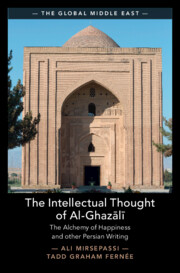
Abu Hamid Muhammad al-Ghazālī (1058–1111) was one of the most influential philosophers of the classical Islamic period, with his intellectual innovations spanning the fields of theology, logic, and law. Despite this, contemporary assessments of Ghazālī often present him as hostile to rationality, and a guardian of dogma and orthodoxy. This study provides an innovative reassessment of Ghazālī's legacy, offering a compelling depiction of a reformer in his own time with increasing relevance to the issues gripping multicultural and globalized societies today. Ali Mirsepassi and Tadd Graham Fernée closely study Ghazālī's major Persian-language text Kīmīyā-e saʿādat (The Alchemy of Happiness) and its scholarly reception, alongside his lesser-read works, arguing that Ghazālī shared a message of reform, and critique of Abbasid institutions. Ghazālī's critical stance is revealed as both pragmatic and cosmopolitan in its recognition of autonomy from religion in many aspects of life, and in the value placed upon scientific contribution.
The chapter discusses Abdolhossein Zarirnkoub’s Persian-language biography of Ghazālī, Farār az Madrasa (Escape from Madrasa), which argues that Ghazālī’s intellectual formation was significantly shaped by the Persian mystical tradition of his time as well as by a broader Islamic tradition of learnedness. An appreciation of the historical and cultural confluence of the Abbasid and Seljuq Empires is crucial to explaining Ghazālī’s reformist vision. Within Ghazālī’s lifetime, the ideals and promises of the Seljuq state gave way to sudden, chaotic collapse, revealing in the process the malfunctioning of a self-professed regime of salvation. Ghazālī was a child of the Niẓām al-Mulk revolution in administration and politics, with its hopes for unifying the Seljuq and Abbasid states under the banner of justice and governance. Yet Ghazālī witnessed the sudden and tragic collapse of the Seljuq state, after Niẓām al-Mulk and Sultan Malikshāh were assassinated in an explosive chain of events. Ghazālī was witness to a failed state-building project, who nevertheless clung to the ideals of that lost revolution while plotting to reinstate its normative mission by other means.
This chapter discusses Ghazali’s Writings in Persian and reception in Iran. Typical Ghazālī studies center his Arabic output. Yet one major work, The Alchemy of Happiness, was written originally in Persian. Ghazālī participated in a Khurasani cultural tradition. Zarrinkoub argues that Ghazālī’s mystical understanding of Islam, against prevailing literalism, influenced Islamicate civilization and culture. Zarrinkoub highlights the contribution of Persian-speaking philosophers, theologians, and scholars to the mystical and theological development of Sunni Islam. Although Iran is conventionally framed as the epicenter of Shi‘ism, Iran only became a majority Shi‘a country with the Safavid Empire in 1501. Through Persian resources we see a cosmopolitan Islam thriving where the Abbasid Empire intersected with multiple cultural revolutions, and where mysticism and established power clashed and reconciled in Ghazālī’s Sufi encounter. Ghazālī’s flight from the madrasa was a flight from orthodoxy in Islamic education, in his renunciation of the educational system. Ghazālī’s Sufism was partly a critique of the dogmatic understanding of Islam common among the ‘ulama.’
This article examines the complex relationship between Sufism, secularity, and psychiatry through Refik Halid Karay’s 1956 novel, Kadınlar Tekkesi (Women’s Lodge). The article argues that Kadınlar Tekkesi recontextualizes Sufism by medicalizing and pathologizing it through psychiatry and psychopathology. This analysis draws upon discourse analysis and Michel Foucault’s exploration of abnormality and power dynamics. The article contends that this approach diverges from previous anti-Sufi agendas of Turkish novels, which were primarily motivated by religious and moralistic criticisms. The article argues that the application of psychiatric terminology to Sufism suggests a shift in Turkish secularism’s attitude toward Sufism, which transitions from dismissing Sufism as obsolete to engaging with it systematically through scientific study. Informed by modern scientific rationality, this shift signifies a redefined interaction between knowledge and power and the gendered aspects of the medicalization process. The article underscores that interactions between the discourses of secularism, Sufism, and psychopathology suggest a new regime of truth based on secular and scientific thought, while implicitly supported by orthodox Islamic principles.
This article studies some major shifts in the relationship between law and Sufism in South Asian Islam between the eighteenth and the twentieth centuries. It does so by focusing on Shah Wali Allah of Delhi (d. 1762) to examine, first, how these two key facets of Islam interact with each other in his thought and, second, how some influential Muslim intellectuals of the late nineteenth and twentieth centuries have understood and positioned themselves in relation to this aspect of his thought. Though one would be hard pressed to know this from the sanitized modern image of Wali Allah as a scholar of the Quran and hadith, and of a Sufi piety uncompromisingly anchored in them, his Sufism reveals a wide and, from many a modern Muslim perspective, unwieldly range of ideas and practices. Yet it was precisely in that unwieldy breadth and depth that it was generative of some of his key insights into matters of the law. Even as many people have continued to insist on the imbrication of law and Sufism, a sanitization of Wali Allah’s Sufi image serves to highlight wider processes whereby an earlier era’s generative relationship between the two has come to be increasingly attenuated since the late nineteenth century.
This article presents the first complete critical edition and annotated English translation of the nineteenth-century Javanese mystical poem Suluk Lonthang. Combining different disciplinary expertise in old and modern Javanese philology, Tantric Studies, and Islamic Studies, it interprets the protagonist of the poem as an expression of the multifaceted and multivocal Javanese religious landscape of the time, whose historical—and translocal—roots can be discerned in Sufi traditions from the Islamicate and Persianate worlds, as well as Tantric traditions from both pre-Islamic Java and the Indian subcontinent.
This paper illustrates the heterogeneity of Islamic publics in early 20th-century Turkey by examining the life and thought of Ken'an Rifai, a Sufi shaykh and high-ranking bureaucrat in the Ottoman Ministry of Education. It argues that Shaykh Rifai endorsed state secularization reforms on religious grounds and shows how he reformulated Sufi Islam by imbricating Sufi ethics with other social imaginaries of the time through the lens of an upper-class bureaucrat. This paper contributes to Turkish studies by highlighting the previously overlooked role of elite Islamic groups who collaborated with the early republic. It also challenges the dominant paradigm of a binary opposition between the secular ruling elite and pious masses. Additionally, this paper offers insight into broader anthropological and historical Islamic studies by demonstrating the diverse ways Sufi traditions adapted to modern governance.
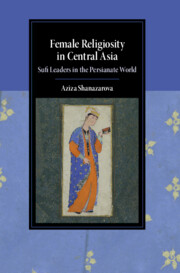
Through revealing the fascinating story of the Sufi master Aghā-yi Buzurg and her path to becoming the 'Great Lady' in sixteenth-century Bukhara, Aziza Shanazarova invites readers into the little-known world of female religious authority in early modern Islamic Central Asia, revealing a far more multifaceted gender history than previously supposed. Pointing towards new ways of mapping female religious authority onto the landscapes of early modern Muslim narratives, this book serves as an intervention into the debate on the history of women and religion that views gender as a historical phenomenon and construct, challenging narratives of the relationship between gender and age in Islamic discourse of the period. Shanazarova draws on previously unknown primary sources to bring attention to a rich world of female religiosity involving communal leadership, competition for spiritual superiority, and negotiation with the political elite that transforms our understanding of women's history in early modern Central Asia.