To save content items to your account,
please confirm that you agree to abide by our usage policies.
If this is the first time you use this feature, you will be asked to authorise Cambridge Core to connect with your account.
Find out more about saving content to .
To save content items to your Kindle, first ensure no-reply@cambridge.org
is added to your Approved Personal Document E-mail List under your Personal Document Settings
on the Manage Your Content and Devices page of your Amazon account. Then enter the ‘name’ part
of your Kindle email address below.
Find out more about saving to your Kindle.
Note you can select to save to either the @free.kindle.com or @kindle.com variations.
‘@free.kindle.com’ emails are free but can only be saved to your device when it is connected to wi-fi.
‘@kindle.com’ emails can be delivered even when you are not connected to wi-fi, but note that service fees apply.
Ignatius Sancho had a rich artistic life, from music to literary criticism to engagement with the theater. Unfortunately, little is known about the latter – Joseph Jekyll’s 1782 short biography of Sancho offers only a few sentences about what appears to have been a failed attempt at playing the titular leads of William Shakespeare’s Othello and Thomas Southerne’s Oroonoko. However, Jekyll’s biography offers an important window into eighteenth-century thinking about race and performance, in spite of (and, in part, because of) its limited and compromised nature. Crucial to Jekyll’s explanation for Sancho’s theatrical failure is a supposedly “defective and incorrigible articulation,” most often read along the lines of disability. This chapter examines how vocal and linguistic performance in the eighteenth-century created and disrupted popular narratives about race.
In the years 1803–1807, a dramatic triple murder case in Shouzhou, Anhui, convulsed officialdom in the Jiangnan region and drove the Jiaqing emperor to exasperation. At a time when many in power felt a sense of crisis as “High Qing” imperial ambitions receded, each stone turned over in this meandering investigation revealed another source of anxiety fitted to the age: incest, poisoning, negligent and corrupt officials, amoral and abusive local gentry, misbehaving yamen runners, pettifogging litigators, and, to top it all off, deadly serious rumors of a subversive opera. This article traces the investigations into both the murders and the theater rumor. What made the former so convoluted and vexing, while the latter was alarming yet easier to resolve? Surprisingly, the Imperial Household’s carefully cultivated relationship with the theater world of Jiangnan realized, in miniature, a level of state–society coordination Qing rulers wished for but which often escaped them elsewhere.
The words 'all rise' announce the appearance of the judge in the thespian space of the courtroom and trigger the beginning of that play we call a trial. The symbolically staged enactment of conflict in the form of litigation is exemplary of legal action, its liturgical and real effects. It establishes the roles and discourses, hierarchy and deference, atmospheres and affects that are to be taken up in the more general social stage of public life. Leading international scholars drawn from performance studies, theatre history, aesthetics, dance, film, history, and law provide critical analyses of the sites, dramas and stage directions to be found in the orchestration of the tragedies and comedies acted out in multiple forums of contemporary legality. This title is also available as open access on Cambridge Core.
This paper presents the theory of improvisational emergence, an account of how social phenomena emerge from improvisational processes. I build outward from the small-group improvisational encounter to provide an account of the relationship between individuals, groups, and societies. Social entities, including groups and societies, emerge from people engaged in group improvisation. But even though social entities emerge from individuals in interaction, their study cannot be reduced to the study of individuals, because once having emerged, social entities have causal power over individuals. The theory of improvisational emergence addresses the structure-agency relationship and the micro-macro debate in sociological theory. It moves beyond practice and structuration theories in positing an ontological separation between people and society. Improvisational emergence allows us to explain the relationship between the improvisational creativity of each participating individual and the collective improvisationality of the group. A complete understanding of social phenomena, including social structures, norms, and cultures, must be grounded in the theoretical and empirical study of creative improvisation.
Cultural exchange was another critically important mechanism for influencing popular emotions. This chapter looks at Sino-North Korean exchanges in theater, film, and the arts. It argues that these exchanges reached large audiences in both countries while inculcating official emotions.
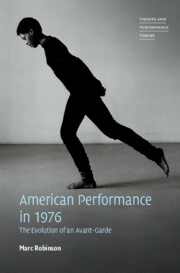
A survey of drama and performance in the period 1975-1980, with emphasis on the innovative plays and experimental productions that appeared in New York in 1976, along with consideration of surrounding developments in visual art, literature, film, and music, and attention to the politics of these transitional years.
1976 was a febrile, transitional year in cultural history, coming after Watergate and Vietnam and before the AIDS epidemic and the rise of the Conservative movement. Bicentennial triumphalism sounded dissonant against a violent past and uncertain future. Marc Robinson here explores how innovative artists across disciplines – drama, dance, music, film, visual art – responded to this period, before zeroing in on avant-garde theater. Over 1976, five landmark productions could be seen within months of one another: Cecil Taylor's A Rat's Mass / Procession in Shout, Meredith Monk's Quarry, the Robert Wilson / Philip Glass opera Einstein on the Beach, Joseph Chaikin's production of Adrienne Kennedy's A Movie Star Has to Star in Black and White, and, finally, the Wooster Group's first open rehearsal of Spalding Gray and Elizabeth LeCompte's Rumstick Road. In close readings of these five works, Robinson reveals the poetics of a transformative moment in American culture.
In many ways the American War of Independence failed to revolutionize American performance culture. After the wartime ban on theater, the resurrected theatrical repertoire quickly reverted to British classics, with a sprinkling of German and French dramas thrown in. Musical performances continued to evoke familiar British folk tunes, comic operettas, or tragic operas. Parade and holiday culture drew on longstanding European forms such as charivari or other genres to celebrate the “perpetual fetes” of the wartime and postwar period. What then would prove “revolutionary” about American performance culture after the war? What could the former colonists proclaim as their own unique and substantive contributions to the cultural life of the new nation?
The chapter probes the relationship between law and performance in the context of transitional justice. By analyzing cultural productions and public performances such as films and theater plays, the chapter examines the ways in which lustration has become dramatized through the themes of secrecy, deception, betrayal, and the desire to know and not to know. While these cultural practices offer insight into the public intimate life of lustration, they also show how they become a site and form of social opposition and critical engagement with the terms of lustration and moral autopsy. In particular, the chapter offers a detailed ethnographic study of the experimental theater play by Wojtek Ziemilski, Small Narration (Mala Narracja), which highlights the layered relationship between theater and law and shows the extent to which the judicial and moralized forms of examination and judgment might travel and be contested by alternative forms of knowing, not-knowing, and relating to life, history, and politics.
Edited by
Martin Nedbal, University of Kansas,Kelly St. Pierre, Wichita State University and Institute for Theoretical Studies, Prague,,Hana Vlhová-Wörner, University of Basel and Masaryk Institute, Prague
Throughout most of the seventeenth and eighteenth centuries, the Habsburg court resided predominantly in Vienna. Consequently, the Habsburg monarchs of Bohemia rarely visited Prague, and visits of the entire court were even rarer because they were expensive both for the monarch and the city. Therefore, each coronation of a Habsburg emperor as the Bohemian king was a significant event reflecting both the immediate political context and more general cultural and historical trends, such as the role of music in court ceremonies and the relationship between Bohemian and Viennese musical practices. This chapter sketches the relationship between coronation music and music and operatic developments in Prague in general, particularly in connection to the coronations of Charles VI (1723), Maria Theresa (1743), Leopold II (1791), and Francis II (1792).
The performing arts are, by definition, a public enterprise. Public Humanities are invested in sharing information publicly, reliably, and making it easy to find. Music, dance, theatre, and live art each have their own disciplinary methods and theories that do not necessarily align with those in the humanities. This essay explores how public works and public history projects can intersect with the performing arts. I posit that principles from the performing arts can be applied to public-facing work in the humanities and other disciplines. I detail seven key components of performing arts research and art-making and demonstrate how they can apply to Public Humanities.
Chapter 3 demonstrates the centrality of fiscal infrastructures to the action of Marlowe’s plays. His Tamburlaine plays, The Jew of Malta, and A Massacre at Paris all hinge on the agencies created by – and the violence associated with –wealth organized into treasuries. The protagonists of these plays – Tamburlaine, Barabas, and the Duke of Guise – draw attention to their own and others’ treasuries, and their stories underscore both the security and the volatility associated with treasuries in action. In each play, treasuries drive the action by creating security for some through extreme violence to others. For Marlowe, treasuries are central to his depiction of geopolitical existence. Fiscal realities, in turn, represent a primary formal mechanism impacting how Marlowe’s characters – and audiences – experience the antagonistic spaces of geopolitical existence. Marlowe’s awareness of the challenges of implementing sovereignty are thus central to his ongoing project of creating theatrical states of emergency.
This chapter “listens in detail” to hybrid Latinx literary forms, including drama and spoken word poetry, as they respond to neoliberal anti-immigrant policy, whiteness, and homophobia from 1992 to our current global pandemic moment. The chapter registers how Latinx literature turns to hybrid texts that perform sound (language, accents, music), utilizing the sonic an agentive site to respond to neoliberal constructions of citizenship and to articulate new forms of belonging. Josefina López’s play Detained in the Desert (2010) shows the affective experiences of a second-generation Chicana tuning into border language, Spanish-language radio, and musical soundscapes to resist the racist and sexist profiling of her body in the aftermath of Arizona’s SB 1070. Tanya Saracho’s El Nogalar (2013) demonstrates how Latinx border communities wield silence as a strategy to survive narcoviolence. Virginia Grise’s Your Healing Is Killing (2021) amplifies the intersectional and structural traumas that shape BIPOC communities’ access to health care. These inequities speak to the continued need for collective self-care.
Even in the worst conditions, Jews needed to hear music, read books, attend lectures, watch actors perform, and participate in a myriad of cultural activities in order to connect to prewar values and memories. This chapter highlights the extraordinary cultural production of Jews in situations from cramped, dangerous ghettos, to the worst possible extremes, concentration and extermination camps. Jews stressed how much cultural activity helped them retain their psychological integrity and resist Nazi attempts to dehumanize them.
This chapter examines the implications of mapping Latinx theater history through a singular narrative of race and cultural resistance. Scholars have written the history of Latinx theater as the story of minoritarian struggles for representation against the dominant white gaze since the 1960s. I assess how the narrative of overcoming racial oppression has taken a decidedly romantic form since it tells the story of how Latinx communities move from oppression toward an emancipatory future, and how, in turn, this romance’s linear temporal plot defines Latinidad as brown and as antithetical to whiteness. The “romance of Latinidad,” I argue, has served generations of Latinxs artists to craft an aesthetic and a cultural politics of resistance. However, the story of brown resistance consolidates a post-1960s brown/white racial binary that erases non-brown Latinxs from Latinx theater history. After tracing the generations of artists included in the resistance narrative, the chapter turns to Latinidad’s pre-1960s past and discusses the biography and racial ideologies of Josefina Niggli (1910–83), the Mexican American playwright whose whiteness and folkloric representations of Mexicans trouble the romance of brown resistance. Indeed, the analysis seeks to account for Latinidad’s antiracist possibilities by reckoning with Latinx theater’s collusions with racism.
The Athenian experience may help us to sharpen several decisive questions of our time: In what form do the mechanisms of inclusion and exclusion that run through a group build a true society that is more than the sum of its disparate networks? Conversely, by what processes does a society come to tear itself apart, or even disintegrate? How do heterogeneous social arenas and temporalities coexist within it? Under what conditions should the fervor of exceptional situations be maintained without sinking into totalitarian unity? All these questions unfold with clarity in one quite singular moment of the history of Athens: the civil war of 404/3 BC.
Around Nicomachus, the alleged son of a public slave, who became the collector and transcriber of the city’s laws, a group of men in the service of Athenian institutions takes shape. Radically distinct from that of the magistrates, their activity was well and truly outside the political field, as described in Plato’s Statesman. It brought together slaves and free men, whether they played the role of assistant to the archons or of undersecretaries to certain magistrates. Reading the prytany inscriptions suggests that, within it, the distinction between free men and slaves prevented the formation of a collective identity based on a specific skill and professional dignity. The chorus of bureaucrats that surrounds Nicomachus, in short, is only a mirage. Trapped by the city’s self-representation, such a reading would, however, be erroneous. It undoubtedly underestimates the existence of an administrative culture of which these men, whether they were free or slaves, could be the guardians, and about which our sources are admittedly tenuous. Above all, it ignores the opportunities public slaves were given to accede, if not during their lifetime, then possibly via the intermediary of descent, to the society of free men. Nicomachus, after all, was perhaps the son of a dēmosios, and, if this was the case, it allows us to suggest, on the one hand, that service to the city could lead some of these slaves to see their descendants acquire citizenship and, on the other hand, that citizenship could be acquired through the transmission of professional skills from father to son, which were put to service for the common good. Therefore, it is perhaps through the transmission, over several generations, of a skill used in the service of Athens that the chorus of the bureaucrats of the city came into being, which transcended the distinction between free men and slaves.
Chapter Three analyzes Rogers’ move into vaudeville , the national entertainment circuit that fascinated the American public during the first two decades of the twentieth century. The Oklahoman became a star attraction whose cowboy garb and tremendous roping skills delighted audiences all over the country. Rogers also gradually developed another skill that became his calling card – humorous commentary. As an emblem of the American West that was gradually disappearing in the wake of urban, industrial growth, and a natural humorist whose down-home jests and good-natured wisecracks delighted audiences, Rogers began to establish a national presence. This period also saw his stormy courtship of, and marriage to, Betty Blake, a young woman from back home. The marriage would last for the rest of his life.
This chapter focuses on the Black body in the narrative genre of passing literature, which combines issues of embodiment with those of visuality. It begins by arguing that, whereas recent literary culture habituates us to immediacy, access, and confession, the passing plot operates on different terms. At a moment when many artists and critics are arguing for the importance of opacity to relational frameworks, the passing plot comes into focus as a special testing ground for viewing racialized embodiment and ethical sociality in fresh ways. The chapter goes on to argue that just as the passing plot proves a rich container for considering the ethics of relation, dramatic literature offers a particularly productive platform for considering passing literature today. My case study for these claims is Branden Jacob-Jenkins’s play An Octoroon (2014). A metatheatrical riff on a prominent nineteenth-century melodrama called The Octoroon (1859), the play avoids conveying some intimate truth about racial embodiment – the secret ostensibly kept by the passing figure – in order to offer new opportunities for Jacobs-Jenkins’s audience to become aware of their embodied participation in acts of racialization.
Edited by
Alejandra Laera, University of Buenos Aires,Mónica Szurmuk, Universidad Nacional de San Martín /National Scientific and Technical Research Council, Argentina
This chapter looks at politically defiant women’s theatre and performance in Argentina from the 1960s onward though the concept of the skin. It pays special attention to the varying ways in which women in theater and performance have engaged with the ever-pressing and pervasive issues of gender-based violence, power, the body, family, memory, and resistance. Drawing upon Griselda Gambaro’s visionary Información para extranjeros (1971/1987), we suggest multidirectional dialogues with the process of state-led terror and forced disappearance perpetrated during the 1976–83 military dictatorship. While discussing varying traditions of contestation and rebellion across feminist theater and performance, we build this dermography of contemporary women’s theatre and performance in which Piel de Lava (Skin of Lava) is not only the name of a group but the symbol of a new form of politically committed, “post-traumatic” feminist performance. In those terms, the chapter discusses some of the most audacious and innovative recent feminist pieces, including Lola Arias’ installations suggesting implicated forms of spectatorship, Romina Paula’s singular approach to motherhood through desiring mothers and dissident daughters, as well as the alternative forms of staging gender disobedience proposed by Albertina Carri and Analía Couceyro in their rereading of Tadeys (2019).