To save content items to your account,
please confirm that you agree to abide by our usage policies.
If this is the first time you use this feature, you will be asked to authorise Cambridge Core to connect with your account.
Find out more about saving content to .
To save content items to your Kindle, first ensure no-reply@cambridge.org
is added to your Approved Personal Document E-mail List under your Personal Document Settings
on the Manage Your Content and Devices page of your Amazon account. Then enter the ‘name’ part
of your Kindle email address below.
Find out more about saving to your Kindle.
Note you can select to save to either the @free.kindle.com or @kindle.com variations.
‘@free.kindle.com’ emails are free but can only be saved to your device when it is connected to wi-fi.
‘@kindle.com’ emails can be delivered even when you are not connected to wi-fi, but note that service fees apply.
Despite a number of researches and studies led by successive generations of specialists, it has not been possible to determine in what circumstances and when shadow theatre performances first reached the Arab world. The main obstacle to establishing these facts is a very small number of written accounts that would be the key point of reference in the debate on this issue. The oldest known historical sources referring to shadow theatre in the Egyptian context date back to the Fatimids. One example is the work of an eleventh-century optician Ibn al-Hayṯam, in which the author confirms the presence of this form of art. Nonetheless, it is the account of Ibn Ḥiǧǧa al-Ḥamāwī’s which clearly states that in 1171 a shadow theatre performance was watched by Ṣalāḥ ad-Dīn al-Ayyūbī in the company of his minister al-Qādi al-Fāḍil. Ibrāhīm Ḥamāda in his monograph titled Ḫayāl aẓ-ẓill wa-tamṯīliyyāt Ibn Dānyāl (Shadow Theatre and Ibn Dāniyāl’s Plays) mentions that during the Fatimid dynasty, the shadow theatre was present both at court and in the street among the lower social classes. He also suggests that it might have appeared at the end of the tenth century as a new phenomenon. ʿAlī Ibrāhīm Abū Zayd, on the other hand, is of the opinion that this form of art was originally intended only for the court, and it gradually grew more and more popular over the years, to the point that it became a very important part of local folklore. The author of the monograph titled Tamṯīliyyāt ḫayāl aẓ-ẓill (Shadow Theatre Plays) believes that the Fatimid rulers, known for their wealth and affinity for art, could attract groups of shadow theatre artists who, together with merchants, sought a source of income for themselves in wealthy mansions by offering new and interesting entertainment.
Ibn Ḥiǧǧa al-Ḥamāwī’s account says that al-Qāḍī al-Fāḍil approached the idea of watching the shadow theatre with some reservations and it was only the encouragement of Ṣalāḥ ad-Dīn which persuaded him to participate in the performance. However, after the show was finished, he rated it very positively.
When the revolution broke out in Libya, Ibrāhīm al-Kūnī described man’s behavior in life-threatening conditions and his way of thinking. The author shows the uprising principally as an uprising of young, inexperienced people who sacrificed their lives to fight for a better future. Still, they fear that history may repeat itself and the new power may not be better than the previous one. This is a warning against totalitarianism and the imperfection of human nature, for it is man who is responsible for the path he chooses. Through the example of protagonists devoted to the dictatorship, the author shows the process of becoming addicted to false ideology. All the infractions perpetrated by those who swore their allegiance to the regime: hatred, rape, pain, the exploitation of human weakness, and even murder have been strongly condemned in the work under discussion.
The main theme of the novel Fursān al-aḥlām al-qatīla (The Knights of Slain Dreams) is the Libyan revolution that broke out on February 17, 2011. The main character and narrator is Ġāfir. He belongs to the representatives of the Libyan intelligentsia. He was once a teacher but was fired because of his opposition to falsifying history and worshiping Gaddafi. The novel takes place in a building in Misrata (Mişrāta), where the fate of Gaddafi and all of Libya was decided. The work describes the course of the revolution on the streets of that city.
Ġāfir tells how, along with his companions, he wanted to knock out a passage in the wall to get to the tallest skyscraper in Misrata called Aḍ-Ḍamān and to eliminate Gaddafi’s snipers who were there, who shot everyone who went out into the streets of the city. However, Ġāfir got stuck in a building that was attacked by Gaddafi’s forces. He hid under sandbags in one of the rooms on the third floor, where he heard the conversations of soldiers below. Sidra was on the second floor with her two children. The hero heard the conversations of the enemies and their beastly treatment of the woman.
Ibrāhīm b. Ḥasan al-Kurānī al-Shahrazūrī al-Shahrānī belonged to the Shāfi‘ī madhhab and was a ṣūfī in the Naqshabandī order. Muḥammad Khalīl al-Murādī in his Silk al-Durarft a‘yān al-Qarn al-thānī ‘ashar (Bulaq 1301/1883, I, 5 f.), states that he was born in 1025/1616 and died in 1101/1697 in Medina. He studied under the best scholars of his day in Damascus, Cairo, and Medina where he finally settled down. His fame spread and pupils came to him from distant lands to attend his lectures in the prophet's mosque. He was the author of more than 100 books and treatises. The Garrett Collection of the Library of Princeton University contains manuscripts of several of them, one being an autograph. The names of many of these will be found in the Silk loc. cit., Brockelmann, GAL, G. n, 505 and S. II, 520, and Ismā‘īl Pasha al- Baghdādī's Dhayl to Ḥājjī Khalīfa, Istanbul, 1951, I, 35 f.
Ibrāhīm al-Kawnī was born in 1948 in a remote region of the Libyan desert near the border with Algeria and Niger. According to his own testimony he grew up speaking Tamashek, the Tuareg language, and only learnt Arabic after the age of twelve when he went to school in one of the oasis towns of Southern Libya. He states that from an early age onwards he had developed the ambition of writing what he calls ‘the epic of the desert’, a task which, in his view, had yet to be accomplished. After a long period of gestation, much of it spent in Poland and Russia where he came to know the work of his literary mentor Dostoevsky, al-Kawnī burst on to the literary stage in the late 1980s with a succession of remarkable books, some twenty by now, which brought him fame and international recognition.
The chief protagonist in all his works is the Sahara desert, which he describes in one of his early short stories as ‘God's regent on this earth who carries out His edicts and commands in harsh totality’. In his recent interview, he went yet further, stating that ‘God, man and beast are joined into one body called Sahara’ (al-Kawnī, Discours, p. 98). This fusion of the transcendental and the real in al-Kawnī's vision of the desert resides at the core of his extensive oeuvre and is, perhaps, the principle reason why it may be placed within the remit of magical realism as has been observed by a number of critics. Hafez credits him with having provided Arabic literature ‘with a dimension of magic realism similar to that in Latin American fiction’, while Eissa considers that in al-Kawnī's work magical realism has the effect of fusing man and his desert environment into a single entity by erasing ‘the conventional distinction between character and space’.
The objective of this paper is to examine more closely the interface between the magical and the real in Ibrāhim al-Kawnī's first novel, a substantial work in four volumes written between 1986 and 1988 which carries the title al-Khusūf (‘The Lunar Eclipse’). It narrates the story of Shaykh Ghūmā, a Tuareg tribal chief and warrior who faces the progressive loss of all that he holds dear: his offspring, his friends, his beloved, his favourite animals and plants and, perhaps most painfully of all, his desert abode.
Ibrahim Kâhya al-Qazdağli came from what we might call the secondary branch of the Qazdağli line started by Mustafa Kâhya. He was the tābiʿ of Mustafa Kâhya's rather obscure follower Süleyman Çavuş, who seemed content to subordinate himself to his older and more enterprising khūshdāsh Hasan Kâhya. Ibrahim's ethnicity cannot be determined with any certainty. The mühimme repeatedly refers to him by the nisba Kazdağli, implying that he, like Mustafa Kâhya, came from western Anatolia. Yet the mühimme applies the epithet Kazdağli to earlier household heads, such as Hasan and ʿOsman Kâhyas, whom the records of Cairo's sharīʿa courts indicate to have been mamluks. If Ibrahim were a mamluk, he would have followed a pattern within the developing Qazdağli household of leadership by manumitted mamluks. Like the previous generation of Qazdağlis, furthermore, Ibrahim's generation evidently adhered to the “weaker comrade” tradition to which Ibrahim's patron Süleyman Çavuş himself had fallen victim. Thus, Ibrahim emerged as primus inter pares among Süleyman Çavuş's clients, the rest of whom barely warrant mention in the chronicles.
Ibrahim Kâhya followed established Qazdağli practice in using the pilgrimage as a channel of influence. We recall that at the time of the massive Qazdağli defection to the ʿAzeban corps in 1710, Hasan Çavuş al-Qazdağli was busy serving as serdar qiṭār al-ḥajj while his lesser khūshdāsh Süleyman held the post of serdar al-ṣurra and one Ibrahim Çorbaci that of serdar Jiddawī.
War and neutrality — Warfare on land — Occupation of enemy territory — Legislative, judicial and administrative functions of Occupant — Geneva Convention Relative to Protection of Civilian Persons in Time of War, 1949, Article 64 — Repeal or suspension of penal laws in occupied territory — Discretion of Occupying Power regarding investigations, rules of procedure and evidence before military courts — Operation of dual legal system in occupied territory — Position of new government as new sovereign — Function of military courts — Nature of military legislation — Defence (Emergency) Regulations — The law of Israel
War and neutrality — Warfare on land — Occupation of enemy territory — Legislative, judicial and administrative functions of Occupant — Geneva Convention relative to Protection of Civilian Persons in Time of War, 1949 (Article 64) — Repeal or suspension of penal laws in occupied territory — Discretion of Occupying Power regarding investigations, rules of procedure and evidence before military courts-Operation of dual legal system in occupied territory — Position of new Government as new sovereign — Function of military courts — Nature of military legislation — Defence (Emergency) Regulations — The law of Israel
Few Islamic teachings can boast the fame, if not thenotoriety, enjoyed by the doctrine of “unity ofexistence”, also known as “unity of being”(waḥdat al-wujūd). Thiscontroversialphilosophical doctrine becameintimately associated with the towering figure ofthe Arabmystic of al-Andalus, Muḥyī'l-Dīn Ibn 'Arabī(d. 638/1240). Although Ibn 'Arabī himselfdoes notseem to have applied this ambiguous term to hisloosely structured meta physical speculations, itgained wide currency among his followers startingfrom the celebrated Anatolian thinker Ṣadr al-Dīhal-Qūnawī (d. 673/1274).
Among his many studies of Mawsilī metal work, D.S. Rice focuses on a group of five objects produced by a single workshop, that of Ahmad al-Dhakī al-Mawsilī, between 620/1223 and 640/1242. Among them the Cleveland ewer (620/1223) and the Louvre basin made for the Ayyūbid Sultān al-‘Ādil II (636–8/1238–40). One object, only briefly described by Rice and not studied in detail, for Rice did not have access to it at that time, is the ewer of Ibn Jaldak, the subject of this article. The aim of this paper is to revisit the question of origin of the Mawsilī School of metalwork through the close examination of this single object—the Maxsilī ewer now in the Metropolitan Museum (no. 91.1.586) made by Ibn Jaldak in 623/1226. The ewer represents a turning point in the development of Mawsilī metalwork and a key piece to the puzzle. By tracing its origin the article attempts to shed light on the larger question of the origin of the Mawsilī School and its metalworkers.
This article presents the first complete biography in English of the early hadith critic al-Jūzjānī (d. 259/873?), in addition to a thorough analysis of his work Aḥwāl al-rijāl, the earliest Syngramma dedicated to the genre of al-jarḥ wa-l-taʿdīl. Through a detailed examination of al-Jūzjānī's engagement with the opinions of earlier hadith critics, his use of the terms of hadith criticism and his own remarks, this article delineates his conception of the function of hadith, methodological framework and approach to the appraisal of hadith transmitters, arguing that al-Jūzjānī may have been the first and only hadith scholar to methodically incorporate the consideration of transmitters’ conformity to the “correct” doctrines in hadith criticism. His methodological innovation, however, departs from existing convention among ahl al-ḥadīth. As a result, although al-Jūzjānī's authority as a hadith critic was well recognized, his approach failed to appeal to succeeding contributors to hadith criticism.
The final expulsion of Moriscos from Spain in 1609 brought a new wave of Spanish Muslims to Tunis to join that substantial community of their fellow-countrymen which had increased steadily in number from the fall of Naṣid Granada onwards. Among these refugees and immigrants were some with considerable technical expertise: architects, military men, and skilled craftsmen whose arrival on Muslim territory caused a minor technological renaissance.
The novel is not directly about the revolution, but Ibrāhīm Darġūṯī exposes the corruption that has ruled the whole country under Ben Ali’s rule. However, it does not give an answer as to how to free yourself from the dictatorship that underlies widespread corruption in society. The author does not speak directly about the revolution in Tunisia, but only alludes to it. Nevertheless, one can guess that the writer is skeptical and even perceives it as a negative event. Darġūṯī does not refer to President Ben Ali by name, but instead gives him the symbolic name of the bestial Mongol commander “Hulagu,” who in 1258 conquered Baghdad and contributed to the final collapse of the Abbasid dynasty. In his opinion, the revolution is not a spring of the people, but brings anarchy and destabilization.
The following passage, being the narrator’s statement, is the only place in the novel where the author mentions the revolution in Tunisia:
I was surprised by the condition of this woman, whom I forgot for a moment because of the ongoing discussions about the situation of the country and its population and the chaos overcoming cities and desert areas after the escape of Hulagu by his plane, which left the noble people with palace and cars.
In the novel, the writer really uses the magical world in relation to modern life, its corruption and problems. He does this through a portrayal of a lost young girl who emotionally reacts to changes occurring in the country.
The novel Waqāi‘ mā ǧarā li-al-mar’a ḏāt al-qabqāb aḏ-ḏahabī (Circumstances Related to What Happened to a Woman in Golden Clogs) is an expression of anxiety and frustration of an author devoid of illusions. He exposes the hypocrisy of the authority, which can change selfhood and influence the behavior of the individual. It is always the most difficult to commit the first crime. Afterwards things seem to follow their own course.
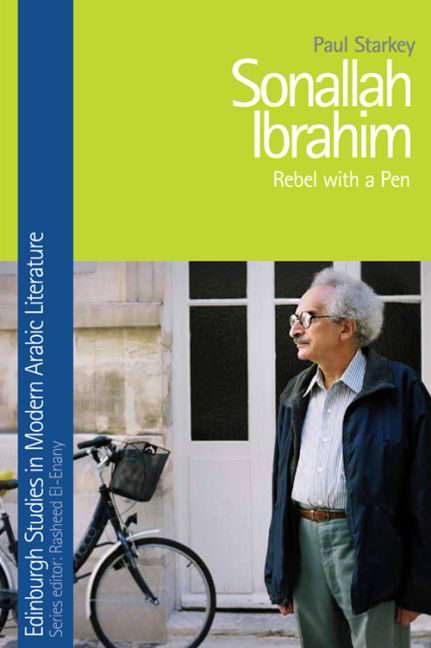
This book provides an introduction not only to the works of Sun'Allah Ibrahim, but also, more generally, to the modern literature of Egypt (and elsewhere in the Arab world) over a 40-year period, in its social, historical and political setting.