To save content items to your account,
please confirm that you agree to abide by our usage policies.
If this is the first time you use this feature, you will be asked to authorise Cambridge Core to connect with your account.
Find out more about saving content to .
To save content items to your Kindle, first ensure no-reply@cambridge.org
is added to your Approved Personal Document E-mail List under your Personal Document Settings
on the Manage Your Content and Devices page of your Amazon account. Then enter the ‘name’ part
of your Kindle email address below.
Find out more about saving to your Kindle.
Note you can select to save to either the @free.kindle.com or @kindle.com variations.
‘@free.kindle.com’ emails are free but can only be saved to your device when it is connected to wi-fi.
‘@kindle.com’ emails can be delivered even when you are not connected to wi-fi, but note that service fees apply.
In the face of the everchanging and increasingly complex regulatory and socio-technical challenges posed by AI and the Internet of Things, there is an urgent need for closer collaboration between technology designers and lawyers. Accountable Design provides a timely framework for bridging disciplines to design legally accountable technologies. Proposing the new concept of Accountable Design, Lachlan David Urquhart explores how to incorporate legal values into human-centered design processes. Three novel case studies ground discussion by showcasing uses of new technologies in cities, homes, and biometric applications while exploring how to design for privacy, security, trust, and safety. The book synthesizes insights from across technology law, human-computer-interaction, design research, science and technology studies, and philosophy of technology to address the challenges of building better technological design futures for humans and society.
In the years surrounding the Iranian Constitutional Revolution, major non-Muslim communities of Zoroastrians, Christians, Jews, and Baha'is negotiated identities, rights, and power structures. Using primary documents from Iranian, British, and French archives, Saghar Sadeghian sheds light on an underexplored aspect of Iranian and Middle Eastern history and offers a comparative view of these communities during the late Qajar era. This study draws on theories from Foucault, Agamben, and Lefebvre, providing an interdisciplinary analysis that connects history and sociology. The position of non-Muslims in Iranian society created heterotopias for the Muslim majority, yet the fluid identities blurred boundaries and bent regulations. Sadeghian explores the roles of non-Muslims in the revolution, demonstrating the impacts on these groups at the intersection of religion, economy, and politics.
Few ideas have had a more powerful effect on the modern world than that of race, yet few ideas are less understood. Bringing together contributions from leading international scholars, this volume traces the crystallisation of this concept in western intellectual discourse in the eighteenth century, its rapid rise to prominence as a governing concept across the world from the mid-nineteenth through the mid-twentieth centuries, and its legacy from the Cold War and era of decolonisation to the present. Through multiple case studies, the chapters provide new angles on more familiar contexts, such as Enlightenment Europe, while introducing related themes in areas including India and New Zealand. Race in the Modern World offers a comparative understanding of the multiplicity of ways that race has been conceptualised, how these ideas changed over time, and how the world of ideas shapes the world in which we live.
Both John Milton and Andrew Marvell have been revaluated in recent years. Yet this is the first sustained scholarly work to compare the two great seventeenth-century poets. In his new book, which stands as the culmination of a distinguished academic career, Warren Chernaik examines the relationship of the two writers and their complex responses to their troubled times. The poets were close friends, yet the trajectory of their careers and their posthumous reputations differed significantly. As well as taking an active part in the major political and religious upheavals of their times, both poets engaged seriously with classical, Christian and humanist thought. Combining close readings of their poetry and prose with detailed consideration of historical and intellectual context, Chernaik sheds fresh light on the enduring works of poets whose words still resonate strongly with today's readers.
In recent years, the United States has witnessed a resurgence in mainstream acceptance of overt, racist rhetoric from politicians. This increased tolerance arises despite previous evidence suggesting that white Americans reject racist appeals when they are explicit. Destabilized examines this shift and points to a perception of threat to white dominance as the root cause. The book finds that when white Americans feel their dominance in the racial hierarchy is unstable, their prejudice activates, and they seek to 'restabilize' the racial hierarchy by accepting negative, explicit racial appeals. Analyses of survey experiments, observational survey data, and political media demonstrate this phenomenon. Finding that this link exists among both white Republicans and white Democrats, Destabilized speaks broadly to the nature of whiteness as a racial identity rooted in the desire for dominance.
Mathematicians, physicists, engineers, and data scientists will welcome this comprehensive, practical guide to computing spectral properties of operators in infinite-dimensional settings with rigorous guarantees. It explains why standard discretisation can fail and shows how to overcome these pitfalls. It develops resolvent-based algorithms with provable convergence and certified error bounds, organised by a precise computability classification that clarifies what is achievable, what is impossible, and what extra information makes problems tractable. Topics include spectra and pseudospectra, spectral measures and functional calculus, spectral types, fractal and Cantor-type spectra, essential versus discrete spectra and multiplicities, spectral radii, abscissas and gaps, nonlinear operator pencils, and verified computation. A distinctive feature is the integration of modern applications, including a fully rigorous treatment of data-driven Koopman spectral analysis. Hundreds of worked examples, exercises with solutions, notes, and usable code make the book both a reference and a practical toolkit for researchers and students.
Why are Latin Americans increasingly disillusioned with democracy, even as the region has made social progress? This book examines the paradox of widespread political discontent amid improvements in poverty reduction, education, and expanded rights. It shows how rising expectations and broken promises have generated social frustration and political reactions, which take two different forms: they can target all political elites (vertical discontent) or focus on opposing political coalitions (horizontal discontent). Each form poses unique challenges for democracy. Bringing together leading scholars in sociology and political science from Latin America and the United States, the volume offers a multidisciplinary and comparative perspective on the drivers of democratic erosion. Drawing on empirical case studies and a shared analytical framework, the book sheds light on the tensions between democratic aspirations and lived experiences, making it a valuable resource for understanding the forces reshaping Latin America's political landscape and the broader erosion of democracy.
Why do some societies embrace religious diversity while others struggle with exclusion? Faith and Friendship reveals how the friendships we form—and those we avoid—shape interfaith attitudes across the Muslim world. Drawing on large-scale surveys from Indonesia and beyond, the book shows that religiously homogeneous friendships can unintentionally nurture stereotypes and social divides. Introducing the Boundaries, Opportunities, and Willingness (BOW) Framework, the book explains how state policies, civic spaces, and personal choices combine to determine whether people connect across faith lines. Blending rigorous research with vivid human stories, Faith and Friendship offers a new way to understand the roles of religion and social networks in everyday life and provides insights for anyone seeking to bridge interfaith divides.
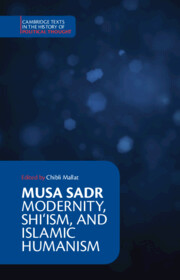
Musa Sadr was a leading force in Lebanese politics from the early 1960s until his disappearance in Libya in 1978. Like now, this was a time of turmoil, violence, and change in the Middle East. Sadr has been portrayed as primarily a charismatic man of action whose inspirational qualities led Lebanon's Shia Muslims to the centre of the political stage. This book also reflects his position as a thinker whose actions were firmly rooted in universal ethical and religious values, and for whom Islam was social philosophy as well as faith. With twelve texts taken from lectures or talks given by Sadr between 1966-1977, an introduction, and a chronology of Sadr's life, the book situates Sadr within currents of humanist intellectual thought. Detailed contextualising footnotes accompany the translations, highlighting the enduring relevance and topicality of Sadr's ideas.
The Cambridge Companion to Modern Arabic Literature redefines how we engage with Arabic literary traditions in a global context. This comprehensive and accessible companion situates modern Arabic literature at the forefront of debates about time, language, geography, and media. Through incisive case studies and close readings, leading scholars explore the dynamic intersections of Arabic literature with postcolonial, feminist, and ecological thought, as well as its transnational and translational dimensions. From the Nahda to the Anthropocene, from fuṣḥā to ʿāmmiyya, and from the Maghrib to the Arab diaspora, the companion maps the evolving contours of Arabic literary production. Far from being peripheral, Arabic literature emerges as a vital force in reimagining the dynamics of comparative and world literary studies. This companion is an essential resource for scholars, students, and readers seeking to understand the transformative power of modern Arabic literature.
Montesquieu is among the most important figures in the history of political thought, yet his published writings reveal next to nothing regarding his personal life. This volume provides the first English translations of letters revealing the character, lifestyle, and ambitions of this titled aristocrat, landowner, feudal lord, wine producer, and influential author. The letters chosen include intimate details regarding his marriage, family life, dalliances, and literary ambitions alongside frank assessments of French and European politics, warfare, and religion that would have aroused government censors if made public. We learn how eagerly Montesquieu sought entry into Parisian social circles after publishing his Persian Letters (1721), and we see how greatly he valued friendships with Parisian women whose influence at court could protect writers criticizing the existing order. In sum, the letters translated for this volume provide crucial context for his published work, illuminating how his life experiences shaped his worldview.
Empirical Animal Law challenges long-held assumptions about what animal law reforms help or harm animals. Drawing on original empirical studies and a broad interdisciplinary body of research, the book tests whether familiar tools of advocacy such as incremental reforms, criminal prosecutions, litigation, and protest really reduce animal suffering. Moving beyond moral intuition and ideology the book reveals how people perceive animal harm, which messages and messengers persuade, and when well-intentioned strategies may backfire. With chapters on factory farming reforms, criminal punishment, litigation strategy, protest backlash, and moral framing, Empirical Animal Law offers the first comprehensive, data-driven account of how animal law operates in practice and calls for a new empirically informed movement.
This book explores how language shapes our engagement with fiction, from understanding characters to discussing stories. It delves into the unique ways we communicate about fictional worlds, showing how fiction-related talk is used in a variety of situations. Andreas Stokke explores the semantics and pragmatics of fiction-related language, focusing on how we use language to create and discuss fictional stories and characters. He argues that the linguistic tools used for fiction are the same as those for reality, yet fictional communication is distinct as it is unconstrained by real-world reference and allows for saying things without incurring factual commitments. He also shows how fictional names retain their meaning across many ways of using them. He then analyses the various ways in which we talk about fiction, including metafictional, interfictional, and counterfictional discourse.
This is a comprehensive introduction to one of philosophy's deepest and most fascinating puzzles, the Liar Paradox. It introduces key theories of truth and paradox, and combines accessibility with depth, tracing the paradox from its simplest formulations to the most sophisticated contemporary theories. Chapters by leading philosophers and logicians present both classical and non-classical approaches - supervaluationist, paracomplete, paraconsistent, and substructural - and examine broader families of paradoxes alongside general theories of paradoxicality. The volume also explores the paradox's connections to meta-mathematics, modality, vagueness, quantifiers, context-dependence, and natural language semantics, demonstrating its far-reaching significance and its central role in logic, philosophy of language, and theoretical linguistics. Structured for clarity, each chapter introduces key ideas and develops advanced arguments, making the book an essential resource for students, researchers, and professionals seeking a comprehensive understanding of semantic paradoxes and theories of truth.
How can we build and govern trustworthy AI? Operationalizing Responsible AI brings together leading scholars and practitioners to address this urgent question. Each chapter explores a key dimension of responsibility - fairness, explainability, psychological safety, accountability, consent, transparency, auditability, and contextualization – defining what it means, why it matters, and how it can be achieved in practice. Through interdisciplinary perspectives and real-world examples, the book bridges ethical principles, legal frameworks such as the EU AI Act, and technical approaches including explainable AI and audit methodologies. Written for researchers, policymakers, and professionals, the book offers both conceptual clarity and practical guidance for advancing Responsible AI that is fair, transparent, and aligned with human values.
The central ideas of Isaiah Berlin (1909–1997) remain as alive for our century as they did for his, and his enduring importance as a thinker is matched by his reputation as an essayist of the first rank. This in-depth exploration of a selection of Berlin's most important essays, discussed by a variety of distinguished contributors, offers a scholarly and engaging appraisal of Berlin's most salient philosophical, historical and political preoccupations while relating them to the broad and persistent questions of philosophy, history, politics and culture. Each of the contributors examines Berlin's understanding of humanity through one of his essays, including 'The Hedgehog and the Fox', 'Two Concepts of Liberty', and 'Winston Churchill in 1940', together with less famous ones such as 'The Divorce between the Sciences and the Humanities' and 'The Purpose of Philosophy'. The result is a fresh, penetrating portrait of a major scholar and public intellectual.
Edmund Curll is traditionally considered a pornographer, remembered for having been condemned to gaol and the pillory. Here, Pat Rogers looks beyond this ignominious reputation to focus on the specifics of Curll's working methods as a publisher, his relations with the book trade, his sometimes anomalous position with regard to the milieu of Grub Street, his marketing strategies, and his repertoire of misleading bibliographic tricks. In doing so he throws new light on the factors underlying his quarrels with authors, who included Swift, Pope, and Defoe, alongside many others. Also revealed are Curll's previously unexplored dealings with the politics of the City of London, and his complex uses of anonymity. New biographic data and fuller bibliographical enquiries provide the basis for a more reliable documentation of the shape of his extraordinary, if questionable, activity within the context of the eighteenth-century print world.
Seamus Deane combined academic rigour with an expressive style that was characterised by both passion and commitment. Without losing any scholarly precision or acuity, he succeeded in engaging broader audiences in some of the key debates of his time. These included: the role of culture in creating political structures and conflict; the responsibility of artists, particularly writers, to articulate alternatives; and the need to think beyond Northern Ireland's political stalemate and imagine a New Ireland. This essential book brings together for the first time Deane's early writings and demonstrates his continuing relevance. It shows his mastery of Irish literature and the striking originality of his readings of canonical texts as well as of contemporary writers. It will delight all those already familiar with Deane's unique voice, while also engaging a fresh generation of readers who will encounter here one of the great literary stylists of the island of Ireland.
In this pathbreaking history, Tobias Rupprecht offers a revisionist account of Russia's post-Soviet marketisation from the perspective of the advisors and ministers who oversaw this transformation. Based on extensive interviews with economists and research in state and private archives, he uncovers a significant minority of economic liberals from late Soviet academic and dissident circles who sought to chart a new path, believing free prices and private property were the foundations of a 'civilised country'. This provides a vital challenge to the dominant narrative that neoliberal advisors and organisations imposed harmful reforms on Russia after the collapse of Communism. Liberal reformers faced a profound dilemma – one for which Western advisors had no solution either: Should they commit to democratic political activism and risk irrelevance, or align themselves with those in power and be co-opted by an authoritarian state determined to re-assert its imperial strength?