
Skip to main content Accessibility help
×
  • Cited by 1
    • You may already have access via personal or institutional login
    • Select format
    • Publisher:
      Facet
      Publication date:
      10 September 2022
      31 December 2013
      ISBN:
      9781856049900
      9781856045780
      Dimensions:
      Weight & Pages:
      Dimensions:
      Weight & Pages:
    • Subjects:
      Humanities, General
    You may already have access via personal or institutional login
  • Selected: Digital
    Add to cart View cart Buy from Cambridge.org
    Subjects:
    Humanities, General

    Book description

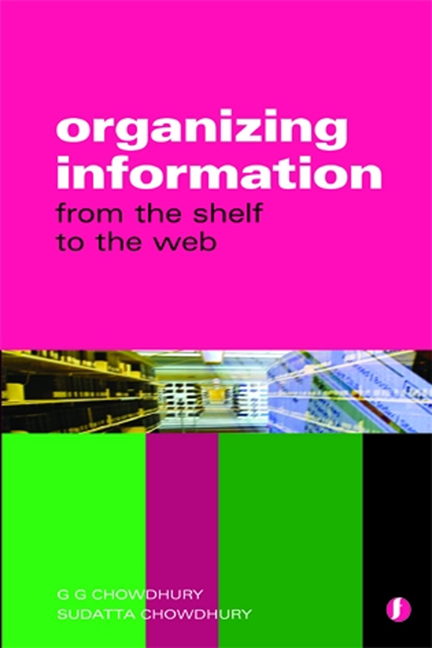
    Tomorrow's LIS professionals will have to be conversant with all the tools and techniques for organizing information in different domains - from the traditional library shelf to full-scale digital libraries. This core text covers the organization of the entire spectrum of information, and the principles, tools and techniques needed to do this effectively. The most up-to-date textbook yet available on this subject, this comprehensive book covers everything from traditional cataloguing and classification through to metadata, information architecture and the semantic web. Written by experienced academics in the area, who have authored several other successful textbooks, this book provides both an overview of the whole field of information organization and an easy-to-understand introduction to each of the individual topics, which can be followed up with further study by following the references at the end of each chapter.The chapters cover: organizing information - what it means; organizing information in different non-library environments; cataloguing; bibliographic formats - MARC21 and others; library classification; subject heading lists and thesauri in information organization; organization of internet information resources; metadata; markup languages; ontology; information architecture; the semantic web; and, information organization - issues and trends. A key student text for all information and library studies courses, the book is also valuable for practising LIS professionals who need to gain an understanding of the various tools and techniques required to master information organization.

    Refine List

    Actions for selected content:

    Select all | Deselect all
    • View selected items
    • Export citations
    • Download PDF (zip)
    • Save to Kindle
    • Save to Dropbox
    • Save to Google Drive

    Save Search

    You can save your searches here and later view and run them again in "My saved searches".

    Please provide a title, maximum of 40 characters.
    ×

    Contents

    Metrics

    Full text views

    Total number of HTML views: 0
    Total number of PDF views: 0 *
    Loading metrics...

    Book summary page views

    Total views: 0 *
    Loading metrics...

    * Views captured on Cambridge Core between #date#. This data will be updated every 24 hours.

    Usage data cannot currently be displayed.

    Accessibility standard: Unknown

    Why this information is here

    This section outlines the accessibility features of this content - including support for screen readers, full keyboard navigation and high-contrast display options. This may not be relevant for you.

    Accessibility Information

    Accessibility compliance for the PDF of this book is currently unknown and may be updated in the future.
