To save content items to your account,
please confirm that you agree to abide by our usage policies.
If this is the first time you use this feature, you will be asked to authorise Cambridge Core to connect with your account.
Find out more about saving content to .
To save content items to your Kindle, first ensure no-reply@cambridge.org
is added to your Approved Personal Document E-mail List under your Personal Document Settings
on the Manage Your Content and Devices page of your Amazon account. Then enter the ‘name’ part
of your Kindle email address below.
Find out more about saving to your Kindle.
Note you can select to save to either the @free.kindle.com or @kindle.com variations.
‘@free.kindle.com’ emails are free but can only be saved to your device when it is connected to wi-fi.
‘@kindle.com’ emails can be delivered even when you are not connected to wi-fi, but note that service fees apply.
Through vibrant ethnographic storytelling, this study reveals how young women capitalise on uncertainty in Calabar, southeastern Nigeria, to realise respectable futures. Exploring young women's daily activities across different sites from the house to church, sewing shops and beauty salons, Fashioning Futures examines the complex ways in which various forms of uncertainty permeate life in a city shaped by Pentecostal fervour and patriarchal conservatism. Juliet Gilbert demonstrates how young women actively engage with forms of uncertainty such as illusion, dissimulation and fakery to present themselves as respectable urbanites and work towards marriage. Revealing young women's centrality in the construction of urban lifeworlds in contemporary Nigeria, Gilbert re-casts youthhood in Africa, both as an analytical category and as a time of experience.
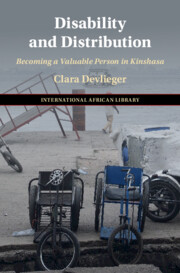
Set in the postcolonial city of Kinshasa (DR Congo), this ethnography explores how people with disabilities navigate debates about the just distribution of resources where there is little state organised welfare, and public perception of disability swings between the 'deserving' and 'undeserving'. Tracing a historic increase of disability due to polio and its long-term effects, this book examines two controversial livelihood activities that serve as informal alternatives to state support: a specialized form of international border brokerage across the Congo River, and a unique practice of bureaucratized begging that imitates state tax collection and humanitarian fundraising. Clara Devlieger examines how such activities shape ways that disabled people conceive the idea of becoming 'valuable people' in local terms: by supporting loved ones, many achieve high esteem against expectations, while adapting exclusionary models of urban personhood to include disability. Devlieger offers a new understanding of the complex dynamic between the imagined role of the state, international discourses of rights, and local experiences of disability.
The Messianic Jews of Ethiopia's Gambella region are Evangelical Christian Zionists who adhere to various Jewish practices and understand their faith as authentically emulating the faith of the first followers of Jesus Christ. Drawing on over a year of ethnographic research in this region, Yotam Gidron traces here the rise and evolution of Christian Zionist and Messianic Jewish faiths amongst Nuer communities in the Ethiopia-South Sudan borderlands. This study approaches processes of religious change from the perspective of believers, examining their pursuits of knowledge and transnational connectivity. In doing so, Gidron considers everyday dilemmas concerning spiritual mediation and truth, as they emerged in relation to church genealogies, Christian literacy, modes of prayer and praise, bloodlines, cattle, and the constitution of various human and divine relationships. As a result, he offers timely insights on spiritual and political life at the global margins, and on contemporary African attitudes towards Israel and the Middle East.
What if anthropology's fundamental assumptions about cultural and social context were shaped by a philosopher many anthropologists have never engaged with? This book explores how, from the early twentieth century to the present day, anthropological ideas about context have been shaped by Ludwig Wittgenstein's evolving philosophy, often without anthropologists fully realizing it. It shows how Wittgenstein's philosophical journey mirrors anthropology's own theoretical transformations. Through careful analysis of key figures from Malinowski and Radcliffe-Brown to Geertz and contemporary theorists, Paolo Heywood reveals unexpected connections between philosophical developments and anthropological practice. The result is a surprising genealogy of how we came to think about culture, society, and everyday life the way we do. This intellectual history illuminates the hidden philosophical assumptions that continue to shape anthropological work today. It reveals how disciplines are shaped by ideas they've forgotten they borrowed, and the surprising ways such ideas evolve in new contexts.
The Conclusion recaps the conceptual themes of the book, emphasising the need for scholars to renew their focus upon the intertwined nature of kinship, class, and capital not only in the empirical study of capitalism on the African continent, but in anthropology where the study of kinship has veered away from questions of inheritance and property since the 1980s, a subject to which it is only now returning. It recaptures the book’s emphasis on the erosion of moral economies under conditions of land’s commodification, and the way this shapes the pauperisation of junior kin.
The Introduction sets the scene for the book’s chapters and analysis. On the northern periphery of Nairobi, in southern Kiambu County, the city’s expansion into a landscape of poor smallholders is bringing new opportunities, dilemmas, and conflicts. Profoundly shaped by Kenya’s colonial history, Kiambu’s ‘workers with patches of land’ struggle to sustain their households while the skyrocketing price of land ratchets up gendered and generational tensions over their meagre plots, with consequences for class futures. Land sale by senior men turns would-be inheritors, their young adult sons, into landless and land-poor paupers, heightening their exposure to economic precarity. The Introduction sets out how these dynamics are lived at the site of kinship, and how moral principles of patrilineal obligation and land retention fail in the face of market opportunity. Within this context, the Introduction sets out the book’s exploration of how Kiambu’s young men struggle to sustain hopes for middle-class lifestyles as the economic ground shifts beneath their feet.
Chapter 2 turns towards the neighbourhood of Ituura. It introduces my field site in detail by exploring cases of local youth who are said to have been ‘wasted’ by alcoholism. In contrast to those who are said to have ‘given up’ on their futures, other young men are shown to embrace discourses of moral fortitude to sustain their hopes for the future while working for low, piecemeal wages in the informal economy. Such youth claim that one must be ‘bold to make it’. Engaging with anthropological discussion on waithood and hope, the chapter shows how young men cultivate moral fortitude through an ethics of endurance – a hope for hope itself, a way of sustaining belief in their own long-term futures that involves economising practices, prayer, and avoidance of one’s peers who are seen to be a source of temptation and pressure to consume.
This interleaf comprises a journey through peri-urban Kiambu, a glimpse of its terrain and inhabitants, as well as an arrival at the homesteads of Ituura, where the book’s narrative is set.
Chapter 5 explores the construction of women, especially young women, as dubious and untrustworthy figures in male discourse, a source of cynicism and doubt about kinship’s future. It captures men’s fears about ‘greedy’ women and ‘gold diggers’ who only want to marry men in order to expropriate their wealth. At the same time, the chapter explores counter-discourses of young women getting by in a world of male failure, their relations with their male kin, and their ambitions to become successful ‘hustlers’ in their own right. Speaking to regional literature on love, marriage, and youth relationships, it explores the gendered tensions created by a world of masculine destitution, illuminating male fears about the capacity of women to exploit their ‘in-betweenness’ to acquire patrilineal land.
Chapter 1 introduces the region of Kiambu in detail, establishing the stakes of moral debate over wealth amongst men in the region. While an older generation preaches the labour ideology (the notion that hard work will bring success) that allowed them to prosper in the aftermath of independence, it has been undermined by dwindling land holdings and opportunities for ‘off-farm income’, creating a crisis of hopelessness as young men wonder if they will ever reach the ‘level’ of their elders. Framing the study of masculine destitution to follow, the chapter discusses the legacies of the ‘Kenya Debate’, a regional debate in political economy about the relative prosperity of Kenya’s peasantry after independence. It argues for a processual, non-static approach to economic change in central Kenya, allowing us to see how class divides have been opened across generations due to population pressure on land. Its subdivision within families exerts stronger pressure on young family members who find themselves in the situation of being virtual paupers – land poor and ‘hustling’ for cash.
Chapter 4 turns towards the role of women’s work in reproducing the household, focusing on the labour of relation-making in the neighbourhood as a means of creating economic networks through which material assistance can be sought. Commenting on anthropological literature that frames African contexts as ones of ‘mutuality’ and ‘obligation’, the chapter discusses the difficulty of finding assistance for aspirational projects (especially school fees) in an atomised neighbourhood where families compete for the prestige of economic advancement. It remarks upon the possibilities and limits of caring labour as a means through which women enter into economic relations of mutual support with others.
Chapter 3 shows how older men, established patriarchs, wrestle with the temptation to sell their land and live lives of ‘fun’, abandoning their obligations to pass on wealth to future generations. Speaking to a rich regional literature on fatherhood and provider masculinity, it unveils a local politics of masculine responsibility, focusing on the question of land sale and fatherly obligation. Adult men from the Ituura neighbourhood who work for wages in the informal economy to support their families are shown to condemn other ‘bad’ men who sell their family land to live ‘comfortable’ lives of short-term consumption. The discourses of self-styled moral men valorise their self-disciplined control of a desire to consume wealth against the grain of immorality they perceive in the neighbourhood and beyond, especially by retaining their ancestral land. Complicating these heroic narratives of economic striving, the chapter explores the life circumstances that force land sale, as well as a growing cynicism amongst working-aged men towards the obligations of patrilineal kinship.