To save content items to your account,
please confirm that you agree to abide by our usage policies.
If this is the first time you use this feature, you will be asked to authorise Cambridge Core to connect with your account.
Find out more about saving content to .
To save content items to your Kindle, first ensure no-reply@cambridge.org
is added to your Approved Personal Document E-mail List under your Personal Document Settings
on the Manage Your Content and Devices page of your Amazon account. Then enter the ‘name’ part
of your Kindle email address below.
Find out more about saving to your Kindle.
Note you can select to save to either the @free.kindle.com or @kindle.com variations.
‘@free.kindle.com’ emails are free but can only be saved to your device when it is connected to wi-fi.
‘@kindle.com’ emails can be delivered even when you are not connected to wi-fi, but note that service fees apply.
Rooting Transience through Residence without Settlerism
Dakar was not a deeply rooted Atlantic city born of the earlier commercial era but a new city erected during and following the moment of colonial conquest, representing the new relationship between France and West Africa. France did not consider its major cities in Africa to be sites of indirect rule or places in which native authority as conceived by the state would hold sway. Rather, they were sites of France's power, embodied in signs of French civilization and ideals, which were not masked but overtly conveyed. French administrators saw the presence of their own as a boon and marker of modern urban life in their cities in sub-Saharan Africa, which they understood to be inherently nonurban and unmodern.
This chapter explores the complex relationship with residence that existed at the level of the colonial state, pointing to the importance of its ideas regarding two populations—one that it termed European and another that it recognized as autochthonous—in helping it project attitudes toward everyone else. It reveals that white residence dictated French priorities in Dakar, even in the absence of a settler dynamic, while also showing that the existence of a community of autochthons provided a language of rightful urban belonging to only a limited group of Africans. Dakar was not built atop a tabula rasa. The society that inhabited the Cap-Vert peninsula shaped the evolution of urban forms and dynamics, as occurred throughout colonial Africa. John Parker's work on Accra showed that many of the important debates that emerged with urban growth occurred not only between the state and Africans but within African communities, especially autochthonous ones. Working in Yoruba towns, Margaret Peil proposed a model for the interactions between autochthons and newcomers, positing the ways in which each adapts to the other by way of turning to different livelihoods. These are important perspectives that intervene in the tendency to perceive dynamics involving autochthons as ethnically defined or principally tied to land ownership concerns. For Dakar, autochthony influenced both transactional culture and the model of transient residence as well as the racial contours of French assertions regarding city dwelling.
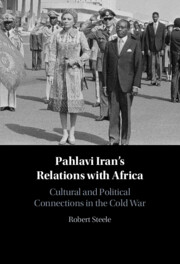
This book presents the first comprehensive study of Iran's complex relationship with Africa during the late Pahlavi era. While many studies of Iran's foreign relations during the Cold War present Iranian policy as fully aligned with the United States, Robert Steele reveals Iran as an independent actor capable of forging its own path, and shows that Africa was central to Iran's economic policy and security strategy during the reign of Shah Mohammad Reza Pahlavi. Africa was where the shah sought allies to balance the radicalism of Nasser, often through Iranian aid, customers for Iranian oil and potential sources of uranium. Bolstered by the British withdrawal from the Persian Gulf in 1971 and the oil price hike of 1973, Steele also shows how the shah saw an opportunity for his Iran to play a leading role in the Indian Ocean, revealing the central place of Africa in Iran's global strategy.
From the early second millennium AD more hierarchically organised societies marked by the rise of southern Africa’s first states developed in the north of southern Africa, culminating in Great Zimbabwe and its successors. This chapter outlines the processes involved, including the roles played by hunter-gatherer communities (for example at K2 and Mapungubwe) and the histories of farming societies on their periphery (notably those of Zimbabwe’s Nyanga Highlands). Much of this research is new and the past two decades have also seen challenges emerge to the importance previously accorded Indian Ocean trade in accounting for the emergence of social complexity, to the historical relationships between major centres (K2, Mapungubwe, Great Zimbabwe, Khami), and to understandings of the internal organisation, chronology, size, and functioning of those sites. Discussing these debates – particularly those relating to the settlement organisation of Great Zimbabwe and other stone-walled sites and the social implications of this – involves considering how far political action should be understood in terms of Indigenous, rather than Western, concepts.
This chapter begins by highlighting southern African archaeology’s importance at a global level, stressing the enormous time-depth over which hominins have been present in the region, the diversity of its archaeological record, and the contributions that this has made and continues to make to broader debates within archaeology and anthropology. Next, it indicates key changes made here relative to the first edition of this book in 2002 and then identifies the main sources of evidence available for reconstructing southern Africa’s past. These include archaeology, palaeoclimatic and palaeoenvironmental science, ethnographic data, historical linguistics, genetics, and oral and written histories. The chapter then introduces the overall structure of the book, ending with a discussion and justification of some key matters of nomenclature regarding how southern Africa’s varied inhabitants have been/should be called. Guidance is also given on matters of orthography relative to sounds not used in English.
Livestock first entered southern Africa a little over 2,000 years ago and by the mid−1600s Khoe-speaking herders were widely distributed across the western third of the region. Debates over how pastoralist societies developed and how and by what routes livestock were introduced have been transformed over the past two decades by significant major fieldwork projects, a growing number of detailed genetic and linguistic studies, and new interpretative frameworks partly inspired by deeper acquaintance with pastoralist practice in East Africa. Important advances have also been made in understanding Khoe rock art, the chronology of pottery, and the relevance of disease in constraining the southward spread of livestock. This chapter reviews these developments, while also grappling with the thorny question of how, if at all, forager and herder societies can be differentiated archaeologically and what form relations took between those who kept domestic livestock and those who did not. Questions of identity (ascribed and asserted) and the degree of coherence to be expected between genetic, linguistic, ethnographic, historical, and archaeological sources come to the fore.
Understanding the past requires understanding how it has been created. This is not simply about improving methodologies, but also the theoretical approaches employed and the broader socio-political framework within which they are applied. This chapter therefore delineates major developments in southern African archaeology from its nineteenth-century origins to the present, situating them with respect to the region’s wider history and the broader social and political context in which they emerged. It also considers how archaeological research was constrained by, but simultaneously challenged, structures of racial oppression during the twentieth century, differences in the experience of southern Africa’s states (including research disparities within and between them), some of the key paradigms within which archaeological research is currently conducted, and the problems encountered in making archaeology accessible to all sections of society. Another theme concerns the theoretical and methodological challenges that archaeologists face when invoking the ethnographies of southern Africa’s recent or contemporary inhabitants to help understand the past revealed by their research.
Only for the transition between the Pleistocene and the Holocene (c. 13,000−8,000 years ago) do we have a rich and chronologically relatively well-controlled record with which to explore the impacts on hunter-gatherer populations of the profound ecological changes associated with the shift from glacial to interglacial climates and through which to consider their own creativity at such a time. Previous archaeological work developed competing hypotheses to explain the shifts from microlithic to non-microlithic and back to microlithic (of a different kind) technologies during this period. These are considered here, along with potential evidence for patterns of social relations similar to those found in Bushman groups of the ethnographic present. At the same time, fuller publication of work from Elands Bay Cave allows further discussion of the value of John Parkington’s pivotal concept of ‘place’ and of the merits and disadvantages of employing ‘industries’ as building blocks for thinking about the hunter-gatherer past. New fieldwork in Lesotho reinforces this, along with the importance of deepening the relation between theory and the process of archaeological excavation itself.
A richer, better-resolved dataset allows both ‘social’ and ‘ecological’ perspectives to be explored in greater detail than is possible for earlier periods. Themes discussed include regionalisation in material culture, the development of formal burial, shifts in exchange networks, changes in landscape use and subsistence, fluctuations in regional demography, and potential indicators of socio-economic intensification. This last point raises the question of how ‘complex’ southern Africa’s hunter-gatherer societies were and whether social and/or environmental constraints inhibited the emergence of food production using indigenous resources. Recent improvements in dating now offer the possibility of drawing southern Africa’s rich hunter-gatherer rock art into temporally anchored conversations with other components of the archaeological record. The chapter shows that Bushman ethnography strongly supports interpretations of that art in terms of beliefs and practices associated with shamanism, but that new theoretical work (notably studies employing the ‘new animism’) and further work on gender and initiation continue to expand how it can be understood.
This chapter looks at the profound advances made over the past two decades or so in our understanding of modern human origins, of how humans lived in southern Africa during Marine Isotope Stages 6−4, and of their cognitive capacities. While genetics and palaeontology cannot establish a central role for southern Africa in H. sapiens’ emergence, the region provides the most detailed early evidence anywhere for a wide range of complex behaviours that speak to the cognitive abilities of those responsible for them: art, jewellery, bone tools, archery, pigment manufacture, pyrotechnology, snaring and trapping of small game, etc. Much of this material is associated with the Still Bay and Howiesons Poort industries and the significance of this is discussed along with how southern Africa’s record relates to the wider Palaeolithic context in Africa and Eurasia. While underlining the importance of sites like Blombos, Border Cave, Klasies River, Pinnacle Point, and Sibhudu, the chapter emphasises the limitations of (near-)coastal/Fynbos Biome-oriented research and the increasing importance of fieldwork in other regions, such as Namaqualand, the southern Kalahari, and highland Lesotho.
This chapter looks at the establishment of farming communities in the east of southern Africa within the broader context of agropastoralist expansion south of the Equator and the spread of Bantu languages. Much of the literature on this topic depends heavily on analysis of ceramic design and arguments linking variation in this to variation in broad ethnolinguistic affiliations. The cultural-historical framework based on this is discussed, but alternative methods of ceramic classification are also explored, while the antiquity and utility of the Central Cattle Pattern settlement structure and its cognitive associations are critically assessed. In their dependence on a direct historical approach that is projected far back into the past both questions provide an agriculturalist counterpoint to the use of Bushman ethnography for understanding archaeological hunter-gatherer societies. Beyond these more theoretical concerns, Chapter 10 also emphasises the role of metallurgy, the social relations and subsistence base of early farming societies, the start of their engagement with Indian Ocean trade networks, and their interactions with pre-existing forager communities.
Neither southern Africa’s archaeology nor its history or contemporary social and political structure can be understood without reference to its experience of colonialism and conquest or of the resistance to this. This chapter therefore looks at the archaeology of Portuguese exploration and subsequent settlement in Mozambique, as well as at the much more expansive colonisation of southern Africa set in motion by the establishment of a Dutch East India Company (VOC) base at Cape Town in 1652. It traces the spread of European settlement into the region’s interior, the emergence of new creolised populations on and beyond the frontiers of that settlement, the institutionalisation of the social, economic, and political structures that led to apartheid, and – crucially – the resistance of Indigenous societies to this. Chapter 13 also discusses the Mfecane and the emergence of the Zulu, Basotho, Ndebele, and Swazi states, among others, to emphasise their contemporaneity and potential connections with European settler expansion and to encourage comparative study of processes of state formation, migration, and population incorporation common to both.
Just as the archaeology of the Zimbabwe Culture’s later phases (the Torwa and Mutapa states) can be understood as an exercise in historical archaeology structured by dialogue between the evidence of material culture and that of oral and written histories, so too can the recent past of farming communities and their neighbours south of the Limpopo. Here (and extending into modern Botswana), the archaeological record of the past several hundred years is that of the ancestors of today’s Sotho/Tswana, Nguni, Tsonga, and Venda peoples. This chapter therefore looks at the expansion of farming populations on to the temperate grasslands of South Africa’s interior; the multiple interactions between farmers, pastoralists, and hunter-gatherers (something also increasingly informed by genetics); early contacts with European traders on southern Africa’s Indian Ocean coast; the creative potential of cattle, metals, and other indigenous resources to generate power and wealth; the emergence of more complex societies and denser patterns of settlement; and the construction of new built landscapes that are only now beginning to be understood in detail (notably in Mpumalanga and Gauteng).
Returning to some of the themes addressed in Chapter 3, this final chapter considers the wider social responsibilities of archaeologists working in southern Africa in the twenty-first century. Matters discussed include gender and racial equity within the discipline itself (especially with respect to South Africa), how best to relate the work done by archaeologists to the wider public, heritage management and conflicts over this (including the restitution of cultural sites, property, and human remains), the roles of contract archaeology, university teaching departments, and museums, the importance of publication, and the potential for developing post-colonial approaches to the interpretation of archaeological evidence. In highlighting possible future research trends, the chapter concludes by emphasising the need for work that is both intellectually sound and socially engaged and by reiterating the global significance of southern Africa’s immensely long and varied archaeological record.
This chapter sets out some of the key frameworks within which southern African archaeology operates. It first establishes the boundaries of ‘southern Africa’ for the purposes of this book and then examines the region’s physical geography. The climate and topography described frame southern Africa’s present-day ecology, which is discussed using the biome divisions of Mucina and Rutherford (2006). The chapter then considers how environmental change affected southern Africa during the Quaternary (using the well-known Marine Isotope Stage (MIS) system), the data that archaeologists and others use to reconstruct past environments, and the principal climatic mechanisms at work in the region. It concludes by outlining and assessing the major chronometric and other dating methods employed to build the chronological framework of southern Africa’s past.