To save content items to your account,
please confirm that you agree to abide by our usage policies.
If this is the first time you use this feature, you will be asked to authorise Cambridge Core to connect with your account.
Find out more about saving content to .
To save content items to your Kindle, first ensure no-reply@cambridge.org
is added to your Approved Personal Document E-mail List under your Personal Document Settings
on the Manage Your Content and Devices page of your Amazon account. Then enter the ‘name’ part
of your Kindle email address below.
Find out more about saving to your Kindle.
Note you can select to save to either the @free.kindle.com or @kindle.com variations.
‘@free.kindle.com’ emails are free but can only be saved to your device when it is connected to wi-fi.
‘@kindle.com’ emails can be delivered even when you are not connected to wi-fi, but note that service fees apply.
Chapter 7 queries how the law addresses evolving concepts such as intentionality, intersectionality, and multiracial identities. In a common law system, legal precedents are static even though public understanding of race in society has expanded dramatically. This chapter explores the historic requirement to demonstrate evidence of an intent to discriminate to justify intervention by the law, which emerged from a traditional understanding of racism as personal and purposeful. Despite the potential harm of neutral policies creating disparate damages in racialized communities, this barrier to governmental action and its concomitant justification for neglect, matters. Students will explore the inability of the law to address multiple racial identities simultaneously and the legal consequences of ignoring intersectionality. The text considers a proposed constitutional amendment to address this limitation. Finally, the law’s hesitance to address multiracial identities is explored, questioning whether current legal structure is adequate to address contemporary understandings of racism and racial discrimination.
Chapter 4 examines the consequences when the state does not protect the security of people within its realm because of their race, and how this negligence intersects with the contemporary criminal justice system. The chapter focuses on current arguments surrounding Black Lives Matter and similar movements in Latino and Native communities regarding state violence against communities of color. The primary sources examine several criminal justice protections provided under the Constitution, consider the Fourteenth Amendment’s requirements of state and federal governments, and question how the government protects the people against itself and from White majorities. Readers may engage with the continuing debates around the responsibility of governments to ensure that policing is not racialized and consider the most just specific policies or legal interpretations focusing on the accountability of state actors. The chapter conncludes by exploring the potential of the constitutional requirement of a jury of peers for criminal prosecution may hinder the exercise of state-sanctioned racialized violence.
Chapter 6 investigates the legal options to ameliorate historic approaches to race, allowing the United States to more closely align with its national ideals. Over time, different branches of government developed strategies to ameliorate the damage caused by institutionalized racism. However, courts have wrestled with the question of how these remedies might reify race – making it more central to American life – or destroy the unique aspects of communities, forged by their shared experiences fo race, in an effort to provide greater equality. The chapter asks if the law and Constitution require public institutions to be color-blind in their treatment of race, or does the racial history of the nation demand color-conscious remedies. The text traces the evolution of affirmative action, especially in education, as a means of compensating for generational exclusion and the Supreme Court’s changing perception on color blindness as a constitutional principle.. The treatment of those U.S. territories that have not been granted statehood, where the majority of the population are people of color is explored. Finally, recent expansions to Native sovereignty are examined and the reader is asked to consider the impact of such protections on Native equality.
Chapter 5 queries how cultural and community identities legally intersect with issues of race. Here readers explore how the law wrestles with the relationship between laws and cultural customs and norms within racialized communities. The text asks the reader to determine if the law should treat discrimination against cultural expressions frequently connected to race, such as hair style or language, with the same scrutiny as racial discrimination. Scholars and the courts have disagree about the relationship between the two and the text engages this debate by presenting different scholarly attempts to resolve this conflict. In this chapter students will explore the statutorily protected capacity of Native communities to privilege the adoption of children of indigenous descent into Native families over White families. Another significant question emerges from the excerpted cases of whether Native tribal communities in the United States are racial or political entities. The answer to this question impacts core questions of political autonomy and sovereignty, as well as the social constructions of other racial identities.
The Conclusion to the book introduces two new metaphors that force readers to consider their own personal and collective responsibility in addressing the relationship between race and the law in the United States. Students should leave the text with a clearer personal understanding of the national dynamics around racial discourse in the United States and, ideally, a better understanding of both the potential and limitations of the law in solving societal problems within a democratic system.
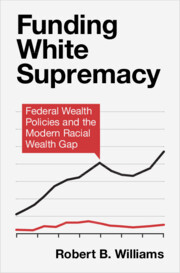
In Funding White Supremacy, Robert B. Williams shows how current federal policies have perpetuated and expanded the racial wealth gap in the United States. Through the lens of stratification economics, Williams explores how twelve tax expenditures buried in the federal tax code shower over $1 trillion annually to mostly wealthy, white households, while federal estate and gift taxes have been systematically dismantled. The book reveals how these policies originated in a period of overt racial oppression and have evolved in the modern, post-Civil Rights era, not only contributing to the expanding racial wealth gaps over the last fifty years but how they have also fostered the growth of white wealth at the expense of Black wealth. This book is a must-read for anyone seeking to understand how federal policies contribute to the vast and expanding racial wealth gap at the core of the American system of white supremacy.
This article examines an overlooked period of CIA history: the directorship of William Raborn. While previous scholarship points to Raborn being a lacklustre DCI, little substantial discussion has been held on the reasons why he struggled so much. This article proposes that Raborn's problems were due to his inability to assimilate to the agency's organizational culture, with his willingness to supply “intelligence to please” and his lack of worldliness being key. Subsequently, Raborn's tenure damaged both the reputation and the efficacy of the CIA during the mid-1960s, and led to increasing presidential neglect and enhanced scrutiny of their operations.
In 1998, Bill Clinton hosted a town hall on race and sports. 'If you've got a special gift,' the president said of athletes, 'you owe more back.' Gift and Grit shows how the sports industry has incubated racial ideas about advantage and social debt since the civil rights era by sorting athletes into two broad categories. The gifted athlete received something for nothing, we're told, and owes the team, the fan, the city, God, nation. The gritty athlete received nothing and owes no one. The distinction between gift and grit is racial, but also, Joseph Darda reveals, racializing: It has structured new racial categories and redrawn racial lines. Sports, built on an image of fairness, inform how we talk about advantage and deservedness in other domains, including immigration, crime, education, and labor. Gift and Grit tells the stories of Roger Bannister, Roberto Clemente, Martina Navratilova, Florence Griffith Joyner, and LeBron James – and the story their stories tell about the shifting meaning of race in America.
This text explores how the legal history and judicial decisions of the United States contribute to the dynamic societal debates Americans are having around race today. It pairs historical cases and primary sources with contextual commentary to ensure students comprehend how decisions from the past deeply impact the laws they have inherited, as well as shape contemporary issues and political movements. This framework also highlights the distinctive characteristics of the various time periods and how they connect to other eras to provide students with a full appreciation of the events and environments influencing cases. Written in an accessible and engaging style, it avoids the traditional focus of many caselaw books and instead promotes a sound understanding of the legal concepts and dynamics that inform current discussions of racial identities, challenging the usual development of doctrinal law and court decisions defining race. An Instructor Manual is available online, with additional teaching resources and assessment materials for each chapter, to foster meaningful class discussions about future choices and how to pursue a more equal nation.
Critics of populism and advocates of elitist democracy often place greater confidence in political elites than in the general public. However, this trust may be misplaced. In five experiments with local politicians, state legislators, and members of the public, the author finds a similar willingness across all groups to entrench their party's power when given the opportunity – a self-serving majoritarianism that transcends partisan lines. This tendency is strongest among committed ideologues, politicians running in highly competitive districts, and those who perceive opponents as especially threatening. Local elected officials even appear more focused on securing their party's next presidential victory than on opposing bans against their political rivals. These findings challenge the conventional mass/elite dichotomy, revealing little differences in undemocratic attitudes. Safeguarding democracy likely requires shifting focus from those individual attitudes to strengthening institutional restraints against majority abuses. This title is also available as Open Access on Cambridge Core.
Shifting Allegiances provides a comprehensive analysis of the increasing presence and influence of Latino Republicans in Congress and state legislatures. Contrary to past assumptions, this Element reveals that Latino Republicans are a diverse group, no longer confined to Cuban Americans in South Florida. By examining election data and candidate characteristics since 2018, the authors uncover the factors contributing to the success of Latino Republicans, including district demographics, conservative values, and strategic campaigning. This shift in political dynamics highlights a broader trend of ideological realignment and offers insights into the evolving landscape of Latino political representation in the United States.
As climate change intensifies, conflict-prone tropical regions face heightened vulnerabilities, yet little is known about how climate adaptation and food security efforts affect conflict dynamics. Using South Sudan – a country highly susceptible to climate stress and conflict – as a test case, this Element analyzes how international nongovernmental organizations' (INGO) climate adaptation interventions influence civil war and local social conflicts. It develops a theoretical framework linking climate adaptation to conflict, positing both positive and negative externalities. Drawing on original high-resolution data on INGO-driven adaptation and food security efforts, alongside climate, conflict, and development data, findings are substantiated with interviews from policy workers in South Sudan. The results indicate that while adaptation generally does not reduce conflict, interventions that promote preparedness and are implemented during periods of high climate stress can mitigate social conflicts between militias, pastoralists, and farmers. These insights provide guidance for designing climate adaptation strategies that reduce conflict risks.
The article studies the war artifacts and military symbols, particularly bullets and tattoos, in Héctor Tobar’s novel about the Guatemalan civil war, The Tattooed Soldier (1998) and Salomón de la Selva’s testimonial poetry about World War I, El soldado desconocido (1922). Although the texts were written more than seven decades apart, the two authors’ treatments of these objects demonstrate ligatures between soldiering, disability, and the frailty of the Global North’s patriotism in Latinx narratives. They depict the effects of war on vulnerable bodies as well as the central value of the figure of the soldier. In his novel, Tobar builds on de la Selva’s poetic explorations, from the soldiers in the European trenches to the soldier turned immigrant. Their narratives capture how soldiers in global and local conflicts look for a sense of masculinity and patriotism, but instead expose the atomization and dark side of contemporary American cultures across borders. For both authors, war creates physical and psychological wounds that go unrecognized and for which the US is never held responsible. Tobar and de la Selva reveal war artifacts and militaristic symbols as original, tangible sites that expose this reality.
This chapter imagines potential and as yet unexplored rapprochements between William Carlos Williams (1883–1963) and Julia de Burgos (1914–53), two contemporaneous writers on the brink of Latinx identification, as it is currently conceived. Observing their generically and linguistically diverse writing practices – marked by distinct introspections about Puerto Rican, Caribbean, pan-Hispanic, Anglo-American, and European identities – I open a discussion of the authors’ experiences of everyday spaces (the city street, the hospital ward, the intergenerational home). What I call “lyrical mobilities” constitutes the process of imagining Williams’s and de Burgos’s movements through hemispheric histories as well as geographic and linguistic spaces. It is also a critical attempt to read these two canonical authors in terms of the spaces they had in common, which, in turn, helps extend our understanding of Latinx lives across disciplines that have contained Williams and de Burgos within discrete silos.
This chapter asks how religion has been understood in Chicanx literature by connecting the performance of syncretic spiritual labor with the task of telling stories about the exploitation of Chicanx labor. It takes Tomás Rivera’s 1971 … y no se lo tragó la tierra (Tierra) and Denise Chávez’s 1994 novel Face of an Angel (Angel) as test cases. By closely revisiting a work of criticism that is emblematic of the way Chicanx literary criticism approaches the role of religion in literature, this chapter shows how reproductive labor, service labor, and syncretic religious labor are inadvertently obscured by the urgency of attending to class identity and farm labor in the case of Tierra, or non-religious spirituality and fetishized indigeneity in the case of Angel. In particular, the chapter returns to Ramón Saldívar’s germinal reading of Rivera’s novel and Theresa Delgadillo’s incisive interpretation of Chávez’s novel to explore how subtly and entirely certain subjectivities become illegible. Drawing inspiration from scholars such as Judith Butler, the chapter scrutinizes notions of agency within gender performance and advocates for a paradigm shift that acknowledges the deeper significance found in seemingly menial tasks, such as washing dishes or clearing used plates.