To save content items to your account,
please confirm that you agree to abide by our usage policies.
If this is the first time you use this feature, you will be asked to authorise Cambridge Core to connect with your account.
Find out more about saving content to .
To save content items to your Kindle, first ensure no-reply@cambridge.org
is added to your Approved Personal Document E-mail List under your Personal Document Settings
on the Manage Your Content and Devices page of your Amazon account. Then enter the ‘name’ part
of your Kindle email address below.
Find out more about saving to your Kindle.
Note you can select to save to either the @free.kindle.com or @kindle.com variations.
‘@free.kindle.com’ emails are free but can only be saved to your device when it is connected to wi-fi.
‘@kindle.com’ emails can be delivered even when you are not connected to wi-fi, but note that service fees apply.
Debates about Latinx literary representations of war tend to emphasize either how Latinx literature offers a means of repair for war’s ravages or, alternatively, that violence is constitutive of latinidad itself. This chapter charts a middle course through both positions by arguing that US Latinx literature highlights both irresolute, unreconciled wars and, what Jesse Alemán describes as Latinx “micro-wars” within major conflicts; such micro-wars, furthermore, often involve clashes and negotiations around the racialized boundaries of Latinx communities. Here we survey a range of Latinx representations of the Civil War, World War II, the Korean War, and wars of revolution and counterinsurgency in Viet Nam and Central America. Rather than waging war on an irredeemable enemy, we conclude, Latinxs lay siege to the imperial relationship championed by the US in most of these conflicts.
This chapter focuses on examples of Rivera’s “brown noir” that use noir conventions to draw into critical relief the intersection of anti-Mexican racism, labor exploitation, and patriarchy. Rivera’s brown noir dramatizes the pitfalls of taking vicarious pleasure in film and related representations where work, heterosexual romance, or education inexorably leads to happy endings. Experiences of vicarious pleasure, Rivera suggests, can be contradictory, toggling between appeals to incorporation and the recognition of exclusion and subordination. On the one hand, he was interested in how cinema as an ideological state apparatus encourages farmworkers to take vicarious pleasure in images that are hurtful and oppressive. On the other hand, in his literary and cultural essays, Rivera also analyzed contexts in which farmworkers turned such cinematic appeals into opportunities for critical thinking about the disjuncture between film representations and their own lives. He suggests that, because Hollywood films formally appeal to farmworkers while practically excluding them from representation (or incorporate them as minor, subordinate characters), appeals to vicarious pleasures can generate insights into the construction of social hierarchy and inequality. Rivera dramatized his theories about vicarity in his brown noir film treatment for his story “La mano en la bolsa”/“Hand in His Pocket.”
This chapter locates an important constellation of Latinx literary modernities in the editorial offices and print shops of New York City’s late nineteenth- and early twentieth-century Spanish-language press. In contrast to familiar expressions of literary modernity in Spanish and English centered on literary autonomy, those of interest in this chapter pursued the possibilities of an expanding and increasingly interconnected world of print for achieving democracy and social justice. In New York City, that pursuit began in the context of Cuba’s and Puerto Rico’s anticolonial struggle against Spain – in the form it took in the 1880s and 1890s as José Martí built the coalition that organized Cuba’s final independence war with Spain. Some of his collaborators, including Rafael Serra and Sotero Figueroa, made Cuba’s revolutionary movement a source of ambitious thinking about the interrelationship of modern media, democracy, and social justice. Their ideas help to reveal continuities that run through early twentieth-century Spanish-language periodicals in New York City and their late nineteenth-century predecessors – including those associated with the literary movement of modernismo. Across those periods, Latinx editors and writers launched visionary and largely understudied innovations designed to make modern media a means of enabling participation in creating just democracies.
This chapter interrogates the South–South internationalism of renowned US Nuyorican poet Miguel Algarín. It argues that the abjection in Morocco featured in his poem “Tangiers” reacts to French coloniality. More specifically, Algarín’s Orientalist evocations of underage child prostitution operate under a French hegemony, coming into crisis when a Third World alliance fails. Although his engagement with African self-determination exhibits residues of a French hegemony undergirding and undercutting what I term a poetic Latin-African solidarity, his South–South approach enriches postcolonial studies, in which Latin American – and, by extension, Latinx – identities have been sidelined.
This volume approaches Latinx literatures of the late nineteenth and early twentieth centuries through the prismatic lens of modernity. Foregrounding from the outset that there is no single Latinx experience, we understand Latinx modernities as multiple and multiplying. Latinx literary modernities constellate the coloniality of US domination, the rapid and often traumatic social changes wrought by new technologies, the displacements associated with domestic revolutions and international warfare, and the innovation of literary forms commensurate with the spiritual yearnings of people on the margins of society. Our volume assumes an organization based on conceptual categories of US and Latin American modernities with the intent of highlighting emergent approaches to Latinx literatures. These conceptual categories – space, being, time, form, and labor – allow scholars working on different national groups across different time periods to be in more direct conversation with one another without assuming that they are telling the same story. Our categories make visible surprising connections, illuminate new methods, and push back against the coloniality of aesthetic models that limit the conditions of possibility for Latinx literature.
An in-depth study of the assassination of Jeanette and Katryn Schoon at the hand of apartheid spy, Craig Williamson, that explores how the lives of a group of white activists intersected with and were impacted by the undercover security police and their operations both within and outside of South Africa.
This is the first book-length account of the assassination of Jeanette and Katryn Schoon on 28 June 1984, ordered by Craig Williamson, a member of the security service and apartheid spy. Jeanette Curtis Schoon and Craig Williamson first met in 1973 at Wits University. Schoon was part of a network of white activists fighting apartheid; Williamson had successfully infiltrated the student movement and rose within its ranks. He held positions of trust, first within the National Union of South African Students and later, after pretending to 'flee' the country, as an office-bearer of the International Universities Exchange Fund in Sweden, which helped fund many South African activists in exile.
The book uncovers how the lives of a group of white activists intersected with and were impacted by the undercover security police and their operations both within and outside of South Africa in a multitude of ways.
Williamson received amnesty for his role in the Schoons' murder, among other crimes. This book shows the limits of the TRC process to deliver social justice and render healing from South Africa's apartheid past. That justice has not been served to the Schoons remains a tragedy in this story of struggle against apartheid.
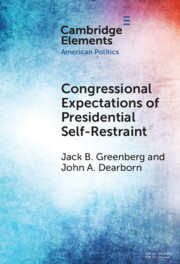
This Element explores how Congress has designed laws reliant on an assumption of presidential self-restraint, an expectation that presidents would respect statutory goals by declining to use their formal powers in ways that were legally permissible but contrary to stated congressional intent. Examining several laws addressing political appointments since the 1970s – statutes involving the FBI director, Office of Personnel Management director, chairman of the Joint Chiefs of Staff, director of national intelligence, Federal Emergency Management Agency administrator, inspectors general, Senior Executive Service, vacancies, Social Security Administration commissioner, and Consumer Financial Protection Bureau director – the authors demonstrate lawmakers' reliance on presidential self-restraint in statutory design and identify a variety of institutional tools used to signal those expectations. Furthermore, the authors identify a developmental dilemma: the combined rise of polarization, presidentialism, and constitutional formalism threatens to leave Congress more dependent on presidential self-restraint, even as that norm's reliability is increasingly questionable.
Recent scholarly interest in Lillian Smith and her controversial best-selling novel Strange Fruit (1944) has ignored the importance of the magazine she edited with her partner Paula Snelling, South Today (1936–45). After considering Smith and Snelling's cultivation of an ideal southern literature through their book reviews, this article reads the short stories Smith published in South Today, which functioned as early drafts of Strange Fruit. Tracing the significance of the magazine's readers, I argue that the process of editing a magazine shaped the structure and style of Smith's novel, considering what literary magazines can tell us about southern identity.
This book introduces scholars and students of literature to previously neglected or unknown works of literature-such as José Rodríguez Cerna's chronicles and Leonor Villegas de Magnón's memoir of the Mexican Revolution-as well as new approaches to canonical texts by Maria Amparo Ruiz de Burton, Julia de Burgos, Tomás Rivera, and Gloria Anzaldúa. It challenges how previous generations of scholars have understood American modernity by rejecting a standard, historical organization and instead unfolding in clusters of essays related to key terms-space, being, time, form, and labor-corresponding to the overlapping legacies of Spanish and US colonialism and expansion that frame Latinx experience. This volume showcases the diversity of US Latinx communities and cultures, including work on Mexican/Chicanx, Central American, and Caribbean figures and highlighting the evolution of scholarship on Afro-Latinx creative expression and Latinx representations of indigeneity.
Environmental policies and enforcement pose fundamental corruption issues relating to the tensions between economic self-interest and the public good. By directing our attention to the challenges of collective action, they also highlight the importance of state-level institutional and political characteristics – notably, the political clout of industrial and environmental lobby groups. High levels of corruption and low levels of trust both weaken the stringency and enforcement of environmental policies and affect levels of emissions, although as levels of trust in a state increase, the effects of corruption weaken or vanish. Our environmental findings closely parallel those in other chapters having to do with COVID policies – not surprising, as they raise similar questions of policy and compliance – and support our argument that thinking solely in terms of specific acts of rule- or law-breaking is an incomplete understanding of corruption, its causes, and its consequences.
The United States, despite its generally favorable rankings on international indices, has significant corruption problems. Those issues cannot be ignored, but neither should they be exaggerated or oversimplified. American corruption is not any one single problem: contrasts are apparent among the states, across regions, and at different levels of the federal system. Some are illegal, but other types are legal – or not clearly against the law. While corruption is a significant issue in the context of law enforcement, race relations, environmental policy, and public health, its sources, consequences, and context differ from one sector to the next. Inequalities along racial and class lines add further complexities and significantly affect the prospects of reform. Checking corruption and dealing with its consequences will be a matter not only of enacting and enforcing sound laws but of how well we govern ourselves within a large, complicated, multi-level, but fundamentally democratic constitutional framework.
Arguments that corruption is “grease for the wheels,” benefiting economic growth, are difficult to sustain. State-level findings show that extensive corruption tends to leave a state poorer, and more economically unequal, than states where the problem is less significant. Citizens’ ability to respond to those difficulties by political means is in turn influenced by corruption itself, general levels of political participation, the strength or weakness of trust in officials and fellow citizens, the amount and quality of political news coverage in the mass media, and a state’s social composition. Problems of low trust could conceivably be addressed via effective universally applied public policies, but those in turn can challenge, and be challenged by, key aspects of America’s long-term bargain between government and citizens and by citizens’ expectations of each other. Corruption often undermines trust, and trust can underwrite effective reforms, but the relationships are complex and contingent upon levels of trust that are neither too low nor too high.