To save content items to your account,
please confirm that you agree to abide by our usage policies.
If this is the first time you use this feature, you will be asked to authorise Cambridge Core to connect with your account.
Find out more about saving content to .
To save content items to your Kindle, first ensure no-reply@cambridge.org
is added to your Approved Personal Document E-mail List under your Personal Document Settings
on the Manage Your Content and Devices page of your Amazon account. Then enter the ‘name’ part
of your Kindle email address below.
Find out more about saving to your Kindle.
Note you can select to save to either the @free.kindle.com or @kindle.com variations.
‘@free.kindle.com’ emails are free but can only be saved to your device when it is connected to wi-fi.
‘@kindle.com’ emails can be delivered even when you are not connected to wi-fi, but note that service fees apply.
This two-volume work, published in 1847 by cavalry officer Daniel Henry Mackinnon (1813–84) describes his military service in India, in the campaigns against the Afghans in 1839 and the Sikhs in 1845–6. In the first edition, reissued here, the author is referred to only as 'a cavalry officer', but in the second edition of 1849, Mackinnon, a career soldier and writer, abandons his anonymity. Volume 2 continues the account of the First Anglo-Afghan War, and the eventual withdrawal of British troops, after which Mackinnon travelled to Delhi and Agra before returning home. He went back east in 1845, when the apparent peace of Northern India was about to be disturbed by the Anglo-Sikh War. Again, his description of the events leading to conflict are somewhat partisan, but his eye-witness accounts of the battles in which he fought (in one of which his horse was shot underneath him) are gripping.
Published in 1874, this groundbreaking monograph on the palaeography of southern India gained great scholarly acclaim. Arthur Coke Burnell (1840–82) served in the Indian Civil Service and as a judge, also building up a large collection of original or copied Sanskrit manuscripts. Originally intended as an introduction to his vast and pioneering Classified Index to the Sanskrit Manuscripts in the Palace at Tanjore (1880), this work won Burnell an honorary doctorate at the University of Strasbourg. Replete with documentary evidence, it contains copies and explanations of numerous texts, the decipherment of which threw new light upon an obscure chapter in the history of writing, offering new theories for dating the introduction of writing into India and the origin of southern Indian alphabets and numerals. Although Burnell's work has since been built on and sometimes superseded, this is still a much-cited resource in South Asian palaeography and epigraphy.
The Indo-Aryan language family is a branch of the Indo-European phylum, and includes Hindi, Urdu, Bengali, Punjabi, Kashmiri and Gujarati. First published in 1872, this three-volume comparative grammar of the family was written by the British civil servant John Beames (1837–1902). From 1866 he spent twelve years in India, during which he gathered data for what he intended to be the first comprehensive and accurate Indo-Aryan grammar. Volume 1 focuses on phonetics and phonology. Drawing on evidence from Indo-Aryan sound systems, it shows Sanskrit to be the languages' parent, while exploring some non-Sanskritic exceptions. It also gives a detailed historical background to the languages, provides careful descriptions of their vowel and consonant systems, and explores how Indo-Aryan phonology has changed over time. Beames' findings remain central to the work of general linguists, phonologists and language typologists.
Sir Henry Bartle Edward Frere (1815–84) was recognised as one of the ablest colonial administrators of his generation. His service in British India, where he rose to serve on the Supreme Council, was distinguished by his promotion of municipal institutions and his inclusion of the Indian people. In this respect he was ahead of his time. At the outbreak of the Indian Rebellion of 1857, his actions helped limit the spread of the uprising. As Governor of the Cape Colony in South Africa he was directed to confederate the disparate territories there into a single nation, but this mission was marred by his unilateral decision to wage war on the Zulus. In 1894, John Martineau (1834–1910) published this sympathetic two-volume biography. Volume 1 covers Frere's ascent in India from a lowly civil servant to one of its most influential rulers.
This work by Sir James Outram (1803–63), subtitled A Commentary and originally published in two parts in 1846, is an attempt by the author to vindicate his reputation which, he believes, was sullied by Sir William Napier's book The Conquest of Scinde (1845; also reissued in this series), in which he is represented as devoid alike of military and diplomatic skill. (William Napier was the brother of Sir Charles Napier, the British Commander-in-Chief in India, and his account is not unbiased.) In Part 1, Outram declares his intention to expose these misrepresentations and to vindicate a reputation which for a quarter of a century he had 'maintained unimpeached'. He claims to corroborate his version of events using personal correspondence, describing in detail and in the first person the political and diplomatic intrigues and the military actions which led to the conquest of the Province of Sindh by the British.
Published in 1866, this two-volume work is a passionate account of the momentous Taiping Rebellion of 1850–64, which spread across southern China, involving the death of around 20 million people. An English officer and supporter of the rebels, Augustus Frederick Lindley (1840–73) actively fought for them and believed devotedly in their cause. Led by Christian convert Hong Xiuquan, they rose up against the ruling Qing dynasty in an attempt to force social, commercial and religious reforms, but were eventually brutally crushed with the aid of British and French forces. Prior to his death at the age of only thirty-three, Lindley produced this accomplished work of historical exposition and anti-imperialism. Volume 1 examines Chinese society and the tyrannical imperial rule; the origin, outbreak, incidents and atrocities of the conflict; and Lindley's own role and experiences as trainer, advisor and soldier.
The beginning of the Ahom dynasty in eastern Assam dates back to AD 1228. This kingdom, which was one of the longest reigning dynasties in India, continued until the beginning of nineteenth century. This book discusses the reasons behind the durability of this state. It analyses the factors that contributed both to development of Ahom and its eventual downfall through an examination of technology, production and system of governance. The author proposes a new categorisation of the Ahom state, which he calls the paik mode of production. This involves examination of the specific tools and technologies used in rice cultivation, varieties of rice cultivated, techniques of gunpowder manufacture, different kinds of guns and canons manufactured, system of guerrilla warfare and extent of civil construction. Overall the book presents a rich account of a lesser known region in India and opens up a new area of historical examination. The book will interest graduate students and academic researchers of South Asian History, especially with a focus on northeastern part of India. General readers interested in the history of Assam will also find this book useful.
The Indo-Aryan language family is a branch of the Indo-European phylum, and includes Hindi, Urdu, Bengali, Punjabi, Kashmiri and Gujarati. First published in 1875, this three-volume comparative grammar of the family was written by the British civil servant John Beames (1837–1902). From 1866 he spent twelve years in India, during which he gathered data for what he intended to be the first comprehensive and accurate Indo-Aryan grammar. Volume 2 focuses on nouns and pronouns. It begins by looking at the stems and suffixes that form Indo-Aryan nouns, and compares their systems of inflection for gender, number, possession and case. It moves on to explore their pronoun systems, showing how they operate in terms of interrogatives, reciprocals, indefinites and demonstratives, and how person is expressed. Beames' findings remain central to the work of general linguists, grammarians and language typologists.
It was not until the early twentieth century that the previously unpublished source of this 1859 work was identified as being itself a reworking of François Froger's Relation du premier voyage, fait en 1698, 1699 et 1700, a journal of his experiences as a young engineer while sailing with the first French ambassadorial party to China. This translation by Saxe Bannister (1790–1877) supplements the original official account with anecdotes and notes: the work is therefore based on composite primary evidence. This does not detract, however, from the worth of this book, in which Bannister uses a lengthy introduction and appendices of further primary evidence to apply what can be learned from earlier works to the contemporary context of the Opium Wars, aiming to promote a more peaceful and balanced attitude towards China. It is a useful example of scholarly propaganda in the history of nineteenth-century Anglo-Chinese relations.
James Outram (1803–63) was a British East India Company Army officer who became a national hero after his successful campaign at Lucknow during the Indian Rebellion of 1857. Outram, who was called the 'Bayard of India' for his military exploits, had spent most of his career in India and Afghanistan, where he was involved in numerous armed conflicts. He also worked as a political agent and had much success negotiating on behalf of the British with the Princely States. This two-volume biography of Outram, published in 1880, was written by Frederic John Goldsmid (1818–1908), a British Army officer and civil servant who also spent much of his career in India, and was involved in overseeing the construction of an Indo-European telegraph line before writing about Outram. Volume 2 covers Outram's involvement in the Anglo-Persian War, his role in the Indian Rebellion, and his final years.
This book examines one of the thorniest problems of ancient American archaeology: the origins and domestication of maize. Using a variety of scientific techniques, Duccio Bonavia explores the development of maize, its adaptation to varying climates and its fundamental role in ancient American cultures. An appendix (by Alexander Grobman) provides the first-ever comprehensive compilation of maize genetic data, correlating this data with the archaeological evidence presented throughout the book. This book provides a unique interpretation of questions of dating and evolution, supported by extensive data, following the spread of maize from South to North America and eventually to Europe and beyond.
These extracts from the personal journal of Sir James Outram (1803–63), which he kept while serving with the 23rd Regiment in the British Army of the Indus, describe the British campaigns in Sindh and Afghanistan in 1838–9. In the preface to the book, originally published in 1840, the author explains that his 'rough notes' are not attempting a narrative of the military operations but have been printed 'for the perusal of valued friends'. The work begins in Sindh, where the author joins the campaign that aims to restore Shah Shuja to the throne of Kabul, the ultimately disastrous First Anglo-Afghan War. It is dedicated to Sir William Macnaghten, who was later killed during negotiations with an Afghan chief. Outram himself later clashed with the Napier family over Sir William Napier's account of the Conquest of Scinde, and both books are also reissued in this series.
Published in 1844, this extraordinary book consists of the diaries of Robert Gully and Captain Denham, the Commander of the merchant vessel Ann, who were imprisoned in China in 1842, and notes exchanged between the two men (who were held captive in separate places). After some months of imprisonment, Gully was murdered, but Denham survived and was eventually released. The book, edited by 'a barrister', was designed to inform the British public of 'matters of which hitherto they have had slender but doubtful accounts', and to apply political and diplomatic pressure on the Chinese government, whose official account of the incident denied any wrong-doing by its representatives. Gully had distinguished himself in the taking of Ningpo during the Opium War of 1841–2, and later boarded the Ann to return to Macao. The vessel was subsequently wrecked off Formosa (Taiwan), where events related in the book occurred.
Colonialism created exclusive economic and segregatory social spaces for the exploitation and management of natural and human resources, in the form of plantations, ports, mining towns, hill stations, civil lines and new urban centres for Europeans. Contagion and Enclaves studies the social history of medicine within two intersecting enclaves in colonial India; the hill station of Darjeeling which incorporated the sanitarian and racial norms of the British Raj; and in the adjacent tea plantations of North Bengal, which produced tea for the global market. This book studies the demographic and environmental transformation of the region: the racialization of urban spaces and its contestations, establishment of hill sanatoria, expansion of tea cultivation, labour emigration and the paternalistic modes of healthcare in the plantation. It examines how the threat of epidemics and riots informed the conflictual relationship between the plantations with the adjacent agricultural villages and district towns. It reveals how Tropical Medicine was practised in its field; researches in malaria, hookworm, dysentery, cholera and leprosy were informed by investigations here, and the exigencies of the colonial state, private entrepreneurship, and municipal governance subverted their implementation. Contagion and Enclaves establishes the vital link between medicine, the political economy and the social history of colonialism. It demonstrates that while enclaves were essential and distinctive sites of articulation of colonial power and economy, they were not isolated sites. The book shows that the critical aspect of the enclaves was in their interconnectedness; with other enclaves, with the global economy and international medical research.
William Jardine Proudfoot (c.1804–1887) published his critique of Sir John Barrow's Travels in China (1804; also reissued in this series) with the agenda of exposing the latter as unreliable and unjust. Barrow had accompanied Lord Macartney on the first British mission to the Chinese Imperial Court (1792–4), in a party that also included the official astronomer, Dr James Dinwiddie, Proudfoot's grandfather. Comparing Barrow's account to that found in other records, Proudfoot concludes that the earlier work was 'a great humbug', ascribing to Barrow the 'powerful motive' of self-promotion. In a work full of vitriol against its subject, Proudfoot's concern is to honour the memory of the mission's members, whom he felt Barrow belittled and vilified, and also to point out factual inaccuracies, accusing him of seeking amusement rather than truth in his anecdotes. Read alongside Barrow's work, it makes for an interesting, scornful, and often entertaining counter.
�Statemaking and Territory in South Asia: Lessons from the Anglo�Gorkha War (1814�1816)� seeks to understand how European colonization transformed the organization of territory in South Asia through an examination of the territorial disputes that underlay the Anglo�Gorkha War of 1814�1816 and subsequent efforts of the colonial state to reorder its territories. The volume argues that these disputes arose out of older tribute, taxation and property relationships that left their territories perpetually intermixed and with ill-defined boundaries. It also seeks to describe the long-drawn-out process of territorial reordering undertaken by the British in the nineteenth and twentieth centuries that set the stage for the creation of a clearly defined geographical template for the modern state in South Asia.
This two-volume work, published in 1847 by cavalry officer Daniel Henry Mackinnon (1813–84) describes his military service in India, in the campaigns against the Afghans in 1839 and the Sikhs in 1845–6. In the first edition, reissued here, the author is referred to only as 'a cavalry officer', but in the second edition of 1849, Mackinnon, a career soldier and writer, abandons his anonymity. Volume 1 begins with a lively account of the Andaman Islands, before 'arrival in India' at Calcutta and a long march past the foothills of the Himalayas to the North-West Frontier province. Mackinnon fought at the decisive battle of Ghuzni in the First Anglo-Afghan War, and provides an eye-witness account of the storming of the city, though his description of the political and diplomatic conflicts which preceded the outbreak of the wars is somewhat simplistic, and inevitably Anglophile.
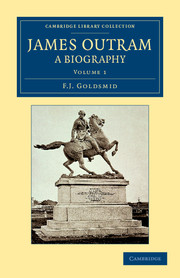
James Outram (1803–63) was a British East India Company Army officer who became a national hero after his successful campaign at Lucknow during the Indian Rebellion of 1857. Outram, who was called the 'Bayard of India' for his military exploits, had spent most of his career in India and Afghanistan, where he was involved in numerous armed conflicts. He also worked as a political agent and had much success negotiating on behalf of the British with the Princely States. This two-volume biography of Outram, published in 1880, was written by Frederic John Goldsmid (1818–1908), a British Army officer and civil servant who also spent much of his career in India, and was involved in overseeing the construction of an Indo-European telegraph line before writing about Outram. Volume 1 covers Outram's childhood and his early years in the army in India, up to 1845.
Lady Isabel Burton (1831–96) was a distinguished nineteenth-century traveller, writer and critic. She and her husband Richard explored the Middle East, India, Africa and South America extensively during his diplomatic placements and for their own pleasure. Individually and collaboratively they produced several exquisitely detailed travelogues, recording custom, culture, politics and geography. This account of their travels, first published in 1879, details the Burtons' leisurely route to India through Europe before crossing the Mediterranean and continuing south through Egypt and the Arabian Peninsula. This skilful and humorous narrative brings the places and people to life through personal anecdotes, observations and colourful description. Burton's political and historical comments on the lands she travels through are reasoned, well-researched and afford valuable insight into public opinion and world affairs at this time.
William Robertson (1721–93), Principal of the University of Edinburgh and historiographer to His Majesty for Scotland, published this work in 1791. Already famous for a History of Scotland, which went into many editions, and a History of America, Robertson aimed to synthesise all earlier western accounts of the subcontinent from classical times to the sixteenth century. Beginning with a consideration of the practical difficulties facing explorers from Europe and Africa who headed east, Robertson discusses the (legendary) Pharaoh Sesostris of Egypt, Alexander the Great, and Roman military incursions into, and trade with, India, before turning to the Portuguese, Spanish, French and English explorers of the early modern period, furnishing his account with copious source notes. A long appendix then describes 'the genius, the manners, and institutions of the people of India, as far as they can be traced from the earliest ages to which our knowledge of them extends'.