To save content items to your account,
please confirm that you agree to abide by our usage policies.
If this is the first time you use this feature, you will be asked to authorise Cambridge Core to connect with your account.
Find out more about saving content to .
To save content items to your Kindle, first ensure no-reply@cambridge.org
is added to your Approved Personal Document E-mail List under your Personal Document Settings
on the Manage Your Content and Devices page of your Amazon account. Then enter the ‘name’ part
of your Kindle email address below.
Find out more about saving to your Kindle.
Note you can select to save to either the @free.kindle.com or @kindle.com variations.
‘@free.kindle.com’ emails are free but can only be saved to your device when it is connected to wi-fi.
‘@kindle.com’ emails can be delivered even when you are not connected to wi-fi, but note that service fees apply.
The labor organization experience among India's informal workers since the 1980s challenges the existing labor literature, which asserts that informal workers cannot organize without an established employer, a single workplace, or a legal employment contract. Indeed, Indian informal workers have been organizing into unions and nongovernmental organizations (NGOs) since the 1970s and 80s. Of the seven organizations examined in this study, six are membership-based trade unions registered under the Trade Union Act (1926) and one is a NGO registered under the Trust and Societies Act. Whereas the construction organizations are independent of political parties, the bidi unions are affiliated with left-wing political parties. Although informal workers’ unions are structured like formal workers’ unions, their strategies differ from those of formal workers.
Drawing from both sets of interviews, I address my first set of research questions in this chapter. How does the informal nature of production affect workers’ collective action strategies? From where do they draw their structural power? Do their strategies vary across industry or state? I argue that to accommodate their dispersed and insecure employment circumstances, informal workers have made three key changes to formal workers’ struggles. These changes are consistent across industries and states, and they are significant to our understanding of workers’ democratic participation in the current liberalization era. Moreover, they challenge conceptualizations of informal workers as delinked from the state (see also Agarwala 2006, 2008).
In sharp contrast to the informal workers’ movements in Tamil Nadu analyzed in Chapter 3, those in West Bengal have not succeeded in attaining material benefits from the state. Only one-third of the sixty informal workers interviewed in West Bengal from 2002 to 2004 received any type of material benefit (either work or welfare related) as a result of joining a union (as opposed to thirty of the forty interviewees in Tamil Nadu and more than half of the forty interviewees in Maharashtra). In addition, the type of benefit received in West Bengal differed from those received in Tamil Nadu and Maharashtra. Of the twenty-one interviewees who received a benefit in West Bengal, nearly all received work-based benefits, as opposed to welfare benefits. These benefits were largely confined to members of the politically affiliated construction union. Moreover, the benefits (whether work or welfare related) received by workers in West Bengal were provided by unions, not by the state. Politicians in West Bengal have rarely been directly involved in improving the livelihoods of the state's informal workers. That benefits received in West Bengal were not consistent across organization type or industry and were largely confined to work-based benefits provided by a union indicates that the “new” informal workers’ movement outlined in Chapter 2 was less successful. By 2004, informal workers in West Bengal had failed to create a movement that could withstand the pressures of flexible production structures and simultaneously assure some justice to poor workers.
This finding is surprising given West Bengal's history of revolutionary, class-based politics that, as detailed later, began in the early nineteenth century. From 1977 to 2011, West Bengal was ruled by the Communist Party of India-Marxist (CPM). CPM won consecutive elections based on a promise of guaranteeing benefits for workers. Yet, informal workers have rarely been a CPM priority. Drawing from the state framework outlined in the Introduction, in this chapter I examine the evidence for the “low-success” case of West Bengal, arguing that CPM's unchallenged leadership, its entrenched organizational structure and social base, and its lack of interest in liberalization reforms (until recently) made it difficult for unions in West Bengal to frame informal workers’ demands in terms that appealed to CPM's interest in retaining power.
This Appendix provides background information for my calculations of the size and characteristics of the informal workforce using the 1999 National Sample Survey on Employment and Unemployment (NSS) (NSSO 2001a). For a more detailed discussion of this issue, see Agarwala (2009). Perhaps the largest obstacle to work on the informal economy to date has been the lack of consensus on how to define, and thus count, informal workers. Recent studies have begun to establish definitions that are becoming consistent, at least within India.
Since the early 1970s, scholars have used a diverse range of methodologies to capture the informal workforce. When Keith Hart first coined the term “the informal sector,” there was little agreement about the concept, much less the methodology used to measure it. Almost no national-level data sets collected information on informal workers. As a result, scholars offered different, sometimes even conflicting, conclusions about the causes and effects of informal work.
For decades, workers in rich and poor countries organized around a model that forced the state to hold employers responsible for ensuring their security and basic needs. In return, workers promised to provide their labor without strife. Although nations varied in the degree of protection promised and provided to workers, the ideal contract remained consistent across nations, and workers enjoyed, at the very least, an ideological and material claim to livelihood rights. Since the 1980s, however, the normative roles of the state and of workers have changed, and the conventional contract between them has begun to sever as a result. State governments are increasingly portraying informal, unprotected workers as the ideal worker, even though they operate outside state regulation. Multilateral institutions and public media are tagging governments that retreat from their welfare functions as modern and efficient. Perhaps most striking for students of development, the percentage of people living in perpetual insecurity – with no guaranteed benefits from either an employer or a state – is increasing.
At the source of these trends lies a new economic and political model of development that is proliferating throughout the world as countries liberalize their economies and integrate with one another. Under this model, states and firms pursue economic growth through competition in a global marketplace. To remain competitive, firms argue that they must reduce labor costs by hiring informal workers who, by definition, are not protected by state law. States are supporting firms in their decision to hire unprotected labor by initiating incentive programs that encourage formally protected workers to leave their jobs, creating free-trade zones where firms are not required to comply with labor laws, and contracting public-sector services to private-sector firms that can hire informally. As opportunities in the formal sector diminish, a growing proportion of household members are forced to engage in informal employment.
The state of Maharashtra provides our final case of how state factors affect the amount and type of benefits that informal workers attain. In this study, Maharashtra exemplifies a “middle success” case for the new informal workers’ movement outlined in Chapter 2. Like in West Bengal (examined in Chapter 4), informal workers in Maharashtra have had limited success in eliciting benefits from the state. The state's informal workers are forced the Maharashtrian government to show some interest in providing minimal levels of welfare. Twenty-three of the forty informal workers interviewed for this study received a material benefit in Maharashtra (as opposed to thirty of the forty in Tamil Nadu and only twenty-one of the sixty in West Bengal). In contrast to West Bengal, of the benefits informal workers attained in Maharashtra, nearly all were welfare benefits and relatively few were work-based benefits, indicating a greater focus on the new informal workers’ movement. Unlike Tamil Nadu (examined in Chapter 3), however, most of the welfare benefits were provided by the unions, rather than the state, indicating less success in institutionalizing the new movement into the state's political agenda.
Drawing from the state framework outlined in the Introduction, I argue in this chapter that informal workers’ limited success in attaining state-provided welfare benefits in Maharashtra can be attributed to the state's commitment to liberalization and its electoral context, which has been largely uncompetitive and never pro-poor. Maharashtra's political leadership encountered some competition in the 1990s, but all the competing parties have appealed to intermediate and elite caste members and been impervious to mass demands for social justice and equity. Informal workers, therefore, have not had ample opportunities to use their mass, plebian, or “poor” vote bank to attract politicians. Maharashtra's economic policies, however, have provided informal workers with a small window of political opportunity to attain welfare benefits. Since the early 1990s, Maharashtra's government has pursued liberalization policies (including deregulation and privatization) alongside an active, pro-business industrial policy that includes building export-promotion zones and reforming labor laws. These policies have undermined workers’ ability to pressure employers and have stifled some of the strongest workers’ struggles in India. At the same time, they have enabled the state's informal workers to attain some welfare benefits for their members by claiming to be a partner in the state's economic agenda.
“Listen sister, we are just poor folks who work to put bread in our stomachs. We can't do anything else. If we ask for more, we lose our jobs. If we lose our jobs, we will die,” explained Basama, an unskilled construction worker in Mumbai, India. Basama's statement reflects a sentiment of vulnerability often heard among poor, informal workers in India. Informal workers produce legal goods and services but engage in operations that are not legally registered. Therefore, unlike formal workers, informal workers are not officially recognized by their employers, and they are not regulated or protected by fiscal, health, and labor laws. Although some work at home or in unregistered subcontractors’ workshops, others operate openly on the employers’ site or in a public space (such as the street). As a result of receiving decreased protection, informal workers usually work in harsh conditions, with low levels of technology and capital, and no labor rights.
In most developing countries, informal labor – labor that is not formally protected – represents the majority of the labor force. In India, informal workers comprise 93 percent of the labor force or 82 percent of the nonagricultural labor force. This informal labor is central to contemporary economies. Informal workers construct buildings, build roads, grow and sell fruits and vegetables, clean homes and streets, sew clothes, weld car parts, and make shoes – not to mention the boxes they come in. Despite early predictions of its eventual demise, informal labor has remained entrenched in poor countries and has even shown signs of growing in rich countries. During the 1980s and 1990s, the world's informal labor force grew as economies expanded and global employment increased by 30 percent (ILO 2008). After the 2008 financial crisis shook the world, the need for low-cost, flexible informal labor was predicted to increase even more (Koba 2009). The undeniable fact is that unregulated, unprotected workers can no longer be viewed as marginal or temporary. Yet, despite their significance, informal workers continue to live in dire poverty and insecurity.
Asian Capitalism and the Regulation of Competition explores the implications of Asian forms of capitalism and their regulation of competition for the emerging global competition law regime. Expert contributors from a variety of backgrounds explore the topic through the lenses of formal law, soft law and transnational regulation, and make extensive comparisons with Euro-American and global models. Case studies include Japan, China and Vietnam, and thematic studies include examinations of competition law's relationship with other regulatory terrains such as public law, market culture, regulatory geography and transnational production networks.
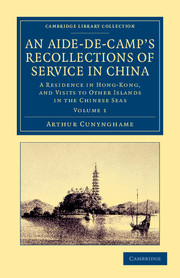
This two-volume work, published in 1844, is a memoir of time spent in China by Captain Arthur Cunynghame (1812–84), aide-de-camp to Major-General Lord Saltoun, Commander of the East India Company's troops in China. Cunynghame set off from Plymouth Sound on board HMS Belle-Isle in late 1841 to take up his post, and the first half of Volume 1 consists of a description of the long journey out to China (they touched at Rio de Janeiro before re-crossing the Atlantic to South Africa, and later visited Singapore and Hong Kong). Once in China, Cunynghame travelled widely in the course of his duties, and recorded his experiences in detail, from the wonders of the Yangtse River to the walls of Nankin: as he observes in his dedication, 'events and anecdotes occurring in a country that is so strange and new to all Europe may be worth recording'.
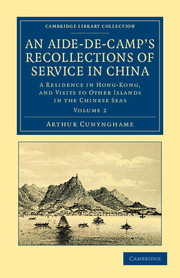
This two-volume work, published in 1844, is a memoir of time spent in China by Captain Arthur Cunynghame (1812–84), aide-de-camp to Major-General Lord Saltoun, Commander of the East India Company's troops in China. In Volume 2, the author is invited to visit Ning-po, recently given the status of a 'treaty port', and he subsequently travels to both Hong Kong and Canton (Guangzhou), both now open to international trade. Cunynghame next accompanied Saltoun to the Philippines, and gives a fascinating account of life in Manila. Ordered home in 1844, he travelled via Hong Kong and Malaya to Calcutta, then south to Madras (Chennai) and Ceylon (Sri Lanka), and eventually home to England, via the Red Sea, the Sinai Desert, Egypt and the Mediterranean, noting the curiosities among both people and places with undiminished zest.
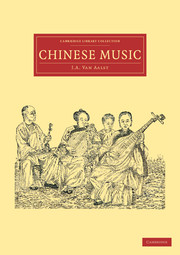
First published in 1884 by the Statistical Department of the Inspectorate General of Customs in Shanghai, this work is probably best known as a source of musical material for Puccini's opera Turandot. It was reprinted several times and remained the primary source in a Western language of detailed information on Chinese music until the mid-twentieth century. Van Aalst, born in Belgium in 1858, spent his working life with the Imperial Maritime Customs Service where his ability as a musician was noticed by the Inspector General, Robert Hart. It is thought likely that the work was published to coincide with the London Health Exhibition of 1884 in South Kensington to which Van Aalst had been sent to lecture. Different types of music (ritual and popular), the range of instruments, and musical notation are all explained, the intention being to enable a better understanding of Chinese music by those in the West.
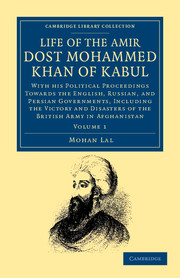
With his Political Proceedings towards the English, Russian, and Persian Governments, Including the Victory and Disasters of the British Army in Afghanistan
In this two-volume biography of 1846, Indian diplomat and author Mohan Lal (1812–77) describes the life of Amir Dost Mohammed Khan (1793–1863), the ruler of Afghanistan. The work also includes an eye-witness account of the disastrous First Anglo-Afghan War. Lal, who was attached to the British mission to Kabul, had prepared an account in English and Persian which was lost during the chaos of the war, but he later put the story together again. In his Preface, Lal apologises to the reader for his abundant errors both in grammar and idiom and explains that anecdotes about the Amir's adventures and morals were generally communicated to him second-hand. However, the book, which contains illustrations and draws personal correspondence, is a fascinating account of the ruler himself and of his political dealings with the English, Russian and Persian governments at the time of the 'Great Game' in Central Asia.
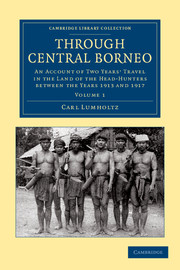
The Norwegian explorer and ethnographer Carl Lumholtz (1851–1922) wrote the influential ethnographic studies Among Cannibals and Unknown Mexico (both reissued in this series) after his journeys through Australia and Mexico respectively. In 1913, Lumholtz went on his final expedition, which aimed to explore the large parts of Borneo unknown to the rest of the world. Interested by tales of head-hunting, he wanted to spend time with the indigenous people and conduct research. Originally published in 1920, this two-volume work is Lumholtz's account of his expedition. Many of the illustrations in the work are from photographs taken by the author, including pictures of members of the different tribes he stayed with. Volume 1 begins with an overview of Borneo and goes on to describe the expedition's journey into the jungle, and the various ceremonies experienced during the journey, which provide interesting insights into tribal life and belief systems.
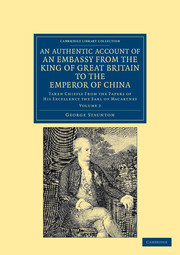
George Leonard Staunton (1737–1801) arrived in China in 1792 as a member of a British delegation whose objective was to improve trade and establish better diplomatic relations with the Chinese, who, at the time, restricted economic activity with foreigners to the port of Canton (Guangzhou). Although the group managed to secure an audience with the Qianlong Emperor - to whom the British envoy Lord Macartney famously refused to kowtow - their mission failed. Staunton kept detailed notes throughout his time in China, and in 1797 this two-volume account of the visit was published, and later translated into French and German. Volume 2 describes in detail the Emperor's reception of the British delegation - including a description and discussion of the kowtowing incident - thus giving a rare glimpse into the Imperial court at a time when Westerners were almost never allowed access. Staunton also provides further descriptions of the delegation's travels around China.
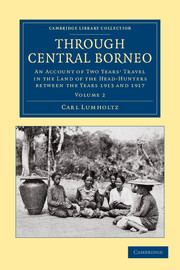
The Norwegian explorer and ethnographer Carl Lumholtz (1851–1922) wrote the influential ethnographic studies Among Cannibals and Unknown Mexico (both reissued in this series) after his journeys through Australia and Mexico respectively. In 1913, Lumholtz went on his final expedition, which aimed to explore the large parts of Borneo unknown to the rest of the world. Interested by tales of head-hunting, he wanted to spend time with the indigenous people and conduct research. Originally published in 1920, this two-volume work is Lumholtz's account of his expedition. Many of the illustrations in the work are from photographs taken by the author, including pictures of members of the different tribes he stayed with. Volume 2 begins with the expedition's stay with the Penihing people. Throughout the volume, the folklore of the different tribes is discussed, and a chapter on head-hunting and its purposes is included.