To save content items to your account,
please confirm that you agree to abide by our usage policies.
If this is the first time you use this feature, you will be asked to authorise Cambridge Core to connect with your account.
Find out more about saving content to .
To save content items to your Kindle, first ensure no-reply@cambridge.org
is added to your Approved Personal Document E-mail List under your Personal Document Settings
on the Manage Your Content and Devices page of your Amazon account. Then enter the ‘name’ part
of your Kindle email address below.
Find out more about saving to your Kindle.
Note you can select to save to either the @free.kindle.com or @kindle.com variations.
‘@free.kindle.com’ emails are free but can only be saved to your device when it is connected to wi-fi.
‘@kindle.com’ emails can be delivered even when you are not connected to wi-fi, but note that service fees apply.
Previous chapters of this book have demonstrated that, through a combination of religious change, new communication technologies, institutional networks and a plethora of anjuman-based activity in the urban public sphere, many Shi‘a began to see themselves as adherents of a free-standing Shi‘a religion, and members of a de facto community attached to it. This chapter further elaborates upon the significance of these changes, by examining the development of a distinctive Shi‘a politics in colonial India. Little significant work on the politicization of the Shi‘a in colonial India has been published; by contrast, a far greater emphasis has been placed upon the consolidation of the generic category of the Muslim as a basis of political mobilization. This chapter instead argues that, while a number of Shi‘a were heavily involved in a wider Muslim politics, both in Lucknow itself and in India more broadly, many Shi‘a organized independently and differed substantively on major political questions affecting Muslim and other communities. Implicit in this description of Shi‘a political mobilization is a corrective to long-standing assumptions about Muslim political organization in colonial India. Rather than assessing the respective evocations of Muslim and Shi‘a community as coextensive entities to which the individual could relate in different contexts, it argues that Shi‘a and Sunni political identities were increasingly construed as alternative – and even adversarial – forms of political affiliation, adding a political and very contemporary dimension to the experience of sectarianism in colonial India.
This chapter first offers some comparative reflections on the role of Muslim minorities in politics in the colonial world. It then discusses, in turn, Indian Shi‘a responses to the Aligarh Movement, the application of a rhetoric of jihad, and pan-Islamic mobilization. The focus of this chapter is on a period that has long been identified as a determining moment in the development of Muslim separatism, beginning with the consolidation of the Aligarh Movement in the 1870s–80s, and ending with the collapse of the Khilafat Movement in 1924.
This section offers brief biographical synopses of a number of the most prominent ‘ulama discussed in this book; they are just a select few among the many influential and significant mujtahids and scholars active in north India around 1870–1940. Where appropriate they have been grouped by household (khandan-wada), the wider idea of family relational groups bonded by biradari links and endogamy.
The Kintori ‘ulama
Descendants of the Seventh , Moussa, the sayyids who settled in the qasba of Kintor, Barabanki district, around the thirteenth century were of Nishapuri origin. Many of them matured as ‘ulama, and were settled on nazrana land grants in Barabanki and Bahraich districts of Awadh, which they largely retained into the colonial period. Kintor produced a number of related and exemplary scholars from the eighteenth century onwards; alongside those named here, this biradari included Sayyid Ahmad Moussawi Hindi, the paternal grandfather of Ruhollah Khomeini, who emigrated from India to Iran in the 1830s.
The late nineteenth and early twentieth centuries were, paralleling simultaneous developments within other Muslim communities, a period of major transformation within Indian Shi‘ism. This chapter, the first of two to interrogate the aforementioned ‘fresh religious life’ within Shi‘ism, explores several aspects of Shi‘a clerical and lay religious expansion. Early sections examine the bureaucratization of religious learning through the expansion of madrasa education, and the reworking of the public role of the senior ‘ulama. Later sections turn away from this focus on the ‘formal’ clerical milieu towards the powerful, and often more diffuse, efforts at lay propagation in the early twentieth century, looking at engagement with printing technology and the language of religious proselytization (tabligh). Throughout, the chapter stresses how Shi‘ism, previously identified with an amorphous blend of sayyid cultural norms, doctrinal orientations and religious observances, was gradually articulated as something approximating a reconceptualized religion, one of objective relevance to a broad constituency of followers (mominin) as well as its sayyid spokesmen and public leaders. Later sections turn towards another facet of this expansion of religious knowledge, namely the growth of inner-Islamic religious polemic (munazara). The chapter thus interrogates the question of why the processes of religious proselytization (tabligh) and disputation (ikhtilafat) within Shi‘ism were apparently so functionally intertwined as to be often indistinguishable.
The formation of shi‘a madrasas in colonial India
As has been described in much scholarship, the late nineteenth century witnessed the foundation of numerous madrasas across the United Provinces, whether the dar-ul-‘ulum at Deoband (1867) and the various seminaries created across north India in its image; the Nadwa’t ul-‘Ulama (established as a madrasa in 1898) as well as equivalent ‘Barelwi’ schools such as Misbah ul-‘Ulum (Mubarakpur, 1898) and Manzar-i-Islam (Bareilly, 1904). Some literature on these Sunni religious schools in India has interpreted them as linking India into transnational patterns of Arabic learning, and facilitating communication between Indian ‘ulama and global scholarly networks. Other studies have emphasized instead the impact of these madrasas within the Indian subcontinent itself, describing their creation of an indigenous clergy and their contributions to processes of Islamic renewal (tajdid) within a South Asian framework. Less frequently remarked upon is the foundation of a striking number of Shi‘a madrasas, especially in Lucknow, from 1889 onwards. These schools show a similarly multi-faceted impact, at once connecting the Indian Shi‘a with scholarly traditions observed in the wider world, but also creating a much enlarged body of Indian ‘ulama and the educational infrastructure for sustaining it on Indian soil. Emerging Shi‘a seminaries bore comparison with their Sunni counterparts in important ways: the formation of a recognized and ordered nisab (curriculum), the dispensation of agreed and distinguished qualifications of learning, and the dissemination of education across the ties of kinship and locality.
The field of Chinese internet studies is rich and diverse. Just this past year, exciting new books have been published on internet use among urban youth (Liu 2011), online videos (Voci 2010), online carnival (Herold and Marolt 2011), new media events (Qiu and Chan 2011), and cyber-nationalists (Shen and Breslin 2010).
Colonial transformation of the relations of production contextualized the cultural articulation of a new set of values, prejudices, and tastes for the Bengali Hindu middle class. These cultural values, together with the political and economic conditions of colonialism, formed the habitus of this class. This paper tries to understand this self-fashioning by the middle class through their construction of a ‘Bengali’ cuisine. A distinct enthusiasm for new gastronomic possibilities defined this cuisine, and yet, at the same time, it possessed important elements of continuity from pre-colonial times, evidenced especially in the reinstitution of caste-based norms of gastronomy. The resultant cuisine was cosmopolitan yet still Bengali.
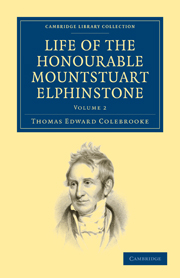
Mountstuart Elphinstone (1779–1859) was appointed through family influence to the East India Company, and arrived in India in 1796. He learnt Persian, and developed an interest in Indian literature and politics. After postings in Afghanistan and Poona he became Governor in 1819 of the recently acquired territory that became known as the Bombay Presidency. His biographer also had connections to India. Thomas Edward Colebrooke (1813–1890) was the son of British administrator and Sanskrit scholar Henry Thomas Colebrooke (1765–1837), and although he lived in England and served as an M. P., Colebrooke remained interested in colonial affairs. He had written about Elphinstone's life in 1861 for the Journal of the Royal Asiatic Society and subsequently expanded his work into these two volumes, published in 1884. Volume 2 covers his years in Poona and Bombay, and his eventual return to England.
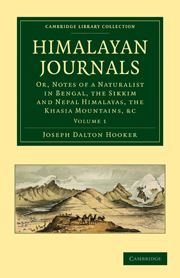
Sir Joseph Hooker (1817–1911) was one of the greatest British botanists and explorers of the nineteenth century. He succeeded his father, Sir William Jackson Hooker, as Director of the Royal Botanic Gardens, Kew, and was a close friend and supporter of Charles Darwin. His journey to the Himalayas and India was undertaken between 1847 and 1851 to collect plants for Kew, and his account, published in 1854, was dedicated to Darwin. Hooker collected some 7,000 species in India and Nepal, and carried out surveys and made maps which proved of economic and military importance to the British. He was arrested by the Rajah of Sikkim, but the British authorities secured his release by threatening to invade, and annexing part of the small kingdom. Volume 1 begins at his arrival in Calcutta, and follows his travels northward to Sikkim and Nepal via Bangalore and Darjeeling, and then on to Tibet.
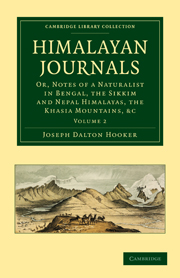
Sir Joseph Hooker (1817–1911) was one of the greatest British botanists and explorers of the nineteenth century. He succeeded his father, Sir William Jackson Hooker, as Director of the Royal Botanic Gardens, Kew, and was a close friend and supporter of Charles Darwin. His journey to the Himalayas and India was undertaken between 1847 and 1851 to collect plants for Kew, and his account, published in 1854, was dedicated to Darwin. Hooker collected some 7,000 species in India and Nepal, and carried out surveys and made maps which proved of economic and military importance to the British. He was arrested by the Rajah of Sikkim, but the British authorities secured his release by threatening to invade, and annexing part of the small kingdom. Volume 2 continues Hooker's description of Nepal and Sikkim (including his brief imprisonment) and his return to Calcutta to begin his journey back to Great Britain.
Richard, Marquess Wellesley (1760–1842) became one of the most controversial politicians of his generation during his time as Governor-General of Bengal (1798–1805). Although this period saw him achieve territorial gains and military victories in India - including the defeat of Tipu Sultan, the ruler of Mysore - the financial cost was considered too high. The East India Company Court of Directors in London disagreed with many of the changes he made, and Wellesley was forced to return to England. This five volume collection of papers, edited by the political activist and historian Robert Montgomery Martin (1800–1868), was published in 1836–1837 and documents Wellesley's period of office in India. Volume 3 covers the period 1802–1804, and focuses on Wellesley's turbulent relationship with the Court of Directors, to whom he had tendered his resignation, though he did not leave. It also refers to the ongoing conflict with the Maratha Empire.
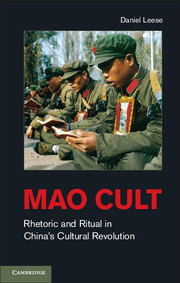
Although many books have explored Mao's posthumous legacy, none has scrutinized the massive worship that was fostered around him during the Cultural Revolution. This book is the first to do so. By analyzing secret archival documents, Daniel Leese traces the history of the cult within the Communist Party and at the grassroots level. The party leadership's original intention was to develop a prominent brand symbol, which would compete with the nationalists' elevation of Chiang Kai-shek. However, they did not anticipate that Mao would use this symbolic power to mobilize Chinese youth to rebel against party bureaucracy itself. The result was anarchy and when the army was called in it relied on mandatory rituals of worship such as daily reading of the Little Red Book to restore order. Such fascinating detail sheds light not only on the personality cult of Mao, but also on hero-worship in other traditions.
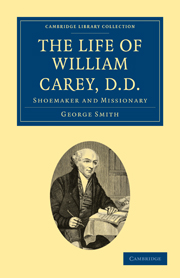
George Smith (1833–1919) published this biography in 1885. Carey (1761–1834), a key figure in the nineteenth-century Protestant missionary movement and founding member of the Baptist Missionary Society, lived and worked as a missionary in India from 1793 till his death 41 years later. The biography is based on Carey's unpublished letters, personal papers, missionary records and the recollections of Carey's friends and colleagues in India. It focuses on Carey's educational work; his involvement in India's agriculture; the mission centres he established throughout India; and his translations of the Bible into Sanskrit, Bengali and many other Indian languages. Smith, a popular Victorian biographer and an expert on India and missionary activity there, paints a vibrant picture of Carey and his extraordinary life. The biography remains a key source for the nineteenth-century Protestant mission movement and for the work of one of its key figures.
The book analyses the strategic rationale of the American security commitment to South Korea in the light of the palpable failure of containment strategy in Indo-China. During the 1970s the dilemma confronting successive American administrations was that, whilst wishing to maintain their old commitment to South Korea, they had no desire to preside over another Vietnam. Military commitment and political support were necessarily disengaged, and the Nixon doctrine served as both the end and the means of containment strategy in Asia. The study identifies the principal conditions that have influenced changing American perspectives on South Korea, and examines some of the general problems of collective security in the region. Unique in the direct engagement of China, the Soviet Union and the United States, the security position of South Korea bears directly upon the achievement of peace and stability throughout East Asia.
The Jains have exerted an influence on Indian Society and religion out of proportion with their relatively small numbers. The Assembly of Listeners: Jains in Society addresses the sociology of the Jains and discusses the notion of the 'community' based on religious affiliation in India. Topics covered include Jain ideals and identity; women in the Jains community; popular Jainism; Jain reform and Jain identity in the UK. This collection is an important theoretical addition to the study of Indian society, which has previously focused mainly on caste and class politics as the fundamental social units. With much recent fieldwork providing unique information on the ethnography of the Jains, this study will prove indispensable to any scholar interested in this little-known but highly influential social group.
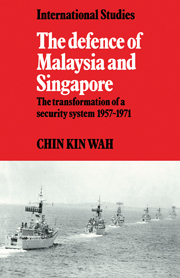
This book was first published in 1983: for fourteen years since Malaya's independence in 1957, the external defence of the Malayan (later Malaysian) - Singapore region was provided for within the legal framework of the Anglo-Malaysian Defence Agreement. The external powers involved were Britain, Australia and New Zealand. Kin Wah Chin provides a study of the defence of the region from the perspective of evolving intra-alliance relations within a unique defence system which embraced an anchor power, two associates and two recipients of alliance security.
Reginald Heber (1783–1826) was appointed as the second Anglican Bishop of Calcutta in 1823, having previously been connected with both the Church Missionary Society and the Society for the Promotion of Christian Knowledge. At the time, the diocese of Calcutta covered all of India, and also southern Africa and Australia, and his short episcopate involved much travelling around his scattered flock. Heber's account of his travels in India and Sri Lanka was published by his widow Amelia in 1828, and expanded to three volumes in this third edition of 1828–1829, which provides a valuable description of the culture of India in the 1820s. Heber wrote positively about the moral character of Hindus, and identified faults as well as strengths in British rule in India. Volume 2 describes his travels from Cawnpore through Delhi, Agra and Jaipur to Baroda in north-west India, and includes much detail about Indian customs.
Reginald Heber (1783–1826) was appointed as the second Anglican Bishop of Calcutta in 1823, having previously been connected with both the Church Missionary Society and the Society for the Promotion of Christian Knowledge. At the time, the diocese of Calcutta covered all of India, and also southern Africa and Australia, and his short episcopate involved much travelling around his scattered flock. Heber's account of his travels in India and Sri Lanka was published by his widow Amelia in 1828, and expanded to three volumes in this third edition of 1828–1829, which provides a valuable description of the culture of India in the 1820s. Heber wrote positively about the moral character of Hindus, and identified faults as well as strengths in British rule in India. Volume 3 covers his stay in Sri Lanka and his visit to southern India where he died, and includes a selection of his letters.
One of the many famous 'administrator-historians' of India, James Grant Duff (1789–1858), Captain of the First Regiment of Bombay Native Infantry, first arrived in India as a cadet at the age of sixteen. Quickly mastering the Marathi, Urdu, and Persian languages, Duff became well known for his ability to cut through the cultural divide, and was regarded as a valuable resource for the East India Company's expansion of trade. His wide-ranging network of connections enabled him to obtain unrestricted access to state papers, documents and temple archives. Consequently, Duff's history is comprehensive and thorough; it served as the best history of its kind for decades. More specific than the first, this second volume covers the years 1740 to 1785, focusing on the increasing influence of Europeans, and the political relations between governors of different states and between the native population and the English.
One of the many famous 'administrator-historians' of India, James Grant Duff (1789–1858), Captain of the First Regiment of Bombay Native Infantry, first arrived in India as a cadet at the age of sixteen. Quickly mastering the Marathi, Urdu, and Persian languages, Duff became well known for his ability to cut through the cultural divide, and was regarded as a valuable resource for the East India Company's expansion of trade. His wide-ranging network of connections enabled him to obtain unrestricted access to state papers, documents and temple archives. Consequently, Duff's history is comprehensive and thorough; it served as the best history of its kind for decades. This third and final volume covers the years 1784 to 1819, beginning with the dispute over Nurgood and ending with the final reduction and settlement of the Maratha territory.