To save content items to your account,
please confirm that you agree to abide by our usage policies.
If this is the first time you use this feature, you will be asked to authorise Cambridge Core to connect with your account.
Find out more about saving content to .
To save content items to your Kindle, first ensure no-reply@cambridge.org
is added to your Approved Personal Document E-mail List under your Personal Document Settings
on the Manage Your Content and Devices page of your Amazon account. Then enter the ‘name’ part
of your Kindle email address below.
Find out more about saving to your Kindle.
Note you can select to save to either the @free.kindle.com or @kindle.com variations.
‘@free.kindle.com’ emails are free but can only be saved to your device when it is connected to wi-fi.
‘@kindle.com’ emails can be delivered even when you are not connected to wi-fi, but note that service fees apply.
One of the many famous 'administrator-historians' of India, James Grant Duff (1789–1858), Captain of the First Regiment of Bombay Native Infantry, first arrived in India as a cadet at the age of sixteen. Quickly mastering the Marathi, Urdu, and Persian languages, Duff became well known for his ability to cut through the cultural divide, and was regarded as a valuable resource for the East India Company's expansion of trade. His wide-ranging network of connections enabled him to obtain unrestricted access to state papers, documents and temple archives. Consequently, Duff's history is comprehensive and thorough; it served as the best history of its kind for decades. This third and final volume covers the years 1784 to 1819, beginning with the dispute over Nurgood and ending with the final reduction and settlement of the Maratha territory.
One of the many famous 'administrator-historians' of India, James Grant Duff (1789–1858), Captain of the First Regiment of Bombay Native Infantry, first arrived in India as a cadet at the age of sixteen. Quickly mastering the Marathi, Urdu, and Persian languages, Duff became well known for his ability to cut through the cultural divide, and was regarded as a valuable resource for the East India Company's expansion of trade. His wide-ranging network of connections enabled him to obtain unrestricted access to state papers, documents and temple archives. Consequently, Duff's history is comprehensive and thorough; it served as the best history of its kind for decades. This first volume includes preliminary observations on geography, climate, people, religion, and early history of the Maratha country. Its fourteen chapters detail the general history from 1000 CE to 1740, starting with the Islamic conquest of the Deccan.
The geologist Richard Dixon Oldham (1858–1936) published the second edition of Geology of India in 1892 for the Geological Survey of India. The work is a thoroughgoing revision of the first edition of the same manual compiled by H. M. Medlicott (1829–1905) and W. T. Blanford (1832–1905), published in 1879. It contains one of the earliest and most important geological surveys of India. Owing to an increase in available data since the first edition, descriptions of the rock formations of the country are arranged chronologically. This edition is particularly important for the data on, and discussion of, the age and origins of the Himalayas. It includes other chapters on metamorphic and crystalline rocks, fossils, vegetation, volcanic regions, geological history, and rock formation. It is a key work of nineteenth-century geology which remains relevant for geologists studying the subcontinent today.
This six-volume History of the Indian Mutiny was first produced in 1890 by Colonel George Malleson (1825–1898), who combined Sir John Kaye's History of the Sepoy War in India with his own later work. Kaye (1814–1876) was a prolific writer of biography and history who started the Calcutta Review in 1844. His use of evidence collected from personal and professional contacts supports (perhaps predictably) his assertion that the rebellion is a story of British 'national character', and the narrative is illustrated with biographical and personal anecdotes. Malleson's contributions however are derived from his controversial 'Red Pamphlet' (1857) and other writings, in which he is unafraid to criticise or praise British troops and administration as the occasion demands. Volume 6 examines the non-military aspects of the Mutiny, and the response of Anglo-Indian civilians to the revolt and to its aftermath. It also contains a comprehensive index.
James Kerr, a captain in the East India Company, translated this Persian text on the history of the Marathas in India. Published in 1782, it was one of the first English works to appear on the subject. Its content was compiled for Kerr by a Hindustani using Persian manuscripts and oral tradition. The Marathas had replaced the Mughal emperors as controllers of a large part of the sub-continent by the beginning of the eighteenth century, and it was inevitable that they would come into conflict with the East India Company. At the time of publication, the first of the three Anglo–Maratha wars had just ended, and interest in Indian affairs was great. Kerr denies any claim to be a historian, or to offer an analysis of his sources. The narrative outlines the growth of Maratha power from the seventeenth century, and concludes with a glossary of Indian terms.
Alicia Little (1845–1926) was a prolific writer who moved to China after her marriage to missionary Archibald Little (1838–1907) in 1866. She published many accounts of Chinese culture and society before founding the successful campaign against foot-binding in 1895. This volume, first published in 1903, contains her biography of the eminent Chinese statesman Li Hung–Chang (1823–1901). Li was a towering figure in late nineteenth century Chinese political life, exerting a profound influence over Chinese foreign policy and relations and overseeing China's development of western style industrialism until his dramatic fall from power following China's defeat in the 1894 Sino-Japanese War. Using contemporary newspaper accounts, eyewitness descriptions, and interviews with his contemporaries, Little describes Li's life chronologically, describing his rise to prominence following the Taiping Rebellion in 1851. This volume was the first extensive account of Li's life to be published in English.
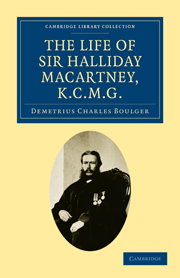
Commander of Li Hung Chang's Trained Force in the Taeping Rebellion, Founder of the First Chinese Arsenals, for Thirty Years Councillor and Secretary to the Chinese Legation in London
Demetrius C. Boulger (1853–1928) published several works on Asia, including this 1908 biography of Sir Halliday Macartney (1833–1906), a military doctor turned diplomat. Boulger describes how, interrupting his studies, Macartney served as a medical volunteer with the Anglo-Turkish contingent in the Crimea. After completing his medical degree Macartney joined the army and travelled to India and China. In the early 1860s he took an active part in crushing the Taiping Rebellion under the leadership of the young General (then Captain) Gordon, joined the Chinese Service, and was swiftly promoted. Macartney founded the first ever arsenal in China at Nanking and was its director for ten years. He transferred to the diplomatic service, and for over thirty years was a lead negotiator in Anglo-Chinese affairs. He also organised the diplomatic representation of China at various European courts and became a Counsellor to the Chinese Embassy in London.
Emma Roberts' 1835 work, compiled from articles she published in the Asiatic Journal, was well received in India and England. Roberts lived in India from 1828 with her sister and her brother-in-law who served in the 61st Bengal infantry. In 1830 she moved to Calcutta, where she edited and wrote for the Oriental Observer and contributed to periodicals and annuals. Returning to London in 1832, she threw herself into the literary world, publishing in several different fields. This book reveals Roberts' sympathetic attitude to the Indian people and her genuine interest in providing a thorough and honest report of their culture. Volume 3 covers topics including the position of women, shopping, gardening, manners, education, missionaries, politics, Anglo-Indian relations and the military establishment, as well as expanding on subjects discussed in the earlier volumes. For more information on this author, see http://orlando.cambridge.org/public/svPeople?person_id=robeem
First published in 1876, this volume contains first-hand accounts of the first voyages to Tibet by British diplomat George Bogle (1747–1781) and scholar Thomas Manning (1772–1840) in the eighteenth and early nineteenth centuries. In 1774 Bogle was appointed the leader of the first British diplomatic mission to the previously unknown country of Tibet in an attempt to establish friendly relations and open trade links between the two countries. Bogle spent six months wintering in various places in Tibet, exploring Tibetan culture and politics. Thomas Manning became the first English national to enter the city of Lhasa and to speak with the Dalai Lama in 1811. Edited by prolific writer and president of the Royal Geographical Society Sir Clements Markham (1830–1916), this fascinating volume also includes a detailed introduction providing the historical and geographic context of the voyages, together with biographies of the two adventurers.
This 1937 work is framed as a maritime history as distinct from an economic history, and was highly acclaimed on first publication. Parkinson's focus is the activities of the East India Company in India and the East Indies between 1793 and 1815. Although a scholarly work, firmly founded on primary sources, it presents a potentially dry subject in a vivid and lively way which is extremely readable. Rather than narrating the history of the East India Company, Parkinson provides a series of descriptions of how it operated, the goods it traded, and the experiences of employees or passengers who sailed east. He reminds the modern reader of how fundamental the prevailing winds were to the trade routes, and the great discomforts of long sea voyages. This is a fascinating story of the realities of British economic involvement in India and the Far East during a key period of consolidation.
The Book of Ser Marco Polo, the Venetian is a nineteenth-century edition of the famous travelogue written by Rustichello da Pisa and Marco Polo, describing the travels of the latter through Asia, Persia, China and Indonesia between 1271 and 1291. The book secured lasting fame for its editor, the prominent geographer and literary scholar Henry Yule, who was awarded the founder's medal of the Royal Geographical Society for his efforts. The two-volume work, the result of Yule's research in Palermo, Venice, Florence, Paris and London and of extensive correspondence with scholars around the world, has long been considered an authoritative source on Polo's travels. Volume II comprises Books Three and Four of the travelogue and contains descriptions of the coastal regions of Japan and India and the east coast of Africa. Book Four describes the wars among the Mongols and the regions of the far north, including Russia.
It was primarily through Buddhism that the Indian culture took its stronghold in China. This is the reason why in the history of Sino-Indian cultural relations, Hinduism occupies a negligible position. Most of the Indian scholars who went to China between the second century and the eleventh century of the Christian era were Buddhists. There is indeed mention of very few Hindu scholars who, in spite of being Hindus, worked extensively for the Chinese renderings of Sanskrit Buddhist scriptures as interpreters.
Nevertheless along with the dissemination of Buddhism among the Chinese people, an impact of Indian knowledge of science, astrology and medicine on them can be traced clearly. People were drawn to the study of Indian medicine enshrined in the Atharvaveda and Indian astrology. A few translations of the treatise on Indian medicine by the Chinese support this conjecture. Apart from these translations, it is interesting to note that there are references to Indian medicinal herbs in Chinese pharmacological books. There was a strong belief among the Chinese emperors that the Indian doctors knew about certain medicines which could enhance longevity of their apparently short mortal life. It was quite often that the Chinese emperors, with the hope to live longer, used to send their officials to India in search of Indian doctors.