To save content items to your account,
please confirm that you agree to abide by our usage policies.
If this is the first time you use this feature, you will be asked to authorise Cambridge Core to connect with your account.
Find out more about saving content to .
To save content items to your Kindle, first ensure no-reply@cambridge.org
is added to your Approved Personal Document E-mail List under your Personal Document Settings
on the Manage Your Content and Devices page of your Amazon account. Then enter the ‘name’ part
of your Kindle email address below.
Find out more about saving to your Kindle.
Note you can select to save to either the @free.kindle.com or @kindle.com variations.
‘@free.kindle.com’ emails are free but can only be saved to your device when it is connected to wi-fi.
‘@kindle.com’ emails can be delivered even when you are not connected to wi-fi, but note that service fees apply.
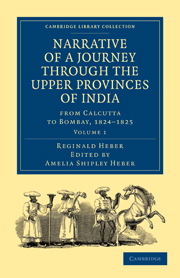
Reginald Heber (1783–1826) was appointed as the second Anglican Bishop of Calcutta in 1823, having previously been connected with both the Church Missionary Society and the Society for the Promotion of Christian Knowledge. At the time, the diocese of Calcutta covered all of India, and also southern Africa and Australia, and his short episcopate involved much travelling around his scattered flock. Heber's account of his travels in India and Sri Lanka was published by his widow Amelia in 1828, and expanded to three volumes in this third edition of 1828–1829, which provides a valuable description of the culture of India in the 1820s. Heber wrote positively about the moral character of Hindus, and identified faults as well as strengths in British rule in India. Volume 1 describes his voyage to India, his first impressions of Calcutta, and his journey from there to Allahabad.
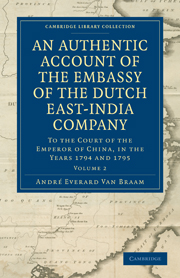
First published in French in Philadelphia in 1797 and translated into English for the London edition of 1798 reissued here, this travelogue by André Everard van Braam Houckgeest (1739–1801) was received with enthusiasm by readers hungry for exotic accounts of distant lands. It vividly describes a visit to the Chinese imperial court by a delegation from the Dutch East India Company soon after the British Macartney embassy, and delivers a rare glimpse of an unfamiliar landscape and culture. Fascinated by his experiences, van Braam records that he thought it 'far better to lose a few hours rest, than to let a single remarkable object escape me'. Volume 2 includes one of the last known Western descriptions of the spectacular Summer Palace, destroyed in 1860, and a detailed list of several hundred Chinese paintings and drawings that van Braam brought back and intended to donate to the French nation.
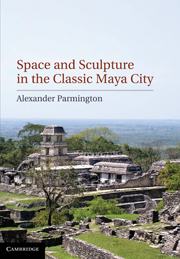
In this book, Alexander Parmington examines how images, texts and architectural form controlled and channelled movement of particular sets of people through various precincts in Classic Maya cities. Using Palenque as a case study, this book analyses specific building groups and corresponding sculptures to provide insight into the hierarchical distribution and use of ritual and administrative space in temple and palace architecture. Identifying which spaces were the most accessible and most public, and which spaces were segregated and highly private, Dr Parmington demonstrates how sculptural, iconographic and hieroglyphic content varies considerably when found in public/common or private/elite space. Drawing on specific examples from the Classic Maya and other early civilisations, he demonstrates that by examining the intent in the distribution of architecture and art, the variation and function of the artistic themes represented in sculpture and other monumental works of art can be better understood.
Raised in a politically-active household, Emily Eden's childhood prepared her well for her role as companion to her brother, the Governor-General of India. Outwardly all that a middle-class spinster should be, Eden never permitted diplomacy to dilute her letters home. Published in 1866, the letters provoked sympathy among women who had similarly endured dusty bonnets to accompany fathers and husbands to distant outposts of the British Empire. As one reviewer noted, this book is 'addressed primarily to a public consisting of wives, sisters, or daughters of possible Governors-General, and is sure therefore of general popularity'. There is still plenty to amuse modern audiences. Volume 1 takes readers from the packing of steamer trunks in London, through sea voyages and monsoons. Accounts of peacocks and pageants are balanced against ironic observations regarding domestic arrangements, all of which demonstrate Eden's skill as a sensitive and witty author.
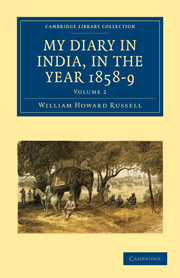
William Howard Russell was sent to India by The Times to report on the conflict of 1857–1859 known as the Indian Mutiny. His previous work was in the Crimean War and his exposés of conditions there led to the sending of Florence Nightingale and her nurses, improvements to supplies and conditions, and to the demand for military and administrative reform. It was largely because of his contributions that war correspondence emerged as a new branch of journalism. In his Indian diary, Russell criticises British snobbery as well as attitudes to and treatment of the Indians, and advocates leniency and conciliation. Volume 2 continues his experiences, recounting anecdotes of military and civilian life with sympathy for the native people, intermingled with an unswerving belief in the rightness of the British presence in India. His advocacy of non-military rule, however, made the work controversial in its time.
This is an evocative account, first published in 1883, of the final expedition to the East by Isabella Bird (1831–1904), who was one of the most famous Victorian female explorers, and the first woman to be admitted to the Royal Geographical Society. The Golden Chersonese is the ancient name for the Malay Peninsula, as named by the Greek geographer and astronomer Ptolemy. The book is a collection of twenty-three letters written by Bird to her ailing sister, Henny, in Scotland. Henny died as the book was published and Bird dedicates the book of letters to her memory. As well as giving detailed descriptions of her travels and adventures in and around Malaysia, the book also includes fascinating accounts of many aspects of the region, including the people, culture, landscapes and wildlife. It also contains a number of delightful illustrations and a thorough appendix.
Among Hills and Valleys in Western China, first published in 1901, is a detailed and accurate picture of missionary work undertaken by Miss Hannah Davies, who had made it her life's work to tour the Chinese provinces and preach her Christian belief, as well as encouraging local people to build places of worship and also helping those in poverty. Some of the sketches of life and character are extraordinarily descriptive and beautiful, and a remarkable journey is described in this series of letters and journal extracts. There is, amongst other stories, a fascinating account of an assembly addressed by Bishop Cassells, the first Protestant bishop in western China, and his heartfelt pleas to the people to help build a new church. The book is well illustrated, with an introduction by Isabella Bird (now Mrs J. F. Bishop), the nineteenth-century British missionary, travel writer and historian.
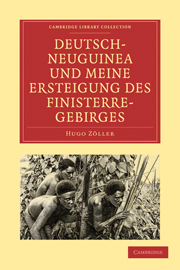
Eine Schilderung des ersten erfolgreichen Vordringens zu den hochgebirgen Inner-Neuguineas, der Natur des Landes, der Sitten der Eingeborenen und des gegenwaïrtigen Standes
Hugo Zöller (1852–1933) was a German journalist and explorer who travelled to South America, West Africa and New Guinea in the course of his exciting career. This book is an account, first published in 1891, of his expedition to New Guinea in 1888, during which he became the first European to explore the island's mountainous interior. He describes the German colonial settlements on the coast, the logistical preparations for his mission, the climate, geology, flora and fauna of the island, the indigenous peoples and their customs, the local languages, to which he devotes a substantial chapter, and the hardships and highlights of the journey. The appendix contains a timeline listing European activity around New Guinea from 1526 to 1891 and a glossary in tabular form listing 300 words in 45 indigenous languages. A bibliography and index are also included, and the book contains drawings, photographs and maps.
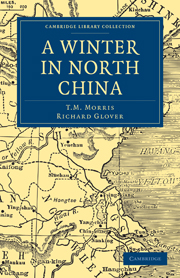
In the winter of 1890, the Reverend T. M. Morris and the Reverend Richard Glover spent five months journeying through the Shantung and Shansi provinces in north China. Commissioned by the Baptist Missionary Society to inspect the work of all missionaries in the area, the two clergymen travelled by boat, cart, wheelbarrow and 'other strange conveyances' in order to complete their mission. Published in 1892, this book compiles the letters sent home by Morris, originally appearing in The East Anglian Daily Times and the Freeman. Writing with notable Christian zeal, Morris ably describes the difficulties faced in such a journey, delighting at the people encountered and wondering at the awe-inspiring landscape. With a preface by Glover attesting to Morris' 'careful and shrewd' observational skills, and a map of the area covered in this remarkable journey, this book provides a novel insight into nineteenth-century China.
The publications of the Hakluyt Society (founded in 1846) made available edited (and sometimes translated) early accounts of exploration. The first series, which ran from 1847 to 1899, consists of 100 books containing published or previously unpublished works by authors from Christopher Columbus to Sir Francis Drake, and covering voyages to the New World, to China and Japan, to Russia and to Africa and India. François Leguat (1637–1735) was a French Huguenot who became the leader of a group of seven Huguenot refugees forced to colonise the island of Rodriguez in 1693, after the French claimed their intended destination, the Ile de Réunion. He remained on the island for two years, before escaping via the neighbouring island of Mauritius. Volume 2 describes his imprisonment on Mauritius and in Jakarta before his return to Europe via the Cape of Good Hope in 1698.
This work, published in 1864, is the 'popular edition' of John Clark Marshman's account of the missionaries William Carey, William Ward and Joshua Marshman (his father), originally published in 1859 in two volumes as The Life and Times of the Serampore Missionaries. It documents the lives of the three main Serampore Missionaries from their humble origins and conversions to the Baptist Church to their pioneering work in Western Bengal. This shorter edition nevertheless contains a wealth of detail on the administration and politics of colonial India, on the experiences of the missionaries and in particular their efforts in advancing education among the indigenous people. It covers the founding of schools and later the renowned Serampore College, the missionaries' Bible translations into various languages including Bengali (Bangla) and Chinese, and their efforts to promote literacy in indigenous languages. Ward's pioneering study of Hinduism is also reissued in this series.
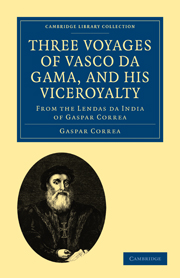
The publications of the Hakluyt Society (founded in 1846) made available edited (and sometimes translated) early accounts of exploration. The first series, which ran from 1847 to 1899, consists of 100 books containing published or previously unpublished works by authors from Christopher Columbus to Sir Francis Drake, and covering voyages to the New World, to China and Japan, to Russia and to Africa and India. Vasco de Gama (c. 1460–1524) was a Portuguese explorer who commanded the first European expedition to sail directly to India. He was later appointed Viceroy of Portuguese India in 1524. This volume, first published in 1869, contains an account of his expeditions written by the Portuguese historian Gaspar Correa (c. 1496–c. 1563), taken from his book Lendas da India. His work is an important contemporary history of Portuguese colonialism in India, using contemporary sources not available to later Portuguese historians.
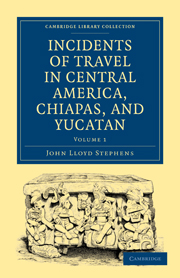
John Lloyd Stephens (1805–1852) was an American politician, explorer and writer who is renowned for his pioneering research into the ancient Maya civilisation of Central America. In 1839 Stephens was appointed a Special Ambassador to the Federal Republic of Central America (modern Belize, Honduras, Nicaragua, Guatemala and El Salvador). First published in 1841, this two-volume work is an account of his travels in 1839 and 1840, visiting and recording ancient Mayan sites. Stephens describes Copán, Palenque and forty-two other ancient sites and includes over fifty illustrations drawn by his travelling companion Frederick Catherwood (1799–1854), a professional architect. Although earlier accounts of Mayan ruins had been published, Stephens' vivid descriptions and Catherwood's meticulous drawings were far more detailed and accurate than previous reports, and kindled Victorian interest in the ancient Maya civilisation. Volume 1 focuses on Copán and the indigenous cultures of Central America.
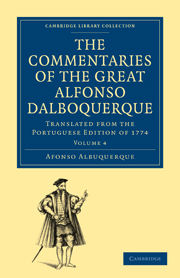
The publications of the Hakluyt Society (founded in 1846) made available edited (and sometimes translated) early accounts of exploration. The first series, which ran from 1847 to 1899, consists of 100 books containing published or previously unpublished works by authors from Christopher Columbus to Sir Francis Drake, and covering voyages to the New World, to China and Japan, to Russia and to Africa and India. Volumes 53, 55, 62 and 69 of the series contain the English translation of The Commentaries of the Great Afonso Dalboquerque, translated and edited by Walter de Grey Birch. Afonso de Albuquerque (1453–1515) was a Portuguese naval officer and nobleman whose successful military campaigns helped establish Portugal's colonies in India. Volume 4 contains a description of his unsuccessful siege of Aden in 1513, his capture of Ormuz in 1515 and his death later the same year.
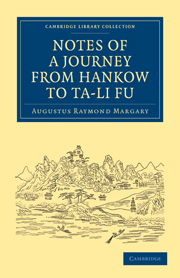
The journal of Augustus Raymond Margary's groundbreaking journey from Hankow in the Hubei province of central China, to Bhamo in Upper Burma was published in 1875, soon after his death. Margary was part of the Chinese consular service and had lived in China since 1867, working as an interpreter. This journal begins in August 1874 at the start of his journey, the purpose of which was to meet Colonel Horace Browne to act as his interpreter as he attempted to open an overland trade route between China and India. Margary was the first Englishman successfully to complete the 1,800 mile trip through Szechwan to Yunnan, doing so in six months. On the return trip, he and two servants made a diversion, hearing of danger on his proposed route, but were murdered in the town of Manwyne, leading to public outrage and commemorative publication of accounts of his life and travels.