To save content items to your account,
please confirm that you agree to abide by our usage policies.
If this is the first time you use this feature, you will be asked to authorise Cambridge Core to connect with your account.
Find out more about saving content to .
To save content items to your Kindle, first ensure no-reply@cambridge.org
is added to your Approved Personal Document E-mail List under your Personal Document Settings
on the Manage Your Content and Devices page of your Amazon account. Then enter the ‘name’ part
of your Kindle email address below.
Find out more about saving to your Kindle.
Note you can select to save to either the @free.kindle.com or @kindle.com variations.
‘@free.kindle.com’ emails are free but can only be saved to your device when it is connected to wi-fi.
‘@kindle.com’ emails can be delivered even when you are not connected to wi-fi, but note that service fees apply.
In English, there are verbs that take two objects, a direct and an indirect object: ‘I gave the waiter a tip’, ‘I cooked him dinner’. The direct object is the thing (seldom a person) that the verb directly acts upon. The indirect object is usually an animate being for or to whom the action is done. The indirect object can be expressed in two ways. Both the direct and indirect objects sometimes appear a simple nouns or pronouns, and in this case, the indirect object precedes the direct one (as in the examples given). The indirect object can also be indicated with the prepositions ‘for’ or ‘to’, in which case it follows the direct object: ‘I gave a tip to the waiter’ or ‘I cooked dinner for him’. In terms of Nahuatl grammar, we might term the indirect object the beneficiary (this term is to be understood broadly, as the indirect object may be harmed rather than benefited by the action). In these instances, the Nahuatl verb can take two objects, one representing the regular direct object and the other the beneficiary. Such verbs are called bitransitive. Unlike the case with English, where word order clearly distinguishes which is which when the beneficiary appears without the preposition, the bitransitive verbs in Nahuatl make no such formal distinction. In the natural order of things, the direct object will be inanimate and the beneficiary animate, but this is by no means always the case.
In Nahuatl, the principal difference between nouns and verbs is the ability of the latter to express tense and mood and the impossibility of this with the former.
Nahuatl verbs have nine tense and mood forms plus two derived conjugations called directional (22.4, 5). Thanks to its morphological regularity, this system, which we will look at one piece at a time, is actually quite simple.
Each of the nine forms is built upon one of the four verb bases. In this sense, the term “base” signifies a variant of the verb stem.
We have seen (1.1) that all the forms can be derived from the present tense and that the present form is also the dictionary listing. This dictionary form is called base 1 (long base).
We are now going to study the preterite tense. This form pretty much corresponds to the simple past (and occasionally the pluperfect) of English, and is built on base 2.
This volume analyzes whether China's thirty years of legal reform have taken root in Chinese society by examining how ordinary citizens are using the legal system in contemporary China. It is an interdisciplinary look at law in action and at legal institutions from the bottom up, that is, beginning with those at the ground level that are using and working in the legal system. It explores the emergent Chinese conception of justice - one that seeks to balance Chinese tradition, socialist legacies and the needs of the global market. Given the political dimension of dispute resolution in creating, settling and changing social norms, this volume contributes to a greater understanding of political and social change in China today and of the process of legal reform generally.
The publications of the Hakluyt Society (founded in 1846) made available edited (and sometimes translated) early accounts of exploration. The first series, which ran from 1847 to 1899, consists of 100 books containing published or previously unpublished works by authors from Christopher Columbus to Sir Francis Drake, and covering voyages to the New World, to China and Japan, to Russia and to Africa and India. A member of a noble Roman family, Pietro della Valle began travelling in 1614 at the suggestion of a doctor, as an alternative to suicide after a failed love affair. The letters describing his travels in Turkey, Persia and India were addressed to this advisor. This 1664 English translation of della Valle's letters from India, republished by the Hakluyt Society in 1892, contains fascinating ethnographic details, particularly on religious beliefs, and is an important source for the history of the Keladi region of South India.
Isabella Bird's Unbeaten Tracks in Japan was published in 1880 and recounts her travels in the Far East from 1876. Bird was recommended an open-air life from an early age as a cure for her physical and nervous difficulties. She toured the United States and Canada, New Zealand, Australia and the Sandwich Islands, before travelling to the Far East in order to strengthen herself to marry Dr John Bishop and live in Edinburgh. Created out of the letters Bird wrote home, primarily to her sister, Volume 1 recounts her experiences as a solo woman traveller living among the Japanese in Yokohama and Niigata. It includes descriptions of clothing, food and drink, education, housing, theatre, women's lifestyles, religion, plant life, medicine, shopping and other day-to-day activities, as well as the vicissitudes and excitement of the conditions and process of travelling, including by boat and pack-horse.
First published in 1863, this is the enchanting account of the travels of George Fleming (1833–1901) in the far north of China. Fleming began his epic journey in Tien-tsin, where he was stationed as an army doctor at a British military garrison; there he was granted special permission to travel almost 700 miles as far as Moukden and to Manchu Tartary, the birth place of the Manchu dynasty. Fleming's route took him through many regions that had been inaccessible to western travellers until the Treaty of Tien-tsin (1858–1859). His vivid account describes the people and customs he met; the landscape; the climate; the language and dialects; the agricultural practices of the various regions; and the struggles and hardships he faced during his journey. Fleming's work is a monument of Victorian travel literature and an important source in understanding Victorian perceptions of China and of Chinese culture.
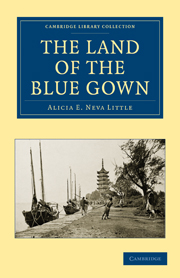
In the Land of the Blue Gown, first published in 1908, is a thorough and descriptive non-fiction work by Mrs Archibald Little. Born in 1845, she became best known for her travel writing and for her campaign against the Chinese custom of foot-binding. Mrs Little travelled widely both alone and with her husband, Archibald (1838–1909), and eventually settled in the Sichuan province of China. She admired many aspects of Chinese culture, but made it her life's work to become a vigorous leader of the anti-foot-binding movement. This book paints a marvellously descriptive account of her travels to Beijing and remoter parts, and describes her views on the culture, scenery, customs, religion, and much more. The book is extensively illustrated throughout, and also includes a chapter on her 'anti-foot-binding tour'. Other books by Mrs Little and her husband are also reissued in this series.
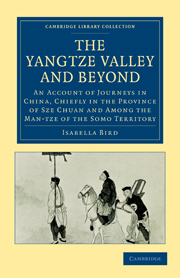
The Yangtze Valley and Beyond, first published in 1899, contains the account by the redoubtable Isabella Bird (now Mrs J. F. Bishop) of a journey through central China in 1896–1897. The volume focuses on her travels though the province of Szechuan and among the Man-tze of the Somo territory. Many of the areas she explored and carefully described were almost unknown to European visitors and had not been mentioned in any earlier English publications. The volume is based on journal letters and the diary written during her journey, and it is generously illustrated with photographs and Chinese drawings. Bishop's work was warmly received in England and praised especially for the information included on agriculture and industry. The Geographical Journal heralded the work as 'undoubtedly one of the most important contributions to English literature on that country'. It remains a key source for late nineteenth-century British perceptions of China.
Through the Yang-tse Gorges is Archibald Little's diary (published in London in 1888) of his journey up the Yangtze River from Shanghai to Chongqing by a native junk boat in 1883. Little strongly advocated the introduction of steam travel on the upper part of the river between Yichang and Chongqing, a port open to Western trade. The upper Yangtze was full of gorges and rapids which made travel treacherous; Little's journey by junk boat took a month, whereas the journey by steamship would have taken only 36 hours. He was repeatedly rebuffed in his attempts to introduce steam travel to the upper Yangtze by the Chinese government, which he accused of standing in the way of modernisation. He successfully introduced a steamship on the upper Yangtze river in 1898. Several other books by Little and by his intrepid wife are also reissued in this series.
The publications of the Hakluyt Society (founded in 1846) made available edited early accounts of exploration. The first series, which ran from 1847 to 1899, consists of 100 books containing published or previously unpublished works by authors from Christopher Columbus to Sir Francis Drake, and covering voyages to the New World, to China and Japan, to Russia and to Africa and India. Shipwrecked on the Maldives in 1602–1607, Pyrard de Laval learnt the local language and studied the culture, flora and fauna of the islands. On his escape to Goa he continued his cultural investigations in Portuguese India, before returning to France by way of Saint Helena and Brazil in 1611. His book, which included practical advice for French traders travelling to Asia and a phrase book for visitors to the Maldives, was an immediate success. This three-volume translation of the 1619 edition appeared in 1887–1890.
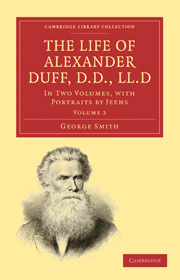
George Smith (1833–1919) spent many years in India as an educator and editor of the Calcutta Review. He was a great supporter of missionary work and became secretary of the foreign mission committee of the Free Church of Scotland in 1870. He also wrote popular books of missionary biography including this two-volume Life of Alexander Duff (1879). Duff (1806–1878) was the first foreign missionary of the Church of Scotland and a leading figure in promoting Christian education in India. Duff pioneered what he called 'downward filter theory' which centred on educating India's upper caste through English in the hope that this elite group would then take responsibility for the evangelisation and modernisation of South Asia. Volume 2 describes Duff's life from 1843 until his death in 1878, covering his contribution to the 1854 educational reforms in India and the founding of the University of Calcutta.