To save content items to your account,
please confirm that you agree to abide by our usage policies.
If this is the first time you use this feature, you will be asked to authorise Cambridge Core to connect with your account.
Find out more about saving content to .
To save content items to your Kindle, first ensure no-reply@cambridge.org
is added to your Approved Personal Document E-mail List under your Personal Document Settings
on the Manage Your Content and Devices page of your Amazon account. Then enter the ‘name’ part
of your Kindle email address below.
Find out more about saving to your Kindle.
Note you can select to save to either the @free.kindle.com or @kindle.com variations.
‘@free.kindle.com’ emails are free but can only be saved to your device when it is connected to wi-fi.
‘@kindle.com’ emails can be delivered even when you are not connected to wi-fi, but note that service fees apply.
Perhaps a more charismatic man, or less of a loner than Willis, might have established a ‘school’ of architectural scholarship. Nevertheless, without either state responsibility for heritage (as in France, where medieval architecture was on the syllabus of the École des Chartes from 1847), or a long-standing tradition of academic study of the arts (as in Germany), formal study of architectural history in Britain was unlikely to have gathered much support. Yet there remained a strong tradition of amateur study and, gradually, some paid posts. For the younger generation, as for his own, Willis was a vital source of data – required both by the continued tradition of AI congresses and for the architectural sections of the new Victoria History of the Counties of England (VCH, founded in 1899), of which Charles Peers was made Architectural Editor in 1903, before becoming an Inspector of Ancient Monuments under the Act of 1913. Archaeological research continued to be required for restoration work and, in the years following the First World War, antiquarianism – in the form of ‘local history’ – achieved renewed popular interest, with new series of guides such as those for the Great Western Railway, the Batsford series of Antiquary's Books, Bell's Cathedral Guides and the Little Guides. For all its popularity, however, architectural history had an ambiguous academic status. Whilst history and the archaeology of the ancient and prehistoric worlds were beginning to be taught as separate university subjects, architectural history was merely a subsidiary element in an architect's training (still only rarely undertaken via a university degree), or otherwise an amateur enthusiasm.
Robert Willis was born at the turn of a new century, but into a world which was still thoroughly ancien régime. His background was one of patronage and preferment; his upbringing that of a gentleman amateur. He had the confidence of the social superior, a belief that intellectual achievement was his birthright. Yet the circumstances of his birth and upbringing also fostered a certain aloofness. Willis's detached self-possession surely derived from his background and the autonomy it both required and fostered.
FAMILY BACKGROUND
The Willis clan had risen to prominence through Robert's grandfather Francis Willis (1718—1807, Figure 1) physician to George III from 1788. The reverend doctor was famed in his own day, and has since become notorious, as one of the pioneers in the treatment of the mentally ill. His methods ranged from use of the straitjacket to encouraging his patients to read Shakespeare — a passion evidently shared by his grandson, who acquired a rare First Folio edition of the plays. The Willis family papers in the British Library and those still in the possession of the family are tied up with the bureaucracy and politics of the king's illness. As they make clear, treatment of the king's bouts of apparent insanity was highly political.
To pontificate on the subject of monsters is in effect to take them seriously, to enter into their game; it is to be duped by their appearance instead of recognizing the human being who lurks behind the monstrous form.
René Girard, Violence and the Sacred, 253
The previous chapters of this volume have examined sculptures primarily from the regions of Auvergne, Burgundy, and Lyonnais, a selection that could be criticized for manifesting a Francophilism that continues to characterize much pedagogy and scholarship in Romanesque sculpture in the Anglo-American orbit. The present chapter breaks with this trend by turning to Portugal, home to more than 200 Romanesque sites that are virtually unknown, much less studied, outside that nation's borders.1 Within the context of a study on monsters, which often occupy the physical or conceptual margins of works of art, there is perhaps something appropriate in mining the significance of sculptures in a region that has been marginalized in scholarship. But my motivations are more than reactionary, for monsters constitute a salient aspect of the decoration of Portuguese Romanesque monuments, perhaps more so than in any other region of Europe. Scores upon scores of imaginary creatures appear on capitals, corbels, and other surfaces of this kingdom's churches. This trend even holds true for the region's tympana, on which animals and monsters frequently appear, typically to the exclusion of human figures. The western portal of Nossa Senhora de Orada, for example, features a lion and harpy to either side of a palm tree. With no other details articulated within this sculptural field, the viewer's attention focuses largely on two beasts.
Portuguese scholars have long recognized the abundance of carvings of animals, both real and imaginary, among their nation's monuments, and have offered various interpretations. Manuel Real construed the many and varied creatures in carvings as manifesting the national character of Portuguese art. José Mattoso detected a Benedictine imprint in, for example, the prevalence of the Lamb of God (Agnus Dei) iconography, which he attributed to the influence of La-Charité-sur-Loire, a Burgundian institution that participated heavily in the reform of Portuguese monastic institutions during the twelfth century. This imagery enjoyed particular favor in the region, with examples at Águias, Coimbra, Travanca, and other sites.
Cambridge … Were we asked to express its characteristic by a single word, we should answer, dullness. It must be remembered that communication in those days was slow; news did not arrive until it was stale; travelling, especially for passengers, was expensive, so that, at least for the shorter vacations, many persons did not leave Cambridge at all; and some remained there during the whole year – we might say, in some cases, during their whole lives. For the same reasons strangers rarely visited the University. The same people dined and supped together day after day, with no novelty to diversify their lives or their conversation. No wonder that they became narrow, prejudiced, eccentric, or that their habits were tainted with the grosser vices which there was no public opinion to repudiate.
John Willis Clark
After the metropolitan amusements of London and the medieval ambiance of King's Lynn, in Michaelmas (autumn) term 1822, Willis found himself in what was then another small market town, surrounded by fens still not fully drained, through which the ‘narrow, dirty Cam’ meandered. As yet untouched by Royal Commissions or railways, and still dominated by the corporations of town, university and colleges, Cambridge remained the product of its founding charters and ancient customs – or, in Joseph Priestley's terms, a ‘stagnant pool’. The opening quotation from Willis's nephew paints a picture of the town in the early years of the nineteenth century with only minor exaggeration for comic effect.
A few examples may be found throughout the Christian period of eminent churches, of which the structures & the history are known. These may be selected as landmarks in the wilderness & all others must be referred to them by analogy of style & distribution.
One building thoroughly & minutely examined in structure & history affords more genuine instruction than a cursory review of an hundred. Let us proceed to search for the Landmarks.
Robert Willis
In the (now destroyed) Guildhall at Canterbury, at 8 p.m. on 11 September 1844, Willis presented a paper to the inaugural congress of the newly founded British Archaeological Association. Published the following year, his account of Canterbury Cathedral was the first book ever to be defined by its author as an ‘architectural history’. At the same time as Willis was becoming dissatisfied with the limitations of the membrological approach, the peripatetic format of the archaeological meetings, usually set in an ancient cathedral city, enabled him to evolve a more forensic method, focused on a single building. In the series of lectures, books and articles treating the great churches of England which he produced across the next three decades, Willis devised an approach which continues to inform architectural investigation and for which he is widely revered as ‘the father of structural archaeology’. This chapter explores how ‘architectural history’, as defined in Chapter 4, was understood by Willis's archaeological audience, and how the approach he devised in the 1840s evolved, seeing it as a response to particular circumstances, rather than as a progression towards a modern discipline.
Silver spread into plates is brought from Tharsis, and gold from Ophaz: the work of the artificer, and the hand of the coppersmith: violet and purple is their clothing: all these things are the work of artificers.
Jeremiah 10:9
It is not necessary to “read” the riddle. The pattern in itself is sufficient and it is beautiful.
H .D., Helen in Egypt
Metaphors of reading have long been applied to the interpretation of medieval sculpture. In his celebrated 1831 novel, Notre Dame, Victor Hugo described the sculptures adorning medieval churches in terms of writing, as having an intelligible message. An enthusiastic student of medieval monuments, Hugo was constantly in contact with leading archaeologists, who often likened medieval images to language as well. Central to the approaches of Charles Cahiers, Adolphe Didron, and Charles Martin, among others, was the grounding of their interpretations of medieval art in texts, especially Biblical and exegetical. Contemporary developments probably lent force to this interpretive model. The improvement in mass printing techniques over the course of the nineteenth century, accompanied by the tremendous expansion of a literate public, resulted in reading became increasingly naturalized as a human activity in Western Europe. Yet the application of reading metaphors to the interpretation of Romanesque and Gothic sculpture was likewise more than a modern projection onto the past, for medieval authors made similar comparisons. Gregory the Great (540–604) influentially defended religious art on the grounds that it functioned analogously to religious texts, especially for the illiterate, and thereby tacitly acknowledged that reading works of art is a profitable exercise that could advance religious understanding.
The church father was silent, however, on the precise mechanics of how images were to be read. This question, we are increasingly aware, is important because modes of reading texts vary dramatically from community to community. The twenty-first-century reader, for example, is typically silent as he or she progresses through a text in a largely linear fashion. With respect to twelfth-century monks, Ivan Illich and Jean Leclerq, among others, have identified in their reading practices a pervasive engagement with the physicality of the text.
Aimer une femme passe encore; mais une statue, quelle sottise!
Gustave Flaubert, La Tentation de Saint Antoine
THE ‘‘EXT RAORDINARY FORTUNE’’ OF CENTAURS
Johann Joachim Winckelmann eloquently described ancient sculptures, especially male nudes, in terms of what he considered to be Greek ideals. In the wake of this foundational argument, it has became something of a commonplace to identify in the heroic male nudes of Donatello, Michelangelo, and other early modern sculptors who were inspired by antique prototypes evidence for a humanistic turn in European civilization. Within the economy of this historical model the art of the Middle Ages typically serves as a way station between the cultural heights of antiquity and the Renaissance. In his magisterial study on the nude in Western art, Kenneth Clark argued that that medieval Christian asceticism “eradicated” the image of bodily beauty, with nudes typically associated with humiliation and torture. Accordingly, far from visualizing the best of human aspirations, the unclothed body in medieval art manifested the shame that was a consequence of the Fall of Man.
Recent research on the nude in art has reconsidered the assumptions underpinning this historical model. Creighton Gilbert, for one, questions the longstanding identification of the “Hercules” figure on Nicola Pisano's thirteenth-century pulpit in the Pisa baptistery, persuasively arguing that this figure is more appropriately identified as Judah. Whereas Vasari's model of cultural rebirth largely informed previous interpretations of this nude figure to be an antique hero, Gilbert argues that theological concerns largely informed Nicola Pisano's design of this figure, perhaps even superseding a desire for the revival of Classical sensibilities or the advancement of a proto-humanist agenda. Nor were all medieval nudes necessarily read through a strict moralizing lens. Sherry Lindquist points out that nudes in medieval art serviced a complex and nuanced set of needs. Representations of unclothed bodies could function as much more than vehicles for negative moralizing, for they could likewise serve to highlight various ideals, among others, sanctity and the beauty of creation.
In this chapter, I aim to expand upon the emergent discourse on medieval nudes by considering the case of monstrous bodies. In addition to typically being represented without clothing, images of monsters often relied upon the authority of antique models, whether directly or indirectly, in the articulation of their forms.
We do not know what a dragon means, just as we do not know the meaning of the universe, but there is something in the image of the dragon that is congenial to man's imagination, and thus the dragon arises in many latitudes and ages. It is, one might say, a necessary monster.
Jorge Luis Borges, The Book of Imaginary Beings
This book began at an ice-cream social. A few minutes after introducing herself, an octogenarian described to me how she had compulsively read through Stephanie Meyer's Twilight series, which traces the romantic entanglements of three high school students: a girl, a vampire, and a werewolf. Though my conversation partner acknowledged that there was something to be feared in these creatures of the night, ultimately these books were gripping for her because as a teenager she had been sexually attracted to monsters, had used them to navigate the troubled waters of her adolescence. My own snobbish tastes in literature had previously blinded me to the positive work that Meyer's writings could perform. The ambiguous status of imaginary creatures, which can simultaneously attract and repel, began to intrigue me, for I had long regarded representations of monsters largely in negative terms: as allegories for menacing Others, as apotropaic totems, as embodiments of vices, and so on. How, I wondered, might the monsters that feature throughout medieval art look if one acknowledged the possibility that they could service positive ends?
I t has been my great fortune that support for my pursuit of this question has come from many sources. A Faculty Fellowship from the Council on Research and Creative Work at the University of Colorado, Boulder, freed me from teaching and service obligations, and allowed me to devote substantial attention to this book during the 2010–11 academic year. A Kayden Research Grant from the University of Colorado helped defray production costs of this book. Colleagues at Boulder who helped me refine various aspects of my thinking along the way or have provided assistance include Dan Boord, Chris Braider, Marilyn Brown, Scott Bruce, James Córdova, Diane Conlin, Claire Farago, Deborah Haynes, Bob Nauman, Carole Newlands, J.P. Park, and Beth Robertson.
His practical knowledge of carpentry and machinery: his inventive genius: and his power of lucid exposition, made him a most attractive Professor, and his lecture room was always crowded. No matter how dry the subject, he knew how to make it interesting: not that he ever condescended to employ any of the modern methods of clap-trap by which ‘sensational’ lecturers ‘draw’: but whether he discoursed on rope-making or on the organ, on joints, or the Jacquard loom, he held his audience spell bound; and dismissed them charmed alike with the knowledge they had gained, and the pure English in which it had been conveyed to them.
‘The Late Professor Willis’, from the Cambridge Chronicle(6 March 1875)
Before his appointment as Jacksonian Professor in 1837, Willis had carved out for himself a very personal position within the world of Cambridge scholarship. After his elevation to the professorial rank, he necessarily took on a more public role, paralleling those which he would play within the worlds of archaeology and architecture. Unlike Whewell or William Buckland (1784—1856), he never aspired to recognition as a ‘public moralist’ but whether called upon by the state, or through his own private initiative, Willis shouldered the wider responsibilities beginning to be required of a nineteenth-century intellectual. These ranged from representing the depth and breadth of Cambridge scholarship when he lectured to Prince Albert as Chancellor of the University, to devising and promoting apparatus for teaching mechanical principles to artisan audiences.
The rapid progress which has been made both in the study and in the practice of Gothic Architecture … is very gratifying; the two things should always go together: we always find that the architects who are most successful in practice are those who have studied the history of their art most carefully.
J.H. Parker (1861)
What shall I say then of your crackbrain connoisseurs whose ‘models’ are the hideous monstrosities of the sculptors and painters of the dark ages? Verily we may expect the fashion soon to be, if some Professor Willis or Society of Antiquaries would but give the word, that the hieroglyphic men in Egyptian temples or the three Chinese all ‘walking through their groves of trees’ on the willow-pattern plate, will be the ‘models’ of pure taste in the delineation of ‘the human form divine’!
Robert Kerr
At the same time as science was becoming an index for progress, and its perceived advancement was becoming an epochal narrative for the nineteenth century, so the very notion of progress gave a new importance to history. The linearity of progress was balanced by a desire to revive aspects of the past and Willis's career closely coincided with what came to be known as the Gothic Revival, a movement which saw architectural style take centre stage as the index for an epoch. Nineteenth-century ‘progress’ both required and was embodied in new construction, from machine sheds and railway stations to municipal offices and model dwellings.
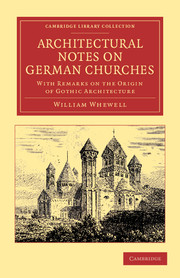
A tutor of mathematics at Cambridge, William Whewell (1794–1866) mostly published on mechanics. He became professor of mineralogy in 1828, Knightbridge professor of moral philosophy in 1838, and master of Trinity College in 1841. This work is unusual among his writings for its focus on architecture, yet the emphasis placed on terminology is consistent with his other publications, such as An Essay on Mineralogical Classification and Nomenclature (1828). Architectural Notes is significant for offering a detailed theoretical analysis of the origins of Gothic architecture, especially of the mechanical principles underlying it, notably the pointed arch. The discussion of German churches, despite the book's title, is of secondary concern, although guidance is given for recording Gothic buildings. This first edition was published anonymously in 1830. The second (1835) and third (1842) editions bore Whewell's name and were partially revised to reflect recent research on the origin of the pointed arch.
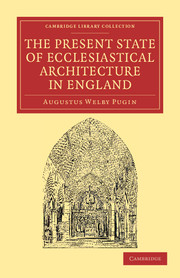
Augustus Welby Pugin (1812–52), architect, writer, and designer, learned his draughtsmanship and love of medieval architecture from his father. Initially he was better known as a designer rather than an architect. His conversion to Roman Catholicism was a key moment for him, and shaped his subsequent career. His most famous book, Contrasts, was published in 1836, and expressed his belief in the aesthetic and moral superiority of pre-Reformation architecture. This 1843 book comprises two illustrated articles which had been published in the Dublin Review in 1841 and 1842, and examined recent English church buildings. During the 1840s there was a surge in church building, and bodies such as the Cambridge Camden Society hotly debated the connection between architecture and spirituality. In the first paper, Pugin discusses how to meet the needs of a small Catholic parish. In the second, he commends the influence of the Ecclesiologist on church architecture.