To save content items to your account,
please confirm that you agree to abide by our usage policies.
If this is the first time you use this feature, you will be asked to authorise Cambridge Core to connect with your account.
Find out more about saving content to .
To save content items to your Kindle, first ensure no-reply@cambridge.org
is added to your Approved Personal Document E-mail List under your Personal Document Settings
on the Manage Your Content and Devices page of your Amazon account. Then enter the ‘name’ part
of your Kindle email address below.
Find out more about saving to your Kindle.
Note you can select to save to either the @free.kindle.com or @kindle.com variations.
‘@free.kindle.com’ emails are free but can only be saved to your device when it is connected to wi-fi.
‘@kindle.com’ emails can be delivered even when you are not connected to wi-fi, but note that service fees apply.
The upper band of the south wall concludes the narrative of the Holy Family. Unfortunately, some paintings show damage, with parts of the intonaco missing. Orvietan documents note repainting in the return from Egypt and the Holy Family at the temple. Conservation reports indicate that the artist(s) who did the repainting, probably Il Pastura (c. 1497–99), respected the original composition, per recorded instruction from the Opera del Duomo. Despite some retouching, conservation reports state that the remaining compositions, including the figure arrangements, architecture, landscape, and balustrade, are original to Ugolino.
Even before more celebrated artists such as Fra Filippo Lippi, Masaccio, and Donatello delved into the psychological responses of their figures, Ugolino di Prete lario understood what it meant to paint souls. Although few modern scholars have recognized his gifts, surely, on July 8, 1357, when the Opera del Duomo hired him as the lead painter for a fresco program in the new Cappella del Corporale, they knew and admired his gifts for storytelling and character analysis. The initial contract addresses him by his full name with the title “magister,” which indicates a high level of training, experience, and the competency to orchestrate a complex fresco program.
In the rectangles and the lunettes on the facing upper north and south walls, Ugolino maintains earthbound settings; for better visibility from so far below, he simplifies the compositions and reduces the depths of field. The emphasis shifts from the Marian narrative to Logos, or the Word made flesh, as articulated by John in his first chapter. They also honor two pivotal events in which Mary participated that happened shortly after Christ’s Resurrection, which comprise two of the most important liturgical feasts of the church: the Ascension and Pentecost. Thus, the paintings honor those who predicted, witnessed, recorded, codified, and shared Jesus’s story.
Construction of the Orvieto Cathedral began in the east end, initially in the Italian Romanesque style. Following Nicholas’s death in 1292, despite upheaval in papal succession, work progressed quickly under Bishop Monaldeschi until c. 1300, then paused, due to the succession of bishops and doubts over the stability of the apse. The confusion left recordkeeping gaps regarding the early capomaestri.
In the last two vignettes that fill the upper band on the southeast and south walls, Ugolino, unlike most artists of monumental Christological narratives, devotes as much space to Mary and Joseph as parents to the youthful Jesus as he does to the more familiar events surrounding his birth. Although most artists recount the two biblical events of Jesus’s youth in one composition each, Ugolino expands the sojourn in Egypt into three episodes and Jesus’s visit to the temple into five. Mary’s character progresses from the nurturer of an infant to a brave refugee, teacher, and spiritual guide for young Jesus. As in the Meditations, the paintings characterize her modest circumstances, travails, and vulnerability as marks of valor rather than as signs of weakness.
To adorn sacred spaces with icons, altarpieces, and narrative programs gives viewers reminders of their faith and gave meaning to liturgy and religious rituals. The Virgin is the first and most frequently portrayed subject, and her portrayal evolved with the development of Christian ideas. A brief overview of artistic precedents forms a context for Orvieto’s place in the continuum, notes where their artists innovated, and why they did. It also confirms Orvieto as being a more progressive intellectual and artistic center, with finer and more innovative artists than scholars previously realized.
The Virgin Mary’s fame arises from her unique, God-given position as the Mother of God, a mysterious paradoxical relationship recognized in the early church, as expressed by Ephrem the Syrian. Her pregnancy, which is where her story begins in scripture, is the first of many paradoxes. Unlike barren Hebrew women, such as Sara, Hannah, and Elizabeth, who were married and matronly when they conceived, Mary was youthful and virginal. Moreover, neither scripture nor legend portray Mary as a charismatic leader, such as the Hebrew heroines Esther, Deborah, and Judith. Instead, she leads a chiefly quiet, often contemplative, traditional female life.
As with Giovanni di Bonino’s window and Giotto’s program at Padua, Ugolino’s narrative opens with the legendary story of Mary’s youth, adding one new event. He begins on the lower band of the north wall and moves clockwise (Figures 6.1–6.6). The six scenes honor three Marian feasts: Mary’s Conception (December 8), her Nativity (September 8) and her two Presentations in the Temple (November 21), primarily drawn from the Golden Legend, the Meditations on the Life of Christ, and the texts of two Orvietan dramas for the Conception of the Virgin.
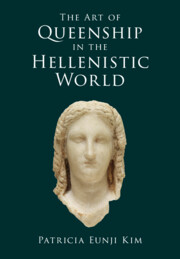
In The Art of Queenship in the Hellenistic World, Patricia Eunji Kim examines the visual and material cultures of Hellenistic queens, the royal and dynastic women who served as subjects and patrons of art. Exploring evidence in the interconnected eastern Mediterranean and western Asia from the fourth to second centuries BCE, Kim argues that the arts of queenship were central to expressions of dynastic (and sometimes even imperial) consolidation, continuity, and legitimacy. From gems, coins, and vessels to monuments and sculpture, the visual and material cultures of queenship appeared in a range of sacred settings, public spaces, royal courts, and domestic domains. Encompassing several dynasties, including the Hecatomnids, Argeads, Ptolemies, Seleucids, and Attalids, Kim inaugurates new methods for comparing and interpreting visual articulations of queenship and ideal femininity from distinct yet culturally entangled contexts, thus illuminating the ways that women had an impact art and politics in the ancient world.
A collection of critical essays exploring artistic interventions in urban spaces in post-colonial South Africa.
Restless Infections is an innovative collection of critical essays exploring artistic interventions in urban spaces, focusing on place-making and the politics of space in post-colonial South Africa. The title refers to Cape Town's popular 'Infecting the City' public art festival and the persistent state of restlessness of a city still grappling with the legacies of colonialism, inequality and racial segregation. The concept of 'restlessness' provides a critical tool for understanding public space in a country desiring economic and political stability, as expressed through transient art forms such as Santu Mofokeng's billboard photography.
The volume shifts the focus of public art discourse in South Africa from static forms like monuments and statues to dynamic, temporary interventions, offering fresh perspectives on public art as an interactive, community-engaged practice. The interventions engage with protest, public intimacy, audience interaction and the disrupted topography of apartheid cities. Through an examination of seminal artworks, contributors address diverse forms of expression that range from site-specific performances, immersive installations, film and photography to online performances. They introduce new perspectives on public sphere performance, such as Khanyisile Mbongwa's re-imagining of township alleyways for public encounters and Mbongeni Mtshali's study of everyday performances that challenge colonial and neo-colonial spatial organisation.
The Kete dance form, once exclusive to royal courts, carries intricate movements, symbolic gestures, and rhythms that mirror Ghanaian history and values. It embodies storytelling, often depicting tales of bravery, unity, or significant historical events. These dances were traditionally reserved for specific occasions within the royal setting, symbolizing prestige, honor, and tradition.
With the passage of time, the transmission of Kete royal dance has transcended its original palace context, finding its way into academic domains. Universities and cultural institutions now extend the legacies of this dance form and even act as custodians of this art form, where scholars, dancers, and enthusiasts collaborate to study, preserve, and teach Kete dance.
Through meticulous documentation, research, and practice, the academy endeavors to honor the Kete dance while making it accessible to a broader audience. This transmission from palace to academy serves as a testament to the resilience and adaptability of cultural traditions. It ensures the continuity of Ghanaian heritage and allows future generations, both within and beyond Ghana, to appreciate and learn from this profound dance form from an Afrocentric perspective.
The changing nature of African landscapes, from rural to urbanized spaces, has been a pre-occupation of African media producers since the beginnings of the African film industry in the 1960s. The authors bring together several examples of African documentary and fiction screen media that present, evaluate and criticize urban and rural landscapes, and the rural and urban dynamic of development, in relation to contemporary issues, from biodiversity, sustainability and deforestation, to inequity, women's rights, political instability, to climate change-related themes of water and food supply, security and sovereignty. These works, comprising multi-platform cinema, streamed moving images and especially documentaries, depict the situations and open the door to rethinking and eventually to the possibilities of proposals responding to the situations portrayed.
The collection Art's Visionary Moment: Personal Encounters with Works That Last a Lifetime was inspired by T. S. Eliot's observation in his 'Dante' (1929): 'The experience of a poem is the experience both of a moment and of a lifetime. … There is a first, or an early moment which is unique, … which can never be forgotten, but … is never repeated integrally; and yet which would become destitute of significance if it did not survive in a larger whole of experience.' In this collection, scholars and artists from a variety of fields speak in personal terms, but with what one has called 'intellectual passion,' of a work of art (poem, play, novel, film, visual art, among others) that, as Dante suggest, has had an immediate effect on them (the 'Visionary Moment' from the title) yet survives 'in a larger whole of experience' (that 'Last a Lifetime' in the collection's sub-title). Some of the titles of essays already submitted show the range of this inquiry: 'Conversations with the Dead'; 'Playing Richard III: The Experience of a Moment and a Lifetime'; 'Picasso's 'Three Musicians''; 'Poetry Meets Power: Tamburlaine the Great'; 'Pleasant Dreaming with 'Thanatopsis''; 'From Madness to Miracle: An Encounter with Shakespeare's Winter's Tale'; 'Fight the Power' Spike Lee's Visionary Moment'; and 'Plastic Art Moment'.
This book examines the poetries of two Aboriginal Australian poets, namely Oodgeroo Noonuccal (formerly Kath Walker; 1920-1993) and Lionel Fogarty (1958-) and two African American Black Arts poets , namely Amiri Baraka (formerly Everett LeRoi Jones; 1934-2014) and Sonia Sanchez (1943-) to demonstrate their role in the struggle for civil and human rights of their peoples from the 1960s. The book demonstrates commonalities and differences in the strategies of these poets' literary and political resistance. These poet-activists, though ethnically diverse and geographically dispersed, share comparable socio-political concerns and aspirations. Their activism is not a reflection of a single ideological current, but a bricolage of many ideologies and perspectives. They have engaged in trans-Pacific political movements and transgressed the borders of any one ideological territory. It is important to establish Aboriginal and African American trans-Pacific communication because these poets have collaborated and engaged in global politics (whether in the form of Garveyism or the 'transnation'). Their poetries are characterized by an irresistible drive towards international rhizomatic collaboration and engagement. This is a transcontinental literary influence exerted by African American poets on Aboriginal poets during the 1960s and beyond.
This scholarly biography traces the life and art of Lebanese-American neo-expressionist, Nabil Kanso (1940-2019). It explores key moments across the artist's transnational career by foregrounding his longest-running, internationally toured exhibition, the Journey of Art for Peace (1985-1993). More specifically, it traces the historical trajectory of his 10 × 28 mural-scale painting, Lebanon, from the circumstances of its production at the height of the Lebanese Civil War in 1983, through its short-lived exhibition history with the Split of Life series in the few years that followed. The book scaffolds an understanding of the artist as an activist and works toward offering distinctly spatial readings of his painterly practice, of which the act of bearing witness is highlighted as permeating the entirety of his oeuvre. It concludes with a contemporary recontextualization of Lebanon in the country's current social, political, and cultural climate, and emphasizes the artist's work as essential to the theorization of larger traditions of political and protest art.
The first of its kind and the result of a research fellowship wherein the author was invited to be the first to work through the artist's unpublished archive, this book lays the groundwork for scholarship on the art of Nabil Kanso. It draws extensively on primary source material, including personal notes, diaries, sketchbooks, correspondences, paintings, watercolors, photographs, recorded interviews, and the like.